AEG HD 8694 Manuale utente

CHDD 8694
HD 8694
Cooker Hood
Operating and Installation Instructions

2
Printed on recycled paper
AEG - putting words into action

3
Contents
Safety warnings 4
For the user 4
For the installer 4
Description of the Appliance 6
Extractor version 6
Filter Version
Hood Operation 8
Using the Remote Control 9
Setting the Remote Control 9
Remote Control Maintenance 9
Maintenance and care 10
Metal grease filter 10
Open the metal grease filter 11
Charcoal filter 12
Changing the light bulb 13
Special accessories 13
What to do if 14
Ser ice and spare parts 15
Guarantee Conditions 16
Technical Details 17
Mounting accessories included 1
Electrical connection 17
Safety warnings for the electrician 1
Wall unit mounting 18

4
Safety warnings
For the user
The cooker hood is designed to extract unpleasant odours from the
kitchen, it will not extract steam.
Always cover lighted elements, to prevent excess heat from
damaging the appliance. In the case of oil, gas and coal fired
cookers it is essential to avoid open flames.
Also, when frying, keep the deep frying pan on the cooker top/
cooker under careful control.
The hot oil in the frying pan might ignite due to overheating.
The risk of self-ignition increases when the oil being used is dirty.
It is extremely important to note that overheating can cause a fire.
Ne er carry out any flambé cooking under the hood.
Always disconnect the unit from the power supply before
carrying out any work on the hood, including replacing the
light bulb (take the cartridge fuse out of the fuse holder or switch
off the automatic circuit breaker).
It is ery important to clean the hood and replace the filter at
the recommended inter als. Failure to do so could cause
grease deposits to build up, resulting in a fire hazard.
For the installer
When used as an extractor unit, the hood must be fitted with a
150mm diameter hose.
Should there already be a pipe of diameter 125 mm that ducts to
the outside through the walls or roof, it is possible to use the 150/
125 mm reduction flange provided. In this case the hood will be
slightly more noisy.
When installing the hood, make sure you respect the following
minimum distance from the top edge of the cooking hob/ring
surfaces:
electric cookers 600 mm
gas cookers 700 mm
coal and oil cookers 800 mm min.
The hood can be installed above these heights but for optimum
performance it should be installed at the distance quoted for the
appropriate heat source.
The national standard on fuel-burning systems specifies a maximum
depression of 0.04 bar in such rooms.
The air outlet must not be connected to chimney flues or combus-
tion gas ducts. The air outlet must under no circumstances be

5
connected to ventilation ducts for rooms in which fuel-burning
appliances are installed.
It is advisable to apply for authorization from the relevant controlling
authority when connecting the outlet to an unused chimney flue or
combustion gas duct.
The air outlet installation must comply with the regulations laid down
by the relevant authorities.
When the unit is used in its extractor version, a sufficiently large
ventilation hole must be provided, with dimensions that are
approximately the same as the outlet hole.
National and regional building regulations impose a number of
restrictions on using hoods and fuel-burning appliances connected
to a chimney, such as coal or oil room-heaters and gas fires, in the
same room.
Hoods can only be used safely with appliances connected to a
chimney if the room and/or flat (air/environment combination) is
ventilated from outside using a suitable ventilation hole approxi-
mately 500-600 cm2 large to avoid the possibility of a depression
being created during operation of the hood.
If you have any doubts, contact the relevant controlling authority or
building inspectors office.
Since the rule for rooms with fuel burning appliances is outlet hole
of the same size as the ventilation hole, a hole of 500-600 cm2,
which is to say a larger hole, could reduce the performance of the
extractor hood.
If the hood is used in its filtering function, it will operate simply and
safely in the above conditions without the need for any of the
aforementioned measures.
When the hood is used in its extractor function, the following rules
must be followed to obtain optimal operation:
short and straight outlet hose
keep bends in outlet hose to a minimum
never install the hoses with an acute angle, they must
always follow a gentle curve only
keep the hose as large as possible (preferably the same
diameter as the outlet hole).
Failure to observe these basic instructions will drastically reduce the
performance and increase the noise levels of the extractor hood.

6
Description of the Appliance
The cooker hood is designed to extract unpleasant odours from the
kitchen, it will not extract steam.
The hood is supplied as a filter unit (with charcoal filter already
supplied and fitted) and can also be used with an extractor function
function by removing the charcoal filter.
Extractor version
The air is discharged to the outside through a pipe, which must be
fitted to connection flange D. Fig. 1.
Remove the grease filters and remove the Charcoal Filter K from its
housing by unscrewing the two screws that fix it to the hood. Refit
the grease filters. Fig. 2.
In order to obtain the best performance the hose should have a
diameter equal to the outlet hole.
Should there already be a pipe of diameter 125 mm that ducts to
the outside through the walls or roof, it is possible to use the 150/
125 mm reduction flange provided. In this case the hood will be
slightly more noisy.
D
D
Fig. 1 Fig. 2
K

Filter Version
The air is filtered through an AEG charcoal filter and returned to the
kitchen through the top grill of the outlet pipe.
You will need an original AEG charcoal filter for the filtering function.
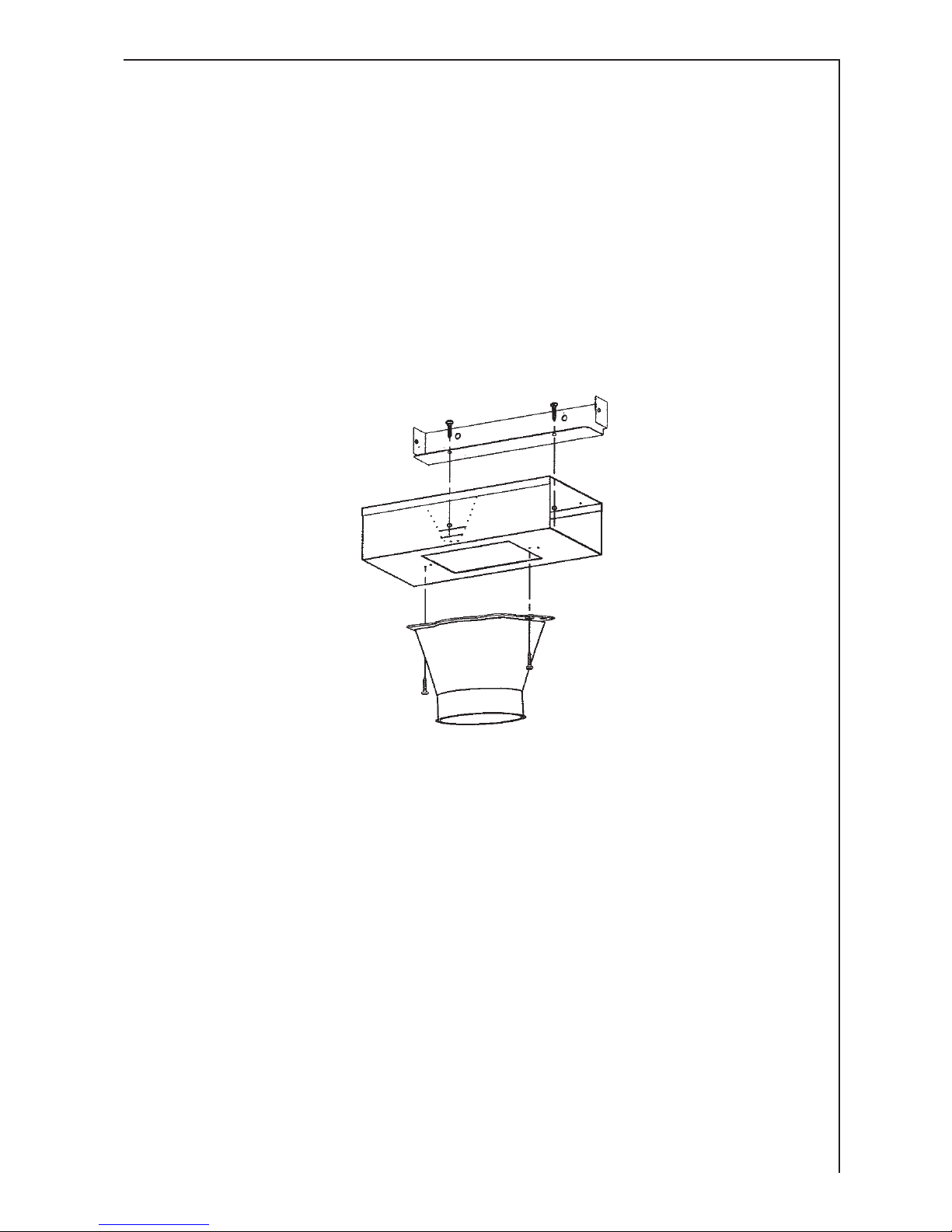
Fix the deflector E using 2 screws Ø 3,5x6.5 mm. Fig. 3.
Fix the connection flange G using 2 screws Ø 3,5x6.5 mm. Fig. 3.
Fig. 3
E
G

8
Hood Operation
Best results are obtained by using a low speed for normal
conditions and high speed when odours are more concentrated.
Turn the hood on a few minutes before you start cooking then you
will get an underpressure in the kitchen. It should be left on after
cooking for about 15 minutes or until all odours have disappeared.
The hood operation may be controlled via the control switches or
with the remote control
The control switches are located on lower side of the chimney.
1 - Hood OFF.
2- Decreases the speed
3- Hood ON, Increases the speed
4- 5/15 (minutes) timer
push once for 5 timer, twice for 15 timer, 3 times to turn the
timer OFF
5- Filter reset
6- Light ON/OFF
F- Saturated filter indicator light
-BUTTON 4: Activates and deactivates the timer. Automatically
turns the appliance off at the speed in operation.
LED on = timer activated - Duration 5 or 15 minutes as set.
-BUTTON 5: Once you have replaced the charcoal filters, press
this button for at least 3 seconds until the light turns off
-BUTTON 4+5: Remote control code programming. Keep both
buttons pressed for at least 3 seconds. A beep will sound to
indicate that the programming mode has been accepted.
Without releasing the buttons, press any one of the remote
control buttons. A beep will sound to indicate that the code has
been accepted and stored.
-F LED: Indicates that the charcoal filter is saturated.
This LED is also ON when the hood is used in the extractor
version, press BUTTON 5 until the light turns off.
12 34 5F6

9
Using the Remote Control
Button 1 = ON / 1st Speed / 2nd Speed / 3rd Speed/4th Speed/OFF
Button 2 = Timer ON/OFF
Button 3 = Light ON/OFF
Setting the Remote Control
Before using the remote control, first
programme it with the hood:
Push Button 4+5, keep both buttons
pressed for at least 3 seconds.
A beep will sound to indicate that the
programming mode has been
accepted.
Without releasing the buttons, press
any one of the remote control buttons.
A beep will sound to indicate that the
code has been accepted and stored.
Remote Control
Maintenance
Clean the remote control using non
abrasive detergents.
Follow the instructions below in order
to replace the battery for the remote
control :
Raise the cover on the base of the
remote control, in order to access
the battery compartment.
Remove the old battery and replace it with a new battery type 23A
12V
Fit the new battery taking care to check the polarity as indicated on
the base of the battery compartment.
Warning!
If the remote control doesnt work , do the following before
calling your local AEG Ser ice Force Centre:
Disconnect the hood from the mains.
Reconnect the hood to the mains.
Repeat the procedure described on paragraph Setting the remote
control
Follow this procedure whenever the remote control doesnt work for
any apparent reason (e.g.: dead battery).
Control
Lamp
Button 2
Button 3
Battery
compartment
co er
Button 1

10
Maintenance and care
The hood must always be disconnected from the electricity
supply before beginning any maintenance work.
Never insert pointed objects in the motors protective grid.
Wash the outside surfaces using a delicate detergent solution.
Never use caustic detergents or abrasive brushes or powders.
Only ever clean the switch panel and filter grille using a damp cloth
and delicate detergents.
It is extremely important to clean the unit and change the filters at
the recommended intervals. Failure to do so will cause grease
deposits to build up that could constitute a fire hazard.
Metal grease filter
The purpose of the grease filters is to aspirate grease particles
which form during cooking and it must always be used, either in the
external evacuation or internal recycling function.
Attention: the metal grease filters must be removed and washed,
either by hand or in the dishwasher, every four weeks.
Questo manuale è adatto per i seguenti modelli
1
Altri manuali AEG Cappa di ventilazione

AEG
AEG X66164MP1 Manuale utente

AEG
AEG CHDD 8510 Manuale utente

AEG
AEG DPE4641M Manuale utente

AEG
AEG DD9963-M Manuale utente

AEG
AEG Perfekt Visor?24 Manuale utente

AEG
AEG DS 60 i GB Manuale utente

AEG
AEG DBE6980HM Manuale utente

AEG
AEG DD8694-M Manuale utente

AEG
AEG DFS 60 P 2 Manuale utente

AEG
AEG 2600 D Scheda tecnica

AEG
AEG DK 60 Schema elettrico

AEG
AEG X66453MDO UK Manuale utente

AEG
AEG X69453MVO UK Manuale utente

AEG
AEG DD 8765 Scheda tecnica

AEG
AEG EVYN AEG181276 Manuale utente

AEG
AEG DKB2640M Manuale utente

AEG
AEG ADF6052AB Manuale utente

AEG
AEG X94484MV1 Manuale utente

AEG
AEG protect d. 3000 Scheda tecnica

AEG
AEG DK 4390 Manuale utente