AEG HD 8760 Manuale utente

HD 8760
HD 8795
Cooker Hood
Operating and Installation Instructions

2
Contents
Safety warnings 57
For the user 57
For the installer 57
Description of the Appliance 59
Extractor version 59
Filter Version 59
Control Panel 60
Switching on the hood 61
Switching on the light 61
Control device for grease or charcoal filter 61
Led signal for grease filter 61
Led signal for charcoal filter 61
e-setting the saturation signal 61
Maintenance and care 62
Cleaning the hood 62
Metal grease filter 62
emoving the frontal screens: 62
emoving the metal grease filter 63
Charcoal filter 64
Changing the light bulb 65
Special accessories 66
Technical assistance ser ice 67
Technical Specifications 68
Mounting accessories included 68
Electrical connection 69
Wall mounting 70
Printed on recycled paper
AEG - putting words into action

3
Safety warnings
For the user
The cooker hood is designed to extract unpleasant odours
from the kitchen, it will not extract steam.
Always cover heating elements, to prevent excess heat from
damaging the appliance. In the case of oil, gas and coal fired
cookers it is essential to avoid open flames.
Also, when frying, keep the deep frying pan on the cooker top/
cooker under careful control.
The hot oil in the frying pan might ignite due to overheating.
The risk of self-ignition increases when the oil being used is dirty.
It is extremely important to note that overheating can cause a fire.
Ne er carry out any flambé cooking under the hood.
Always disconnect the unit from the power supply before
carrying out any work on the hood, including replacing the
light bulb (take the cartridge fuse out of the fuse holder or switch
off the automatic circuit breaker).
It is ery important to clean the hood and replace the filter at
the recommended inter als. Failure to do so could cause
grease deposits to build up, resulting in a fire hazard.
For the installer
When used as an extractor unit, the hood must be fitted with a
150mm diameter hose.
Should there already be a pipe of diameter 125 mm that ducts to
the outside through the walls or roof, it is possible to use the 150/
125 mm reduction flange provided. In this case the hood will be
slightly noisier.
When installing the hood respect the following minimum
distances from the cooking top:
Electric cooking tops 300mm
The national Standard on fuel-burning systems specifies a maxi-
mum depression of 0.04 mbar in such rooms.
The air outlet must not be connected to chimney flues or combus-
tion gas ducts. The air outlet must under no circumstances be
connected to ventilation ducts for rooms in which fuel-burning
appliances are installed.
The air outlet installation must comply with the regulations laid down
by the relevant authorities.

4
When the unit is used in its extractor version, a sufficiently large
ventilation hole must be provided, with dimensions that are approxi-
mately the same as the outlet hole.
National and regional building regulations impose a number of
restrictions on using hoods and fuel-burning appliances connected
to a chimney, such as coal or oil room-heaters and gas fires, in the
same room.
Hoods can only be used safely with appliances connected to a
chimney if the room and/or flat (air/environment combination) is
ventilated from outside using a suitable ventilation hole approxi-
mately 500-600 cm2 large to avoid the possibility of a depression
being created during operation of the hood.
If you have any doubts, contact the relevant controlling authority or
building inspectors office.
Since the rule for rooms with fuel burning appliances is outlet hole
of the same size as the ventilation hole, a hole of 500-600 cm2,
which is to say a larger hole, could reduce the performance of the
extractor hood.
If the hood is used in its filtering function, it will operate simply and
safely in the above conditions without the need for any of the
aforementioned measures.
When the hood is used in its extractor function, the following rules
must be followed to obtain optimal operation:
short and straight outlet hose
keep bends in outlet hose to a minimum
never install the hoses with an acute angle, they must always
follow a gentle curve.
keep the hose as large as possible (preferably the same diam-
eter as the outlet hole).
the length should be no more than:
3 metres with one 90° bend
2 metres with two 90° bends
Bends of more than 90° will reduce the efficiency of the hood
and reduce the airflow.
Failure to observe these basic instructions will drastically reduce the
performance and increase the noise levels of the extractor hood.

5
Description of the Appliance
The hood is supplied as an extractor unit and can also be used with
a filtering function by fitting one charcoal filter.
You will need an original AEG charcoal filter for this function
(Available from your local AEG Service Force Centre).
Extractor version
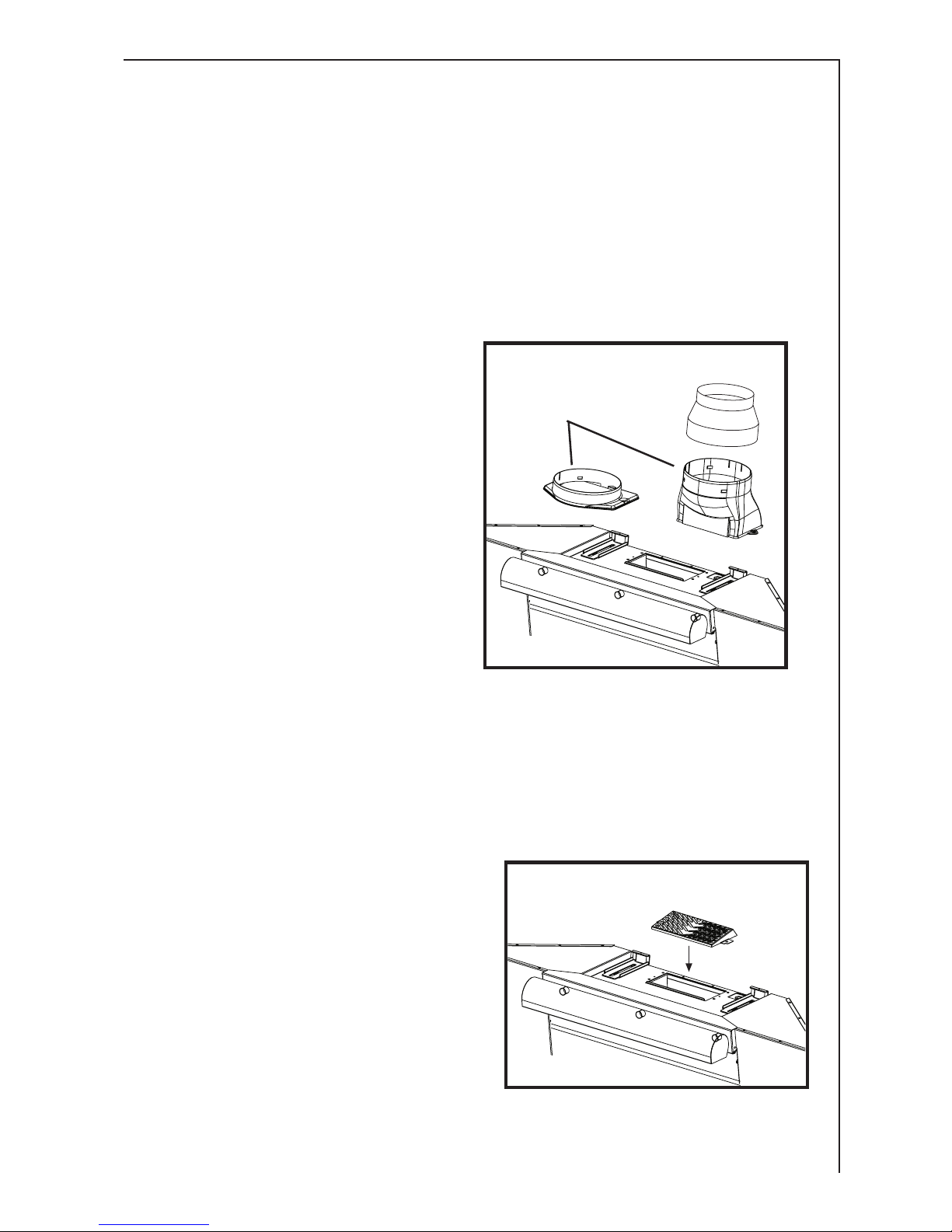
In this version fumes are
extracted to the outside via
a hose connected to the
coupling ring. Fig. 1.
In order to obtain the best
performance the hose
should have a diameter
equal to the outlet hole.
Should there already be a
pipe of diameter 125 mm
that ducts to the outside
through the walls or roof, it
is possible to use the 150/
125 mm reduction flange
provided. In this case the
hood will be slightly noisier.
Filter Version
The air is filtered through a
charcoal filter and returned to
the kitchen.
You will need an original AEG
charcoal filter for the filtering
function. (See Special
Accessories).
Fix the deflector using 2 screws
Ø 3.5x9.5 mm. Fig. 2.
coupling ring
reduction
flange
Fig. 1
Deflector
Fig. 2

6
Control Panel
Best results are obtained by using a low speed for normal
conditions and a high speed when odours are more concentrated.
Turn the hood on a few minutes before you start cooking, you will
then get an under pressure in the kitchen. The hood should be left
on after cooking for about 15 minutes or until all the odours have
disappeared.
The hood operation can be controlled via the control ball or with the
remote control (the remote control is a special accessory and is
ordered separately).
Every change (changing speed, switching on the lights, etc.) is
recognizable from the variation of light emitted by the control ball
and by an acoustic signal.
The control ball is located below on the right side of the cooker hood.
The control ball is also a light signal :
No signal :
The hood is switched off.
Static green light :
Hood is switched on at power level 1 (minimum).
Static orange light :
Hood is switched on at power level 2 (medium).
Static red light :
Hood is switched on at power level 3 (maximum).
Flashing red light :
Hood is switched on at intensive power level (timed at 5 minutes)
Flashing green light :
Indicates the grease filter saturation - clean the grease filter
Flashing orange light :
Indicates the charcoal filter saturation - clean or replace the
charcoal filter.
Attention!
The control ball flashes orange to indicate the saturation of the
charcoal filter even if the hood is used in the extractor version and
no charcoal filter is fitted.
In this case, perform the signal reset operation as follows: select the
intensive speed (the control ball lights up with a red flashing light),
depress again and hold depressed for about 3 seconds until an
audible signal indicates the reset has taken place.

7
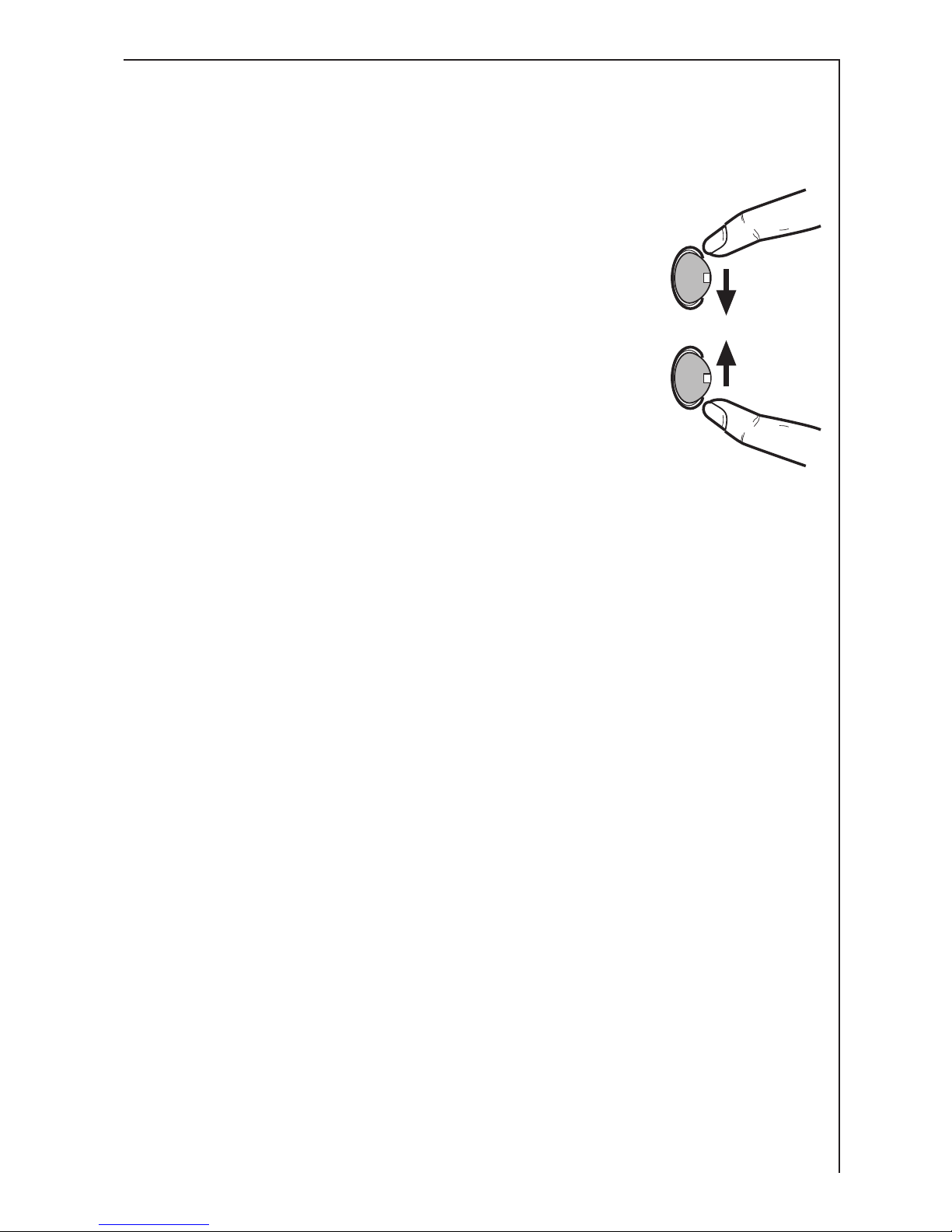
Switching on the hood - Fig. 3
The control ball is a balancer switch.
Depressing the control ball repeatedly towards
the bottom, switches on the hood and you may
select the motor level desired, depressing once
again the hood switches off.
Switching on the light - Fig. 3
Depress the control ball towards the top :
once for reduced lighting,
once again for full lighting,
depress again to switch off the light.
Indicator light for grease or
charcoal filter
The air duct, in this hood, includes a device
that signals when the filter requires cleaning or
changing .
Led signal for grease filter
The LED signal flickers (flickering green light) when the grease filter
requires cleaning, occurs at about 40 operating hours.
Ensure that the indicator light is checked each time the hood is used.
Led signal for charcoal filter
The LED signal flickers (flickering orange light) when the charcoal filter
requires cleaning, occurs at about 160 operating hours.
Ensure that the indicator light is checked each time the hood is used.
Re-setting the saturation signal
After cleaning or replacing the filter, select the intensive speed (the
control ball lights up with a red flashing light), depress again and hold
depressed for about 3 seconds until an audible signal indicates the
reset has taken place.
depress towards
the top to switch
on the lights
depress towards the
bottom to switch on
the hood.
Fig. 3

8
Maintenance and care
The hood must always be disconnected from the electricity
supply before beginning any maintenance work.
Cleaning the hood
Clean the outside of the hood using a damp cloth and a mild deter-
gent.
Never use corrosive, abrasive or flammable cleaning products.
Never insert pointed objects in the motors protective grid.
Wash the outside surfaces using a delicate detergent solution.
Never use caustic detergents or abrasive brushes or powders.
Only ever clean the switch panel and filter grille using a damp cloth
and delicate detergents.
It is extremely important to clean the unit and change the filters at
the recommended intervals. Failure to do so will cause grease
deposits to build up that could constitute a fire hazard.
Metal grease filter
The purpose of the grease filters is to absorb grease particles which
form during cooking and it must always be used, either in the
external extraction or internal recycling function.
Attention: the metal grease filters must be removed and washed,
either by hand or in the dishwasher, every four weeks.
To access the grease filter,
first remove the front panels
which conceal the grease
filter.
Re oving the front
panels:
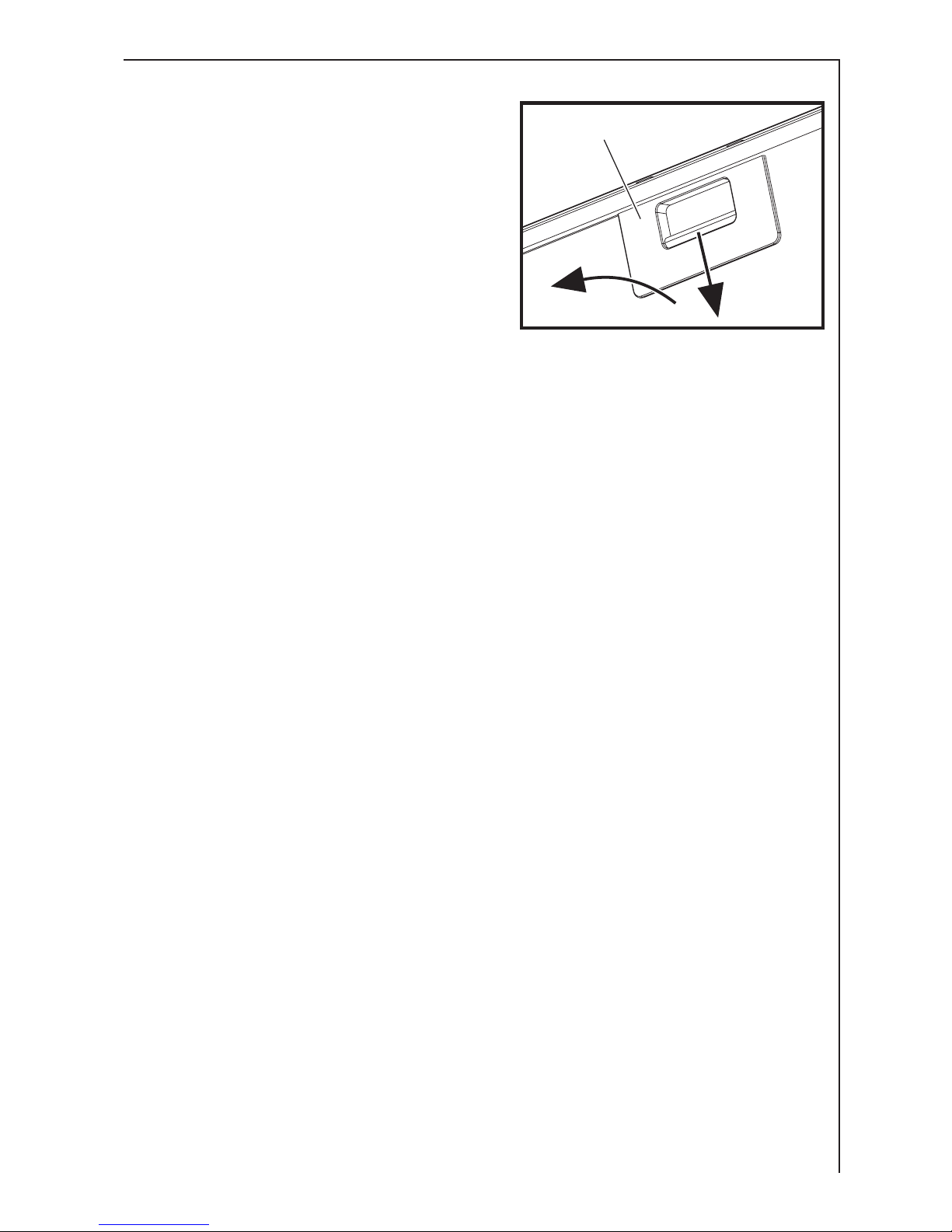
Extract the small panel,
rotate upwards and unhook.
epeat the operation for all
the small panels. Fig. 4. Bild 3
Fig. 4
Unhook
Extract

9
Handle
Fig. 5
Re oving the etal
grease filter
Pull the handle downards, then
extract the filter.Fig. 5.
Hand washing
Soak grease filter(s) for about
one hour in hot water with a
grease-loosening cleaner, then
rinse off thoroughly with hot
water. epeat the process if necessary. efit the grease filters when
they are dry.
Dishwasher
Place grease filters in the dishwasher. Select most powerful
washing programme and highest temperature, at least 65°C.
epeat the process. efit the grease filters when they are dry.
When washing the metal grease filter in the dishwasher a slight
discolouration of the filter can occur, this does not have any impact
on its performance.
Clean the inner housing using a hot detergent solution only (never
use caustic detergents, abrasive powders or brushes).
After having re-installed the grease filter, remount the front panels
following the instructions for removal in reverse.
The narrower front panel is to be mounted at the highest position.

10
Charcoal filter
The charcoal filter should only be used if you want to use the hood
in the recirculation function.
To do this you will need an original AEG charcoal filter (available
from your local Service Force Centre).
Cleaning/replacing the charcoal filter
Unlike other carbon filters, the LONGLIFE carbon filter can be
cleaned and reactivated. At normal use the filter should be cleaned
every second month (when using the hood 2,5 hours per day, in
avarage). The best way to clean the filter is in the dishwasher. Use
normal detergent and choose the highest temperature (65º C).
Wash the filter separately so that no food parts gets stuck on the
filter and later causes bad odours. To reactivate the filter, the filter
should be dried in an oven for 10 minutes with a temperature of
maximum 100ºC.
After approximately three years of use, the charcoal filter should be
replaced with a new, as the odour reduction capacity will be
reduced.
Fitting
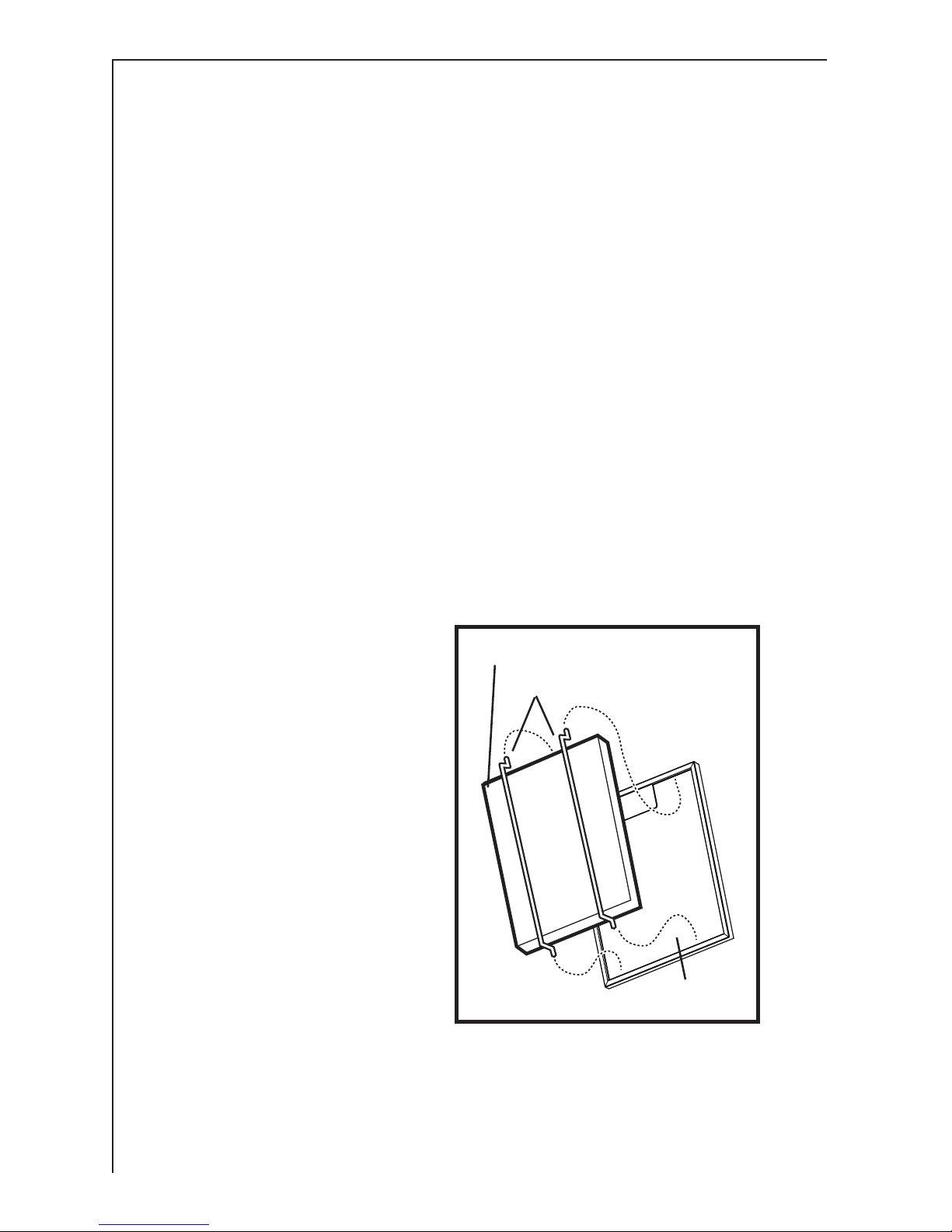
Fit the charcoal filter on the
rear side of the grease
filter, fix it with two metal
wires. Fig. 6.
Attention! The metal wires
are included in the carbon
filterpacking and not on
the hood.
To remo e proceed in the
reverse order.
Always specify the hood
model code number and
serial number when
ordering replacement
filters. This information is
shown on the registration
plate located on the inside
of the unit.
The charcoal filter can be
ordered from your local AEG Service Force Centre.
grease filter
charcoal filter
metal wires
Fig. 6
Altri manuali per HD 8760
1
Questo manuale è adatto per i seguenti modelli
1
Indice
Altri manuali AEG Cappa di ventilazione

AEG
AEG X66453MDO UK Manuale utente

AEG
AEG 350 D Manuale utente

AEG
AEG DBB5960HM Manuale utente

AEG
AEG DIB3951M Manuale utente

AEG
AEG DVE5960HW Manuale utente

AEG
AEG CHDD 8890 Manuale utente

AEG
AEG EFK 101 Manuale utente

AEG
AEG DIE5961HG Manuale utente

AEG
AEG 222 D Manuale utente

AEG
AEG X91384MIO Manuale utente