
Alphasonik DYNAMIS 500 Series Manuale utente

DSW510/DSW512
DYNAMIS 500 SERIES

ALPHASONIK WAS FOUNDED IN 1976 WITH ONE MISSION,
TO BRING STATE OF THE ART PERFORMANCE TO THE
CAR AUDIO ENTHUSIAST.
In these early years we pioneered such ground-breaking technologies
as amplifier fan cooling and high voltage signal transfer which remain a
benchmark in high-end audio.
Today, the new Alphasonik is committed to pushing the envelope with
regards to technology, quality and value. Our electronics feature
audiophile parts and circuit topology designed to let the full musical
experience come through, loud and clear. Our loudspeakers employ
the latest high technology materials and processes such as carbon
reinforced woven glass and titanium vapor deposition to deliver your
music with tremendous impact, dynamics and resolution.
We stand behind our quality with one of the best warranties in
electronics. Compare Alphasonik car audio products against anything
the competition has to offer. We’re confident you will come to one con-
clusion...
ALPHASONIK HAS NO EQUAL.
SETTING THE PACE SINCE 1976
WARNING: This product can expose you
to chemicals including DEHP which is known
to the State of California to cause Cancer, Birth
Defects or other reproduction harm. For more
information go to www.P65warnings.ca.gov.

TABLE OF CONTENTS and introduction
INTRODUCTION.................................2
FEATURES AND SPECIFICATIONS...........3
BUILDING AN ENCLOSURE...............4 - 8
SUBWOOFER PARAMETERS...................9
WIRING DIAGRAM......................10 - 12
TROUBLESHOOTING..........................13
WARNING/DISCLAIMER......................14
WARRANTY...............................15 - 16
NOTES...................................17 - 18
Thank you for purchasing this Alphasonik product. Alphasonik
products are specically engineered and designed for the mobile audio
environment. This manual contains important information about installation,
set-up procedures and integrating your new Alphasonik product into your
vehicle. With proper care and installation, your new product will provide you
with many years of high performance listening enjoyment. We recommend
having an Authorized Alphasonik Dealer install your new product for optimal
performance and to take advantage of our warranty program. Before
installing your new product, please read through the manual to fully
understand the application.
Before making any electrical connections, make sure that you
disconnect the battery’s ground cable to prevent the possibility of short
circuits or damage to your electronic equipment. If your vehicle’s stereo
(head unit) comes with an Anti-theft code, DO NOT disconnect the battery.
If you have the access code for the stereo (head unit), please refer to the
vehicle’s owner’s manual.

FEATURES AND SPECIFICATIONS
3
DSW510
10” DYNAMIS 500 SERIES SUBWOOFER
Proprietary Cast Aluminum Alloy Machine Cut “Alpha” Basket
Proprietary Cooling Rings for Motor Assembly
Laminated non-pressed pulp paper cone with Fiber Glass
High Tensile Strength Two-Layer Surround for Enhanced Control
Flat Progressive Rate Nomex® Damper w/ Spiral-Woven Leads
Rated at 700 watts RMS / 2100 watts MAX
85 dB @ 1w/1m
110 oz Magnet
Frequency Response: 33 - 500 Hz
Dual 4Ω 2” voice coils
8-gauge nickel plated input terminals
Mounting Dimensions - Depth: 170mm / 6.69”
[Through Hole: 226mm / 8.90”] Diameter: 260mm / 10.24”
DSW512
12” DYNAMIS 500 SERIES SUBWOOFER
Proprietary Cast Aluminum Alloy Machine Cut “Alpha” Basket
Proprietary Cooling Rings for Motor Assembly
Laminated non-pressed pulp paper cone with Fiber Glass
High Tensile Strength Two-Layer Surround for Enhanced Control
Flat Progressive Rate Nomex® Damper w/ Spiral-Woven Leads
Rated at 800 watts RMS / 2400 watts MAX
86 dB @ 1w/1m
118 oz Magnet
Frequency Response: 30 - 500 Hz
Dual 4Ω 2” voice coils
8-gauge nickel plated input terminals
Mounting Dimensions - Depth: 180mm / 7.09”
[Through Hole: 276mm / 10.87”] Diameter: 315mm / 12.40”

BUILDING AN ENCLOSURE
4
Now that you know about subwoofer specications it’s time to learn about
building subwoofer boxes. If you’ve done any woodworking you shouldn’t have
much trouble when building a subwoofer enclosure. One of the main
differences will probably be the material used in building subwoofer boxes as
compared to other woodworking projects. When building a custom subwoofer
box you will want to use minimal MDF (medium density berboard).
TOOLS REQUIRED TO BUILD AN ENCLOSURE
Safety goggles
Table saw or circular saw
Powered screw gun
Router or jig saw
Variety of sizes of drill bits
Wood glue
Silicone
Wood screws
To ensure your safety while building an enclosure, please read all manuals for
the power tools you will be using, as they will include valuable information on
handling the tools and safety tips.

BUILDING AN ENCLOSURE
5
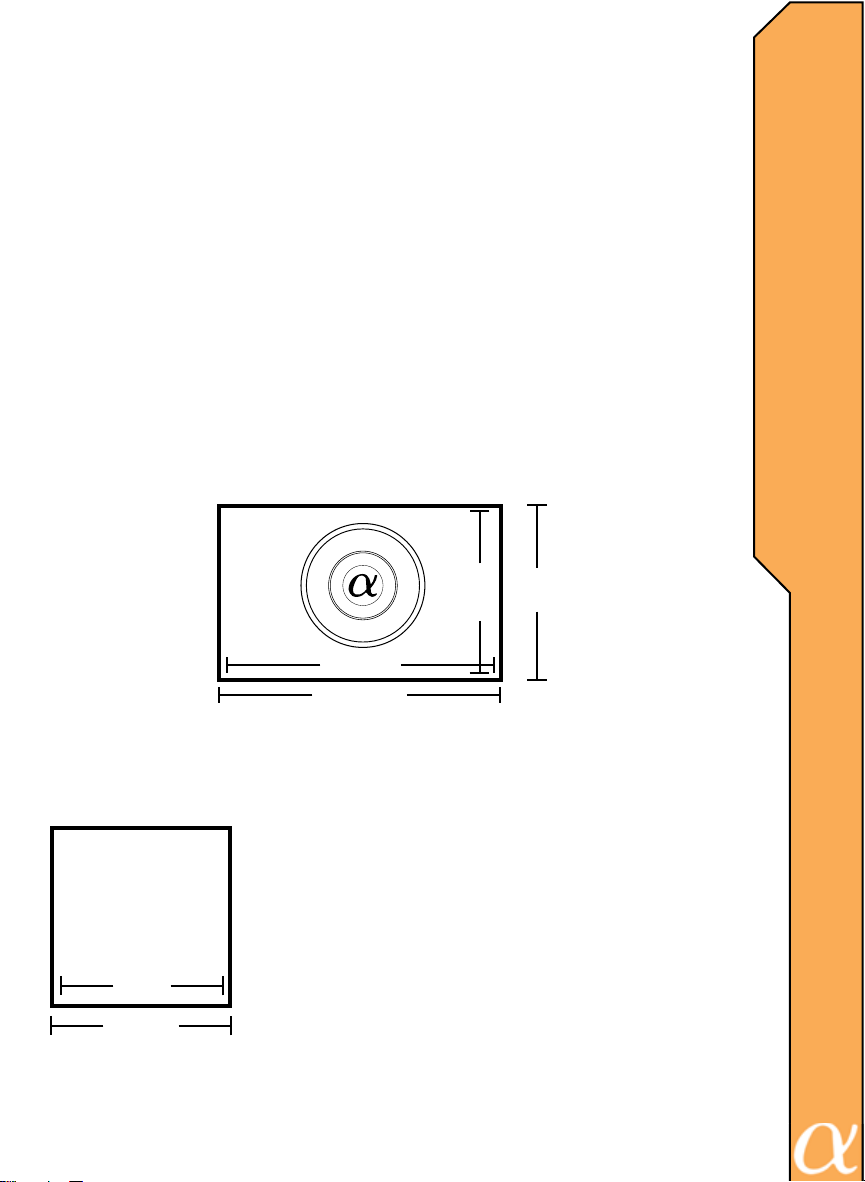
If you’re planning to build your own enclosure and are confused
in what type of enclosure best suits your needs this page will help you
choose what enclosure best ts your needs. There are many different types
of enclosures. The two most common used enclosures are sealed and
vented enclosure. This page will show the advantages and disadvantages
of the two enclosures.
Advantages of a sealed enclosures
*High power handing capability
*Great transient response
*Tolerant of minor enclosure size variation
*Easy to construct
*Smooth roll off (12dB/octave)
Disadvantages of a sealed enclosures
*Requires a woofer with a long excursion for better low bass
frequency response.
*Can have lower sensitivity than ported enclosures.
*When using high power and small enclosures, the woofer is not in
an ideal cooling environment.
*Lower bass as compared to a properly tuned vented enclosure
above the ported tuning frequency.
Advantages of a vented enclosure
*Increased output around vented tuning
*Higher power handling above the port tuning frequency
*Extended frequency response
*Magnet is in a good cooling environment
*Handles higher bass frequencies with less distortion
Disadvantages of a vented enclosure
*Vented enclosure transient response is not as good as sealed
boxes because of the resonant effect of the vent tuning
*Midrange sound coming from inside the enclosure through the vent
can produce unpleasant sound coloration.
*Loss of cone movement control below vent tuning, which can re
sult in high distortion and mechanical failure of the driver.
*Lower power handling below the port tuning frequency.
BUILDING AN ENCLOSURE
6
Calculating a sealed speaker enclosure volume is a six step process.
Step One: Measure Height
Step Two: Measure Width
Step Three: Measure Depth
Step Four: Subtract Thickness of Wood
Step Five: Multiply Height * Width * Depth =
Step Six: Divide the results from step four by 1728
EXAMPLE: 12” * 12” * 12” / 1728 = 1.0 cu. ft.
Complete formula should look like this
Height * Width * Depth / 1728 =_____________
Below are illustrated versions of steps to calculate the enclosure volume.
(ILLUSTRATED EXAMPLE ONLY)
If measured internal dimensions you will skip step four.
13.5"
19.5"
13.5"
12"
12"
18"
Step One:
(Height) 13.5”
Step Two:
(Width) 18”
Step Three:
(Depth) 13.5”
Side View
The wood that we are using is 0.75” thick
The 1.5” that you see in the formula is the thickness
of the wood.
Step Four:
Calculating thickness of wood:
Measure how thick the wood is then
multiply by 2.
The reason that you are multiplying
by 2 is each side of the enclosure.
Width 19.5” - Left + Right(1.5”) = 18”
Height 13.5 - Top + Bottom(1.5”) = 12”
Depth 13.5” - Front + Back(1.5”) = 12”
Step Five: 18 * 12 * 12 = 2592
Step Six: 2592 / 1728 = 1.50 cu. ft.

BUILDING AN ENCLOSURE
15"
23"
13.5"
13.5"
7"
12"
21.5"
4"
4.5"
Calculating a speaker enclosure volume with a port is a seven step process.
The First six steps are the same as the sealed enclosure. The only
difference is calculating the port displacement.
Step One - Six: Follow the rst six steps on the sealed enclosure.
(ILLUSTRATED EXAMPLE ONLY)
If measured internal dimensions you will skip step four.
15” - 1.5” = 13.5”
Step Five: 21.5 * 12 * 13.5 = 3483
Step Six: 3483 / 1728 = 2.01 cu. ft.
Step Seven: Formula to calculate vent displacement
A = π r² A = area | r = radius | d = depth
π * r * r * d = _________ / 1728 = _________
Example:
π(3.14) * r(2.25”) * r(2.25”) * d(7”) = 111.27 sq. in.
111.27 / 1728 = 0.06 cu. ft
2.01 - 0.06 = 1.95 cu. ft. enclosure
Step One: 23”
Step Two: 12”
Step Three: 13.5”
Step Four:
(W)23 - 1.5 = 21.5”
(H)13.5 - 1.5 = 12”
(D)15 - 1.5 = 13.5”
7

BUILDING AN ENCLOSURE
Converting a round port to a slot port.
Calculate the are of the round port(s) being used, then use the square root
function of your calculator to get the interior dimensions of the equivalent
square port. The length (or depth) of the slot port will be the same as that
of the round port
To calculate area: (Area is a two dimensional measurement)
Area = π r²
Area Port
Slot Port
r (2.25”)
A
(4.5”)
A (4.5) Port
π(3.14) * r(2.25) * r(2.25) = 15.9
10.6 x 1.5=15.9
r (2.25”)
10.6”
1.5”
8
SUBWOOFER PARAMETERS
9
Dynamis Series
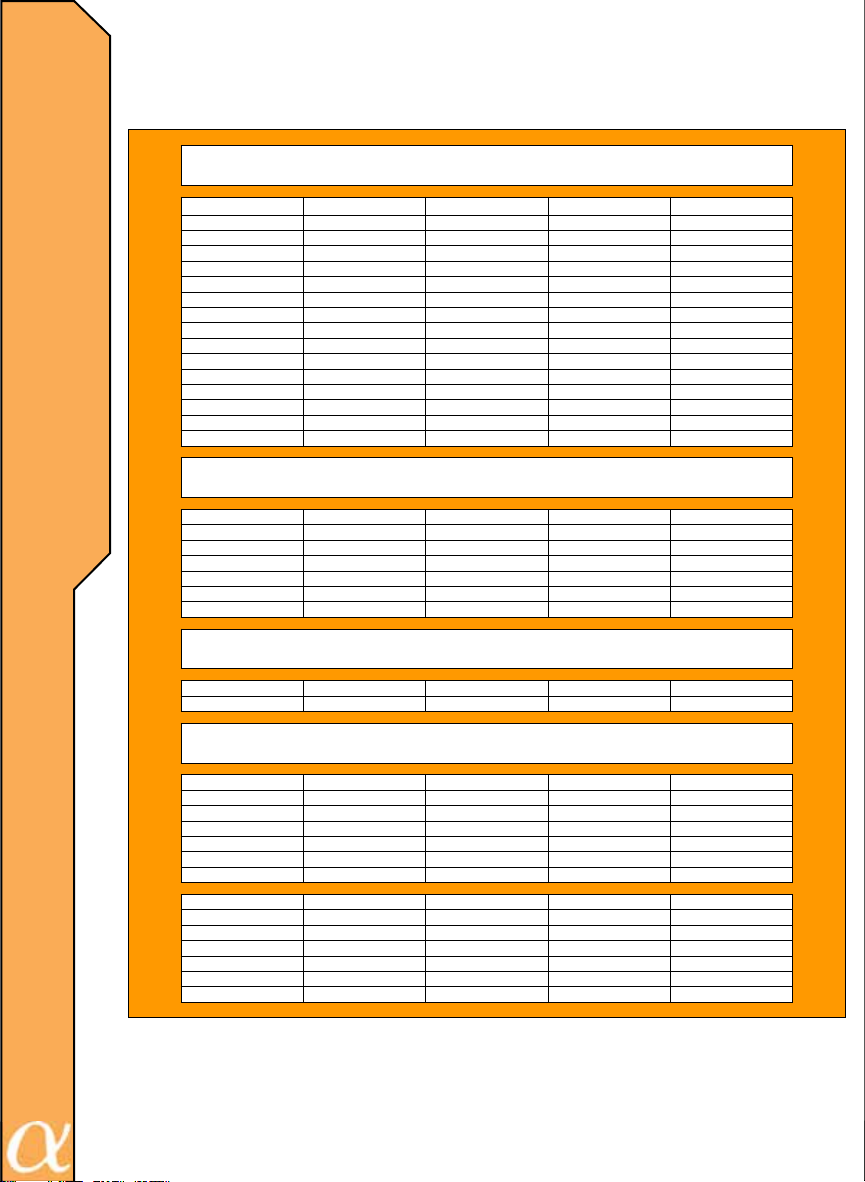
Model #DSW510 DSW512
Fs 38 35
Qts 0.58 0.65
Qes 0.638 0.721
Qms 6.357 6.953
Vas (liters) 16.21 33.14
Vas (Cu. Ft.) 0.57 1.17
Re 3.3 X 2 3.2 X 2
Rms 6.82 7.65
Xmax +/- (mm)
Le 5.11 5.15
Sd 346.36 522.79
SPL 84 86
EBP 60 48
Mmd 172.34 229.28
Freq. Resp. 33Hz-500Hz 30Hz-500Hz
Mounting Dimensions
Depth (mm) 170mm 180mm
Depth (Inches) 6.69" 7.09"
Through Hole (mm) 226mm 276mm
Through Hole (Inches) 8.90" 10.87"
Diameter (mm) 260mm 315mm
Diameter (Inches) 10.24" 12.40"
Displacement .137 Cu.Ft. .184 Cu.Ft.
Sealed Enclosures
Minimum Sealed 0.5 0.85
Maximum Sealed 1 1.75
Vented Enclosures
Minimum Vented 1.5 2
Internal Volume 1.34 1.79
Port Dia/Inches 4 4
Port Length/Inches 9 8.75
(-3dB) 35 32
Tuning Freq. 45 40
Port Displacement 0.06 0.06
Maximum Vented 2.5 3.5
Internal Volume 2.35 3.13
Port Dia/Inches 4 2x4
Port Length/Inches 8.75 14.25
(-3dB) 29 28
Tuning Freq. 35 35
Port Displacement 0.06 0.21
Rev 18.12
Questo manuale è adatto per i seguenti modelli
2
Indice
Altri manuali Alphasonik Subwoofer

Alphasonik
Alphasonik TREIS 300 Series Manuale utente

Alphasonik
Alphasonik NEURON 400 Series Manuale utente

Alphasonik
Alphasonik VENUM 800 Series Manuale utente

Alphasonik
Alphasonik ALPHA 100 PSW110E Manuale utente

Alphasonik
Alphasonik APP122 Manuale utente

Alphasonik
Alphasonik ALPHA 300 SERIES PSW310X Manuale utente

Alphasonik
Alphasonik Flagship Series Manuale utente

Alphasonik
Alphasonik ALPHA 400 PSW410E Manuale utente

Alphasonik
Alphasonik ALPHA 800 PSW810E Manuale utente

Alphasonik
Alphasonik MAYHEM PSW912 Manuale utente


