
ARTHUR MARTIN AC2800AOW2 Manuale utente

CONTENTS
Safety information 2
Safety instructions 3
Operation 5
Daily use 6
Hints and tips 7
Care and cleaning 8
Troubleshooting 9
Installation 11
Technical data 12
Subject to change without notice.
SAFETY INFORMATION
Before the installation and use of the appliance, carefully
read the supplied instructions. The manufacturer is not
responsible for any injuries or damages that are the result of
incorrect installation or usage. Always keep the instructions
in a safe and accessible location for future reference.
Children and vulnerable people safety
•This appliance can be used by children aged from 8 years
and above and persons with reduced physical, sensory or
mental capabilities or lack of experience and knowledge if
they have been given supervision or instruction concerning
the use of the appliance in a safe way and understand the
hazards involved.
•Children between 3 and 8 years of age and persons with
very extensive and complex disabilities shall be kept away
unless continuously supervised.
•Children of less than 3 years of age should be kept away
unless continuously supervised.
•Do not let children play with the appliance.
•Children shall not carry out cleaning and user maintenance
of the appliance without supervision.
•Keep all packaging away from children and dispose of it
appropriately.
General Safety
•This appliance is intended to be used in household and
similar applications such as:
2
–Farm houses; staff kitchen areas in shops, offices and
other working environments
–By clients in hotels, motels, bed and breakfast and other
residential type environments
•Keep ventilation openings, in the appliance enclosure or in
the built-in structure, clear of obstruction.
•Do not use mechanical devices or other means to
accelerate the defrosting process, other than those
recommended by the manufacturer.
•Do not damage the refrigerant circuit.
•Do not use electrical appliances inside the food storage
compartments of the appliance, unless they are of the type
recommended by the manufacturer.
•Do not use water spray and steam to clean the appliance.
•Clean the appliance with a moist soft cloth. Only use
neutral detergents. Do not use abrasive products, abrasive
cleaning pads, solvents or metal objects.
•Do not store explosive substances such as aerosol cans
with a flammable propellant in this appliance.
•If the supply cord is damaged, it must be replaced by the
manufacturer, its Authorised Service Centre or similarly
qualified persons in order to avoid a hazard.
SAFETY INSTRUCTIONS
Installation
WARNING! Only a qualified
person must install this
appliance.
• Remove all the packaging and the
transit bolts.
• Do not install or use a damaged
appliance.
• Follow the installation instructions
supplied with the appliance.
• Always take care when moving the
appliance as it is heavy. Always use
safety gloves and enclosed footwear.
• Make sure the air can circulate around
the appliance.
• At first installation or after reversing the
door wait at least 4 hours before
connecting the appliance to the power
supply. This is to allow the oil to flow
back in the compressor.
• Before carrying out any operations on
the appliance (e.g. reversing the door),
remove the plug from the power socket.
• Do not install the appliance close to
radiators or cookers, ovens or hobs.
• Do not install the appliance where there
is direct sunlight.
• Do not install this appliance in areas
that are too humid or too cold.
• When you move the appliance, lift it by
the front edge to avoid scratching the
floor.
3
Electrical connection
WARNING! Risk of fire and
electric shock.
• The appliance must be earthed.
• Make sure that the parameters on the
rating plate are compatible with the
electrical ratings of the mains power
supply.
• Always use a correctly installed
shockproof socket.
• Do not use multi-plug adapters and
extension cables.
• Make sure not to cause damage to the
electrical components (e.g. mains plug,
mains cable, compressor). Contact the
Authorised Service Centre or an
electrician to change the electrical
components.
• The mains cable must stay below the
level of the mains plug.
• Connect the mains plug to the mains
socket only at the end of the
installation. Make sure that there is
access to the mains plug after the
installation.
• Do not pull the mains cable to
disconnect the appliance. Always pull
the mains plug.
Use
WARNING! Risk of injury,
burns, electric shock or fire.
• Do not change the specification of this
appliance.
• Do not put electrical appliances (e.g.
ice cream makers) in the appliance
unless they are stated applicable by the
manufacturer.
• Be careful not to cause damage to the
refrigerant circuit. It contains isobutane
(R600a), a natural gas with a high level
of environmental compatibility. This gas
is flammable.
• If damage occurs to the refrigerant
circuit, make sure that there are no
flames and sources of ignition in the
room. Ventilate the room.
• Do not let hot items to touch the plastic
parts of the appliance.
• Do not put soft drinks in the freezer
compartment. This will create pressure
on the drink container.
• Do not store flammable gas and liquid
in the appliance.
• Do not put flammable products or items
that are wet with flammable products
in, near or on the appliance.
• Do not touch the compressor or the
condenser. They are hot.
• Do not remove or touch items from the
freezer compartment if your hands are
wet or damp.
• Do not freeze again food that has been
thawed.
• Obey the storage instructions on the
packaging of frozen food.
Internal lighting
WARNING! Risk of electric
shock.
• The type of lamp used for this
appliance is for household appliances
only. Do not use it for house lighting.
Care and cleaning
WARNING! Risk of injury or
damage to the appliance.
• Before maintenance, deactivate the
appliance and disconnect the mains
plug from the mains socket.
• This appliance contains hydrocarbons
in the cooling unit. Only a qualified
person must do the maintenance and
the recharging of the unit.
• Regularly examine the drain of the
appliance and if necessary, clean it. If
the drain is blocked, defrosted water
collects in the bottom of the appliance.
Service
• To repair the appliance contact an
Authorised Service Centre.
• Use original spare parts only.
4
Disposal
WARNING! Risk of injury or
suffocation.
• Disconnect the appliance from the
mains supply.
• Cut off the mains cable and discard it.
• Remove the door to prevent children
and pets to be closed inside of the
appliance.
• The refrigerant circuit and the insulation
materials of this appliance are ozone-
friendly.
• The insulation foam contains
flammable gas. Contact your municipal
authority for information on how to
discard the appliance correctly.
• Do not cause damage to the part of the
cooling unit that is near the heat
exchanger.
OPERATION
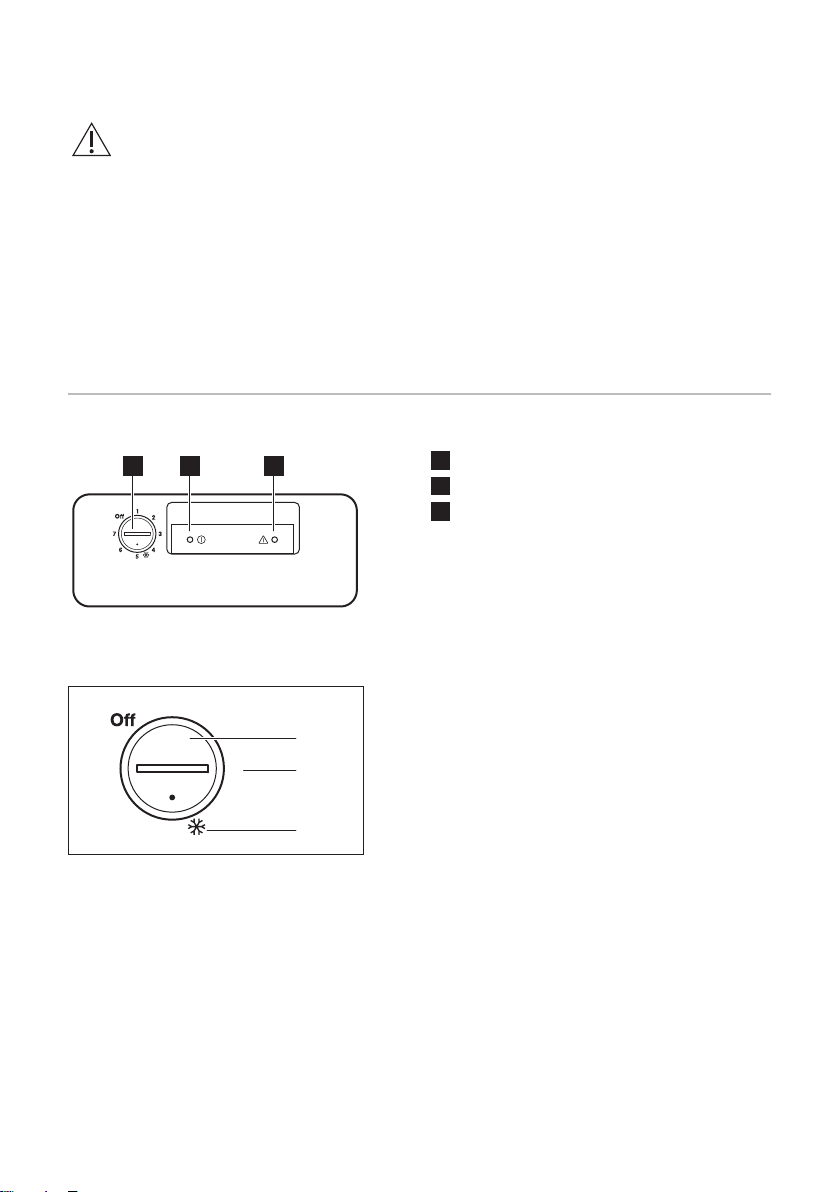
Control panel
21 3
1Temperature regulator
2Power indicator light
3High temperature alarm light
Switching on
B
C
A
2
3
4
5
6
7
1
A. Temperature Regulator
B. Half Loaded position
C. Full Loaded position
1. Insert the plug into the wall socket.
2. Turn the Temperature Regulator to the
Full Loaded position and let the
appliance run for 24 hours to allow the
correct temperature to be reached
before placing food inside.
The power indicator light will light up.
3. Adjust the Temperature Regulator
according to the quantity of the stored
foods.
Switching off
Turn the Temperature regulator to the
OFF position.
Temperature regulation
The temperature within the appliance is
controlled by the Temperature Regulator
situated on the control panel.
5
To operate the appliance, proceed as
follows:
• to obtain the minimum coldness, turn
the Temperature Regulator toward
lower settings.
• to obtain the maximum coldness. turn
the Temperature Regulator toward
higher settings.
In case of freezing less food
volumes, the Half Loaded
setting is the most suitable. In
case of freezing much food
volumes, the Full Loaded
setting is the most suitable.
High temperature alarm
An increase in the temperature in the
freezer (for example due to a power
failure) is indicated by switching on of the
Alarm light .
During the alarm phase, don't place food
inside the freezer.
When normal conditions are restored, the
Alarm light will switch off automatically.
DAILY USE
WARNING! Refer to Safety
chapters.
Freezing fresh food
The freezer compartment is suitable for
freezing fresh food and storing frozen and
deep-frozen food for a long time.
The maximum amount of food that can be
frozen in 24 hours is specified on the
rating plate (refer to "Technical data").
The freezing process lasts 24 hours:
during this period do not add other food to
be frozen.
Storage of frozen food
When first starting-up or after a period out
of use, before putting the products in the
compartment let the appliance run at least
24 hours Temperature Regulator to the
Full Loaded position.
CAUTION! In the event of
accidental defrosting, for
example due to a power failure,
if the power has been off for
longer than the value shown in
the technical characteristics
chart under "rising time", the
defrosted food must be
consumed quickly or cooked
immediately and then re-frozen
(after cooling).
Opening and closing the lid
CAUTION! Never pull the
handle with immense force.
As the lid is equipped with a tightly closing
seal, it is not easy to reopen it shortly after
closing (due to the vacuum formed inside).
Wait for few minutes before reopening the
appliance.
The vacuum valve will help you to open
the lid.
Security lock
The freezer is equipped with a special lock
in order to avoid accidental locking. The
lock is designed in such manner that you
can turn the key and thus close the lid
6
only if you previously push the key into the
lock.
1. To lock the freezer, push the key into
the lock gently and turn the key
clockwise towards the symbol .
2. To open the freezer, push the key into
the lock gently and turn the key
counter-clockwise towards the symbol
.
Spare keys are available at the
local Authorised Service
Centre.
WARNING! Keep the keys well
away from children.
Make sure to remove the key
from the lock before you
discard the old appliance.
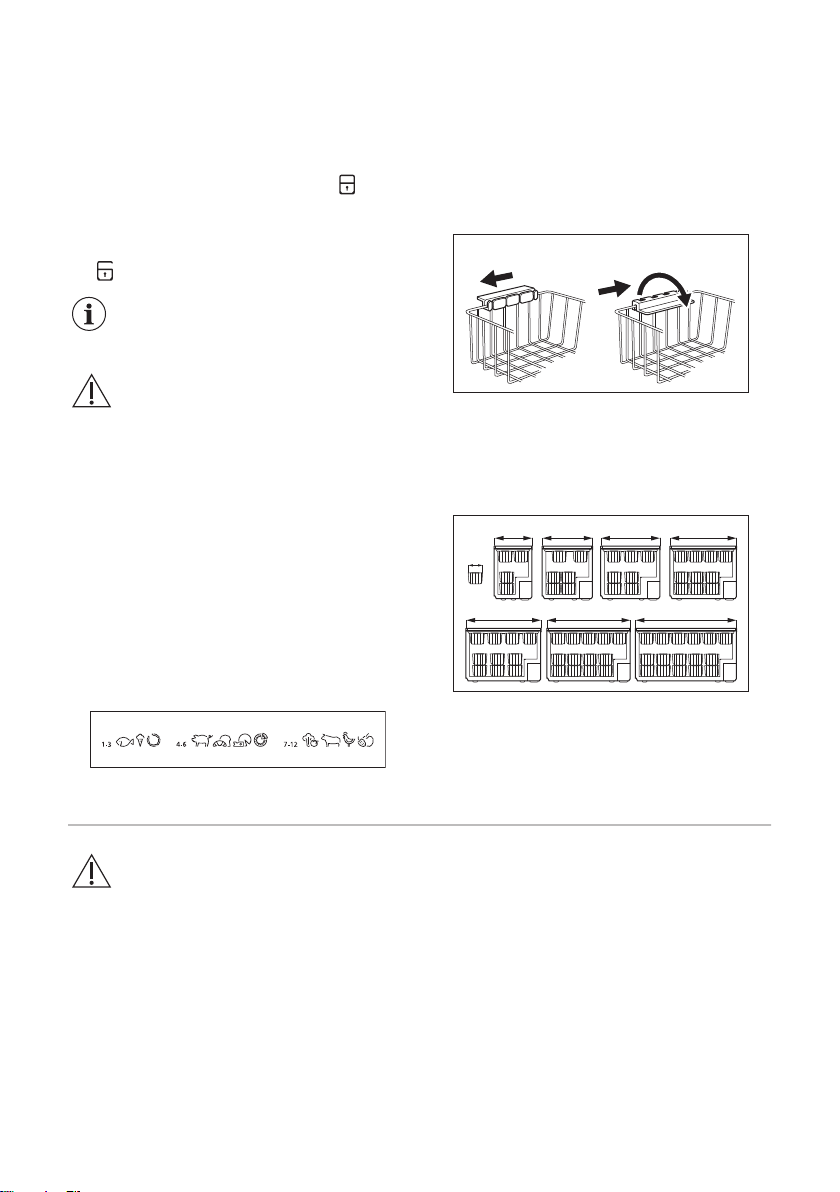
Freezing Calendar
The symbols show different types of
frozen goods.
The numbers indicate storage times in
months for the appropriate types of frozen
goods. Whether the upper or lower value
of the indicated storage time is valid
depends on the quality of the foods and
treating before freezing.
Storage baskets
Hang the baskets on the upper edge of
the freezer (A) or place them inside the
freezer (B). Turn and fix the handles for
these two positions as shown in the
picture.
A B
The following pictures show how many
baskets can be placed inside the various
freezer models.
The baskets will slide into each other.
230
806606 946 1061
1201 1336 1611
You can purchase additional baskets from
your local Authorised Service Centre.
HINTS AND TIPS
WARNING! Refer to Safety
chapters.
Hints for freezing
To help you make the most of the freezing
process, here are some hints:
• The maximum quantity of food which
can be frozen in 24 hours is shown on
the rating plate.
• The freezing process takes 24 hours.
No further food to be frozen should be
added during this period.
• Freeze only top quality, fresh and
thoroughly cleaned foodstuffs.
• Prepare food in small portions to
enable it to be rapidly and completely
frozen and to make it possible
subsequently to thaw only the quantity
required.
• Wrap up the food in aluminium foil or
polythene and make sure that the
packages are airtight.
• Do not allow fresh, unfrozen food to
touch food which is already frozen, thus
7
avoiding a rise in temperature of the
latter.
• Lean foods store better and longer than
fatty ones; salt reduces the storage life
of food.
• Water ices, if consumed immediately
after removal from the freezer
compartment, can possibly cause the
skin to be freeze burnt.
• It is advisable to show the freezing in
date on each individual pack to enable
you to keep tab of the storage time.
Hints for storage of frozen food
To obtain the best performance from this
appliance, you should:
• make sure that the commercially frozen
foodstuffs were adequately stored by
the retailer;
• be sure that frozen foodstuffs are
transferred from the store to the freezer
in the shortest possible time;
• not open the lid frequently or leave it
open longer than absolutely necessary.
• Once defrosted, food deteriorates
rapidly and cannot be refrozen.
• Do not exceed the storage period
indicated by the food manufacturer.
CARE AND CLEANING
WARNING! Refer to Safety
chapters.
Cleaning the interior
Before using the appliance for the first
time, the interior and all internal
accessories should be washed with
lukewarm water and some neutral soap to
remove the typical smell of a brand-new
product, then dried thoroughly.
CAUTION! Do not use
detergents, abrasive powders,
chlorine or oil-based cleaners
as they will damage the finish.
Periodic cleaning
CAUTION! Unplug the
appliance before carrying out
any maintenance operation.
Do not use detergents,
abrasive products, highly
perfumed cleaning products or
wax polishes to clean the inner
side of the appliance.
Prevent damage to the cooling
system.
There is no need to clean the
compressor area.
1. Switch off the appliance.
2. Regularly clean the appliance and the
accessories with warm water and
neutral soap.
Clean the lid seal carefully.
3. Fully dry the appliance.
4. Connect the mains plug to the mains
socket.
5. Switch on the appliance.
Defrosting the freezer
CAUTION! Never use sharp
metal tools to scrape off frost
as you could damage the
appliance. Do not use a
mechanical device or any
artificial means to speed up the
thawing process other than
those recommended by the
manufacturer. A temperature
rise of the frozen food packs,
during defrosting, may shorten
their safe storage life.
Defrost the freezer when the frost layer
reaches a thickness of about 10-15 mm.
The amount of frost on the walls of the
appliance will be increased by the high
level of the outer environment humidity
8
and if the frozen food is not wrapped
properly.
The best time to defrost the freezer when
it contains no or only a little food.
1. Switch off the appliance.
2. Remove any stored food, wrap it in
several layers of newspaper and put it
in a cool place.
3. Leave the lid open , remove the plug
from the defrost water drain and collect
all defrost water on a tray.
4. When defrosting is completed, dry the
interior thoroughly and refit the plug.
5. Switch on the appliance.
6. Set the temperature regulator to obtain
the maximum coldness and run the
appliance for two or three hours using
this setting.
7. Reload the previously removed food
into the compartment.
Periods of non-operation
When the appliance is not in use for long
periods, take the following precautions:
1. Switch off the appliance and
disconnect the appliance from
electricity supply.
2. Remove all food
3. Defrost and clean the appliance and all
accessories.
4. Leave the lid open to prevent
unpleasant smells.
If the cabinet will be kept on,
ask somebody to check it once
in a while to prevent the food
inside from spoiling in case of a
power failure.
TROUBLESHOOTING
WARNING! Refer to Safety
chapters.
What to do if...
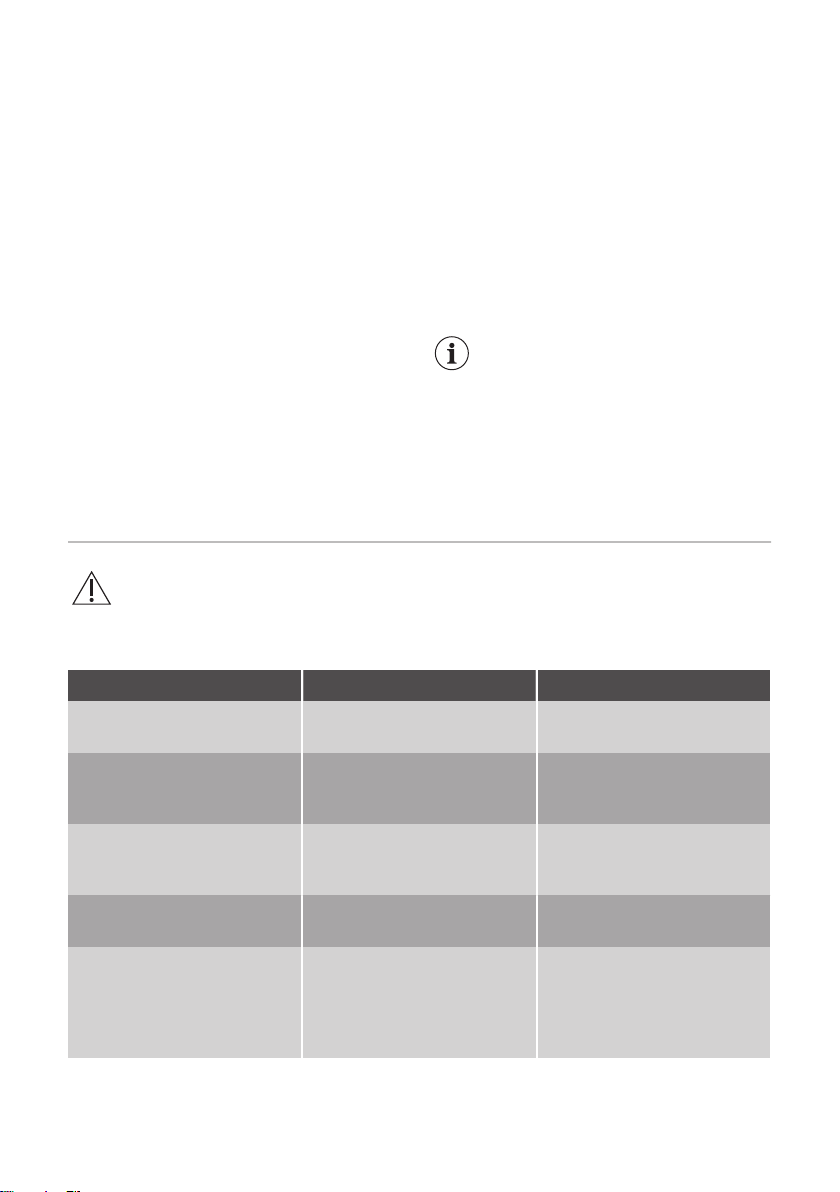
Problem Possible cause Solution
The appliance does not op‐
erate.
The appliance is switched
off.
Switch on the appliance.
The mains plug is not con‐
nected to the mains socket
correctly.
Connect the mains plug to
the mains socket correctly.
There is no voltage in the
mains socket.
Connect to a different elec‐
trical mains socket. Contact
a qualified electrician.
The appliance is noisy. The appliance is not suppor‐
ted properly.
Check if the appliance
stands stable.
Audible or visual alarm is on. The cabinet has been re‐
cently switched on or the
temperature in the appliance
is too high.
Refer to "High Temperature
Alarm" and if the problem
still occurs contact the near‐
est Authorized Service Cen‐
tre.
9
Problem Possible cause Solution
Power indicator light is flash‐
ing.
An error has occurred in
measuring the temperature
or the appliance is not work‐
ing properly.
Contact the nearest Author‐
ized Service Centre.
The lid doesn't close com‐
pletely.
Food packages are blocking
the lid.
Arrange the packages in the
right way, see the sticker in
the appliance.
There is excessive frost. Eliminate excess frost.
The lid is difficult to open. The lid gaskets are dirty or
sticky.
Clean the lid gaskets.
The valve is blocked. Check the valve.
The lamp does not work. The lamp is defective. Refer to "Replacing the
lamp".
The compressor operates
continually.
Temperature is set incor‐
rectly.
Refer to "Operation" chap‐
ter.
Large quantities of food to
be frozen were put in at the
same time.
Wait some hours and then
check the temperature
again.
The room temperature is too
high.
Refer to climate class chart
on the rating plate.
Food placed in the appli‐
ance was too warm.
Allow food to cool to room
temperature before storing.
The lid is not closed proper‐
ly.
Check if the lid closes well
and the gaskets are undam‐
aged and clean.
There is too much frost and
ice.
The lid is not closed correct‐
ly or the gasket is deformed/
dirty.
Refer to "Opening and clos‐
ing the lid".
The water drainage plug is
not correctly positioned.
Position the water drainage
plug in the correct way.
Temperature is set incor‐
rectly.
Refer to "Operation" chap‐
ter.
The temperature in the ap‐
pliance is too low/too high.
The temperature regulator is
not set correctly.
Set a higher/lower tempera‐
ture.
The lid is not closed correct‐
ly.
Refer to "Opening and clos‐
ing the lid".
10
Indice
Lingue:
Altri manuali ARTHUR MARTIN Congelatore

ARTHUR MARTIN
ARTHUR MARTIN AC5200AOW2 Manuale utente

ARTHUR MARTIN
ARTHUR MARTIN AUT5NF26X Manuale utente

ARTHUR MARTIN
ARTHUR MARTIN AC1500AOW1 Manuale utente

ARTHUR MARTIN
ARTHUR MARTIN AUT700AOW Manuale utente

ARTHUR MARTIN
ARTHUR MARTIN ANN2842ACW Manuale utente

ARTHUR MARTIN
ARTHUR MARTIN AC2200AOW2 Manuale utente

ARTHUR MARTIN
ARTHUR MARTIN AC3200AOW2 Manuale utente


