
Asko W6222 Manuale utente

Use & Care Guide
Washing Machine
Dear ASKO customer,
Thank you for choosing this quality product from
Scandinavia, made in Vara, Sweden.
We want you to feel assured that the inside of your new
machine is just as good as the outside and that the ethics and
standards that went into the production of this machine are
just as high as the quality and performance that you will
receive from it. We hope that this product will give you many
years of pleasure.
To get the most out of your new machine, we recommend that
you read the installation and operating instructions before
using the machine.
ASKO W6222

2
Contents
Contents 2
Before using your machine
for the first time 3
Transport protection 3
Packing material 3
Washer door 3
Checking water hardness 3
Safety instructions 4
General 4
Installation 4
Overflow guard function 4
Transport/Winter storage 4
Disposal 4
Child safety 5
Automatic door opening 5
Parts of the washing machine 6
Detergent compartment 6
Options buttons 7
Advice and tips before washing 8
Sorting laundry 8
Clothing 8
Laundry labels 8
Coloured cotton 8
Delicates 8
Laundry label symbols 8
Wool and silk 9
Artificial fibres and synthetic fibres 9
Reducing allergic reactions 9
Dyeing fabrics 9
Washing 10
Sort laundry 10
Turn on the main power switch 10
Open the washer door and load the
washing 10
Add detergent and fabric softener, as
required 10
Select programme 11
Programme chart 11
Select options and settings 12
Close the door and press Start 13
Once the programme has finished 13
Care and cleaning 14
Checking the filter and drainage pump 14
Cleaning the detergent compartment 14
Cleaning the outside of the machine 14
Cleaning the inside of the machine 14
Rinse holes under the agitator 15
If you have hard water 15
Troubleshooting 16
The washer door will not open 16
The machine will not start 16
Error messages 16
Technical information 18
Technical data 18
Standard tests 18
Transport protection 19
Installation 20
Positioning the washing machine 20
Adjusting the feet 20
Connection to water supply 20
Drainage connection 20
Electrical installation 21
Programme plate in multiple
languages 21
Service 22
Before contacting the service division 22
Search words 23
Quick guide 24

3
Before using your machine for the first time
Transport protection
Has the transport protection been re-
moved? If not, see the “Transport protec-
tion” chapter.
Packing material
Sort waste in accordance with local guide-
lines.
Washer door
The washer door cannot be opened until
the machine is connected to the electricity
supply.
To open the door manually, see the sec-
tion entitled “The door will not open” in the
“Troubleshooting” chapter.
It is not possible to start the machine with
the door open.
To open the door during an ongoing pro-
gramme, see the section entitled “Close the
door and press Start”.
Checking water hardness
The quantity of detergent required depends
on water hardness, among other things.
Phone your local Water Board to check the
water hardness in your area.

4
Transport/ Winter storage
If the machine is to be transported or stored
in unheated premises where the tempera-
ture can fall below freezing, do as follows:
• Empty the filter and drainage pump (see
the “Care and cleaning” chapter).
• Shut off the water to the washing ma-
chine, loosen the supply hose to the
intake valve and let the water run out from
the valve and hose.
Disposal
When the machine has reached the end of
its service life and is to be disposed of, it
should immediately be made unusable.
Contact your local authority for information
about where your machine should be dis-
posed of and recycled in the proper way.
The machine is manufactured and labelled
for recycling.
General
• Read and keep the operating instructions!
• Installation of water and electricity, if
required, should be carried out by a quali-
fied professional.
• Damaged supply cord must only be re-
placed by a qualified professional.
• The machine should only be used for
washing items as described in these in-
structions - it is not intended for dry clean-
ing!
• Use only detergent intended for machine
washing!
• Remove any transport protection devices
before using the machine (see the “Trans-
port protection” chapter).
• Repairs and maintenance relating to
safety or performance must be carried out
by a qualified professional.
Installation
See the “Installation” chapter.
Overflow guard function
If the machine’s water level rises above
the normal level, the overflow guard func-
tion begins to pump water out and shuts off
the water intake. If the water level has not
dropped within 60 seconds, the programme
is terminated.
Safety instructions

5
Child safety
Keep an eye on children!
• Always close the door and start the pro-
gramme immediately once you have
added detergent.
• The appliance is not intended for use by
young children or infirm persons without
supervision.
• Young children should be supervised to
ensure that they do not play with the appli-
ance.
• Store detergent and fabric softener out of
the reach of children!
Automatic door opening
The machine comes with an automatic door
opening function, which means that the
door opens automatically once the pro-
gramme has finished.
If you wish to prevent small children or
pets from climbing into the machine, you
can deactivate the automatic door opening
function.
1. Turn off the machine using the main
power switch.
2. Press the Door Open button while simul-
taneously pressing the main power switch.
Release the buttons.
3. Press the Key button and the red fields
go out. Automatic door opening is now
deactivated.
4. Press the Start/Stop button to store the
setting.
If you want to reactivate the function, follow
the instructions above, but when you press
the Key button (point 3) the red fields light
up. Store the setting by pressing the Start/
Stop button.

6
Parts of the washing machine
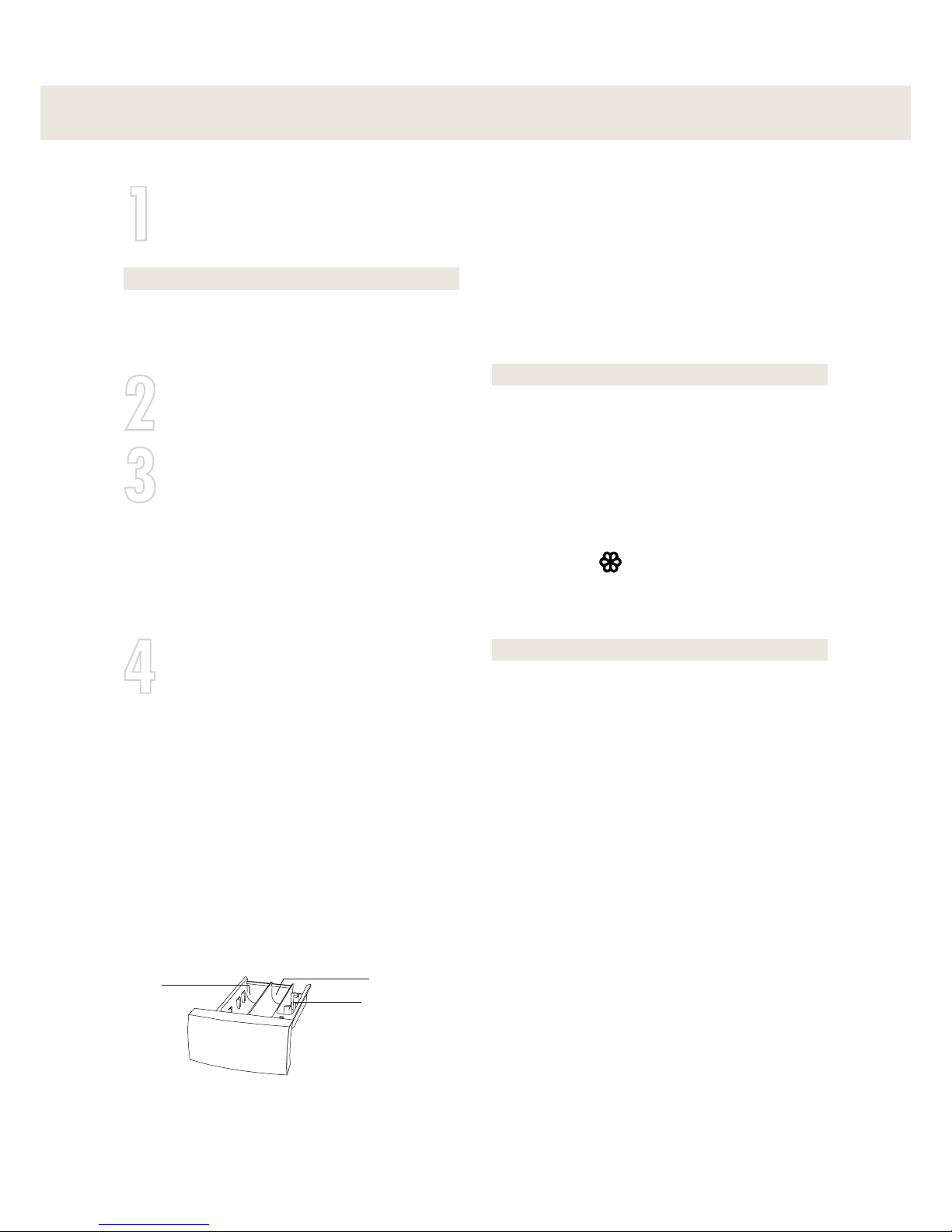
1. Detergent compartment - pre-wash
2. Detergent compartment - main wash
3. Fabric softener compartment
Detergent compartment
1. Detergent compartment
2. Main power switch
3. Programme panel
4. Type plate
5. Hatch - drainage pump
6. Drainage pump (behind hatch)
7. Washer door
8. Outer door (not all models)
5
4
23
1
6
7
8
1
23

7
Front panel
1. Main power switch
2-4. Options buttons
5. Programme selector
6. Display window
7. Door opening
8. Start/Stop
Options buttons
2. Button for selecting Temperature
3. Button for selecting Spin speed
4. Button for selecting Super Rinse
1200
800
Cold
30
40 50
60
95
2
3
4
Cold
30
800800
13001300
40 50
60
95
18
6
7
5
4
2
3

8
Laundry labels
Look at the item’s laundry label. The table
below indicates suitable wash programmes
for various materials and wash loads.
Coloured cotton
Coloured cotton items labelled for hot
washing (60°C) should be washed at 60ºC
the first time in order to remove any excess
dye. If you do not do so, there is a risk that
the colour will run. Use detergent without
bleach in order to preserve the colour of the
fabric.
Delicates
Unbleached linen
Unbleached linen fabrics should be washed
at 60°C, using detergent containing no
bleach or optical whiteners. Heavily-soiled
linen can occasionally be washed at higher
temperatures, but not too often since the
heat can destroy the linen’s shine and
strength.
Advice and tips before washing
Here are some tips that may help you be-
fore washing.
Sorting your laundry
Sort items according to:
• how soiled they are
• colour
• material
Clothing
• Do up zips so that they don’t harm fabrics.
• New coloured items may contain excess
dye and should therefore be washed sepa-
rately the first few times.
• Turn delicate items inside out. This reduc-
es the risk of burling and fading.
• Empty pockets and wash them inside out
if possible!
Laundry
labels Material Programme Load
Cotton, linen, white and light-coloured items. Normal 60° to 95° 1/1 drum
Cotton, linen. Dark-coloured items. Colour 60° 1/1
Polyester, cotton/polyester, nylon. White items. Synthetic 60° 1/2
Rayon, acetate, acrylic. Non-colourfast Synthetic 40° 1/2
items.
Polyester, cotton/polyester, nylon. Synthetic 40° 1/2
Coloured items.
Silk and very delicate items Synthetic 30° 1/3
Items labelled with the IWS or Wool/Hand 40° 1/3
Superwash mark
Laundry label symbols

9
Wool and silk
These fabrics are sometimes labelled as
machine washable and sometimes as hand
wash. The machine’s Wool/Hand pro-
gramme is at least as gentle as washing by
hand.
Wool is especially sensitive to processes
such as washing. If you do not want to spin
it, you can squeeze out the water using
terry towels. In this case select No spin. To
find out how to select this setting, see the
“Washing” chapter. However, most items
can stand a short spin. Select short spin by
selecting spin speed 800 rpm.
Artificial fibres and synthetic
fibres
These materials require plenty of room if
they are not to become wrinkled. Only fill
the drum half way when washing artificial or
synthetic fibres. Select short spin by select-
ing a spin speed of 800 rpm.
Note!
Viscose and acetates are fragile when wet.
Reducing the risk of allergic
reactions
The washing machine is equipped with a
Super Rinse option. Use this for the benefit
of people with sensitive skin, such as those
with allergies and small children.
Economy and efficiency
You can save a lot of energy by not using
more intensive programmes than neces-
sary.
• Select Quick if you just need to freshen up
shirts or exercise clothes, for example. This
will save both water and energy.
• If you select a fast spin speed, this re-
duces energy consumption when drying in
a tumble dryer or airing cupboard.
Dyeing fabrics
If you want to dye fabrics in the machine,
select the Normal programme with the
Super Rinse option On. Select temperature
according to the dye manufacturer’s recom-
mendations.
If the fabric to be dyed is blended material
such as cotton/polyester, select spin speed
800 rpm.
Note!
Add the dye directly to the washing drum
– not to the detergent compartment. After
dyeing, you should run the machine empty
using the same programme. Use the normal
amount of detergent.
Note!
When using agents for bleaching or stain
removal, there is a risk of rust (corrosion)
and discolouration of the machine.
Environmental concerns also lead us to
discourage the use of strong chemicals.
10
Washing
Sort your laundry
See the Advice and Tips section be-
fore washing.
Note!
Empty pockets. Coins, nails and the like
can cause damage to the machine and
fabrics.
Turn on the main power
switch
Open the washer door and
load the washing
If the door is closed, press the Key
button (door open). The red field
lights up and the door opens after a few
seconds. Load the laundry. The laundry
programme chart shows how much laundry
can be washed with each programme.
Add detergent and fabric
softener, as required
The detergent packaging will have
recommendations for how much de-
tergent you should use. The machine holds
6.0 kg of laundry. Overdosing the detergent
may cause bad wash performance. For
lightly soiled load when used on Normal
wash 40°C, we recommend reducing the
amount of detergent.
Powder detergent
Pour the powder into the compartment for
the main wash, and pre-wash as well if
desired.
Liquid detergent
When using liquid detergent, follow the de-
tergent manufacturer’s recommendations.
Wash ball or net
If you use a wash ball or net, place it dir-
ectly in the drum and select a programme
without pre-wash.
Note!
Detergent overdosing does not give better
washing results, but merely causes a great-
er impact on the environment.
Try to use less detergent, and increase only
if you are not satisfied with the results.
Fabric softener
Pour the fabric softener into the compart-
ment with the symbol. Use the dosage
given in the recommendations on the fabric
softener package.
Note!
Do not fill above the compartment’s maxi-
mum fill level. Otherwise fabric softener will
run in too early, which impairs the washing
effect.
1
2
3
4
Fabric softener
Pre-wash
Main wash
Altri manuali per W6222
4
Indice
Altri manuali Asko Rondella

Asko
Asko W6021 Manuale utente

Asko
Asko W600 Manuale utente

Asko
Asko WM33A Manuale utente

Asko
Asko 20605 - Manuale utente

Asko
Asko W640 Manuale utente

Asko
Asko W6324 Manuale di istruzioni

Asko
Asko W6021 Manuale utente

Asko
Asko W6761 Manuale utente

Asko
Asko W40968R/1/2 Manuale utente

Asko
Asko W6863 Istruzioni per il montaggio

Asko
Asko W6441 Manuale utente

Asko
Asko W8844XL W Manuale utente

Asko
Asko PROFESSIONAL WMC622VG Manuale utente

Asko
Asko W600 Manuale utente

Asko
Asko w6884w eco Manuale utente

Asko
Asko PROFESSIONAL WMC947VS Manuale utente

Asko
Asko W6441 Manuale di servizio

Asko
Asko W6221 Manuale utente

Asko
Asko WM25 Manuale utente

Asko
Asko PROFESSIONAL WMC747VS Manuale utente


