
Aspen C107 Manuale utente

C107 OWNERS MANUAL

2
SECTION TOPIC PAGE
SECTION 1 Specifications 3 –4
Service Points 5
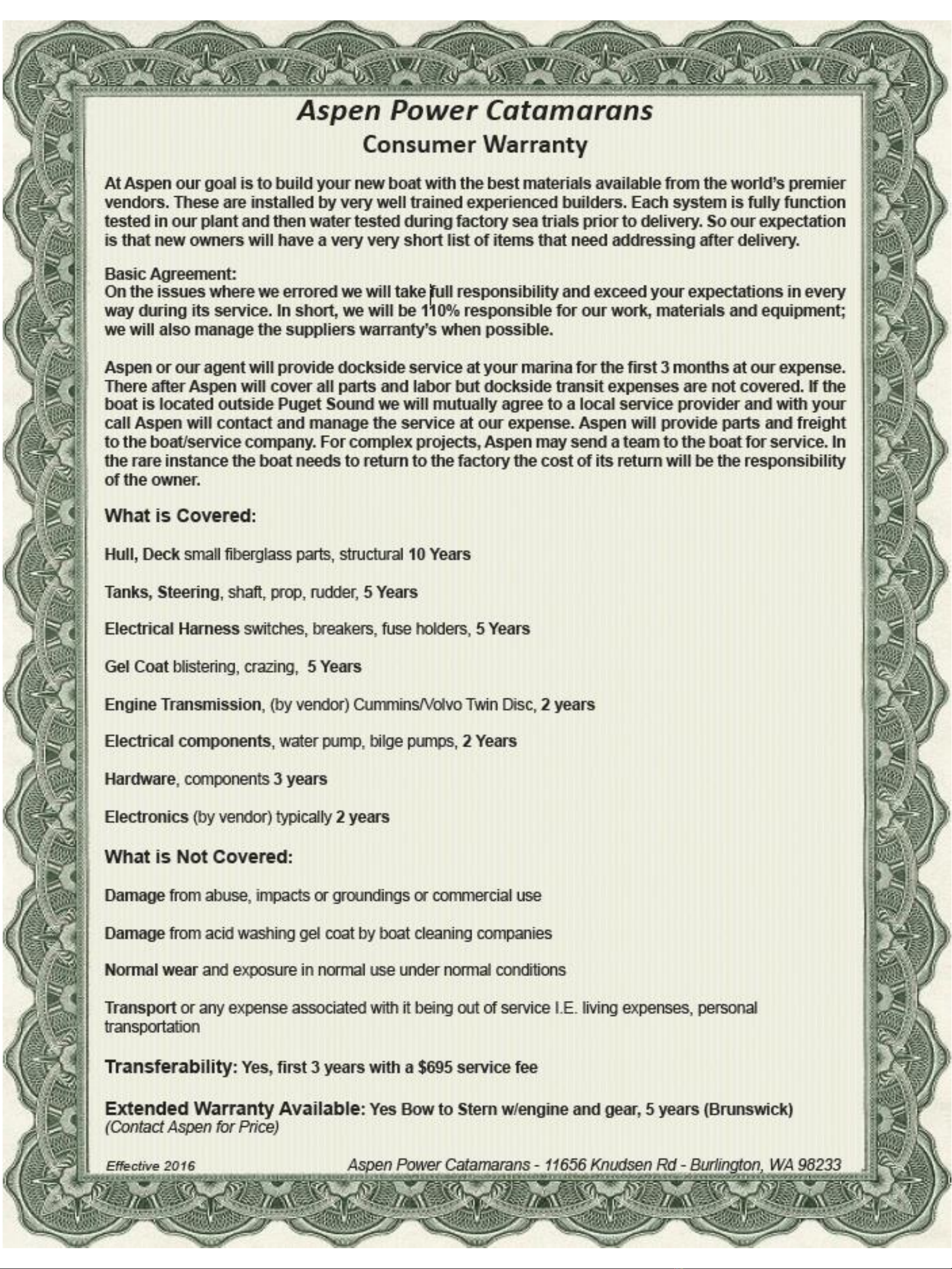
SECTION 2 Aspen Warranty 6
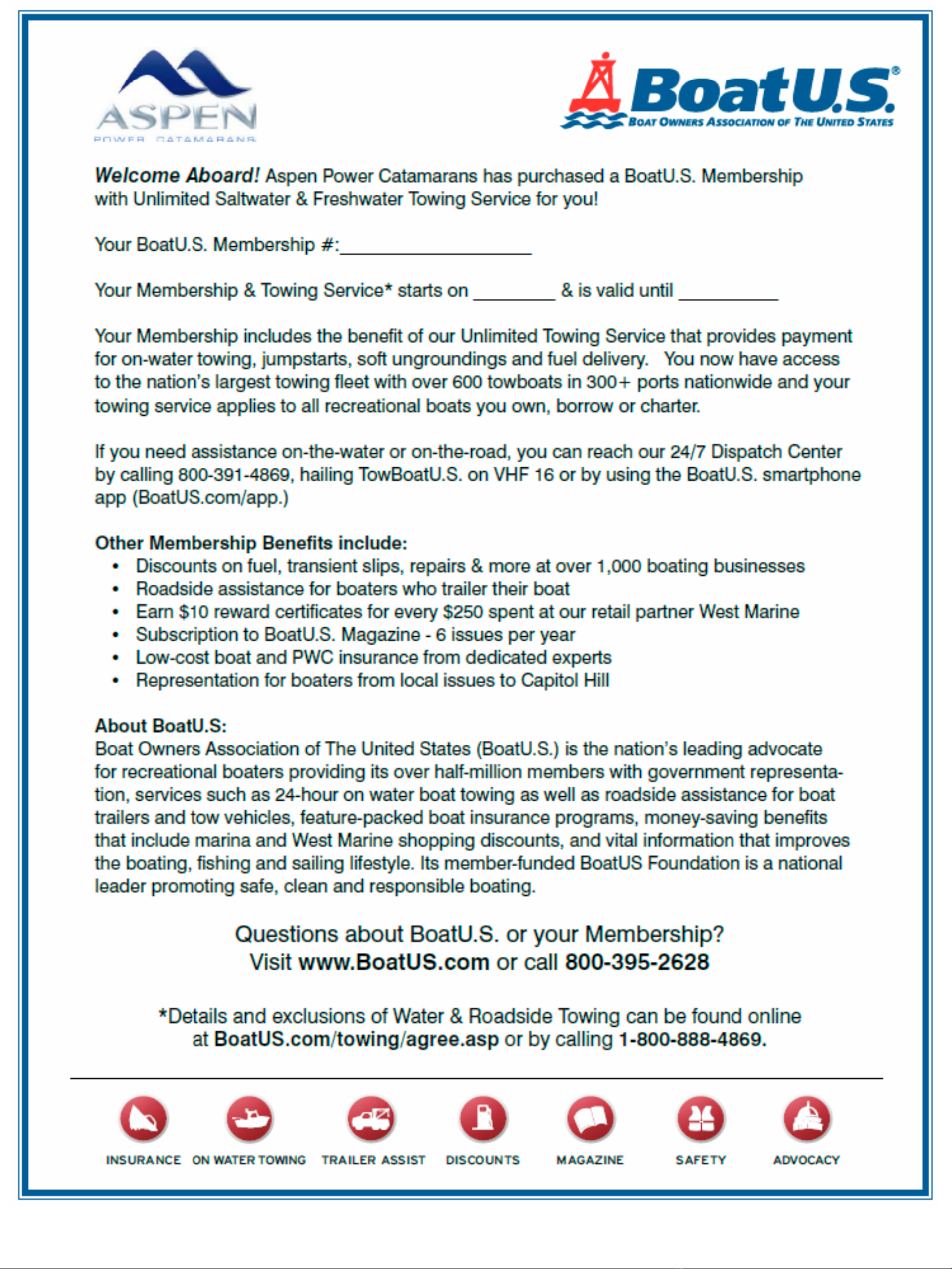
Boat US Membership 7
SECTION 3 Getting Started 8 –10
Batteries & Chargers 11 –13
AC / DC Panels 14 –16
Tank Gauges 17
Fuse Panels 18 –20
Pump Locations 21
SECTION 4 Equipment & Systems 23 –26
Air Conditioning Unit 27
Anchor Operation 28 –29
Tilt Helm & Curtains 30 -31
Fuel System 32
Raw Water Ball Valves 33
Motor Pod Drain Valves 34
Fresh Water System 35 –36
LPG System 37 –39
Teak Care 40
Zinc Replacement Thruster 41
Trailering 42 -45
Lifting Strap 46 -47
Dinghy Launch 48
Outfitting Your Boat 49 –56
Open Hull Photos 57 –59
SECTION 5 Troubleshooting 61 –65
Thruster Maintenance 66 –73
Winterizing 74
SECTION 6 Larry’s Notes: Thruster Logic & Strategy 75
Larry’s Notes: Toilet Logic, Details, Magic 76 –80
Anchoring Woes 81 –84
Service Schedules 85 -87

VESSEL SPECIFICATIONS
VESSEL NAME:
HULL IDENTIFICATION NUMBER:
US APE
MANUFACTURER:
Aspen
MODEL:
C107
LENGTH OVERALL:
36’-8”
LENGTH AT WATER LINE:
34’
BEAM:
10’
DRAFT:
31” Timmed 22”
DISPLACEMENT:
8,780lbs
HULL MATERIAL:
Fiberglass
BOTTOM PAINT:
SeaHawk Biocop
3
ENGINE
DINGHY
ELECTRONICS
Autopilot Reactor 40 CCU
Auto Pilot GHC 20 Display
Garmin Fantom 18 Radar Dome
GPS 19x
Smart Pump
GPSMAP 8612xsv

CAPACITY SPECIFICATIONS
4
Unit Capacity Material
Holding Tank
30 Gallons Polypropylene
Starboard Water Tank
21 Gallons Polypropylene
Port Water Tank
23 Gallons Polypropylene
Port Fuel Tank #1
30 Gallons Aluminum
Port Fuel Tank #2
30 Gallons Aluminum
STBD Fuel Tank #3
70 Gallons Aluminum
Engine Oil
–200hp 4.76 Quarts Yamaha Lube
4M FC W
Engine Oil
–70hp 2.22 Quarts Yamaha Lube
4M FC-W
Hot Water Tank
6 Gallons
Batteries House Bank
Amp Hours
SERVICE POINTS & PARTS
1
OIL CHANGE
Yamaha
Lube (70hp) 4M FC-W 4.7 qts
Yamaha
Lube (200hp) 4M FC-W 2.2 qts
Oil
Filter (70hp)
5GH
-13440-60-
00
1
Oil
Filter (200hp) 69J-13440-03-00 1
2
GEAR OIL CHANGE
70hp
Yamaha Marine Gearcase Lube
SAE 90 API GL-4 .70 qt
200hp
Yamaha Marine Gearcase Lube
SAE 90 API GL-4 1.036 qt
3
ZINCS
Trim Tab Zinc (70hp) 67F-45371-00-00 1
Engine Zinc (70hp)
65W
-45251-00-
00
1
Trim Tab Zinc (200hp) 61A-45371-00-00 1
Engine Zinc (200hp)
6G5
-45251-02-
00
1
5
6
7

GETTING STARTED
ANCHORING
The anchor is on the bow roller. Note: if the winch runs but the line/chain is not coming in,
the clutch is most likely not snugged up. Using the wrench (Lewmar) from the blue owner’s
info bag, insert it in the top of the winch and tighten clockwise. Test again, be careful not to
tighten too far as the bow roller can be bent with the motor’s force.
BATTERIES
The house batteries are located in the starboard aft cockpit lazarette compartment.
The start battery is located in the starboard mid ship storage locker under the dinette.
BILGE PUMPS
There are 3 bilge pumps per hull –each in watertight compartments. All bilge pumps are on
automatic float switches and powered by full time power, even if the switches at the dash
are off. (Power comes from hot float breaker)
DINGHY
Always wear your life jacket when using the dinghy. The dinghy typically has a 450lb capacity
and allows 3- 4 people on board safely.
FUEL TANKS (Expedition)
2 tanks holding 30 gallons each (port side), and a 3rd tank holding 70 gallons (starboard
side).
HOLDING TANK
The holding tank holds 30 gallons. To empty, be 3 miles offshore (if legal in your state) and
hold macerator switch on to dump. It’s best to do when the engine is off so you can hear the
change in motor speed when the tank is dry. There is also a pump outfitting on the step
through at the transom gate.
HEATER
Wallace 30D runs off auxiliary (3 gallon/kerosene) fuel tank located in port hull (Forward
lazarette locker). Or optional Propex propane heater behind the refrigerator running off the
propane tank in the port aft cockpit storage locker.
HOT WATER
There is a 6-gallon hot water tank –110V located in the starboard lazarette.
SAFETY EQUIPMENT (Option)
Aspen boats are typically equipped with 8 life jackets: two under the helm seat (suspender
inflating type), 4 in the starboard aft cockpit storage compartment, and two under the
master bed. The flare kit and first aid kit are also stored under the helm seat. Fire
extinguishers are located to port side of helm and on the aft wall of the ¼ berth.
8

SHORE POWER
Boat comes equipped with a 30-amp service cord. Note: It’s best not to exceed a 25-amp draw or
plug damage may occur. Be sure to twist lock to cord in place for complete connection at the
pedestal.
STOVE
The stove is propane and has a 15lb propane tank. Remember to turn the tank on at the bottle,
and then push the toggle switch next to the sniffer control to feed it power. Then turn on the
sniffer control unit to the right of the stove. Turn switch at stove off after use and close bottle if
leaving the boat for an extended period. Note: When starting the burner, you must hold the
control knob in for 10 seconds after it’s lit to heat the blowout safety sensor while pushing the
ignition button.
WATER
The boat has 2 water tanks, one in each hull. To activate the port tank, switch the water pump
switch at the dash to port side. To activate the starboard tank, move switch to starboard. If switch
is centered, both pumps are off. Capacity is 50 gallons. Remember to not run water continuously
to conserve your water supply.
QUICK START
The main battery switches are typically left on, the AC and DC breakers at the helm are switched
on or off as needed.
A. ENGINE CHECKS: engine oil level should be checked monthly or at the start of
each major trip. Before starting, prime both engines’ fuel systems by gently squeezing
the fuel primer bulb located port and starboard lazarette aft. Squeeze bulb until fuel priming
bulb becomes firm. This greatly reduces cranking time after the engine has set unused for
more than 2 days.
B. COVERS & CUSHIONS: aft deck cooler should be pulled out of the ¼ berth and
placed on the non-skid mat.
C. READY INSTRUMENTS: no action needed.
D. POWER PANELS: DC switches are normally off when leaving the boat for an
extended period of time. This kills power to 95% of the DC equipment. Note: if you
want the refrigerator left on, the lower sub-panel switch must be on. AC panel
breakers are also typically all on except the hot water 110V heater breaker –use
this only when needed as, with other loads, you can exceed 30 amps.
E. START ENGINE: assure throttles are in neutral position. Slip the safety lanyards
in. Turn the key until engine starts.
F. CASTING OFF: remove lines in appropriate manner and stow safely. Then remove
fenders/lines and stow safely. Never leave lines on cleats while underway.
G. UNDERWAY: attentive helmsman at all times.
H. ARRIVING AT MARINA: place fenders on proper side. Remember that neutral is
your friend. Use thrusters once, near dock. 5 second bursts–not more than 30 total.
I. ANCHORING: remove snubber line (safety line/bungee on anchor). Check to
see line in locker is clear and not bound by stored gear. Either at the helm or on the
deck, lower the anchor using switch pad. While retrieving, be sure to clean anchor
(bounce while in water) to clear mud and debris before it gets on the deck and in
the anchor locker.
General Note: If you activate the depth sounder/chartplotters while on land you must deactivate
the depth sounder module, or the transducer will overload and be damaged.
GETTING STARTED
CONTINUED
9

BOTTOM PAINT
We use SeaHawk Biocop paint (PN 1205-1), typically black. This paint is good for boats stored in
and out of the water. We also protect the transducer and metal parts optionally with non copper
biocide antifouling Pettit paint (PN: MDR-720).
PAINTING PROCEDURE
The typical yard will make a major mess of bottom painting an Aspen, as they do not care about
how smooth the final finish is. Their goal is gobs of paint fast, no finesse, paint spurs are OK.
Our goal is a smooth finish that keeps the boat speed at 100% of new. We mix the paint
extremely well, then strain it so it flows well when you apply it with a marine FOAM roller (you’ll
need 9” roller on large surfaces and 4” to move fast in detail areas). We quickly roll the paint in
an area about 3 feet long by 3 feet high, and then put the roller down and go over this area with
a quality 4” finish paint brush lightly TIPPING the surface. When you do it right, the paint lays
down very flat –no lines are present, and no paint spurs are sticking up –smooth as Formica.
The key to this is tipping while the paint is still wet, roll the next section forward 3 feet and tip it
while the first is still WET so you don’t get scuff lines in the paint at the transition points. Try to
end your painted sections on a chine or other hull feature for a smooth finish everywhere. You
might be asking, why do it this way? Aspens are a displacement hull, so when it’s running all –
100% of the hull stays in the water. If you turn this surface into 36 grit sandpaper, it drastically
slows down the boat. We had one owner whose yard did a very lumpy paint job and he lost
5mph off his cruise and top speed. The whole paint job had to be sanded off.
We do two coats on all surfaces, a third on the sides and sun exposed areas, and a fourth on the
bow. On re-coat jobs, it typically takes a day to prep the surface and a day to do the coating.
Note: The paint is ablative which means the glue that holds it together slowly dissolves over time.
Due to this every 4-5 years, you will need to strip all the paint off and start at fresh fiberglass.
You’ll know its time when it starts to flake off after a season of use. Note 2: Bottom paint is a
wear item like car tires, it typically lasts 12-18 months before recoating is needed. Note 3:
When/If you decide to have a diver clean the bottom it’s best to scrub with a piece of Berber
carpet or equivalent, never use a coarse Scotch-Brite or pad unless you plan to repair soon.
PRODUCTS NEVER TO USE ON YOUR BOAT
Swimming pool cleaner (Muriatic Acid)
Soft Scrub with bleach
Comet
Scotch Bright Sponges
Toluene
Acetone
Anything really strong will take the expensive UV stabilizers out of the gel coat surface. And with
no UV protection, the boat will chalk and age.
GETTING STARTED
CONTINUED
10
Indice
Altri manuali Aspen Barca


Manuali Barca popolari di altre marche


PURSUIT
PURSUIT OS 335 Manuale utente

Boston Whaler
Boston Whaler CONQUEST 345 Manuale utente

Jeanneau
Jeanneau SUN ODYSSEY 41 DS Manuale utente

Meridian
Meridian 490 Pilothouse Manuale utente

Advanced Elements
Advanced Elements AdvancedFrame Expedition AE1009 Manuale utente

Robo Marine Indonesia
Robo Marine Indonesia GEOMAR Manuale utente


