DANGER!
Keep children away from the work area. Do not allow children to handle power
tools.
Do not use this tool in the presence of flammable liquids or gases.
Sparks that are created during use may ignite gases.
Keep air hose away from heat, oil, and sharp edges. Check air hose for wear
before each use and ensure that all connections are proper.
Always ensure that the workpiece is firmly secured leaving both hands free to
control the tool.
Always ensure that the tool has stopped before putting it down after use,
for safety purposes and to prevent possible damage to the tool/user.
Keep proper footing at all times in order to ensure correct balance.
WARNING!
Do not allow unskilled or untrained individuals to operate the tool.
Do not use the tool for any task other than that it is
designed to perform.
Locate the compressor in a well-ventilated area for cooling, and a minimum
of 12” (31 cm) away from the nearest wall.
Protect the air hose and the power cord from damage and puncture. Inspect
them for weak or worn spots every week and replace them if necessary.
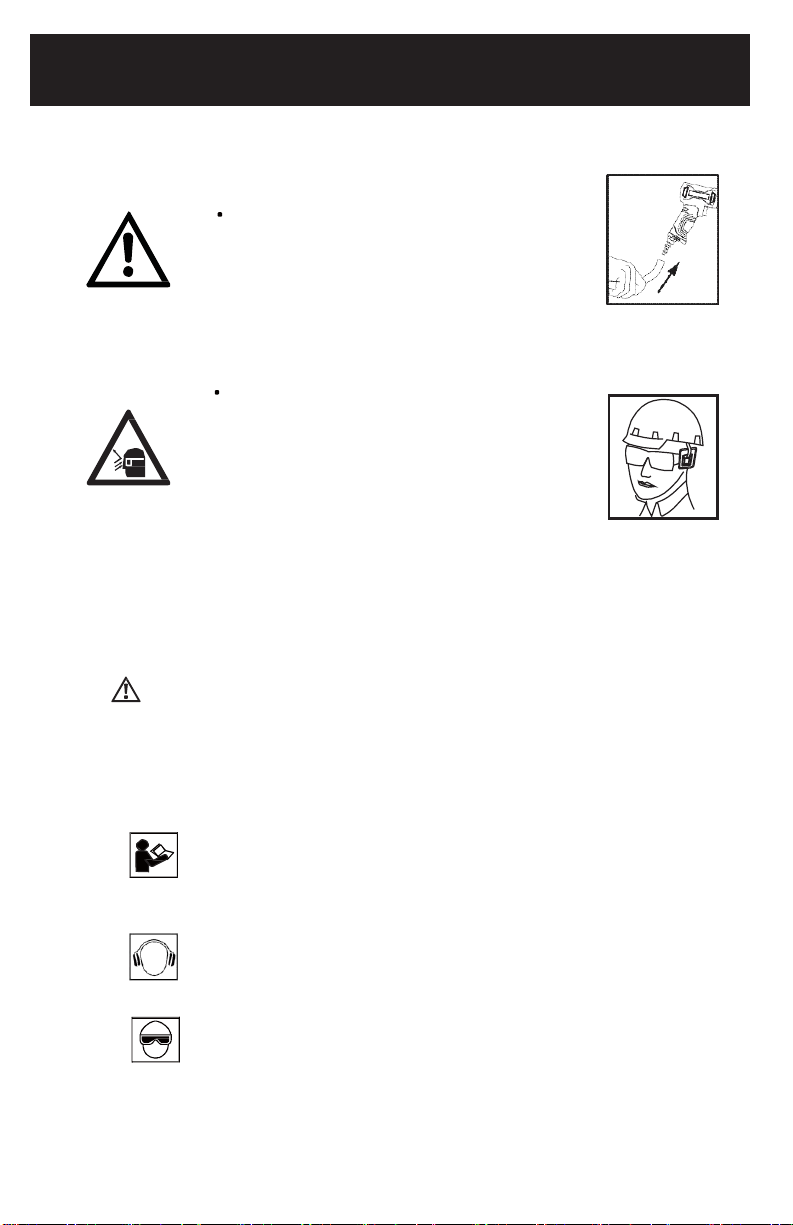
Always wear hearing protection when using the air compressor. Failure to
do so may result in hearing loss.
Do not carry the compressor while it is running.
Do not operate the compressor if it is not in a stable position.
Do not operate the compressor on a rooftop or an elevated position that
could allow the unit to fall or be tipped over.
Do not connect the tool to a compressed air source with a pressure output
that is higher than 90 PSI.
Always replace a damaged gauge before operating the unit again.
CAUTION!
Always ensure that the tool has stopped before connecting to the air supply.
Do not wear watches, rings, bracelets, or loose clothing when using any
air- powered tool.
Do not overload the tool. Allow the tool to operate at its optimum
speed for maximum efficiency.
Do not use a tool that is leaking air, that has missing or damaged parts, or
that requires repairs. Verify that all screws are securely tightened.
For optimal safety and tool performance, inspect the tool daily in order to ensure
free movement of the trigger, safety mechanisms, and springs.
Always keep your air tool clean and lubricated. Daily lubrication is essential to
avoid internal corrosion and possible failures.
Ensure the floor is not slippery and wear non-slip shoes. Floors should be kept
clean and clear.
Always follow all workshop safety rules, regulations, and conditions when
using the tool.
Carry the tool by the handle only, keeping fingers away from the trigger. Do not
carry the tool by the hose, magazine, or any other parts.
Do not use the tool near or below freezing point, as doing so may cause tool
failure. Do not store the tool in a freezing environment to prevent ice formation
on the tools operating valves, as doing so may cause tool failure.
Handling and storage of oil: Use with adequate ventilation. Avoid contact of oil
with eyes, skin, and clothing. Avoid breathing spray or mist. Store in a tightly
closed container in a cool, dry, well-ventilated area free from Incompatible
substances.
Tripping hazard:The air hose may become a tripping hazard when it is
place in the work area. Use care when walking in the work area.