Start your first test with the default settings ppf
= 4 and input format bp.ab. If BIF is running in
reverse direction change the input format to
bp.ba.
If BIF runs with the half play speed set ppf = 2.
If BIF runs with the double play speed set ppf =
8. If BIF is toggling between two frames try input
formats pd0, pd1. pd2 or pd3.
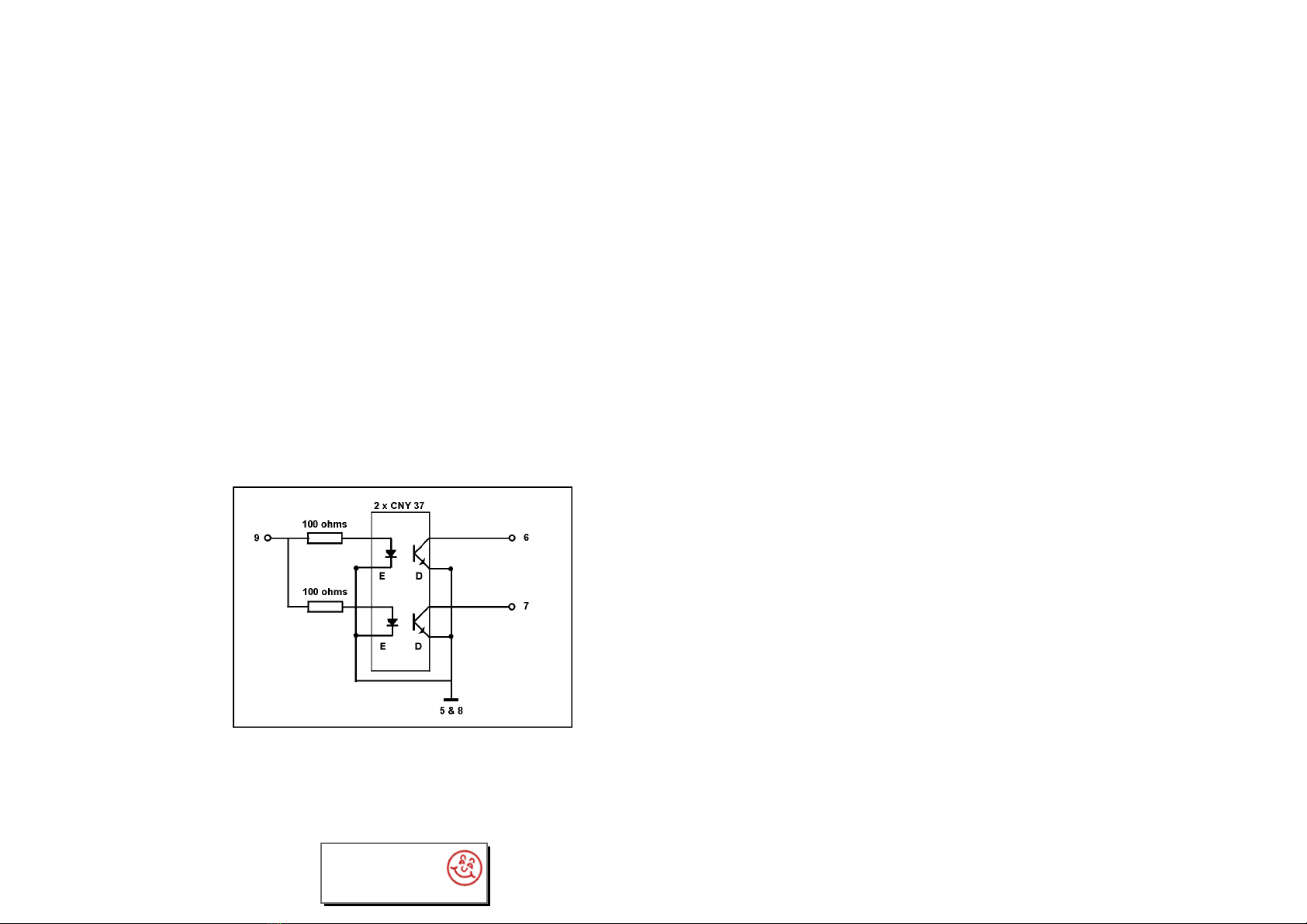
If BIF is not counting at all, check your bi-phase
levels (See page 3).
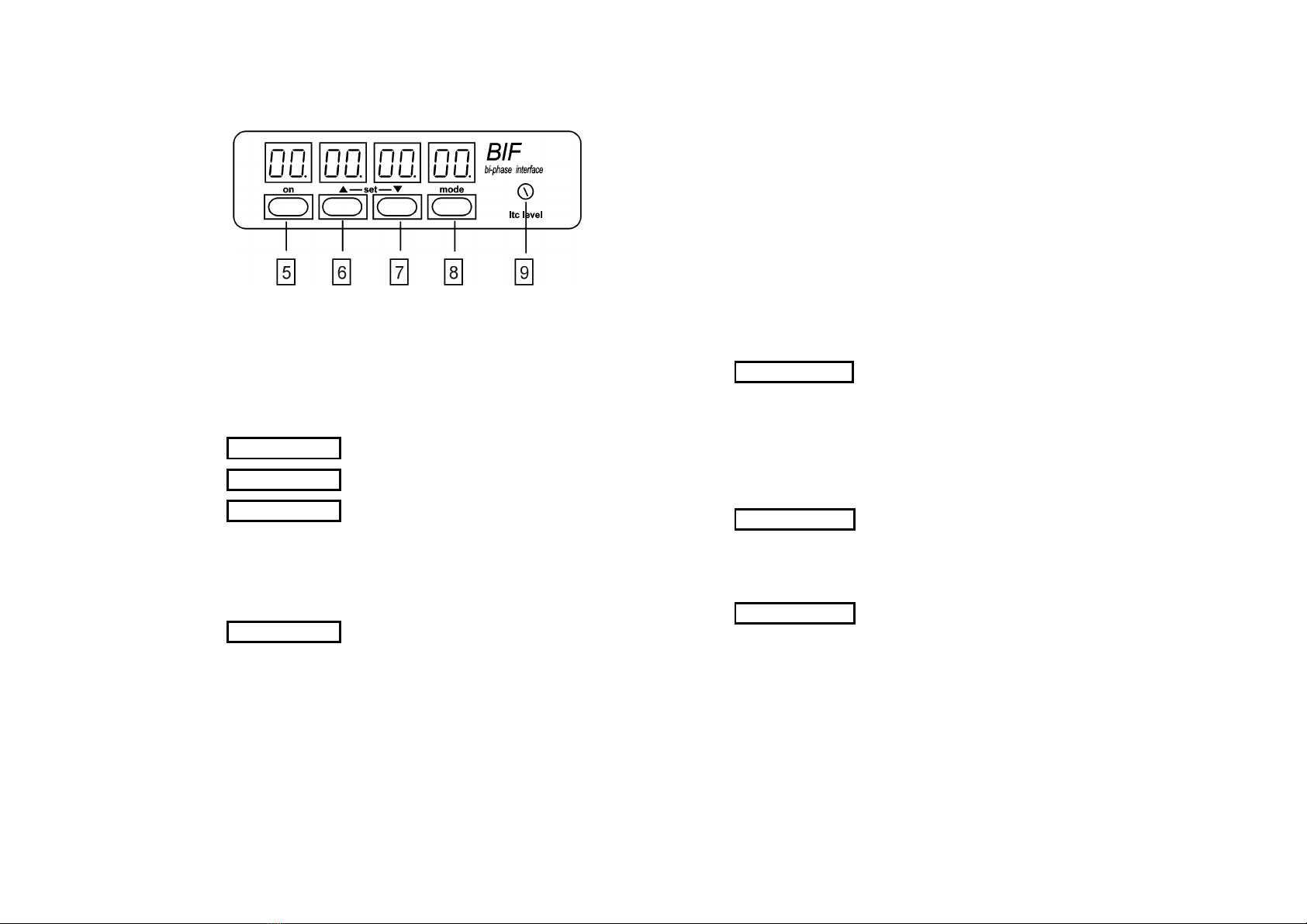
Press the mode key.
S.out oFF
Serial output mode is flashing.
You can set the Serial output mode with up and
down keys to:
„oFF“, „FuLL“, „Loc“, „q.F.“, „q.F.-2“.
If you do not use the MTC output, set „S.out“
mode to „oFF“.
Any DAW, which is able to chase to MTC, will
follow to your film transport at normal play
speed. If the film transport is moving slowly, fast
winding or moving reverse, MTC-slaved DAWs
will not follow to the film transport. For this
reason the BIF bi-phase interface supports
several tricky output modes to cue up your
slaved DAW frame-accurate also at non-play
speed.
Midi Time Code uses two types of messages,
described as quarter frame and full frame. The
quarter frame message is used for normal
running status at play speed and the full
message communicates a specific time for
cueing and locating.
Unfortunately most DAWs and sequencer
programs do not support the „full message“.
Another method to cue up your DAW is the use
of the Midi Machine Control (MMC) „Locate“-
command, if your DAW software supports MMC
slave mode together with MTC slave mode.
If the slaved DAW supports the Midi Time Code
Full Frame messages set „S.out“ to „Full“
If the slaved DAW supports MMC slave mode
together with MTC slave mode, set „S.out“ to
„Loc“ (for example with Digidesign ProTools 4.2,
Roland VS-880, Fostex FD4).
If the slaved DAW only supports MTC slave
mode, try to cue up your DAW with the „S.out“-
settings „q.F.“ or „q.F.-2“ (the Creamware Triple
DAT software for example can be cued up with
the „q.F.-2“-setting).
Press the mode key again to return to the
normal operation mode.
Operation
The BIF is translating bi-phase signals from
90% to 110% of normal play speed into LTC
and MTC quarter frames. All other speeds from
0 up to 30 times play speed will be translated
into LTC-bursts and MTC full / locate / quarter
burst messages.
(See serial output mode)
An LTC burst is an LTC-loop of one frame. Most
LTC chase synchronizers will cue up to it.
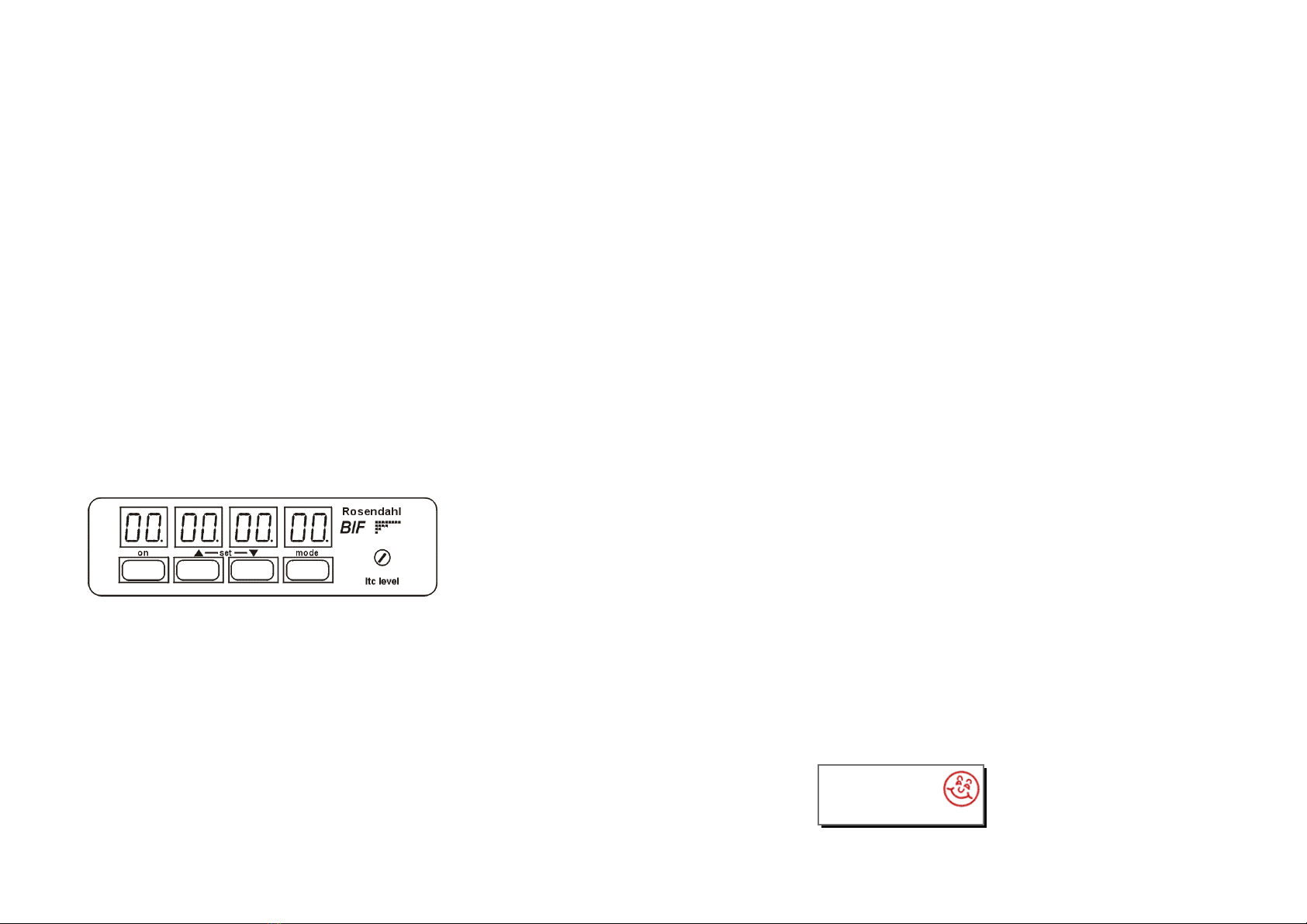
The decimal point of the frames (in the time
code window) is indicating locked time code
generation in play speed. In this "locked" mode
the BIF is interpolating even bad jittering bi-
phase signals into jitterfree linear time code,
ideal for slaving digital audio systems.