7
M8 20
M10 40
M12 70
M14 110
M16 160
M20 320
M22 420
M24 550
M27 800
M30 1100
M33 1400
M36 1700
2.4.2 Assembly procedure
IMPORTANT
Failure to comply with the following procedures
may impair product warranty.
WARNING
Installation, commissioning and maintenance and
repair works should be carried out by qualified
staff. A non-conforming assembly could be the
source of serious accidents.
For actuator assembly on the valve:
IMPORTANT
Check that the assembly position, as shown
on the documentation, complies with system’s
geometry. Check the consistency of the parts of
actuator-valve coupling.
• Operate the actuator so that it reaches the
position matching valve position (section 3�3)�
• Lubricate valve stem with oil or grease�
• Properly clean and remove grease from
coupling flange surfaces�
• Connect, if supplied separately, the
adjustment insert to valve stem and fasten it
with the special fastening pins�
• Lift the actuator using the special lifting
points (section 2�2)�
• Install the actuator so that valve stem inserts
in the coupling area� This coupling should be
made without forcing�
• Fasten the two parts with the threaded
connections (screws, tie rods, nuts)� If
holes of coupling flanges are not aligned,
adequately operate the actuator if necessary
move the mechanical stops backwards
(section 3�4)�
• Fasten threaded connections� Please refer to
table 1�
The screwing values in table 1 were calculated
considering the materials ASTM A320 L7 for
screws or tie rods and ASTM A194 gr�2H for
the nuts�
TABLE 1 - NUTS TIGHTENING TORQUE
Threading Tightening torque (Nm)
2.5 Pneumatic connections
IMPORTANT
Check that the values of pneumatic supply
available are compatible with those reported on
the identification plate of the actuator.
WARNING
The connections should be made by qualified
staff. Use pipes and connections appropriate as
for type, material and dimensions.
Connect the actuator to the hydraulic feed
line with fittings and pipes in accordance to
the plant specifications� They must be sized
correctly in order to guarantee the necessary
oil flow for the operation of the actuator, with
pressure drops not exceeding the maximum
allowable value� The shape of the connecting
piping must not cause excessive stress to
the inlets of the actuator� The piping must be
suitably fastened so as not to cause excessive
stress or loosening of threaded connections,
if the system undergoes strong vibrations�
Every precaution must be taken to ensure
that any solid or liquid contaminants, which
may be present in the hydraulic pipe-work to
the actuator, are removed to avoid possible
damages to the unit or loss of performance�
The inside of the pipes used for the connections
must be well-cleaned before use: wash them
with suitable substances and blow through
them with oil or nitrogen� The ends of the tubes
must be well debarred and cleaned� Once
the connections are completed, operate the
actuator and check that it functions correctly,
that the operation times meet the plant
requirements and that there are no leakages in
the hydraulic connections�
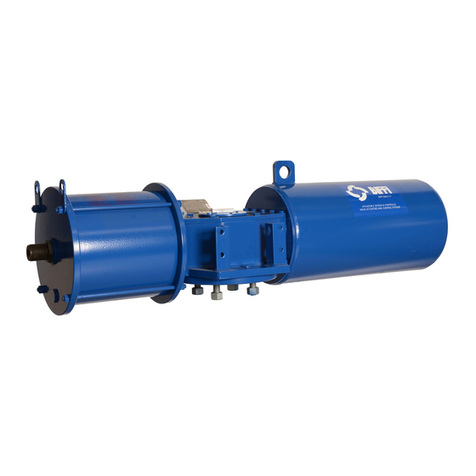
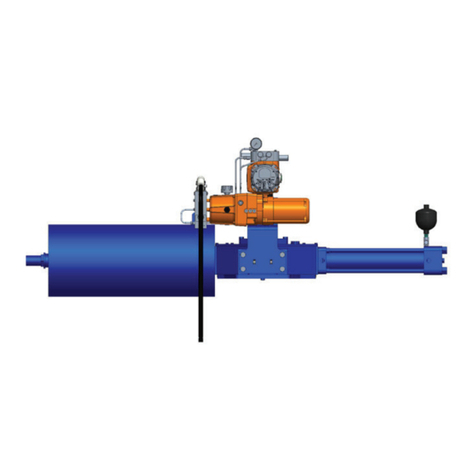
BIFFI OLGA-H HIGH PRESSURE DOUBLE ACTING HYDRAULIC ACTUATOR
INSTALLATION, OPERATION AND MAINTENANCE MANUAL