
Bihui LFTBB Manuale elenco delle parti

Vibration Tile Beater
Usage Instructions
Read before use
LFTBB
INDEX
1Safety Warnings
2Application
3
4
Using Instructions
5
Cleaning and Maintenance
6
Accessories
7
Environmental Protection
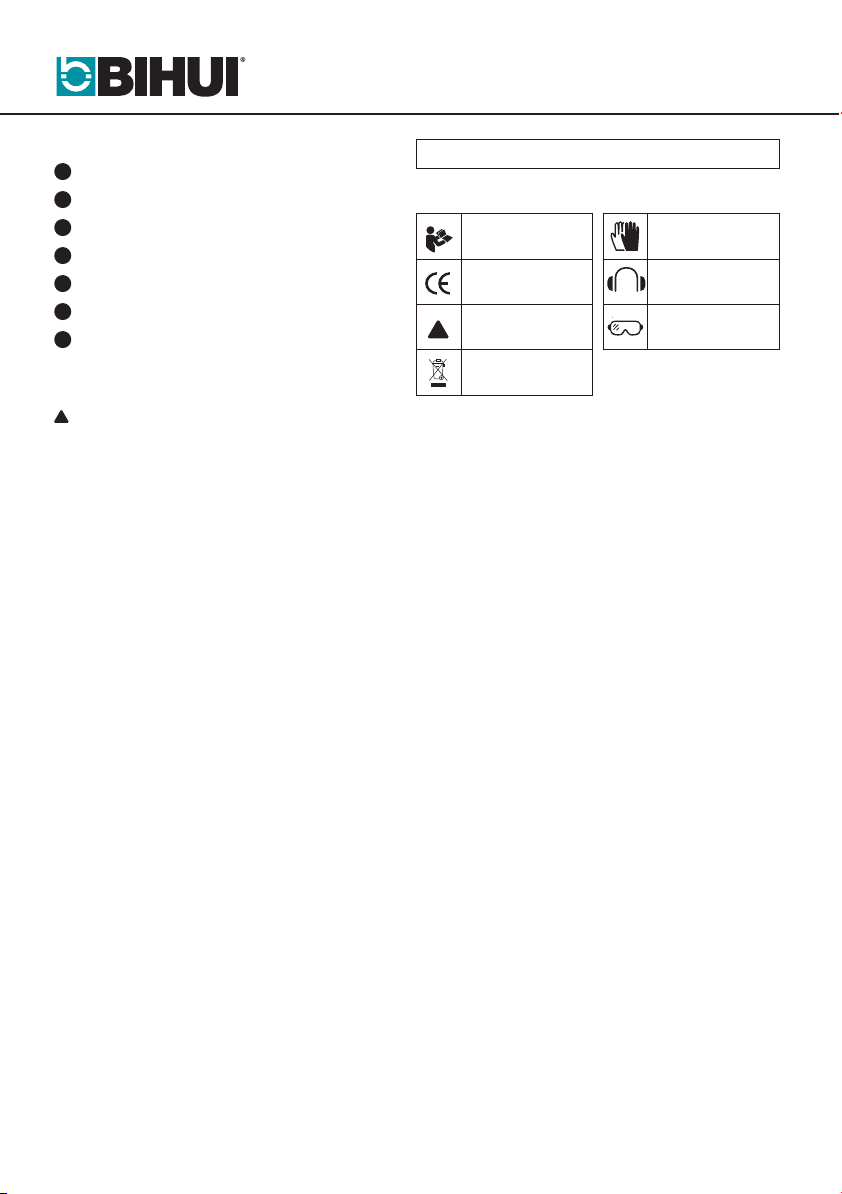
The following are the icons that are used for the tool. Make sure you
fully understand them before using them.
Symbols
Caution
!
Read all safety instructions and warnings provided with power tool. Failure to follow the instructions below may result in electric
shock, fire and / or serious injury.
Keep all warnings and instructions for future reference.
The term "power tool" used in the safety instructions refers to mains operated power tools (with power cord) or to battery operated tools
(without power cord).
1.1 Safety in work area
a) Keep your work area clean and well lit. Disarray or unlit work areas can lead to accidents.
b) Do not work with the power tool in a potentially explosive environment in which flammable liquids, gases or dusts are present.
Power tools generate sparks that can ignite the dust or fumes.
c) Keep children and bystanders away while using the power tool. Distractions can result in a loss of control.
1.2 Electrical Safety
a) The plug of the power tool must fit into the socket. The plug must not be changed in any way. Do not use adapter plugs together
with electrically grounded power tools. Unmodified plugs and matching sockets reduce the risk of electric shock.
b) Avoid body contact with grounded surfaces such as pipes, heaters, stoves, and refrigerators. There is an increased risk of
electric shock if your body is grounded.
c) Keep power tools away from rain or moisture. The penetration of water into a power tool increases the risk of electric shock.
d) Do not misuse the power cord to carry the power tool, hang it up, or unplug it from the power outlet. Keep the connection cable
away from heat, oil, sharp edges or moving parts. Damaged or entangled leads increase the risk of electric shock.
e) When working outdoors with a power tool, only use extension cables that are also suitable for outdoor use. Using an extension
cord suitable for outdoor use reduces the risk of electric shock.
f) If operation of the power tool in a damp environment is unavoidable, use a residual current device. Using a residual current circuit
breaker reduces the risk of electric shock.
1.3 Personal Safety
a) Be attentive, pay attention to what you are doing and be reasonable about working with a power tool. Do not use a power tool
when you are tired or under the influence of drugs, alcohol or medication. A moment of carelessness when using the power tool
can cause serious injury.
b) Wear personal protective equipment and always safety goggles. Wearing personal protective equipment such as a dust mask,
non-slip safety shoes, hard hat or ear protection, depending on the type and use of the power tool, reduces the risk of personal injury.
c) Avoid unintentional startup. Make sure that the power tool is switched off before connecting, receiving or carrying it to the
power supply and / or the battery. Keeping your finger on the switch when you are wearing the power tool or plugging the power
tool into power can cause an accident.
d) Remove setting tools or wrenches before turning on the power tool. A tool or key located in a rotating part of the power tool can
cause injury.
e) Avoid an abnormal posture. Ensure a secure footing and maintain balance at all times. This allows you to better control the
power tool in unexpected situations.
f) Wear suitable clothing. Do not wear loose clothing or jewelry. Keep hair and clothing away from moving parts. Loose clothing,
jewelry or long hair can be caught by moving parts.
g) If dust extraction and collection equipment can be installed, they must be connected and used properly. Using a dust extractor
can reduce dust hazards.
!
Read before use
CE mark
Caution
Conforms to WEEE
Wear safety glasses
Wear hearing protectors
Wear safety gloves
Warranty
1. Safety Warnings
General safety warnings for power tools
Usage Instructions
English
2

h) Do not weigh yourself in false safety and do not overstep the safety rules for power tools, even if you are familiar with the
power tool after many uses. Careless action can lead to serious injuries within fractions of a second.
1.4 Use and care of the power tool
a) Do not overload the power tool. Use the appropriate power tool for your work. With the right power tool you work better and safer
in the specified power range.
b) Do not use a power tool whose switch is defective. A power tool that can not be turned on or off is dangerous and must be repaired.
c) Unplug the power cord and / or remove a detachable battery before making any adjustments to the device, changing the tool
bits, or putting the power tool away. This precaution prevents the unintentional start of the power tool.
d) Store unused power tools out of the reach of children. Do not allow persons to use the power tool that are unfamiliar or have
not read these instructions. Power tools are dangerous when used by inexperienced people.
e) Maintain power tools and insert tools with care. Check that moving parts are working properly and do not jam, that parts are
broken or damaged enough to impair the functioning of the power tool. Have damaged parts repaired before using the power
tool. Many accidents are caused by badly maintained power tools.
f) Keep cutting tools sharp and clean. Carefully maintained cutting tools with sharp cutting edges become less jammed and easier to guide.
g) Use power tools, accessories, tools etc. according to these instructions. Take into account the working conditions and the
activity to be performed. The use of power tools for other than intended applications can lead to dangerous situations.
h) Keep handles and grips dry, clean and free of oil and grease. Slippery handles and gripping surfaces do not allow safe operation
and control of the power tool in unforeseen situations.
1.5 Use and care of the battery tool
a) Charge the batteries only with chargers recommended by the manufacturer. A charger suitable for a particular type of battery may
cause a fire when used with other batteries.
b) Use only the appropriate batteries in the power tools. Use of other batteries may cause injury or fire.
c) Keep the unused battery away from paper clips, coins, keys, nails, screws, or other small metal objects that could cause the
contacts to bridge. A short circuit between the battery contacts can cause burns or fire.
d) If used incorrectly, liquid may leak from the battery. Avoid contact with it. In case of accidental contact, rinse with water. If the
fluid gets into your eyes, seek additional medical attention. Leaking battery fluid may cause skin irritation or burns.
e) Do not use a damaged or modified battery. Damaged or altered batteries can behave unpredictably and cause fire, explosion or injury.
f) Do not expose a battery to fire or high temperatures. Fire or temperatures over 130 ° C can cause an explosion.
g) Follow all charging instructions and never charge the battery or the cordless tool outside the temperature range specified in the
operating instructions. Incorrect charging or charging outside the permitted temperature range can destroy the battery and increase
the risk of fire.
1.6 Service
a) Only have your power tool repaired by qualified personnel and only with original spare parts. This ensures that the safety of the
power tool is maintained.
b) Never use damaged batteries. All battery maintenance should only be done by the manufacturer or authorized service centers.
Follow the instructions for lubricating and changing accessories.
Additional safety warnings from the manufacturer
- Do follow the relevant product safety rules to familiarize yourself with the product
- Improper use or failure to observe the safety instructions in the manual may result in serious injury.
- Any use of a non-original or new battery can cause an explosion, even possible fire, personal injury, or property damage. And BIHUI
warranty terms will not apply in this case.
- Do not disassemble the battery.
- If the operating time has become too short, stop operation immediately. There is a risk of overheating, burns and even explosion.
- If electrolyte gets in your eyes, rinse with clean water and seek medical attention immediately. This can lead to vision loss.
- Do not short the batteries:
a) Do not touch the terminals with conductive material.
b) Do not store the battery in a container with other metal objects such as nails, coins, etc.
c) Do not expose the battery to water or rain.
A battery short circuit can cause a strong current flow, overheating, possible burns and even a malfunction
- Do not store the device and the battery in places where the temperature can reach or exceed 50 ° C.
- Do not burn the battery even if it is badly damaged or worn out completely. The battery can explode in case of fire.
- Be careful not to drop or hit the battery.
Usage Instructions
English
3
Usage Instructions
English
4
Usage Instructions
English
4
- Do not use damaged batteries.- The battery is subject to the dangerous goods laws. Any transfer by a third party or carrier should strictly
adhere to the packaging and label requirements. Please read the detailed rules for the local market and pay attention to them. Please
protect it with a knock and fix the battery firmly to avoid movement of the packaging.
- Always follow the local laws for the disposal of used batteries.
- Make sure that the battery is used for a particular tool. Improper or misuse may result in fire, overheating, explosion or electrolyte leakage.
- Charge the battery cartridge before you have completely discharged it. Stop working and charge the battery if you notice less tool power.
- Never charge a fully charged battery cartridge. By overcharging the charge shortens battery life.
- Charge the battery with the room temperature at 10 ° C - 40 ° C. Leave a hot battery cool before loading.
- Use the battery pack under the ambient conditions of 10 ° C -40 ° C.
- Charge the battery every six months if you do not use it for a long time.
3. Using Instructions
- It is recommended to check the charge indicator before use to ensure that the battery is fully charged.
- Press the power button to start the machine and adjust the vibration frequency according to the demand.(3 gear speed regulation)
- Place the machine on the tile to be laid, press the handle to activate the suction cup, lift the tile and apply it to the adhesive surface
and then activate the vibration.
- After one minute of non-use, the machine will switch off in order to conserve the battery, press the button again to restart it
Charging instructions
-If the indicator turn into yellow or red, recharge the battery.
- The battery will be fully charged in 2 hours, at the end the indicator will turn green to indicate full charge (the red color indicates
the charge in progress).
- The light will automatically turn off when fully charged.
4. Cleaning and Maintenance
- The machine must be stored in dry place .
- Remove any dirt or dust from the surface of the machine after use.
- Store the machine in the carry case supplied to avoid damage.
- During frequent use it is recommended to recharge the battery daily.
5. Accessories
- This accessory is recommended for use with your device specified in this manual.
- Using other accessories or attachments may result in personal injury. Only use accessories or accessories for the stated purpose.
6. Environmental Protection
- Do not dispose of electrical appliances in the household waste.
- Follow the local provisions for the disposal of electrical or battery products.
- Valuable materials can be recovered by recycling.
- The electrical or battery components used for construction are in accordance with the regulation European Directive 2012/19 / EU on
waste electrical and electronic equipment and transposition into national law., used electrical appliances must be collected separately
and recycled in an environmentally sound manner.
- Contact us for further information.
7. Warranty
- The guarantee covers all manufacturing or assembly defects in accordance with the legislation in force. The guarantee does not cover
malfunctions caused by improper use, overloads, failure to follow the operating instructions and normal wear and tear.
- For more detials and information, consult the general guarantee conditions at www.bihuitools.com
2. Application
- Evenly distribute the adhesive under tiles and big slabs during installation.
- Suction cup with 30Kg lifting capacity.
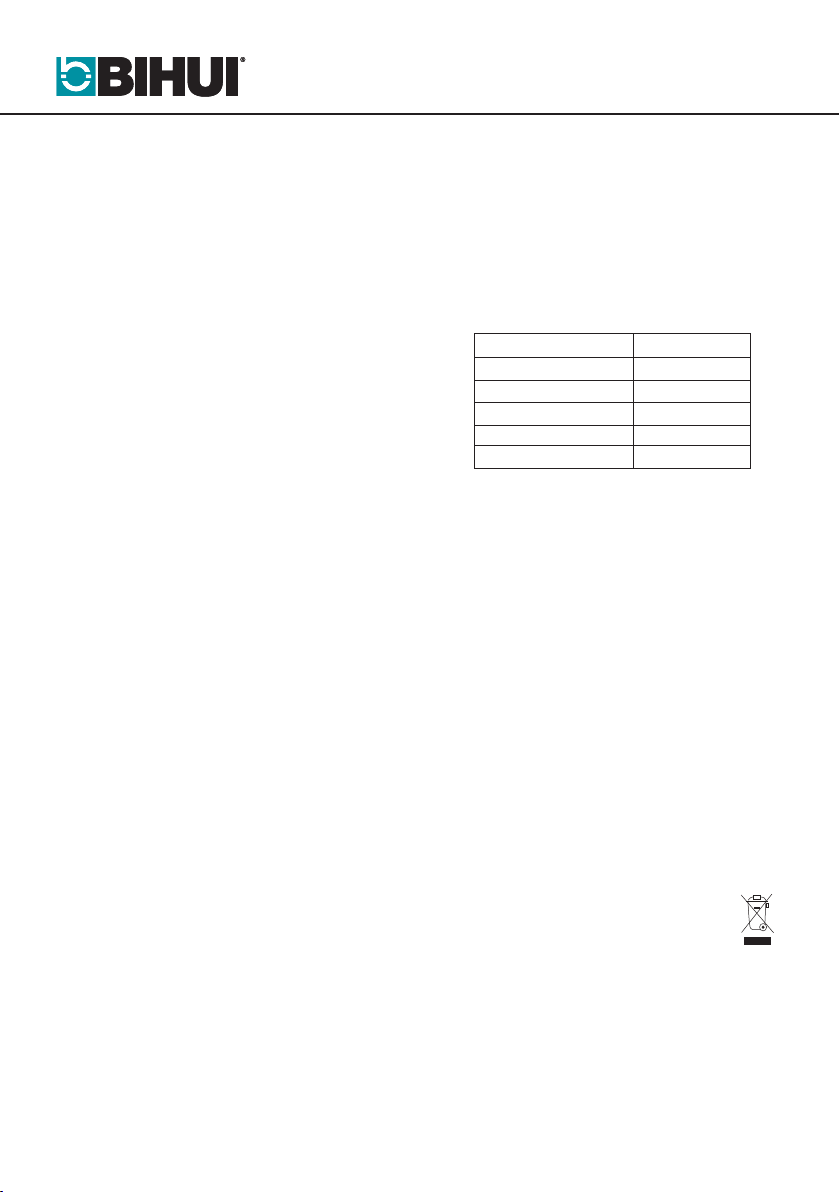
Working Voltage 16.8V
Batter Capacity 2000mA
Charging Current 1A
Adsorption Capacity 30Kg
Vibration Frequency 5000-12000r/min
Charging time 2.0H
Indice
Altri manuali Bihui Utensili elettrici


