
BMW Night Vision Istruzioni per l'uso e l'installazione

Initial Print Date: 03/06
Table of Contents
Subject Page
Introduction . . . . . . . . . . . . . . . . . . . . . . . . . . . . . . . . . . . . . . . . . . . . . . . . . .3
System Overview . . . . . . . . . . . . . . . . . . . . . . . . . . . . . . . . . . . . . . . . . . . . .4
Connection of Control Units . . . . . . . . . . . . . . . . . . . . . . . . . . . . . . . . . . . . .5
Control Unit and Camera . . . . . . . . . . . . . . . . . . . . . . . . . . . . . . . . . . . . . .5
K-CAN . . . . . . . . . . . . . . . . . . . . . . . . . . . . . . . . . . . . . . . . . . . . . . . . . . . . . .5
System Circuit Diagram (Front Equipment - E65/E66) . . . . . . . . . . . . . .6
Connection of Control Units . . . . . . . . . . . . . . . . . . . . . . . . . . . . . . . . . . . . .9
Control Unit and Camera . . . . . . . . . . . . . . . . . . . . . . . . . . . . . . . . . . . . . .9
K-CAN . . . . . . . . . . . . . . . . . . . . . . . . . . . . . . . . . . . . . . . . . . . . . . . . . . . . . .9
System Circuit Diagram (E60/E61/E63/E64) . . . . . . . . . . . . . . . . . . . . . .10
System Components . . . . . . . . . . . . . . . . . . . . . . . . . . . . . . . . . . . . . . . . .12
Components . . . . . . . . . . . . . . . . . . . . . . . . . . . . . . . . . . . . . . . . . . . . . . . . . .12
Night Vision Camera . . . . . . . . . . . . . . . . . . . . . . . . . . . . . . . . . . . . . . . .13
Night Vision Control Unit . . . . . . . . . . . . . . . . . . . . . . . . . . . . . . . . . . . . .14
Button in Light Switch Center . . . . . . . . . . . . . . . . . . . . . . . . . . . . . . . .14
Principles of Operation . . . . . . . . . . . . . . . . . . . . . . . . . . . . . . . . . . . . . . .15
Switch-On Conditions . . . . . . . . . . . . . . . . . . . . . . . . . . . . . . . . . . . . . . . . .16
Operation by iDrive . . . . . . . . . . . . . . . . . . . . . . . . . . . . . . . . . . . . . . . . . . . .17
Calling up Settings . . . . . . . . . . . . . . . . . . . . . . . . . . . . . . . . . . . . . . . . . .17
Calling Up Menu . . . . . . . . . . . . . . . . . . . . . . . . . . . . . . . . . . . . . . . . .17
Zoom - Angle of View of Camera . . . . . . . . . . . . . . . . . . . . . . . . . . . . .18
Bend/Curve Mode . . . . . . . . . . . . . . . . . . . . . . . . . . . . . . . . . . . . . . . . . .19
Full Screen . . . . . . . . . . . . . . . . . . . . . . . . . . . . . . . . . . . . . . . . . . . . . . . . .20
Contrast and Brightness . . . . . . . . . . . . . . . . . . . . . . . . . . . . . . . . . . . . .20
Visibility . . . . . . . . . . . . . . . . . . . . . . . . . . . . . . . . . . . . . . . . . . . . . . . . . . . .21
Service Information . . . . . . . . . . . . . . . . . . . . . . . . . . . . . . . . . . . . . . . . . .22
Axial Camera Adjustment . . . . . . . . . . . . . . . . . . . . . . . . . . . . . . . . . . . . . .22
Vertical Camera Adjustment . . . . . . . . . . . . . . . . . . . . . . . . . . . . . . . . . . . .22
Replacing Camera Washer Jet . . . . . . . . . . . . . . . . . . . . . . . . . . . . . . . . . .22
Displays in Event of a Fault . . . . . . . . . . . . . . . . . . . . . . . . . . . . . . . . . . . . .23
Component Location . . . . . . . . . . . . . . . . . . . . . . . . . . . . . . . . . . . . . . . . . .24
BMW Night Vision
Revision Date:

BMW Night Vision
Model: E60, E61, E63, E64, E65, E66
Production: March 2006
After completion of this module you will be able to:
• Familiarize yourself with the technology used in the BMW Night Vision system
• Know which components are responsible for the system’s operation
•Understand how to utilize the BMW Night Vision Feature
•Know the benefits to having this technology in the vehicle
2
BMW Night Vision
3
BMW Night Vision
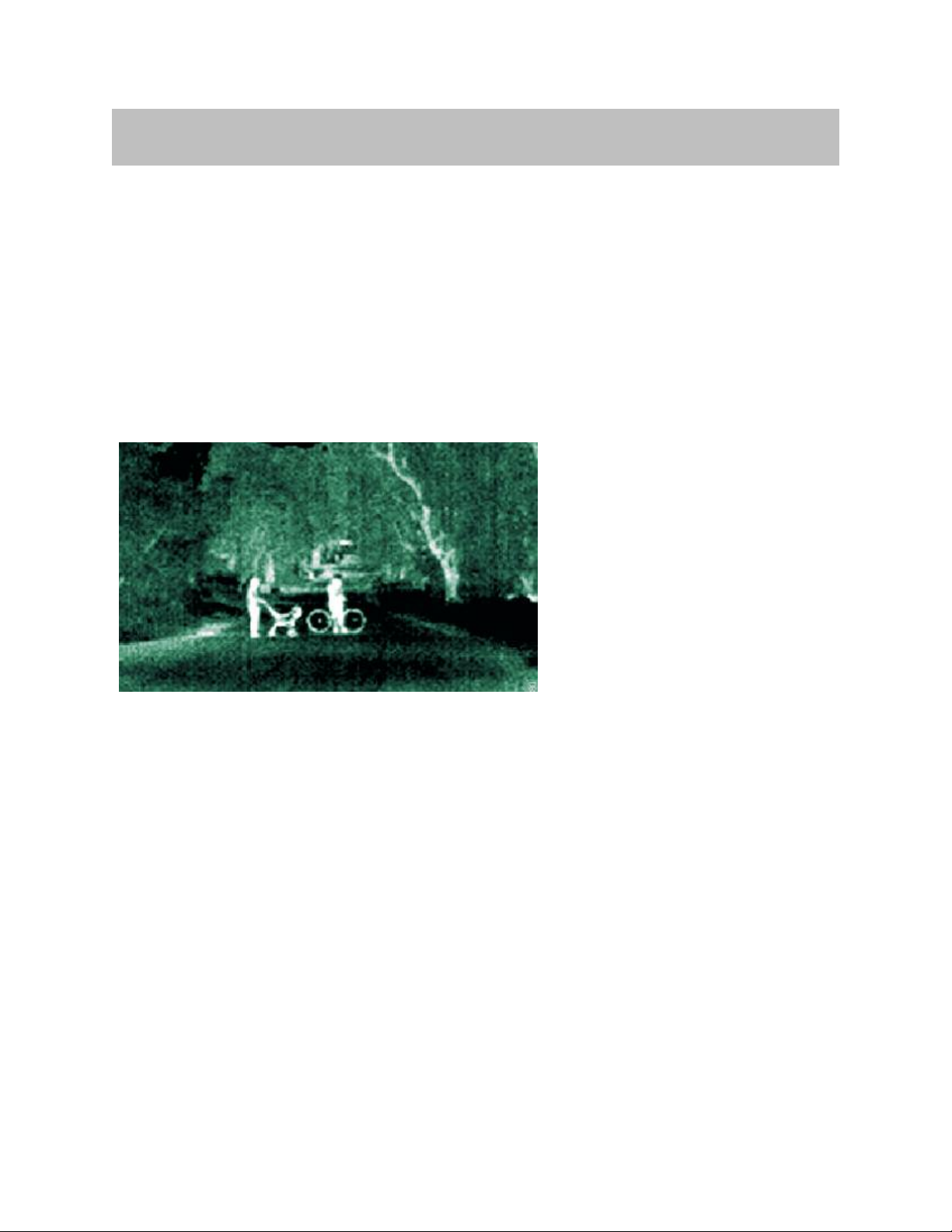
The BMW Night Vision system provides the driver with a black-and-white image of the
driving environment ahead of the vehicle in the central information display (CID).
BMW Night Vision is a 100% passive system without active infrared illumination. Objects
situated ahead of the vehicle are shown in varying degrees of brightness depending on
the temperature of these objects. This enables the driver to detect in good time heat-
emitting objects such as people, animals, and other vehicles.
This thermal image is recorded with a Far Infrared camera (FIR) via a special imaging
sensor which detects the infrared radiation in a specific wavelength range.
The BMW system is distinguished from infrared systems with active illumination by its
resistance to dazzling, its long range, and its clearly structured image.
The system offers the following advantages:
•Improved vision in conditions of dusk and darkness
• No dazzling by the headlights of oncoming vehicles
• Highlighting of unilluminated, heat-emitting objects such as pedestrians, cyclists
vehicles and deer, etc.
• Better overview of the driving situation thanks to the depiction of the route of the
road beyond the headlight cone
• Enlarged depiction thanks to the zoom function of objects in the far distance at high
speeds
• Illumination of bends/curves thanks to the bend/curve mode (pivoting of image
detail)
•Illumination of dark courtyard and garage entrances
Note: The driving speed must be adapted to the relevant visibility conditions
in each case. BMW Night Vision is designed as a supporting system,
which, with a modified driving style, affords the driver an early, better
overview of the road conditions ahead of the vehicle.
Introduction
Image taken from CID
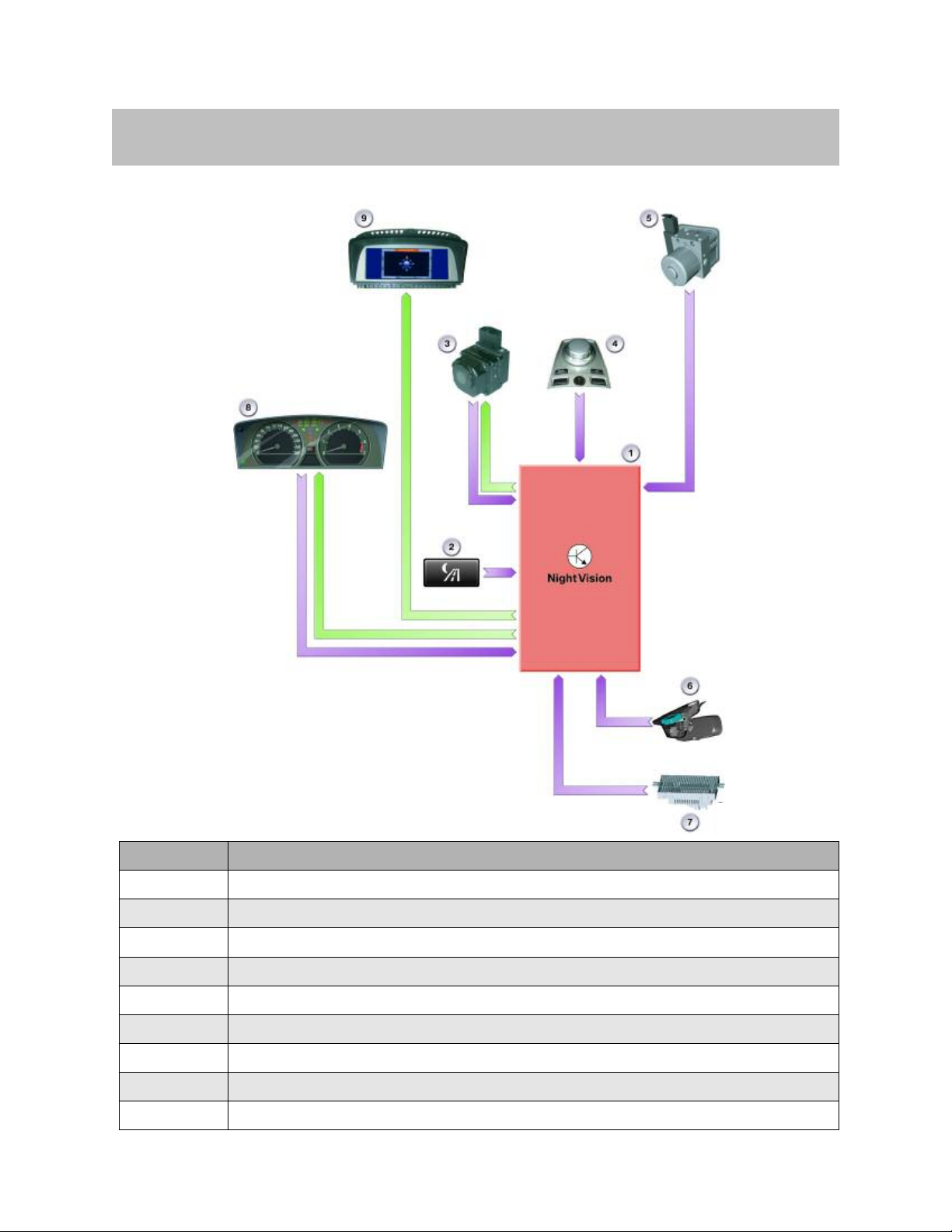
IPO Diagram (E65/E66)
4
BMW Night Vision
System Overview
Index Explanation
1Night Vision control unit
2Button in light switch center
3Night Vision camera
4Controller
5Dynamic Stability Control
6Rain/light sensor
7Light module
8Instrument cluster
9Control display

Connection of Control Units
Control Unit and Camera
The Night Vision control unit and the Night Vision camera are connected via the following
cables:
• LIN bus;
Diagnosis, programming and camera control
• Sym. Video;
Video signal from the camera
• CAN_POW;
Power supply from control unit to camera, heating of camera lens
• Ground;
Common earth/ground of camera and control unit for suppressing interference
The video signal between the camera and the control unit is transmitted via two cables as
a symmetrical, Analog video differential signal.
In the control unit the differential signal is converted into a CVBS signal and, depending
on the equipment specification, transmitted to the navigation system or the video module.
The camera is powered under the following conditions:
• Switching on of BMW Night Vision by the button in the light switch center
• Rain/light sensor detects dusk/half-light (driving lights are switched on)
The BMW Night Vision control unit is powered by the front distribution box via term. 30B.
K-CAN
The K-CAN connection of the Night Vision control unit serves to transmit the diagnosis
and programming data and to read out the information from the RLS (brightness), the LM
(driving lights on) and DSC (yaw rate, speed and steering angle). The signals from DSC
are placed on the K-CAN via the SGM. In addition, the control unit receives information
on the terminal status via the K-CAN.
5
BMW Night Vision
6
BMW Night Vision
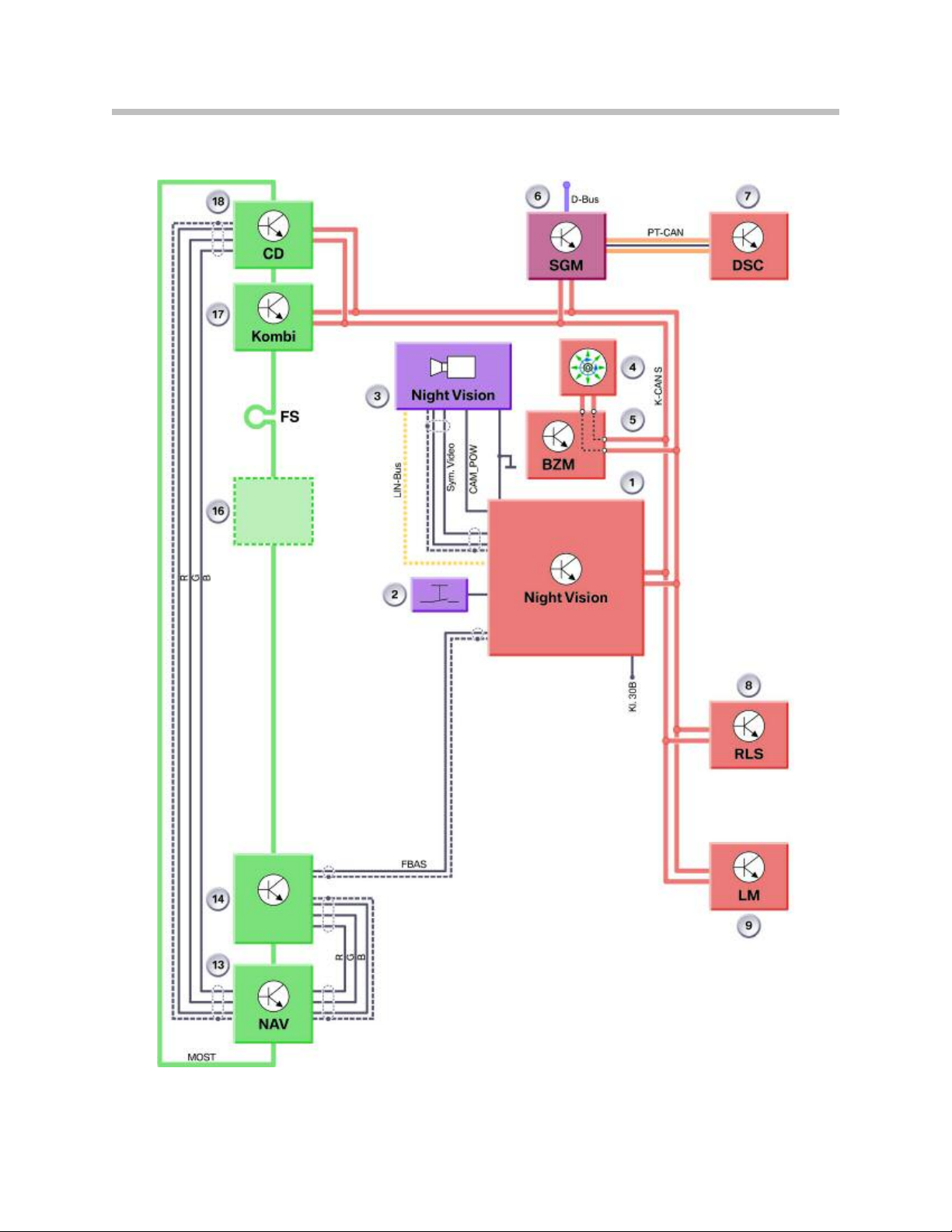
System Circuit Diagram (Front Equipment - E65/E66)

Legend for System Circuit Diagram
7
BMW Night Vision
Index Explanation Index Explanation
1Night Vision ECU 18 Control Display
2Button in Light Switch Center D-Bus Diagnosis Bus
3Night Vision Camera PT-CAN Powertrain CAN
4Controller K-CAN Body CAN
5Center Console Switch Cluster MOST Media Oriented System Transport
6Safety Gateway Module LIN-Bus Local Interconnect Network Bus
7Dynamic Stability Control Kl. 30B Continuous Positive
8Rain/light Sensor Sym. Video Symmetrical, Analog Video
Differential Signal
9Light Module CAN_POW Power Supply, Night Vision Camera
13 Navigation System RGB Red-Green-Blue Video Signal Cable
14 Video Switch, Drive FBAS Composite Video Burst
Synchronization Signal
16 MOST Components (optional) FS MOST Direct Access
17 Instrument Cluster
8
BMW Night Vision
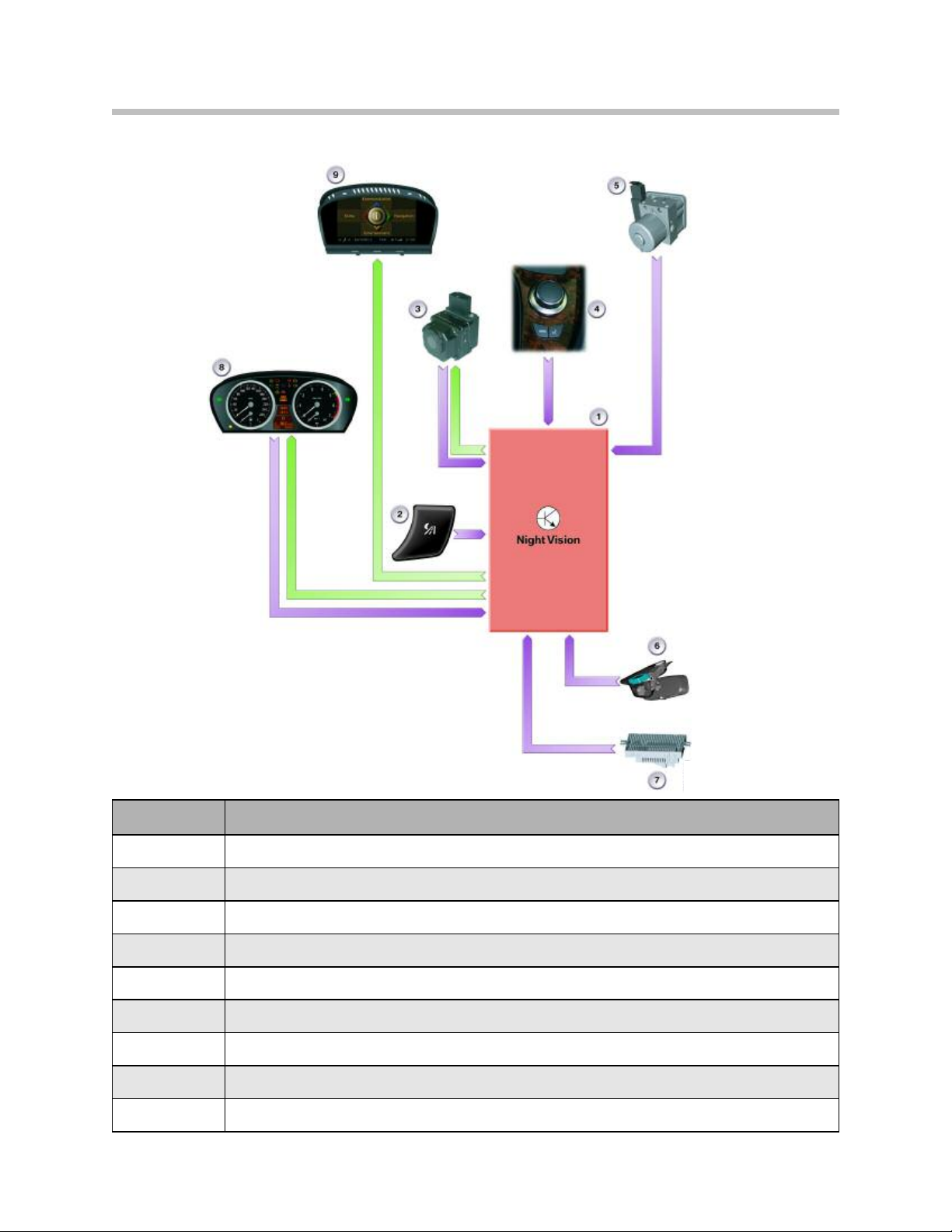
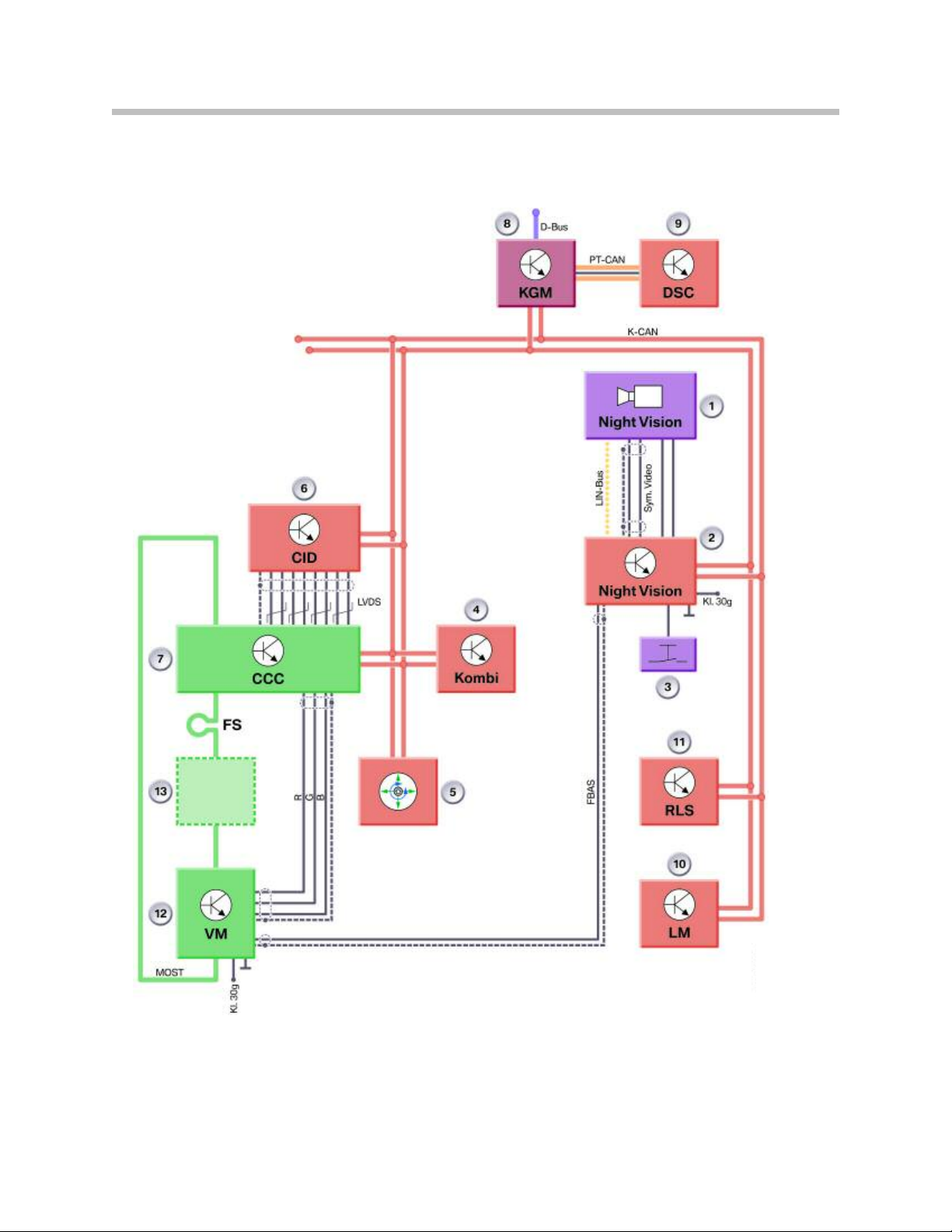
IPO Diagram (E60/E61/E63/E64)
Index Explanation
1Night Vision Control Unit
2Night Vision Button on Light Switch
3Night Vision Camera
4Controller
5Dynamic Stability Control
6Rain/Light Sensor
7Light Module
8Instrument Cluster
9Central Information Display

Connection of Control Units
Control Unit and Camera
The Night Vision control unit and the Night Vision camera are connected via the following
cables:
• LIN bus;
Diagnosis, programming and camera control
• Sym. Video;
Video signal from the camera
• CAN_POW;
Power supply from control unit to camera, heating of camera lens
• Ground;
Common ground of camera and control unit for suppressing interference
The video signal between the camera and the control unit is transmitted via two cables as
a symmetrical, Analog video differential signal.
In the control unit the differential signal is converted into a CVBS signal and, depending
on the equipment specification, transmitted to the navigation system or the video module.
The camera is powered under the following conditions:
• Switching on of BMW Night Vision by the button in the light switch center
• Rain/light sensor detects dusk/half-light (driving lights are switched on)
The BMW Night Vision control unit is powered by the front distribution box via term. 30B.
K-CAN
The K-CAN connection of the Night Vision control unit serves to transmit the diagnosis
and programming data and to read out the information from the RLS (brightness), the LM
(driving lights on) and DSC (yaw rate, speed and steering angle). The signals from DSC
are placed on the K-CAN via the KGM. In addition, the control unit receives information
on the terminal status via the K-CAN.
9
BMW Night Vision
10
BMW Night Vision
System Circuit Diagram (E60/E61/E63/E64)
Indice
Altri manuali BMW Sistema video per auto

BMW
BMW 82 82 0 304 134 Manuale utente

BMW
BMW E90 Manuale utente

BMW
BMW iDrive 4+ Manuale utente

BMW
BMW BMW-APIX-PAS-TDM Manuale utente

BMW
BMW X5 DVD Video System II Manuale utente

BMW
BMW iDrive 4+ Manuale utente

BMW
BMW G12 Guida all'installazione

BMW
BMW PIP Manuale di installazione e funzionamento

BMW
BMW Advanced Car Eye 3.0 Pro Manuale utente

BMW
BMW Head Unt High 3 Guida all'installazione


