
Bogen NQ-EDP01 Manuale utente

Entry Door Phone Configuration Guide
NQ-EDP01
© 2021 Bogen Communications, Inc.
All rights reserved.
740-00142A
211011

i
Contents
Configuring Nyquist Entry Door Phone . . . . . . . . . . . . . . . . . . . . . . . . . . . . . . . . . . . . 1
Using the Dashboard . . . . . . . . . . . . . . . . . . . . . . . . . . . . . . . . . . . . . . . . . . . . . . . . . . . . . . . .2
Updating Firmware . . . . . . . . . . . . . . . . . . . . . . . . . . . . . . . . . . . . . . . . . . . . . . . . . . . . . . . . . .3
Network Settings Tab Parameters . . . . . . . . . . . . . . . . . . . . . . . . . . . . . . . . . . . . . . . . . . . . .5
Configuration Settings Tab Parameters . . . . . . . . . . . . . . . . . . . . . . . . . . . . . . . . . . . . . . . . .8
Accessing Log Files . . . . . . . . . . . . . . . . . . . . . . . . . . . . . . . . . . . . . . . . . . . . . . . . . . . . . . . . .11
Setting DSP Parameters . . . . . . . . . . . . . . . . . . . . . . . . . . . . . . . . . . . . . . . . . . . . . . . . . . . . .13

1
Configuring Nyquist Entry Door Phone
The Nyquist Entry Door Phone (NQ-EDP01) is a hands-free, two-way, wall-mounted, VoIP
speaker phone designed to work with the Nyquist Series IP network-based intercom and
paging solution. It is 802.3af-compliant and designed to facilitate rapid and efficient
deployment using existing network Power over Ethernet (PoE) ports.
This device can be used to place a VoIP/SIP call to an Admin Phone with the press of a
button. The device provides half-duplex communication, allowing one party to speak at a
time, switching automatically whenever it detects that the Admin Phone party is speak-
ing.
The Nyquist server can automatically discover and configure the Entry Door Phone, but
you can also manage the device and manually configure some settings through the web-
based user interface (web UI). It can also operate in Standalone mode, allowing it to be
used without a Nyquist server.
A short press of the appliance’s Reset button reboots the device. If you press the Reset
button for 10 seconds, the appliance returns to the factory default configuration settings.
(Returning to the default configuration settings does not change the appliance’s firm-
ware.)
The following sections describe the process for manual configuration. For information
about using Nyquist’s automatic configuration process, refer to the Nyquist System
Administrator Guide.
To access the appliance’s UI:
Figure 1. Nyquist Appliance Login
Note: Do not use third-party Chrome browser extensions with the Nyquist user interface.
2
1Access the appliance’s web UI by doing one of the following:
a) On your web browser, enter the IP address for the appliance as the URL.
b) From the Nyquist web UI navigation bar, select Stations, select Stations Status,
navigate to the device that you want to configure, and then select the Link icon.
2At the Nyquist Appliance Login page, enter username and password, and then select
Login.
The default username is admin; the default password is bogen.
The dashboard for the selected appliance appears.
Using the Dashboard
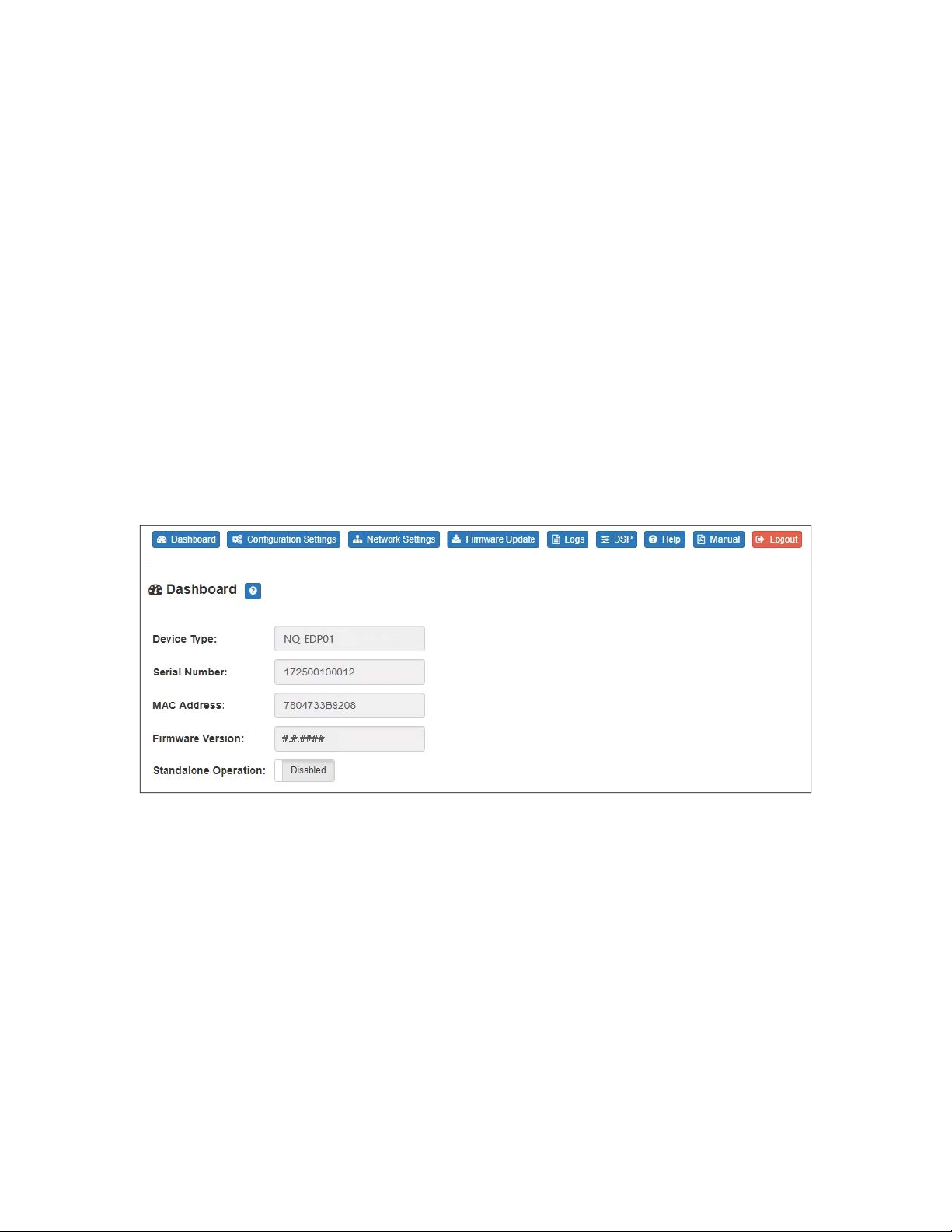
The dashboard displays the following fields:
Figure 2. Nyquist Entry Door Phone Dashboard
Table 1. Appliance Dashboard Fields
Device Type Identifies the model of this device.
Serial Number Identifies the serial number for the device.
MAC Address Specifies the Media Access Control (MAC) address,
which is a unique identifier assigned to network inter-
faces for communications on the physical network seg-
ment.

3
The following buttons are available at the top of all pages in the application.
Updating Firmware
When you select Firmware Update from the appliance’s web UI, the Firmware Update
page appears. From this page you can determine which Nyquist firmware version the
appliance is using and if an update is available. You can also load a firmware release,
install the loaded firmware, restore the configuration to factory defaults, and reboot the
appliance.
Firmware Version Provides the firmware version installed on the station.
Standalone Operation Enables or disables Standalone mode.
Table 2. Appliance Dashboard Buttons
Dashboard Displays the dashboard.
Configuration Settings Accesses the Configuration Settings page where you can
view various options or select to receive configuration
settings from the server.
Network Settings Accesses the Network Settings page where you can view
and set network settings, such as the static IP address.
Firmware Update Accesses the Firmware Update page where you can view
the current Nyquist version, update firmware to a new
version, the configuration to factory defaults, and
reboot the appliance.
Logs Accesses log files, which record either events or mes-
sages that occur when software runs and are used when
troubleshooting the appliance.
DSP Accesses the DSP page where you can view and set
parameters for Digital Signal Processing (DSP).
Help Accesses the appliance’s online help.
Manual Displays the appliance’s configuration manual.
Logout Logs out of the appliance’s dashboard.
Table 1. Appliance Dashboard Fields

4
To use the Firmware Update page:
1On the appliance web UI’s main page, select Firmware Update to view or update the
firmware version.
2If the device is in Standalone mode, selecting the Check for Updates button checks
the Bogen website for the latest firmware version available. If a version newer than
the one currently installed is found, it is downloaded to the appliance.
3If you already have a firmware file you would like to install to the appliance, select
Upload Firmware to upload the firmware file from your computer to the appliance. A
popup screen appears that allows you to select the file that you want to upload. You
can navigate to the file’s location. After you select the file, select Upload.
4The page displays the uploaded firmware version (“New Nyquist Version”) and an
Update Firmware button appears. Select this button if you want to update the appli-
ance’s firmware to the uploaded version.
5If you want to return your appliance to its original factory configuration, select
Restore Factory Settings.
6Select Reboot Appliance to restart your appliance.
Note: A Nyquist appliance connected to the Nyquist network receives a configuration
file from the Nyquist server that includes the latest firmware available from the server.
If the firmware is different from the one installed on the appliance, an automatic firm-
ware update occurs unless the Firmware parameter for the station is left blank. Refer to
the Nyquist System Administrator Guide for more information.
Figure 3. Firmware Update Page

5
Network Settings Tab Parameters
Network settings can be configured dynamically by the Nyquist server or manually by
using the appliance’s web UI.
To manually configure network settings:
1On the appliance web UI’s main page, select Network Settings.
Table 3. Firmware Update settings
Current Nyquist Version Shows the version of the appliance’s currently
installed firmware.
New Nyquist Version Shows the version of the firmware that has been
loaded, though not installed, onto the appliance.
Update Firmware Available only when a new firmware version has
been loaded onto the appliance (as specified in
New Nyquist Version).
Installs the loaded firmware. A reboot may be
required after installation.
Upload Firmware Prompts the user to specify a firmware file, which
will then be loaded (though not installed) onto the
appliance.
Note: To obtain the firmware file for a specific ver-
sion, please contact Bogen Customer Service.
Check for Updates Available only when the appliance is configured
for Standalone mode.
Checks the Bogen website for the latest firmware
version available and, if it finds a version newer
than what is currently installed, downloads it to
the appliance.
Restore Factory Settings Returns the appliance to its original factory con-
figuration.
Note: This does not install the original appliance
firmware. The firmware will not be changed.
Reboot Appliance Restarts the appliance.

6
2Select your desired network settings.
3Select Save.
Network settings are described in the following table:
Figure 4, Network Settings
Table 4, Network Settings
IP Address Identifies the IP address assigned to the appliance.
Netmask Identifies the subnetwork subdivision of an IP net-
work.
Gateway Identifies the address, or route, for the default gate-
way.
VLAN ID Identifies the Virtual Local Area Network (VLAN) for
this appliance. Values range from 0 to 4094.
VLAN Priority Identifies the priority of the network traffic on the
VLAN. Priority can range from 0 through 7.

7
NTP Server Identifies the IP address or the domain name of the
Network Time Protocol (NTP) Server.
Note: This field is only editable when Standalone
Operation is enabled.
TFTP Server Identifies the host name or IP address of the Trivial
File Transfer Protocol (TFTP) server.
The specified TFTP server can be used to automati-
cally set this device’s Configuration settings via the
Get Configuration from Server button.
If TFTP Server from DHCP (see below) is set to “Yes”,
this value will be auto-configured via DHCP option
66, assuming the DHCP server has been configured
to provide option 66. For details, see the documenta-
tion for your DHCP server.
Note: A TFTP server runs on the Nyquist server on
port 69 (the standard TFTP port) and the optional
Nyquist DHCP service automatically provides this
TFTP address via option 66.
Note: If this value is unspecified, the TFTP Server
from DHCP will automatically be set to “Yes”, this
field will become read-only, and DHCP will be used to
configure this setting. To change this value, the TFTP
Server from DHCP setting must be set to No, which
makes the field editable.
Note: This setting is not available when Standalone
Operation is enabled.
TFTP Server from DHCP “Yes” means the device will use the DHCP option 66
value to retrieve an address for the TFTP Server from
DHCP.
“No” means the device will ignore the DHCP option
66 value and use the manually configured value of
the TFTP Server (see above).
Note: This setting is not available when Standalone
Operation is enabled.
Table 4, Network Settings (Continued)

8
Configuration Settings Tab Parameters
The easiest way to configure Nyquist appliances is to obtain configuration settings from
the Nyquist server by selecting Get Configuration From Server. However, you can man-
ually configure an appliance through the appliance’s Web UI when Standalone Operation
is enabled (see "Standalone Operation Configuration Settings” on page 10).
To view the Nyquist appliance configuration:
1On the appliance Web UI’s main page, select Configuration Settings.
2View the settings as described in Table 5 on page 9.
DHCP Enabled Indicates if the device is enabled to use DHCP to
retrieve its IP configuration.
Reboot Appliance Indicates that this appliance should reboot when the
Save button is clicked.
Figure 5. Appliance Configuration Settings (Standalone disabled)
Table 4, Network Settings (Continued)
Indice
Altri manuali Bogen Sistema di interfono

Bogen
Bogen ADP1 Manuale utente

Bogen
Bogen CM-206M Manuale utente

Bogen
Bogen ADP1 Guida

Bogen
Bogen CM-805 Manuale tecnico

Bogen
Bogen IE-4A Manuale utente

Bogen
Bogen TQ6-A Manuale utente

Bogen
Bogen PI35A Manuale utente

Bogen
Bogen ADP1 Guida

Bogen
Bogen PI35A Manuale utente

Bogen
Bogen NYQUIST NQ-GA10P Manuale utente


