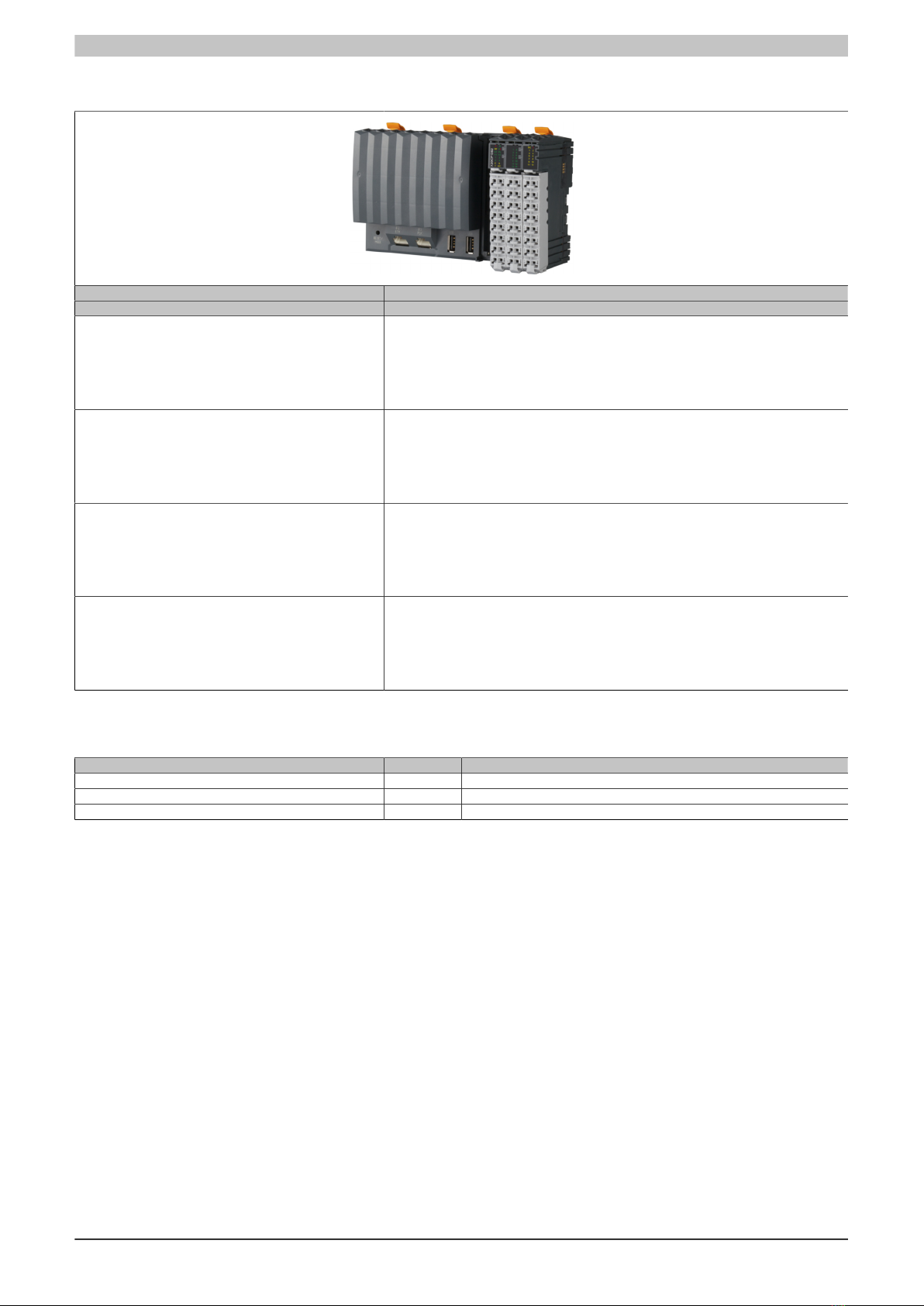
BR-Automation X20CP1301 Manuale utente

X20(c)CP1301, X20CP1381 and X20CP1382
Data sheet V1.21 1
X20(c)CP1301, X20CP1381 and X20CP1382
1 General information
Compact CPUs are available with processor speeds of 200 MHz and 400 MHz. Depending on the variant, up to
256 MB RAM and up to 32 kB nonvolatile onboard RAM is available. A built-in flash drive is available to store up
to 2 GB of application and other data.
All CPUs come equipped with Ethernet, USB and one RS232 interface. In both performance classes, integrated
POWERLINK and CAN bus interfaces are also available. If additional fieldbus connections are needed, the CPU
can be upgraded with an interface module from the standard X20 product range. These CPUs do not require fans
or batteries and are therefore maintenance-free. 30 different digital inputs and outputs and 2 analog inputs are
integrated in the devices. 1 analog input can be used for PT1000 resistance temperature measurement.
•CPU is Intel x86 200/400 MHz compatible with integrated I/O processor
•Ethernet, POWERLINK with poll-response chaining and USB onboard
•1 slot for modular interface expansion
•30 digital inputs/outputs and 2 analog inputs integrated in the device
•1/2 GB flash drive onboard
•128/256 MB DDR3 SDRAM
•Fanless
•No battery
•Battery-backed real-time clock
2 Coated modules
Coated modules are X20 modules with a protective coating for the electronics component. This coating protects
X20c modules from condensation and corrosive gases.
The modules' electronics are fully compatible with the corresponding X20 modules.
For simplification purposes, only images and module IDs of uncoated modules are used in this data
sheet.
The coating has been certified according to the following standards:
•Condensation: BMW GS 95011-4, 2x 1 cycle
•Corrosive gas: EN 60068-2-60, method 4, exposure 21 days

X20(c)CP1301, X20CP1381 and X20CP1382
2 Data sheet V1.21
3 Order data
Model number Short description
X20 CPUs
X20CP1301 ZX20 CPU, with integrated I/O, x86-200, 128 MB DDR3 RAM, 16 kB FRAM, 1 GB onboard flash
drive, 1 insert slot for X20 interface modules, 1 USB interface, 1 RS232 interface, 1 Ethernet
interface 10/100BASE-T, 14 digital inputs, 24 VDC, sink, 4 digital inputs, 2 µs, 24 VDC, sink, 4
digital outputs, 24 VDC, 0.5 A, source, 4 digital outputs, 2 µs, 24 VDC, 0.2 A, 4 digital inputs/out-
puts, 24 VDC, 0.5 A, 2 analog inputs ±10 V or 0 to 20 mA / 4 to 20 mA, 1 PT1000 instead of
an analog input, includes power supply module, 3x terminal block X20TB1F, slot cover and X20
end cover plate X20AC0SR1 (right) included
X20cCP1301 X20 CPU coated, with integrated I/O, x86-200, 128 MB DDR3 RAM, 16 kB FRAM, 1 GB onboard
flash drive, 1 insert slot for X20 interface modules, 1 USB interface, 1 RS232 interface, 1 Ethernet
interface 10/100BASE-T, 14 digital inputs, 24 VDC, sink, 4 digital inputs, 2 µs, 24 VDC, sink, 4
digital outputs, 24 VDC, 0.5 A, source, 4 digital outputs, 2 µs, 24 VDC, 0.2 A, 4 digital inputs/out-
puts, 24 VDC, 0.5 A, 2 analog inputs ±10 V or 0 to 20 mA / 4 to 20 mA, 1 PT1000 instead of
an analog input, includes power supply module, 3x terminal block X20TB1F, slot cover and X20
end cover plate X20AC0SR1 (right) included
X20CP1381 X20 CPU, with integrated I/O, x86-200, 128 MB DDR3 RAM, 16 kB FRAM, 1 GB onboard flash
drive, 1 insert slot for X20 interface modules, 2 USB interfaces, 1 RS232 interface, 1 CAN bus in-
terface, 1 POWERLINK interface, 1 Ethernet interface 10/100BASE-T, 14 digital inputs, 24 VDC,
sink, 4 digital inputs, 2 µs, 24 VDC, sink, 4 digital outputs, 24 VDC, 0.5 A, source, 4 digital outputs,
2 µs, 24 VDC, 0.2 A, 4 digital inputs/outputs, 24 VDC, 0.5 A, 2 analog inputs ±10 V or 0 to 20
mA / 4 to 20 mA, 1 PT1000 instead of an analog input, includes power supply module, 3x terminal
block X20TB1F, slot cover and X20 end cover plate X20AC0SR1 (right) included
X20CP1382 X20 CPU, with integrated I/O, x86-400, 256 MB DDR3 RAM, 32 kB FRAM, 2 GB onboard flash
drive, 1 insert slot for X20 interface modules, 2 USB interfaces, 1 RS232 interface, 1 CAN bus in-
terface, 1 POWERLINK interface, 1 Ethernet interface 10/100BASE-T, 14 digital inputs, 24 VDC,
sink, 4 digital inputs, 2 µs, 24 VDC, sink, 4 digital outputs, 24 VDC, 0.5 A, source, 4 digital outputs,
2 µs, 24 VDC, 0.2 A, 4 digital inputs/outputs, 24 VDC, 0.5 A, 2 analog inputs ±10 V or 0 to 20
mA / 4 to 20 mA, 1 PT1000 instead of an analog input, includes power supply module, 3x terminal
block X20TB1F, slot cover and X20 end cover plate X20AC0SR1 (right) included
Table 1: Order data
Content of delivery
Model number Quantity Short description
- 1 Interface module slot cover
X20AC0SR1 1 X20 end cover plate, right
X20TB1F 3 X20 terminal block, 16-pin, 24 VDC keyed
Table 2: Content of delivery

X20(c)CP1301, X20CP1381 and X20CP1382
Data sheet V1.21 3
4 Technical data
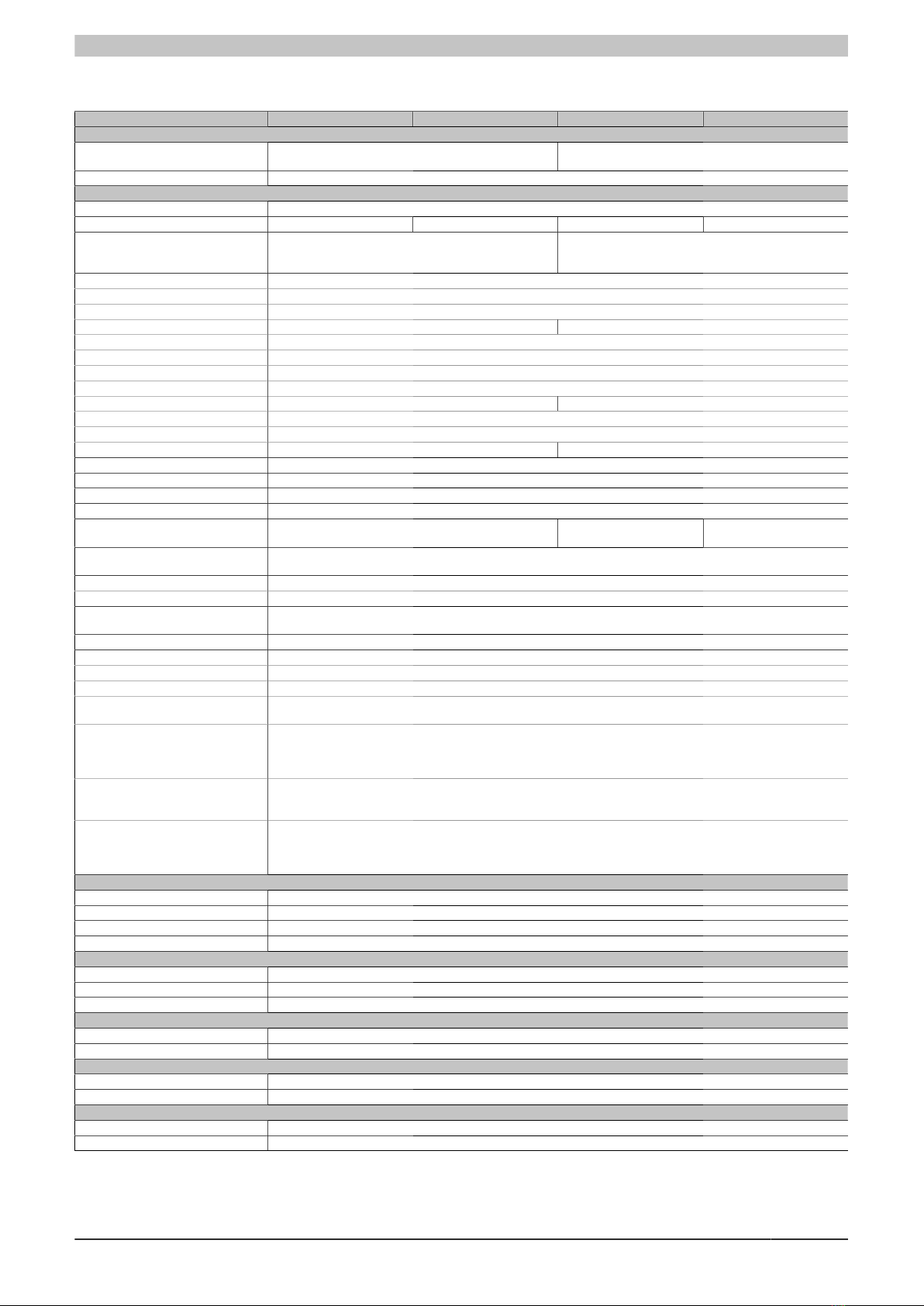
Model number X20CP1301 X20cCP1301 X20CP1381 X20CP1382
Short description
Interfaces 1x RS232, 1x Ethernet, 1x USB, 1x X2X Link 1x RS232, 1x Ethernet, 1x POWER-
LINK, 2x USB, 1x X2X Link, 1x CAN bus
System module CPU
General information
Cooling Fanless
B&R ID code 0xE35B 0xEB58 0xE35C 0xDABB
Status indicators CPU function, Ethernet, RS232, CPU power sup-
ply, I/O power supply, I/O function per channel
CPU function, Ethernet, POWERLINK, RS232,
CAN bus, CAN bus terminating resistor, CPU pow-
er supply, I/O power supply, I/O function per channel
Diagnostics
Outputs Digital outputs: Yes, using status LED and software (output error status)
CPU function Yes, using status LED
CAN bus data transfer - Yes, using status LED
RS232 data transfer Yes, using status LED
Inputs Analog inputs: Yes, using status LED and software
Ethernet Yes, using status LED
I/O power supply Yes, using status LED
POWERLINK - Yes, using status LED
Supply voltage monitoring Yes, using status LED
Overtemperature Yes, using software
Terminating resistor - Yes, using status LED
Controller redundancy possible No
ACOPOS support Yes
reACTION-capable I/O channels No
Visual Components support Yes
Power consumption without interface
module and USB
4.3 W 4.8 W 5.5 W
Power consumption of X2X Link power
supply 1)
0.8 W
Power consumption 1)
Internal I/O 0.8 W
Additional power dissipation caused
by actuators (resistive) [W]
-
Type of signal lines Shielded cables must be used for all high-speed digital inputs/outputs, cable length: Max. 20 m
Certifications
CE Yes
EAC Yes
UL cULus E115267
Industrial control equipment
HazLoc cCSAus 244665
Process control equipment
for hazardous locations
Class I, Division 2, Groups ABCD, T5
ATEX Zone 2, II 3G Ex nA nC IIA T5 Gc
IP20, Ta (see X20 user's manual)
FTZÚ 09 ATEX 0083X
DNV GL Temperature: B (0 - 55°C)
Humidity: B (up to 100%)
Vibration: B (4 g)
EMC: B (bridge and open deck)
CPU and X2X Link power supply
Input voltage 24 VDC -15% / +20%
Input current Max. 1 A
Fuse Integrated, cannot be replaced
Reverse polarity protection Yes
X2X Link power supply output
Nominal output power 2 W
Parallel connection Yes 2)
Redundant operation Yes 3)
Input I/O power supply
Input voltage 24 VDC -15% / +20%
Fuse Required line fuse: Max. 10 A, slow-blow
Output I/O power supply
Nominal output voltage 24 VDC
Permissible contact load 10 A
Controller
Real-time clock Backed up for at least 300 hours, typ. 1000 hours at 25°C, 1 s resolution, -18 to 28 ppm accuracy at 25°C
FPU Yes
Table 3: Technical data

X20(c)CP1301, X20CP1381 and X20CP1382
4 Data sheet V1.21
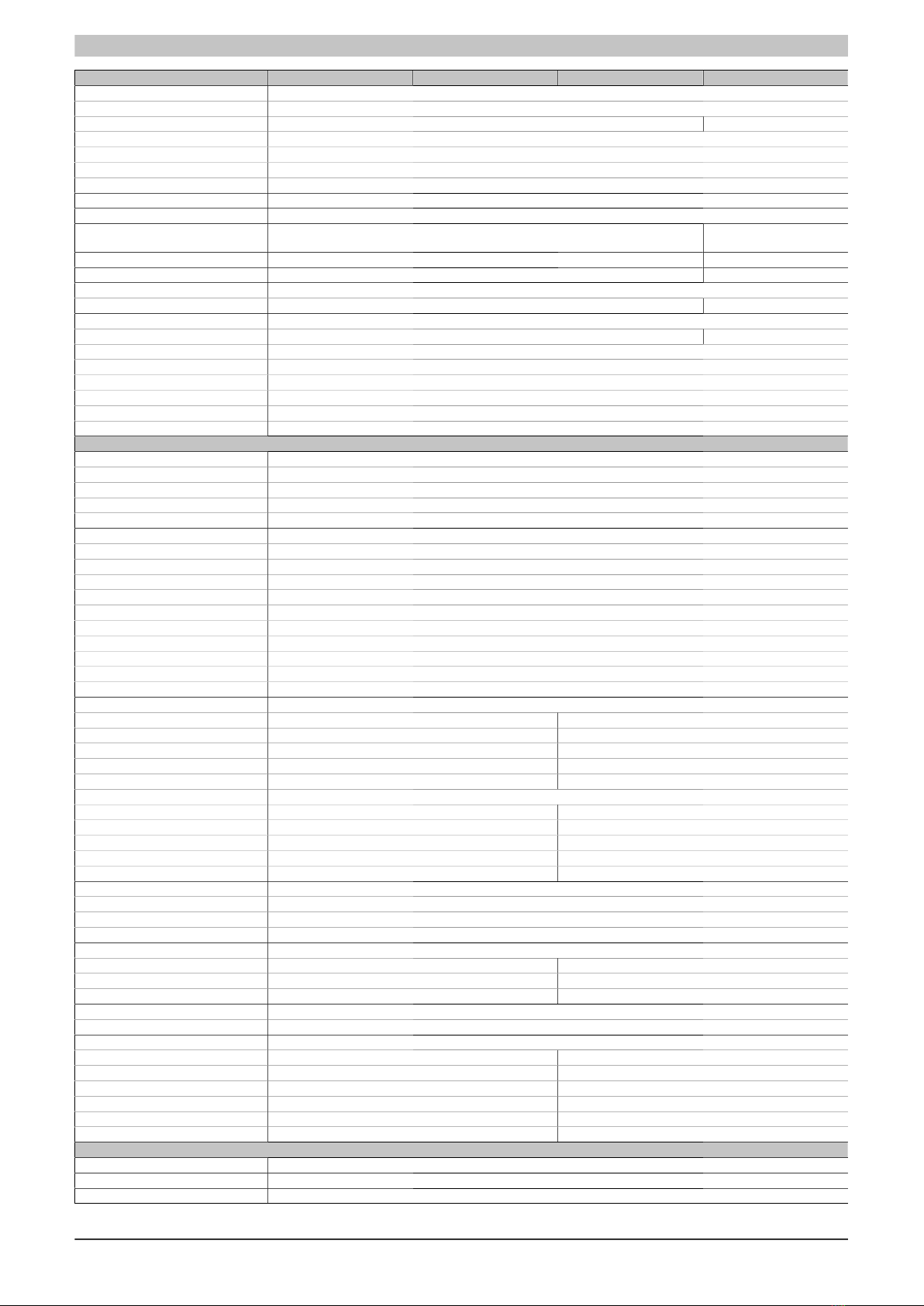
Model number X20CP1301 X20cCP1301 X20CP1381 X20CP1382
Processor
Type Vx86EX
Clock frequency 200 MHz 400 MHz
L1 cache
Data code 16 kB
Program code 16 kB
L2 cache 128 kB
Integrated I/O processor Processes I/O data points in the background
Modular interface slots 1
Remanent variables 16 kB FRAM, retention >10 years 4) 32 kB FRAM, re-
tention >10 years 4)
Shortest task class cycle time 2 ms 1 ms
Typical instruction cycle time 0.0419 µs 0.0199 µs
Standard memory
RAM 128 MB DDR3 SDRAM 256 MB DDR3 SDRAM
Application memory
Type 1 GB eMMC flash memory 2 GB eMMC flash memory
Data retention 10 years
Writable data amount
Guaranteed 40 TB
Results for 5 years 21.9 GB/day
Guaranteed erase/write cycles 20,000
Error-correcting code (ECC) Yes
Interfaces
Interface IF1
Signal RS232
Variant Connection made using 16-pin X20TB1F terminal block
Max. distance 900 m
Transfer rate Max. 115.2 kbit/s
Interface IF2
Signal Ethernet
Variant 1x RJ45 shielded
Line length Max. 100 m between 2 stations (segment length)
Transfer rate 10/100 Mbit/s
Transfer
Physical layer 10BASE-T/100BASE-TX
Half-duplex Yes
Full-duplex Yes
Autonegotiation Yes
Auto-MDI / MDIX Yes
Interface IF3
Fieldbus - POWERLINK managing or controlled node
Type - Type 4 5)
Variant - 1x RJ45 shielded
Line length - Max. 100 m between 2 stations (segment length)
Transfer rate - 100 Mbit/s
Transfer
Physical layer - 100BASE-TX
Half-duplex - Yes
Full-duplex - POWERLINK mode: No / Ethernet mode: Yes
Autonegotiation - Yes
Auto-MDI / MDIX - Yes
Interface IF4
Type USB 1.1/2.0
Variant Type A
Max. output current 0.5 A
Interface IF5
Type - USB 1.1/2.0
Variant - Type A
Max. output current - 0.1 A
Interface IF6
Fieldbus X2X Link master
Interface IF7
Signal - CAN bus
Variant - Connection made using 16-pin X20TB1F terminal block
Max. distance - 1000 m
Transfer rate - Max. 1 Mbit/s
Terminating resistor - Integrated in module
Controller - SJA 1000
Digital inputs
Quantity 14 standard inputs, 4 high-speed inputs and 4 mixed channels, configuration as input or output using software
Nominal voltage 24 VDC
Input voltage 24 VDC -15% / +20%
Table 3: Technical data

X20(c)CP1301, X20CP1381 and X20CP1382
Data sheet V1.21 5
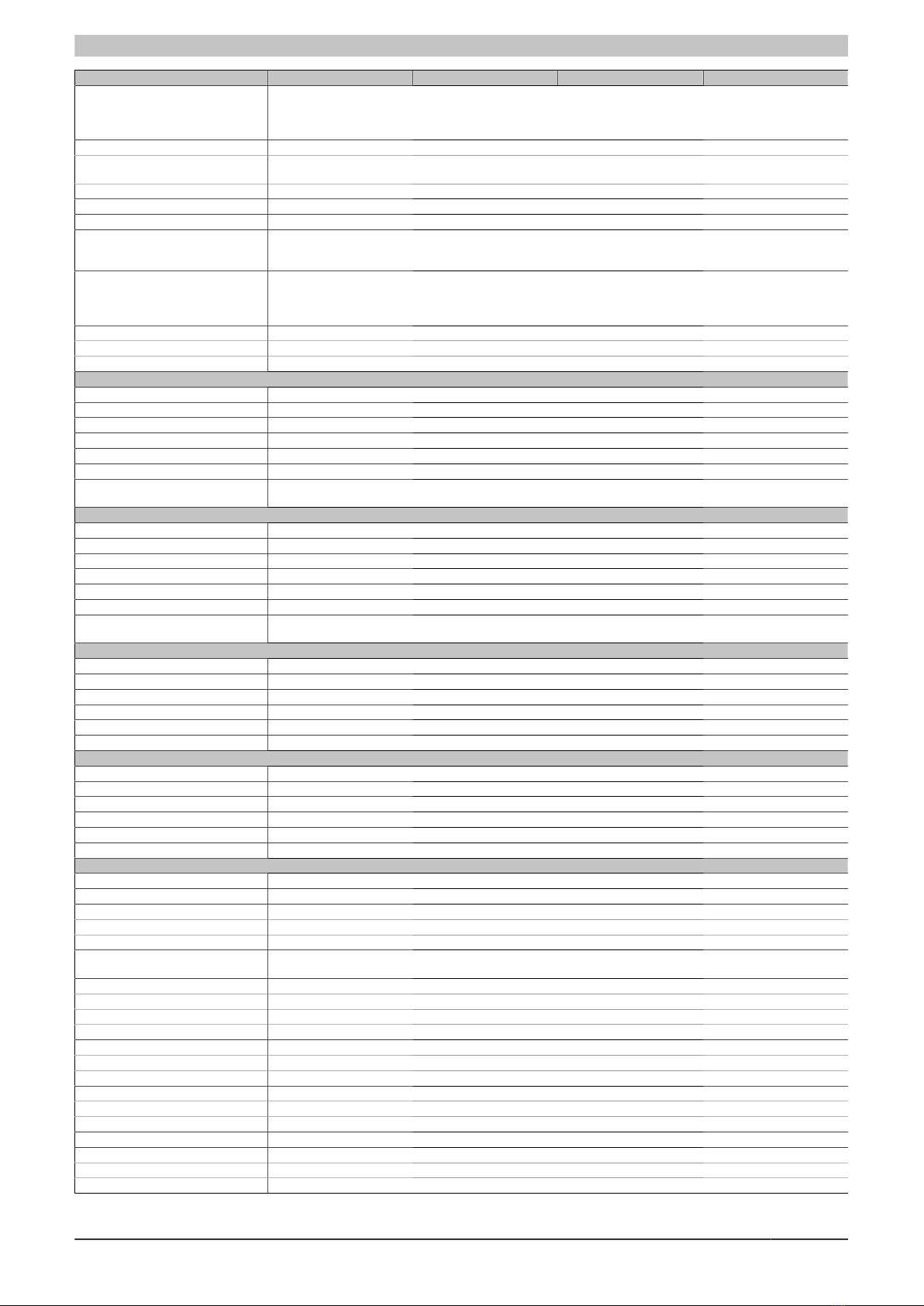
Model number X20CP1301 X20cCP1301 X20CP1381 X20CP1382
Input current at 24 VDC X1 - Standard inputs: Typ. 3.5 mA
X2 - Standard inputs: Typ. 2.68 mA
X2 - High-speed inputs: Typ. 3.5 mA
X3 - Mixed channels: Typ. 2.68 mA
Input filter
Hardware Standard inputs and mixed channels: ≤200 μs
High-speed inputs: ≤2 μs, when used as standard inputs: ≤200 μs
Software Default 1 ms, configurable between 0 and 25 ms in 0.1 ms intervals
Connection type 1-wire connections
Input circuit Sink
Additional functions X2 - High-speed digital inputs:
2x 250 kHz event counting, 2x AB counter, ABR incremental encoder, direction/frequency, peri-
od measurement, gate measurement, differential time measurement, edge counters, edge times
Input resistance X1 - Standard inputs: 6.8 kΩ
X2 - Standard inputs: 8.9 kΩ
X2 - High-speed inputs: 6.8 kΩ
X3 - Mixed channels: 8.9 kΩ
Switching threshold
Low <5 VDC
High >15 VDC
AB incremental encoder
Quantity 2
Encoder inputs 24 V, asymmetrical
Counter size 32-bit
Input frequency Max. 100 kHz
Evaluation 4x
Encoder power supply Module-internal, max. 300 mA
Overload characteristics of encoder
power supply
Short circuit protection, overload protection
ABR incremental encoder
Quantity 1
Encoder inputs 24 V, asymmetrical
Counter size 32-bit
Input frequency Max. 100 kHz
Evaluation 4x
Encoder power supply Module-internal, max. 300 mA
Overload characteristics of encoder
power supply
Short circuit protection, overload protection
Event counter
Quantity 2
Signal form Square wave pulse
Evaluation 1x
Input frequency Max. 250 kHz
Counter frequency 250 kHz
Counter size 32-bit
Edge detection / Time measurement
Possible measurements Period measurement, gate measurement, differential time measurement, edge counter, edge times
Measurements per module Each function up to 2x
Counter size 32-bit
Input frequency Max. 10 kHz
Timestamp 1 µs resolution
Signal form Square wave pulse
Analog inputs
Input ±10 V or 0 to 20 mA / 4 to 20 mA, via different terminal connections
Input type Differential input
Digital converter resolution
Voltage ±12-bit
Current 12-bit
Conversion time 1 channel enabled: 100 µs
2 channels enabled: 200 µs
Output format
Data type INT
Voltage INT 0x8001 - 0x7FFF / 1 LSB = 0x0008 = 2.441 mV
Current INT 0x0000 - 0x7FFF / 1 LSB = 0x0008 = 4.883 μA
Input impedance in signal range
Voltage 20 MΩ
Current -
Load
Voltage -
Current <300 Ω
Input protection Protection against wiring with supply voltage
Permissible input signal
Voltage Max. ±30 V
Current Max. ±50 mA
Table 3: Technical data

X20(c)CP1301, X20CP1381 and X20CP1382
6 Data sheet V1.21
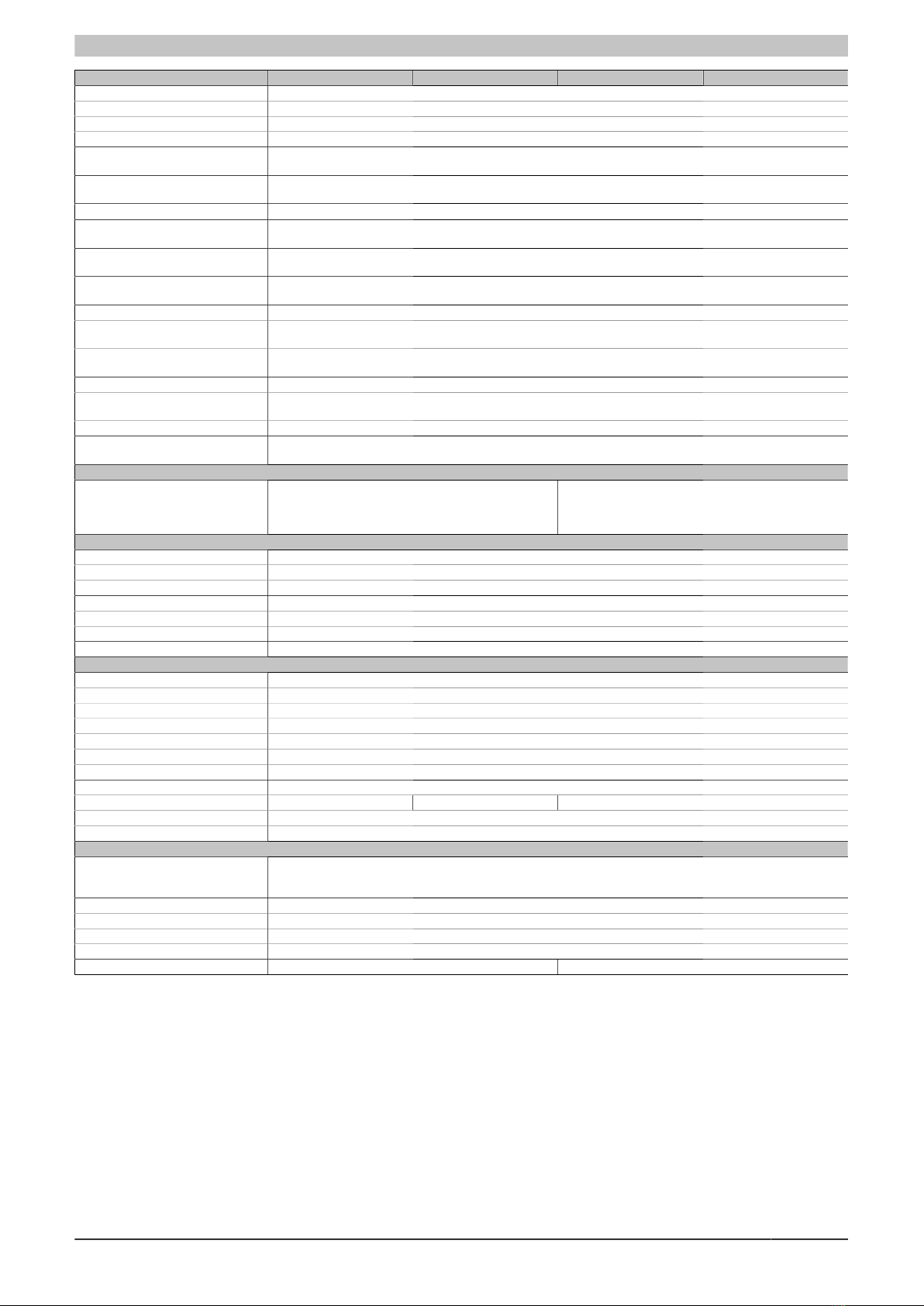
Model number X20CP1301 X20cCP1301 X20CP1381 X20CP1382
Output of digital value during overload Configurable
Conversion procedure SAR
Input filter 3rd-order low pass / cutoff frequency 1 kHz
Max. error at 25°C
Voltage
Gain 0.18% (Rev. <C0: 0.37%) 6)
Offset 0.04% (Rev. <C0: 0.25%) 7)
Current
Gain 0 to 20 mA = 0.15% (Rev. <C0: 0.52%) / 4 to 20 mA = 0.25% 6)
Offset 0 to 20 mA = 0.1% (Rev. <C0: 0.4%) / 4 to 20 mA = 0.15% 8)
Max. gain drift
Voltage 0.017 %/°C 6)
Current 0 to 20 mA = 0.015 %/°C / 4 to 20 mA = 0.023 %/°C 6)
Max. offset drift
Voltage 0.008 %/°C 7)
Current 0 to 20 mA = 0.008 %/°C / 4 to 20 mA = 0.012 %/°C 8)
Common-mode rejection
DC 70 dB
50 Hz 70 dB
Common-mode range ±12 V
Crosstalk between channels <-70 dB
Nonlinearity
Voltage <0.025% 7)
Current <0.05% 8)
Resistance measurement temperature inputs
Quantity 1
Input Resistance measurement with constant current supply for 2-wire connections
Digital converter resolution 13-bit
Conversion time Only temperature input enabled: 200 µs
Temperature and analog input enabled: 400 µs
Conversion procedure SAR
Output format INT or UINT for resistance measurement
Sensor
PT1000 -200 to 850°C
Resistance measurement range 0.1 to 4000 Ω
Temperature sensor resolution 1 LSB = 0x0005 = 0.16°C
Resistance measurement resolution 1 LSB = 0x0005 = 0.49 Ω
Input filter 1st-order low pass / cutoff frequency 7 Hz
Sensor standard EN 60751
Common-mode range 1 V
Linearization method Internal
Measurement current 1 mA
Permissible input signal Short-term max. ±30 V
Max. error at 25°C
Gain 0.3% (Rev. <C0: 1.93%) 9)
Offset 0.15% (Rev. <C0: 0.32%) 10)
Max. gain drift 0.023 %/°C 9)
Max. offset drift 0.012%/°C 10)
Nonlinearity <0.05% 10)
Standardized range of values for resis-
tance measurement
0.1 to 4000.0 Ω
Crosstalk between channels <-70 dB
Common-mode rejection
50 Hz >60 dB
Temperature sensor normalization
PT1000 -200 to 850°C
Digital outputs
Quantity 4 standard outputs, 4 high-speed outputs and 4 mixed channels, configuration as input or output using software
Variant Standard outputs and mixed channels: FET positive switching
High-speed outputs: Push-Pull
Nominal voltage 24 VDC
Switching voltage 24 VDC -15% / +20%
Nominal output current Standard outputs and mixed channels: 0.5 A
High-speed outputs: 0.2 A
Total nominal current Standard outputs and mixed channels: 4 A
High-speed outputs: 0.8 A
Connection type 1-wire connections
Output circuit Standard outputs and mixed channels: Source
High-speed outputs: Sink or source
Output protection 11) Thermal cutoff if overcurrent or short circuit occurs (see value "Peak short circuit current")
Internal inverse diode for switching inductive loads (see section "Switching inductive loads")
Table 3: Technical data

X20(c)CP1301, X20CP1381 and X20CP1382
Data sheet V1.21 7
Model number X20CP1301 X20cCP1301 X20CP1381 X20CP1382
Pulse width modulation 12)
Period duration 5 to 65535 µs corresponds to 200 kHz to 15 Hz
Pulse duration 0 to 100%, minimum 2.5 µs
Resolution for pulse duration 0.1% of the configured frequency
Diagnostic status Standard outputs and mixed channels: Output monitoring with 10 ms delay
High-speed outputs: Output monitoring with 10 µs delay
Leakage current when switched off Standard outputs and mixed channels: 5 µA
High-speed outputs: 25 µA
RDS(on) 140 mΩ 13)
Residual voltage Standard outputs and mixed channels: <0.1 V at nominal current 0.5 A
High-speed outputs: <0.9 V at nominal current 0.1 A
Peak short-circuit current Standard outputs and mixed channels: <3 A
High-speed outputs: <20 A
Switching on after overload or short-
circuit cutoff
Standard outputs and mixed channels: Approx. 10 ms (depends on module temperature)
High-speed outputs: No switch-on
Switching delay
0 → 1 Standard outputs and mixed channels: <300 µs
High-speed outputs: <3 µs
1 → 0 Standard outputs and mixed channels: <300 µs
High-speed outputs: <3 µs
Switching frequency
Resistive load 14) Standard outputs and mixed channels: Max. 500 Hz
High-speed outputs: 50 kHz, max. 200 kHz (see section "Switching frequency derating for high-speed digital outputs")
Inductive load See section "Switching inductive loads"
Braking voltage when switching off in-
ductive loads
Standard outputs and mixed channels: Typ. 45 VDC
Electrical properties
Electrical isolation Ethernet (IF2) and X2X (IF6) isolated from
each other, from other interfaces and from PLC
Channel isolated from bus
Channel not isolated from channel or PLC
Ethernet (IF2), POWERLINK (IF3) and X2X (IF6) isolat-
ed from each other, from other interfaces and from PLC
Channel isolated from bus
Channel not isolated from channel or PLC
Operating conditions
Mounting orientation
Horizontal Yes
Vertical Yes
Installation elevation above sea level
0 to 2000 m No limitation
>2000 m Reduction of ambient temperature by 0.5°C per 100 m
Degree of protection per EN 60529 IP20
Ambient conditions
Temperature
Operation
Horizontal mounting orientation -25 to 60°C
Vertical mounting orientation -25 to 50°C
Derating See section "Switching frequency derating for high-speed digital outputs".
Storage -40 to 85°C
Transport -40 to 85°C
Relative humidity
Operation 5 to 95%, non-condensing Up to 100%, condensing 5 to 95%, non-condensing
Storage 5 to 95%, non-condensing
Transport 5 to 95%, non-condensing
Mechanical properties
Note X20 end cover plate (right) included in delivery
3 X20 terminal blocks (16-pin) included in delivery
Interface module slot cover included in delivery
Dimensions
Width 164 mm
Height 99 mm
Depth 75 mm
Weight 300 g 310 g
Table 3: Technical data
1) The specified values are maximum values. For examples of the exact calculation, see section "Mechanical and electrical configuration" of the X20 system
user's manual.
2) When operated in parallel, the nominal power of 2 W is not permitted to be added to the total power.
3) Up to 2 W bus load.
4) The size of the memory used for remanent variables is configurable in Automation Studio.
5) See Automation Help under "Communication / POWERLINK / General information / Hardware - IF/LS" for more information.
6) Based on the current measured value.
7) Based on the 20 V measurement range.
8) Based on the 20 mA measurement range.
9) Based on the current resistance value.
10) Based on the entire resistance measurement range.
11) For the high-speed digital outputs, derating must be taken into account at a switching frequency >50 kHz (see section "Derating for switching frequency of
high-speed digital outputs"). Overtemperature protection is not provided.

X20(c)CP1301, X20CP1381 and X20CP1382
8 Data sheet V1.21
12) The high-speed digital outputs can be used for pulse width modulation.
13) Only for standard outputs and mixed channels.
14) Standard outputs and mixed channels: At loads ≤ 1 kΩ
5 LED status indicators
5.1 Slot X1
Figure LED Color Status Description
On SERVICE or BOOT operating mode
Blinking The "E" LED blinks red and the "RF" LED blinks yellow when there is a license
violation.
E Red
Double flash Firmware update1)
On Application runningGreen
Blinking Boot mode system start:
CPU initializing the application, all bus systems and I/O modules1)
R
Red On During reset
On SERVICE or BOOT operating modeRF Yellow
Blinking The "RF" LED blinks yellow and the "E" LED blinks red when there is a license
violation.
SE Green/Red Status/Error LED. LED states are described in section "LED "S/E" (LED "Sta-
tus/Error")" on page 8.
On A link to the Ethernet remote station has been established.ET Green
Blinking A link to the Ethernet remote station has been established. The LED blinks when
Ethernet activity is taking place on the bus.
On A link to the POWERLINK peer station has been established.PL Green
Blinking A link to the POWERLINK peer station has been established. The LED blinks
when Ethernet activity is taking place on the bus.
Off Open circuit or disconnected sensor
Blinking Input signal overflow or underflow
A1 - A2 Green
On Analog/digital converter running, value OK
1 - 4 Green Input state of the corresponding digital input
C Yellow On CPU transmitting or receiving data via the CAN bus interface
S Yellow On CPU transmitting or receiving data via the RS232 interface
T Yellow On The terminating resistor integrated in the CPU is switched on.
DC Yellow On CPU power supply OK
Table 4: LED status indicators on the integrated X1 I/O slot
1) The process can take several minutes depending on the configuration.
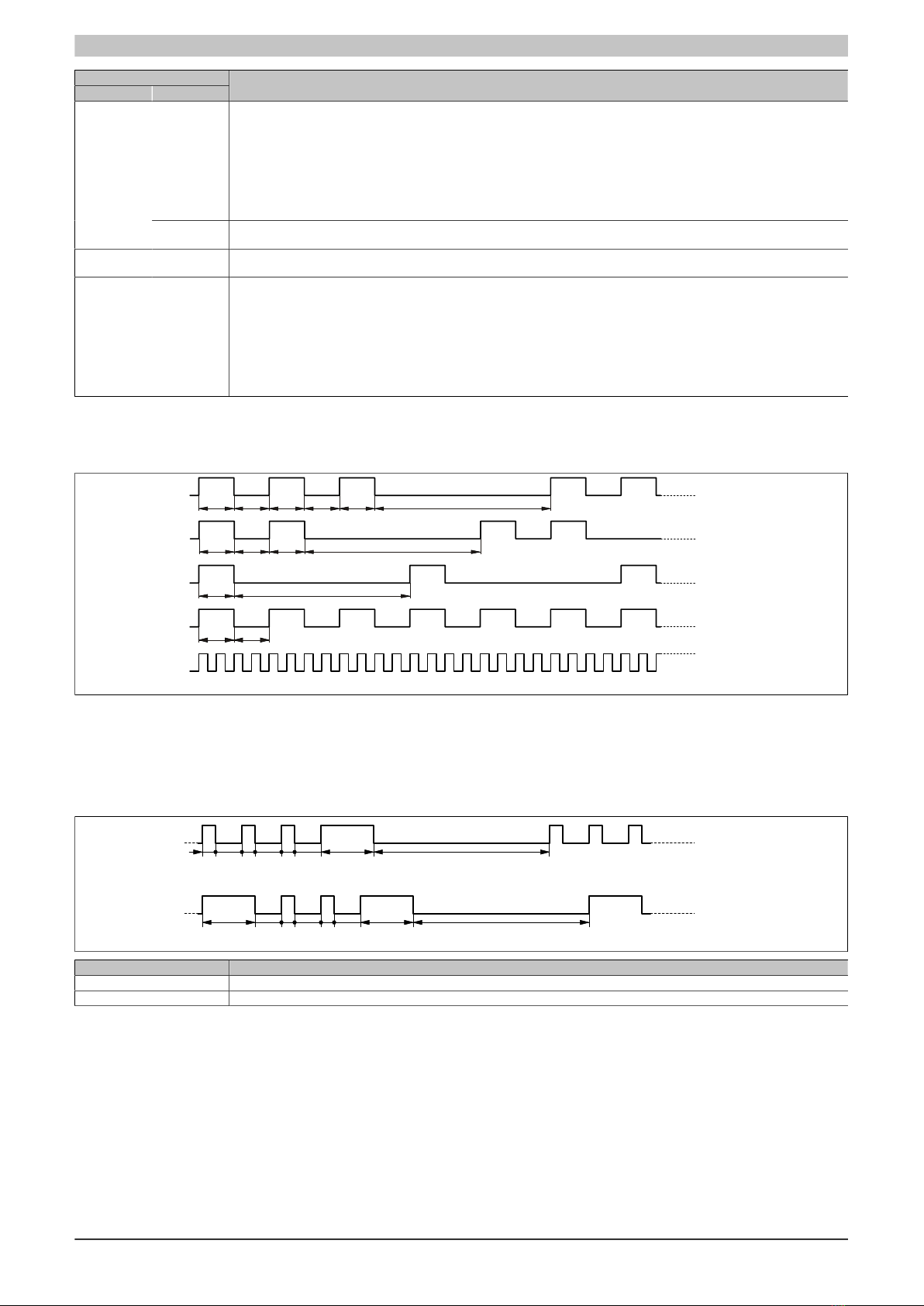
5.1.1 LED "S/E" (LED "Status/Error")
This LED is a green/red dual LED and indicates the state of the POWERLINK interface. The LED states have a
different meaning depending on the operating mode of the POWERLINK interface.
5.1.1.1 Ethernet mode
In this mode, the interface is operated as an Ethernet interface.
LED "S/E"
Green Red Description
On Off The interface is being operated as an Ethernet interface.
Table: LED "S/E": Interface in Ethernet mode

X20(c)CP1301, X20CP1381 and X20CP1382
Data sheet V1.21 9
5.1.1.2 POWERLINK V2 mode
Error message
LED "S/E"
Green Red Description
Off On The interface is in the error mode (failed Ethernet frames, increased number of collisions on the network, etc.).
Note:
Several red blinking signals are displayed immediately after the device is switched on. These are not errors, however.
Blinking On If an error occurs in the following modes, then the green LED blinks over the red LED:
•PRE_OPERATIONAL_1
•PRE_OPERATIONAL_2
•READY_TO_OPERATE
t
t
t
LED "S/E"
Status
Green
Error
Red
Table: LED "S/E" - Error message (interface in POWERLINK mode)
Interface status
LED "S/E"
Green Red Description
Off Off Mode: NOT_ACTIVE
The interface is either in mode NOT_ACTIVE or one of the following modes or errors is present:
•The device is switched off.
•The device is in the startup phase.
•The interface or device is not configured correctly in Automation Studio.
•The interface or device is defective.
Managing node (MN)
The network is monitored for POWERLINK frames. If a frame is not received within the configured time window (timeout), the
interface immediately enters mode PRE_OPERATIONAL_1.
If POWERLINK communication is detected before the time has elapsed, however, the MN is not started.
Controlled node (CN)
The network is monitored for POWERLINK frames. If a frame is not received within the configured time window (timeout), the
interface immediately enters mode BASIC_ETHERNET. If POWERLINK communication is detected before this time expires,
however, the interface immediately enters mode PRE_OPERATIONAL_1.
Flickering
(approx.
10 Hz)
Off Mode: BASIC_ETHERNET
The interface is in mode BASIC_ETHERNET. The interface is operated in Ethernet mode.
Managing node (MN)
This mode can only be exited by resetting the controller.
Controlled node (CN)
If POWERLINK communication is detected during this mode, the interface enters mode PRE_OPERATIONAL_1.
Off Mode: PRE_OPERATIONAL_1
The interface is in mode PRE_OPERATIONAL_1.
Managing node (MN)
The MN is in "reduced cycle" operation. The CNs are configured in this mode.
Cyclic communication is not yet taking place.
Controlled node (CN)
The CN can be configured by the MN in this mode. The CN waits until it receives an SoC frame and then switches to mode
PRE_OPERATIONAL_2.
Single flash
(approx. 1 Hz)
On Controlled node (CN)
If the red LED lights up in this mode, this means that the MN has failed.
Off Mode: PRE_OPERATIONAL_2
The interface is in mode PRE_OPERATIONAL_2.
Managing node (MN)
The MN starts cyclic communication (cyclic input data is not yet evaluated).
The CNs are configured in this mode.
Controlled node (CN)
The CN can be configured by the MN in this mode. A command then switches the mode to READY_TO_OPERATE.
Double flash
(approx. 1 Hz)
On Controlled node (CN)
If the red LED lights up in this mode, this means that the MN has failed.
Table: LED "S/E" - Interface state (interface in POWERLINK mode)

X20(c)CP1301, X20CP1381 and X20CP1382
10 Data sheet V1.21
LED "S/E"
Green Red Description
Off Mode: READY_TO_OPERATE
The interface is in mode READY_TO_OPERATE.
Managing node (MN)
Cyclic and asynchronous communication. Received PDO data is ignored.
Controlled node (CN)
The configuration of the CN is completed. Normal cyclic and asynchronous communication. The transmitted PDO data corre-
sponds to the PDO mapping. However, cyclic data is not yet evaluated.
Triple flash
(approx. 1 Hz)
On Controlled node (CN)
If the red LED lights up in this mode, this means that the MN has failed.
On Off Mode: OPERATIONAL
The interface is in mode OPERATIONAL. PDO mapping is active and cyclic data is evaluated.
Blinking
(approx.
2.5 Hz)
Off Mode: STOPPED
The interface is in mode STOPPED.
Managing node (MN)
This mode does not occur for the MN.
Controlled node (CN)
Output data is not being output, and no input data is being provided. This mode can only be reached and exited by a corre-
sponding command from the MN.
Table: LED "S/E" - Interface state (interface in POWERLINK mode)
Blink times
200
200
1000
200
200
200
200
1000
200
200
All times in ms
Flickering
Blinking
Single flash
Triple flash
200
200
200
1000
Double flash
5.1.2 System stop error codes
A system stop error can occur due to incorrect configuration or defective hardware.
The error code is indicated by LED "S/E" blinking red. The blinking signal of the error code consists of 4 switch-on
phases with short (150 ms) or long (600 ms) duration. The error code is repeated every 2 seconds.
All times in ms
RAM error
Hardware error
150 150 150300 300 300 600 2000
150 150
300 300300600 2000600
Error Error description
RAM error The device is defective and must be replaced.
Hardware error The device or a system component is defective and must be replaced.
Questo manuale è adatto per i seguenti modelli
3
Indice
Manuali Hardware per computer popolari di altre marche

EMC2
EMC2 VNX Series Manuale del proprietario

Panasonic
Panasonic DV0PM20105 Manuale utente

Mitsubishi Electric
Mitsubishi Electric Q81BD-J61BT11 Manuale utente

Gigabyte
Gigabyte B660M DS3H AX DDR4 Manuale utente

Raidon
Raidon iT2300 Manuale utente

National Instruments
National Instruments PXI-8186 Manuale utente