7
I. Pre-Installation
A. Inspect shipment carefully for any signs of damage. All
equipment is carefully manufactured, inspected and
packed. Our responsibility ceases upon delivery of
boiler to carrier in good condition. Any claim for
damage or shortage in shipment must be led
immediately against carrier by consignee. No claims for
variances or shortages will be allowed by Boiler
Manufacturer, unless presented within sixty (60) days
after receipt of equipment.
B. Installation must conform to the requirements of the
authority having jurisdiction. In the absence of such
requirements, installation must conform to the National
Fuel Gas Code, NFPA 54/ANSI Z223.1 and/or CAN/
CGA B149 Installation Codes.. Where required by the
authority having jurisdiction, the installation must
conform to the Standard for Controls and Safety
Devices for Automatically Fired Boilers, ANSI/ASME
No. CSD-1.
C. Appliance is design certied for installation on
combustible ooring. Boiler must not be installed on
carpeting.
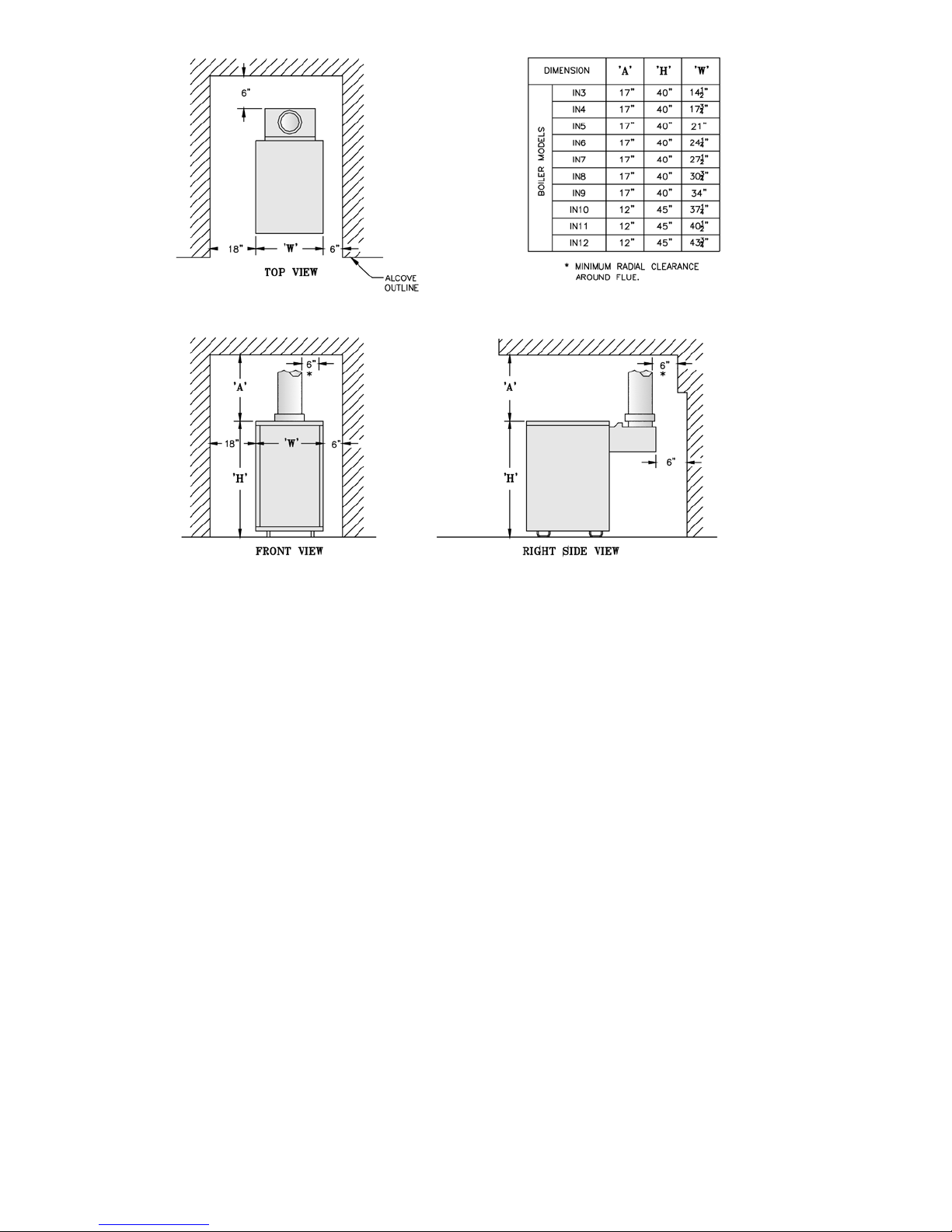
D. Provide clearance between boiler jacket and
combustible material in accordance with local re
ordinance. See Figure 3 for minimum listed clearance
to combustible material. Recommended service
clearance is 24 inches from left side, right side, and
front. Additional clearance may be required on left side
if optional tankless heater is installed. Service
clearances may be reduced to minimum clearances to
combustible materials.
E. Install boiler on level oor as close to chimney as
possible. For basementinstallation provide a solid base,
such as concrete, steel or masonry if oor is not level or
if water may be encountered on oor around boiler.
F. Protect gas ignition system components from water
(dripping, spraying, rain, etc.) during boiler operation
and service (circulator replacement, control
replacement, etc.).
G. Provide combustion and ventilation air in accordance
with applicable provisions of local building codes, or
the National Fuel Gas Code, NFPA 54/ANSI Z223.1,
Section 5.3, Air for Combustion and Ventilation; or
CAN/CGA B149 Installation Codes, Sections 7.2, 7.3
or 7.4.
GNINRAW
rianoitalitnevdnanoitsubmocetauqedA
reporperussaotdedivorpebtsum
.noitsubmoc
The following guideline is based on the National Fuel
Gas Code, NFPA 54/ANSI Z223.1.
1. Determine volume of space (boiler room). Rooms
communicating directly with space (through
openings not furnished with doors) are considered
part of space.
Volume [ft³] = Length [ft] x Width [ft] x Height [ft]
2. Determine Total Input of all appliances in space.
Round result to nearest 1,000 Btu per hour (Btuh).
3. Determine type of space. Divide Volume by Total
Input.
a. If result is greater than or equal to 50 ft³ per
1,000 Btuh, space is considered an unconned
space.
b. If result is less than 50 ft³ per 1,000 Btuh, space
is considered a conned space.
4. Determine building type. A building of unusually
tight construction has the following characteristics:
a. Walls and ceiling exposed to outside atmosphere
have a continuous water vapor retarder with a
rating of 1 perm or less with openings gasketed
and sealed, and
b. Weather-stripping has been added on openable
windows and doors, and
GNINRAW
snoitcurtsniesehtwolloftonoduoyfI
tluseryamnoisolpxeroerifa,yltcaxe
lanosreproegamadytreporpgnisuac
.yrujni
REGNAD
rehtoroenilosagerehwreliobllatsnitonoD
fosecruosro,sdiuqilrosropavelbammalf
,srenaelc,sehcaelb.e.i(snobracordyh
cirbaf,srevomertniap,syarps,slacimehc
.derotsrodesuera).cte,srenetfos
ECITON
,reliobehtfotnetnocretawwolehtoteuD
ehtotdragerhtiwreliobehtfognizis-sim
evissecxenitluserlliwdaolmetsysgnitaeh
tnenopmocdetareleccadnagnilcycreliob
tnarrawTONSEODmahnruB.eruliaf
reliobdezis-simybdesuacseruliaf
otreliobehtezisrevoTONOD.snoitacilppa
.metsyseht