3.3Tools
3mm and 5mm flat blade screwdriver.
14mm and 15mm A/F spanners.
Suitable spanners for installing cable glands.
Pliers, knife, wire strippers/cutters.
3.4Electrical Supplies
The discharge lamp luminaires are supplied from separate control gear boxes. The installation and operating
instructions for these boxes are dealt with in a separate leaflet.
The supply voltage and frequency should be specified for the control gear box when ordering. Running at over
the rated supply voltage will reduce life and at greater than +10% will compromise the fitting. A maximum voltage
variation of +/-6% on the nominal is expected. (The safety limit for operation is +10%). Luminaires should not be
operated continuously at more than +6%/-10% of the rated supply voltage of the control gear or tapping. The
user must determine the actual underlying site supply and purchase or adjust accordingly. Care is needed in
connecting to the nominal 230V UK public supply.
In some cases, the control gear boxes have multi-tap control gear which can be set to a range of 50 and 60Hz
cycle voltages. The tappings are shown on the control gear and the limits are shown on the rating plate. If, the
equipment is located in a high or low voltage section of the system, an appropriate voltage tap should be selected
to obtain the best lamp performance, but care must be taken to log or mark the equipment so that the tappings
can be reset if the equipment is re-located. If in doubt, tappings should be set on the high side.
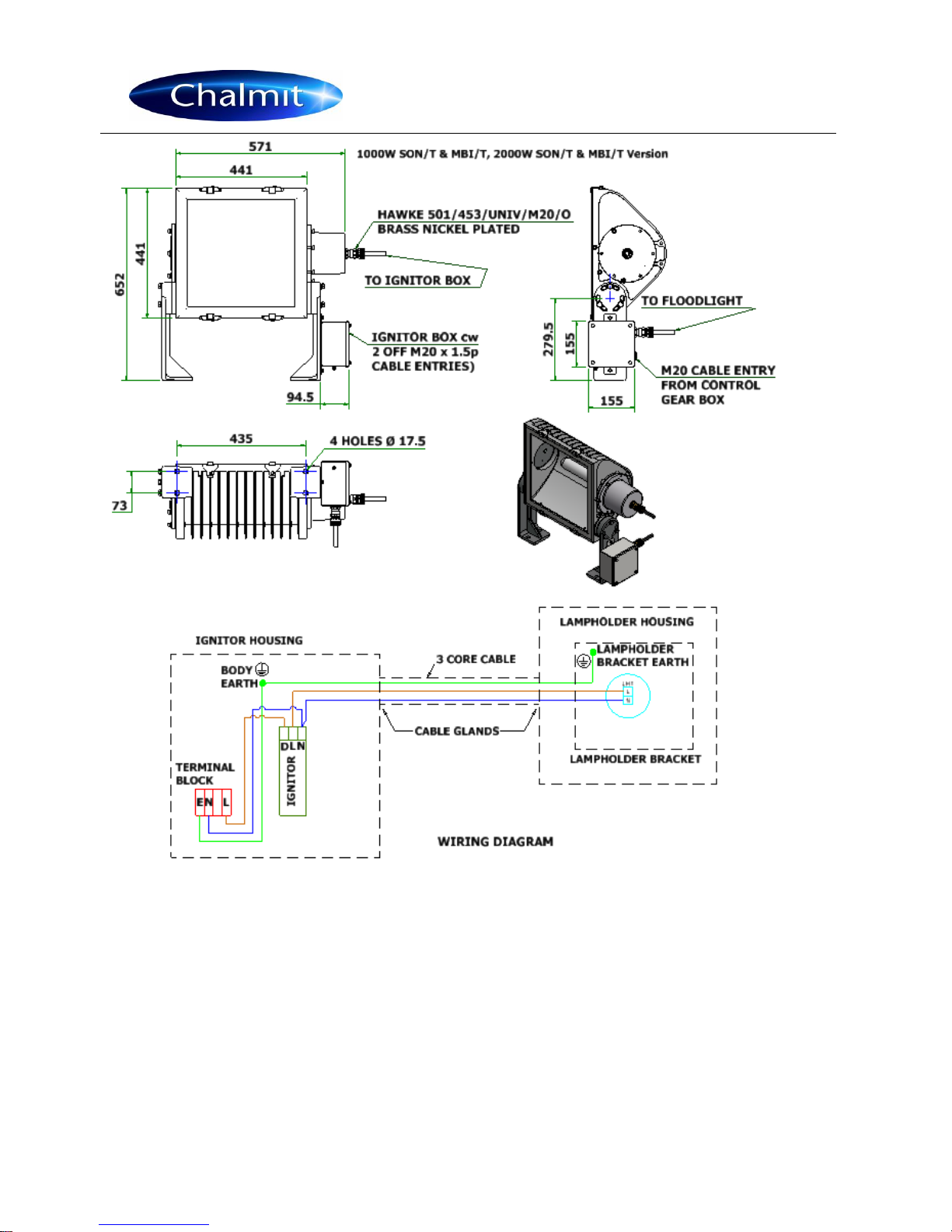
In the case of the HPS lamp the ignitor is fitted in a box attached onto the foot mounting bracket, care should be
taken to ensure the lid orientation is correct to align gasket and sealing edge on body. In this case, a control gear
box without an ignitor is ordered to supply the luminaire. A calculation can then be made to cover the voltage
drop between the control gear box and the luminaire. 10V maximum drop is desirable for HPS. The lamp power
will be reduced. In all cases, the calculation is made on the lamp current, not the corrected circuit current.
The HPS circuit uses a SIP (superimposed pulse) ignitor. This means there are only two connections to the
choke and the tap selection is obvious.
When the construction site supply is different to that of the service location, the tappings should be re-set. If not,
advice on the effect of these temporary supplies should be sought from the Technical Department.
3.5Lamps
When fitting lamps, a check should be made that the lamp steady assembly does not become solid before the
access cover has been fully bolted down. There may be some variation in length on the 1000W SON/T lamps
available.
Chalmit recommends Philips 1000W lamps 390mm long. In the later models, the length variation is catered for by
a lamp steady using a spacer. This spacer can be put either on the stem or inside the steady cup to allow for a
2mm shift in the steady spring compression range. The assembly is available for retrofit for older models.
Care must be taken to fit the correct lamp in order that it will operate properly, maintain the operating conditions
and obtain the design photometric performance.
HPS lamps should be replaced shortly after they do not light. One indication of the end of life for HPS
lamps is "cycling", where the lamp goes out and then re-ignites after a minute or so interval. If discharge
luminaires are burnt continuously, they should be switched off occasionally. This allows old lamps to fail to re-
ignite, reducing the possibility of them becoming diodes with detrimental effects to the control gear.
The above information is current at the time of preparation. The development of lamps and control gear is
ongoing and detailed advice on the lamp performance can be obtained from the lamp supplier.
Note: HPS circuits should not be energised without the lamp fitted.
HPS lamps with internal ignitors must not be used.
3.6 Mounting
Luminaires should be installed where access for maintenance is practical and in accordance with any lighting
design information provided for the installation. This will usually consist of aiming points and aiming angles. The
foot mounting brackets should be secured with lock washers or self-locking nuts and bolts.