06
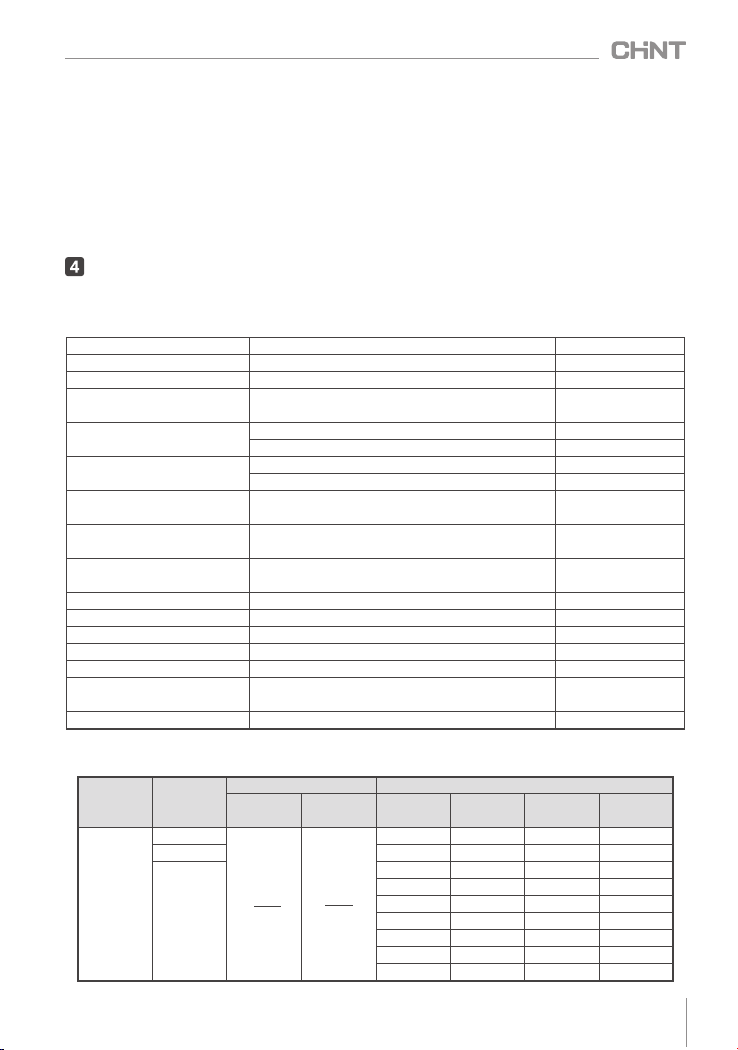
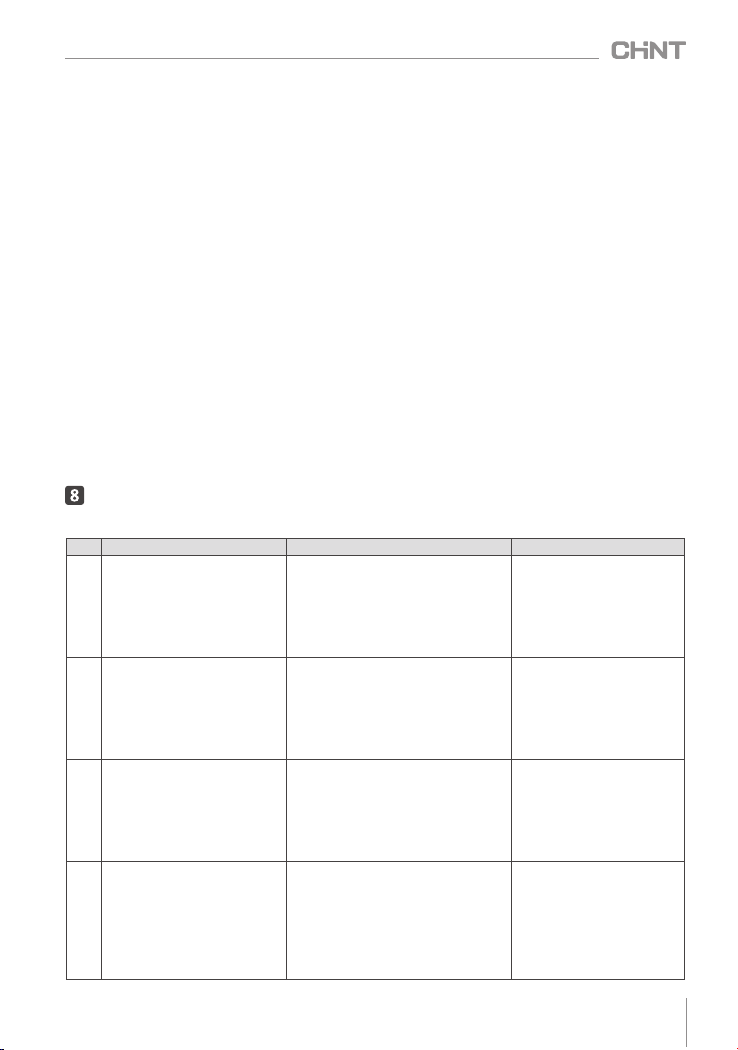
Analysis and Troubleshooting of Faults
Table 7 Analysis and Troubleshooting of Faults
NWC5/NWC6 Series Self-healing Low Voltage Shunt Capacitors
of the capacitor and can cause damage to other components and conductors in the cabinet due to overload.
7.2 Maintenance during operation
Tighten the terminal screws of the capacitor on a regular basis (once half a year) to prevent poor
contact. Remove dust and greasy dirt also.
User should pay close attention to the cabinet and replace any damaged capacitor in time if any under
-compensation of power factor occurs due to significant capacitance drop (50% current decrease), otherwise
it may lead to penalty. If all the capacitors are operating and in good condition but the power factor still
cannot meet requirement, user must add capacity in time to ensure the automatic cycle operation of the
capacitors.
7.3 Service cycle
User should determine the service cycle based on the application conditions, the recommended service
cycle for cabinet is once half a year.
7.4 Maintenance for long-term idle
If the capacitor has been idled for one year or longer, please check if its capacitance value is within the
allowable deviation range (-5%~+8%); conduct pole-to-case voltage withstand test again (apply AC 3kV for
5 seconds); or use megameter to test if the insulation resistance between the three phase terminals and the
case is larger than 100MΩ before using the product.
7.5 Storage conditions, storage period and precautions
The smart capacitor should be stored in a dry and well-ventilated room and protected from rain, moist,
chemicals and dust. The maximum storage period of the product is 36 months. Do not put the smart
capacitor or its package directly on the floor.
1
The measured current of a
newly connected capacitor is
much smaller than the rated
current on its nameplate (same
for multiple capacitors).
If a capacitor with higher rated
voltage is connected to 380V grid,
the actual output current will be
much smaller, which is normal.
There is nothing wrong with the
capacitor, it is just derated.
User should determine the
status of a capacitor based
on its measured capacitance
value (μF). The actual
operating current IC=
Uc/UN ×IN
2
The current of the capacitor is
closed to rated current when
it is first put into operation,
but the current drops after a
period of time.
The current drops as the capacitance
value of the capacitance decreases.
There are several reasons for
capacitance decrease such as
improper use, large harmonic or
quality defect.
Find out the reason and
solve the problem. User
must replace the capacitor
if the capacitance value
drops below 50%.
3
The terminal screws of the
capacitor generate heat or
even turn into black during
operation.
The wire nuts are loose or not
tightened properly during installation.
If the nuts are tightened properly, the
reason might be long-term
overcurrent due to harmonic current
amplification in the grid.
Tighten the nuts, replace
nuts, flat gaskets, elastic
washer if necessary.
4
The fuse in branch circuit
blows frequently (or miniature
circuit breaker trips frequently);
the CJ19 contactor fuses; the
current-limiting resistance
burns frequently; the surface
of XD1 current-limiting reactor
These symptoms are typical when
the grid harmonic is too big or
there is intermittent resonance in
the grid.
Conduct grid harmonic test
or check if there are
harmonic sources such as
frequent converter, rectifier,
intermediate frequency
furnace or electric-arc
furnace installed at load
No.Faults Cause analysis Troubleshooting method