
Clef Audio Soloist-50 Manuale utente

Soloist-50
O W N E R M A N U A L
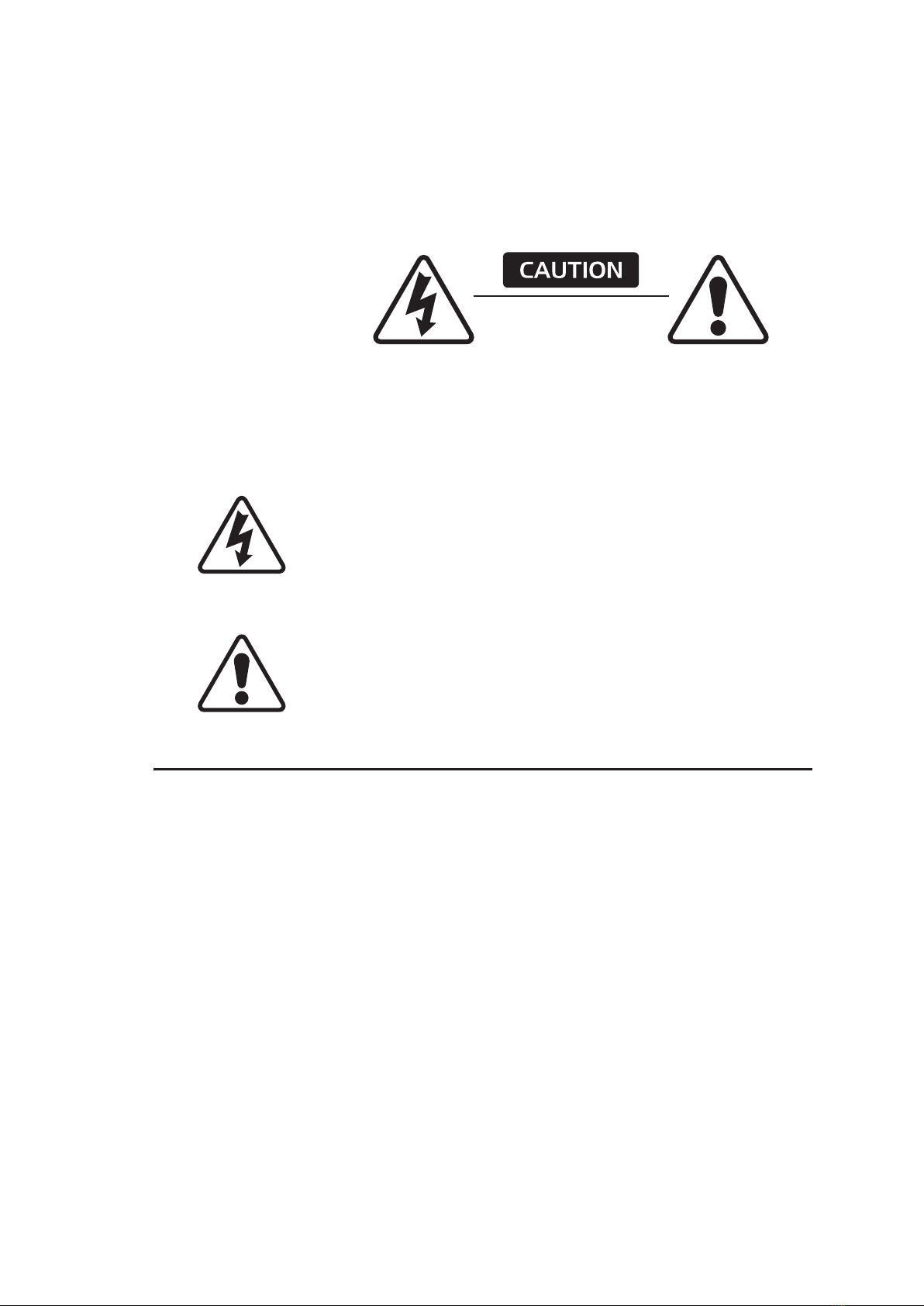
WARNING: TO REDUCE THE RISK OF FIRE OR ELECTRIC SHOCK, DO
NOT EXPOSE THIS APPLIANCE TO RAIN OR MOISTURE.
The lightning flash with arrowhead symbol, within an equilateral
triangle, is intended to alert the user to the presence of uninsulated
“dangerous voltage” within the product’s enclosure that may be of
sufficient magnitude to constitute a risk of electric shock to persons.
The exclamation point within an equilateral triangle is intended to
alert the user to the presence of important operating and
maintenance (servicing) instructions in the literature accompanying
the appliance.
CAUTION: Changes or modifications not expressly approved by the
party responsible for compliance could void the user's authority to
operate the equipment.
RISK OF ELECTRIC SHOCK
DO NOT OPEN
CAUTION: TO REDUCE THE RISK OF ELECTRICAL SHOCK, DO NOT
REMOVE COVER. NO USER-SERVICEABLE PARTS INSIDE. REFER
SERVICING TO QUALIFIED PERSONNEL.
2

Please read all instructions and precautions carefully and
completely before operating your Soloist-50.
1. ALWAYS disconnect your entire system from the AC mains
before connecting or disconnecting any cables, or when
cleaning any component.
2. This product must be terminated with a three-conductor AC
mains power cord that includes an earth ground connection.
To prevent shock hazard, all three connections must ALWAYS
be used.
3. AC extension cords are not recommended for use with this
product
4. NEVER use flammable or combustible chemicals for cleaning
components.
5. NEVER operate this product with any covers removed.
6. NEVER wet the inside of this product with any liquid.
7. NEVER pour or spill liquids directly onto this unit.
8. NEVER block airflow through ventilation slots or heat sinks.
9. NEVER bypass any fuse.
10. NEVER replace any fuse with a value or type other than those
specified.
11. NEVER attempt to repair this product. If a problem occurs,
contact your Clef-Audio retailer.
12. NEVER expose this product to extremely high or low
temperatures.
13. NEVER operate this product in an explosive atmosphere.
14. ALWAYS keep electrical equipment out of the reach of
children.
15. ALWAYS unplug sensitive electronic equipment during
lightning storms.
Important Safety Instructions
3

4
From all of us at Clef Audio,
Thank you for choosing our product.

Unpacking .......................................................................................6
Installation Considerations ...........................................................7
Power Requirements ......................................................................8
Special Design Features .................................................................9
Protections ....................................................................................10
Front Panel ....................................................................................11
Rear Panel .....................................................................................12
Care & Maintenance .....................................................................13
Warranty.................................................................................................................14
Specifications ................................................................................15
Dimensions ...................................................................................16
Table of Contents
5

6
DO NOT attempt to lift or move the Soloist-50 without
adequate assistance. Failure to follow the procedures included
in this section may result in personal injuries and/or product
damage.
DO NOT attempt to lift the Soloist-50 while bending at the
waist. When lifting, stand as straight as possible using the leg
muscles to lift.
When unpacking the Soloist-50:
DO save all packing materials for possible future shipping needs.
DO inspect the Soloist-50 for signs of damage during shipment. If
damage is discovered, contact an authorized Clef Audio dealer for
assistance making appropriate claims.
Unpacking
Caution!
Warning!

Position the Soloist-50 on a stable, horizontal surface where there is
no risk of it being knocked, or subjected to vibration such as from
loudspeakers.
As a “CLASS A/AB” amplifier, the unit dissipates a quantity of
power at all times, and it is important that it is adequately
ventilated. The sides are perforated to allow the smooth flow of
heat through the unit. It is therefore not recommended that the
unit is enclosed in a cabinet or placed where the ventilation holes
on the sides are impeded as this could result in the unit cutting out
due to excessive heat build-up.
Soloist-50 must be protected from humidity - if the unit is
moved from a cold place to a warm room, leave the unit for an hour
or so to allow sufficient time for the moisture to evaporate.
Installation Considerations
Placement
Ventilation
7

8
When shipped, the Soloist-50 is configured for 220-230V AC power
operation at 50Hz. Before operating the Soloist-50 make sure the AC
mains connector label indicates the correct operating voltage for
the current location.
The Soloist-50 has three operating states:
1. Off
Power is disconnected from the AC mains connector or power
switch on rear panel is set “OFF” position.
2. Standby
Power is connected to a small power supply, and control
circuits.
The Soloist-50 consumes less than 30W of power.
3. On
Power is connected to the AC mains connector and all power
components.
The Soloist-50 should be unplugged during lightning storms and
extended periods of non-use. Otherwise, it is designed for
continuous operation. For best performance, make sure power is
connected to the AC mains connector at all times. During normal
operation, do not use the power switch (on the rear panel) to power
off the Soloist-50. Instead, use the on/off button to place the
Soloist-50 into standby.
Power Requirements
Continuous Operation
Operating States

This is the most linear of the amplifier classes, meaning the output
signal is a truer representation of what was imputed. The output
device (transistor) conducts electricity for the entire cycle of input
signal. In other words, they reproduce the entire waveform in its
entirety. These amps run hot, as the transistors in the power amp
are on and running at full power all the time.
Because of these factors, Class A amplifiers are very inefficient for
every watt of output power, they usually waste some watts as heat.
Because of the watts of heat energy released they run very hot,
needing lots of ventilation. But the upside is that these amps are
the most enjoyed of all amplifiers. These amps dig out musical
detail, since the transistor reproduces the entire audio waveform
without ever cutting off. As a result the sound is cleaner and more
linear; that is, it contains much lower levels of distortion. They are
the most accurate of all amps available.
Dual mono design topology. This gives the amplifier better isolation
between channels. Soundstage imaging is improved, offering true
soundstage width and depth. Instrument placement and layering
are more accurate.
The traditional potentiometer is implemented with an electrical
contact that slides over a resistive layer that cause the problem such
as quality of the electrical contact, consistency between separate
audio channels, sensitive to dust. DSA Volume ( Digital Controlled
Step Attenuator Volume) using discrete resistors and relays as
switches solve those problems and improve quality of sound.
Soloist-50 balanced input operates as a differential circuit, and any
unwanted noise, hum, or interference common to both lines is
therefore canceled .
Special Design Features
Class-A Design Circuit
Dual-Mono Design
DSA Volume
True Balanced Input
9

The Speaker Protection Circuit has two main functions:
1. To protect the power amplifier and the loudspeakers during
start-up sequence when the amplifier output might exhibit DC
voltage.
2. To protect the loudspeakers in the unlikely event of an amplifier
power stage failure, where DC component would damage the
speaker voice coil.
Protections
Speaker Protection
10
Indice
Altri manuali Clef Audio Amplificatore


