CML Microcircuits CMX866 Manuale utente

CMLMicrocircuits
COMMUNICATION SEMICONDUCTOR
S
CMX866
V.22 bis Modem
with AT Commands
©2008 CML Microsystems Plc
D/866/5 May 2008 Provisional Issue
Features Applications
•V.22 bis, V.22 and Bell 212A QAM/DPSK •Telephone Telemetry Systems
•V.23, Bell 202, V.21 and Bell 103 FSK •Remote Utility Meter Reading
•Integral AT Command Set with 'Fast Connect' •Security Systems
•V.23 and Bell 202 'Fast Turnaround' •Industrial Control Systems
•Support for Type 1 Caller Line Identification •Electronic Cash Terminals / ATMs
•DTMF/Programmable Tones: Transmit and Receive •Pay-Phones
•'Zero-Power' and Powersave Standby Modes •Cable TV Set-Top Boxes
•Low Power Operation •EPOS Terminals
1.1 Brief Description
The CMX866 is a multi-standard modem for use in telephone based information and telemetry systems.
Control of the device is via AT commands over a simple 9600b/s serial interface, compatible with most
types of host µController. An RS232 compatible interface can be created by the addition of a Level
Converter. The data transmitted and received by the modem is also transferred over the same serial
interface. The on-chip µController interprets these AT commands and controls an internal DSP, which
provides the modem and anciliary functions such as Ring Detection, Call Progress Detection, Hook
Switch control and DTMF autodialling. User-specific DSP functions are also available via the AT
command set.
Hardware support is provided for V.23 and Bell 202 Fast Turnaround and for rapid return to AT Command
mode. A Fast Connect mode has been implemented to reduce modem connection time. Flexible line
driver and receive hybrid circuits are integrated on chip, requiring only passive external components to
build a 2 or 4-wire line interface. Complete examples of 2-wire line interfaces to an external host µC and
to an RS232 interface, including the additional components required for Type 1 CLI, are provided.
The device features a Hook Switch relay drive output and a Ring Detector circuit that remain operational
when the CMX866 is in 'Zero-Power' or Powersave mode, providing an interrupt which can be used to
wake up an external host µC, as well as the CMX866, when line voltage reversal or ringing is detected.
The device is also able to detect off-hook parallel phones by monitoring voice activity on the line.
The CMX866 takes 5mA (typ.) from a single 2.7–5.5V supply and comes in 28-pin SSOP/SOIC packages.

V.22 bis Modem with AT Commands CMX866
©2008 CML Microsystems Plc 2 D/866/5
CONTENTS
Section Page
1.1 Brief Description.................................................................................................1
1.2 Block Diagram.....................................................................................................3
1.3 Signal List............................................................................................................4
1.4 External Components.........................................................................................6
1.4.1 Ring Detector Interface .........................................................................8
1.4.2 Line Interface..........................................................................................9
1.4.3 Serial Interface .....................................................................................11
1.4.4 RESETN pin..........................................................................................12
1.5 General Description..........................................................................................13
1.5.1 Internal Structure.................................................................................13
1.5.2 Operating States and Data Flow.........................................................14
1.5.3 Functional Description........................................................................16
1.5.4 AT Command and Register Set..........................................................17
1.5.4.1 AT Command and S-Register Summary...............................17
1.5.4.2 General Description of AT Commands.................................19
1.5.4.3 AT Commands in Detail..........................................................20
1.5.4.4 Extended AT Commands .......................................................23
1.5.4.5 S-Registers..............................................................................26
1.5.4.6 Result Codes...........................................................................30
1.5.5 Tx USART..............................................................................................30
1.5.6 FSK and QAM/DPSK Modulators .......................................................32
1.5.7 Tx Filter and Equaliser ........................................................................33
1.5.8 DTMF/Tone Generator.........................................................................33
1.5.9 Tx Level Control and Output Buffer...................................................33
1.5.10 Rx DTMF/Tones Detectors..................................................................34
1.5.11 Rx Modem Filterering and Demodulation..........................................35
1.5.12 Rx Modem Pattern Detectors and Descrambler ...............................36
1.5.13 Rx Data Register and USART .............................................................36
1.6 Application Notes .............................................................................................38
1.6.1 Hardware Interface ..............................................................................38
1.6.2 Calling Modem AT Commands...........................................................43
1.6.3 Answering Modem AT Commands ....................................................43
1.6.4 RS232 Transaction Sequence ............................................................44
1.7 Performance Specification...............................................................................45
1.7.1 Electrical Performance........................................................................45
1.7.1.1 Absolute Maximum Ratings...................................................45
1.7.1.2 Operating Limits .....................................................................45
1.7.1.3 Operating Characteristics......................................................46
1.7.2 Packaging.............................................................................................52
It is always recommended that you check for the latest product datasheet version from the
Datasheets page of the CML website: [www.cmlmicro.com].

V.22 bis Modem with AT Commands CMX866
©2008 CML Microsystems Plc 3 D/866/5
1.2 Block Diagram
Figure 1 Block Diagram

V.22 bis Modem with AT Commands CMX866
©2008 CML Microsystems Plc 4 D/866/5
1.3 Signal List
CMX866
D1/D6 Signal Description
Pin No. Name Type
1 XTALN O/P The output of the on-chip Xtal oscillator inverter.
2 XTAL/CLOCK I/P The input to the oscillator inverter from the Xtal
circuit or external clock source.
3 N/C ~ Reserved for future use. Connect this pin to
DVSS.
4 N/C ~ Reserved for future use. Connect this pin to
DVSS.
5 RDRVN O/P
Relay drive output, low resistance pull down to
DVSS when active and medium resistance pull
up to DVDD when inactive.
6 DVSS Power
The negative supply rail for the digital on-chip
blocks.
7 RD I/P
Schmitt trigger input to the Ring signal detector.
Connect to DVSS if Ring Detector not used.
8 RT BI
Open drain output and Schmitt trigger input
forming part of the Ring signal detector. Connect
to DVDD if Ring Detector not used.
9 RESETN I/P Schmitt trigger input to an active-low reset pin.
Connect to DVDD if no external reset signal used
10 RXAFB O/P The output of the Rx Input Amplifier.
11 RXBN I/P
An alternative, switched inverting input to the Rx
Input Amplifier, used to increase the amplifier
gain for the detection of on-hook signals. If this
input is not required, leave the pin disconnected.
12 RXAN I/P
The inverting input to the Rx Input Amplifier
13 RXA I/P
The non-inverting input to the Rx Input Amplifier.
If this pin is to be connected to VBIAS then it
should also be decoupled to AVSS locally.
14 AVSS Power
The negative supply rail for the analogue on-
chip blocks.
15 VBIAS O/P Internally generated bias voltage of
approximately AVDD /2, except when the device
is in Powersave or 'Zero-Power' modes, when
VBIAS will discharge to AVSS. This pin should be
decoupled to AVSS by a capacitor mounted
close to the device pins.
16 TXAN O/P
The inverted output of the Tx Output Buffer.
17 TXA O/P
The non-inverted output of the Tx Output Buffer.

V.22 bis Modem with AT Commands CMX866
©2008 CML Microsystems Plc 5 D/866/5
CMX866
D1/D6 Signal Description
18 AVDD Power The positive supply rail for the analogue on-chip
blocks. Levels and thresholds within the device
are proportional to this voltage.
19 DCDN O/P The inverted DCD signal used for an RS232
interface with a Level Converter.
20 DSRN O/P The inverted DSR signal used for an RS232
interface with a Level Converter.
21 CTSN O/P The inverted CTS signal used for an RS232
interface with a Level Converter.
22 DTRN I/P The inverted DTR signal used for an RS232
interface with a Level Converter.
23 RTSN I/P The inverted RTS signal used for an RS232
interface with a Level Converter.
24 TXD I/P The non-inverted TD signal used for an RS232
interface with a Level Converter. This pin
accepts data from the external host µC for
transmission over the phone line.
25 RXD O/P The non-inverted RD signal used for an RS232
interface with a Level Converter. This pin sends
data to the external host µC which was received
over the phone line.
26 ESC I/P An auxiliary pin to force the CMX866 into
Command Mode from Data Mode and remain
off-hook. The ATO command will return the
CMX866 to Data Mode. This pin should be
connected to DVSS if not required.
27 RIN O/P
The inverted RI signal used for an RS232
interface with a Level Converter. This is a 'wire-
ORable' output for connection to an external
host µC Interrupt Request input. This output is
pulled down to DVSS when active and is high
impedance when inactive. An external pullup
resistor is required (eg. R1 in Figure 2a).
28 DVDD Power The positive supply rail for the digital on-chip
blocks. Levels and thresholds within the device
are proportional to this voltage.
Notes:
I/P = Input
O/P = Output
BI = Bidirectional
T/S = 3-state Output
NC = No Connection

V.22 bis Modem with AT Commands CMX866
©2008 CML Microsystems Plc 6 D/866/5
1.4 External Components
C1, C2 22pF C3, C4, C6 100nF
R1
100kΩC5, C7 10uF
X1 11.0592MHz L1, L2 100nH
(optional)
Resistors ±5%, capacitors ±20% unless otherwise stated.
Figure 2a Recommended External Components for Typical Application
This device is capable of detecting and decoding small amplitude signals. To achieve this DVDD, AVDD
and VBIAS should be decoupled and the receive path protected from extraneous in-band signals. It is
recommended that the printed circuit board is laid out with both AVSS and DVSS ground planes in the
CMX866 area, as shown in Figure 2b, with provision to make a link between them close to the CMX866.
To provide a low impedance connection to ground, the decoupling capacitors (C3 – C7) must be mounted
as close to the CMX866 as possible and connected directly to their respective ground plane. This will be
achieved more easily by using surface mounted capacitors.
VBIAS is used as an internal reference for detecting and generating the various analogue signals. It must
be carefully decoupled, to ensure its integrity. Apart from the decoupling capacitor shown (C3), no other
loads are allowed. If VBIAS needs to be used to set external analogue levels, it must be buffered with a
high input impedance buffer.
The DVSS connections to the Xtal oscillator capacitors C1 and C2 should also be of low impedance and
preferably be part of the DVSS ground plane to ensure reliable start up of the oscillator.

V.22 bis Modem with AT Commands CMX866
©2008 CML Microsystems Plc 7 D/866/5
Figure 2b Recommended Power Supply Connections and De-coupling
ANALOGUE DIGITAL
C3, C6 100nF C4 100nF
C7 10uF C5 10uF
L2 100nH
(optional, see note)
L1 100nH
(optional, see note)
Note: The inductors L1 and L2 and the electrolytic capacitor C7 can be omitted without significantly
degrading the system performance.

V.22 bis Modem with AT Commands CMX866
©2008 CML Microsystems Plc 8 D/866/5
1.4.1 Ring Detector Interface
Figure 3 shows how the CMX866 may be used to detect the large amplitude Ringing signal voltage
present on the 2-wire line at the start of an incoming telephone call.
The ring signal is usually applied at the subscriber's exchange as an ac voltage inserted in series with one
of the telephone wires and will pass through either C20 and R20 or C21 and R21 to appear at the top end
of R22 (point X in Figure 3) in a rectified and attenuated form.
The signal at point X is further attenuated by the potential divider formed by R22 and R23 before being
applied to the CMX866 RD input. If the amplitude of the signal appearing at RD is greater than the input
threshold (Vthi) of Schmitt trigger 'A' then the N transistor connected to RT will be turned on, pulling the
voltage at RT to DVSS by discharging the external capacitor C22. The output of the Schmitt trigger 'B' will
then go high, setting bit 14 (Ring Detect) of the DSP Status Register. The on-chip µController will then
respond by setting pin RIN low.
The minimum amplitude ringing signal that is certain to be detected is:
( 0.7 + Vthi x [R20 + R22 + R23] / R23 ) x 0.707 Vrms
where Vthi is the high-going threshold voltage of the Schmitt trigger A (see section 1.7.1).
With R20-22 all 470kΩas Figure 3, setting R23 to 68kΩwill guarantee detection of ringing signals of
40Vrms and above for DVDD over the range 3 to 5V.
R20, 21, 22 470kΩC20, 21 0.1μF
R23 See text C22
0.33μF
R24
470kΩD1-4 1N4004
Resistors ±5%, capacitors ±20%
Figure 3 Ring Signal Detector Interface Circuit

V.22 bis Modem with AT Commands CMX866
©2008 CML Microsystems Plc 9 D/866/5
If the time constant of R24 and C22 is large enough then the voltage on RT will remain below the
threshold of the 'B' Schmitt trigger for the duration of a ring cycle. The time for the voltage on RT to
charge from DVSS towards DVDD can be derived from the formula:
VRT = DVDD x [1 - exp(-t/(R24 x C22)) ]
As the Schmitt trigger high-going input threshold voltage (Vthi) has a minimum value of 0.56 x DVDD, then
the Schmitt trigger B output will remain high for a time of at least 0.821 x R24 x C22 following a pulse at
RD. The values of R24 and C22 given in Figure 3 (470kΩand 0.33μF) give a minimum RT charge time of
100msec, which is adequate for ring frequencies of 10Hz or above.
Note that this circuit will also respond to a telephone line voltage reversal. The external host μC can
distinguish between a Ring signal and a line voltage reversal by measuring the time that pin RIN is low.
If the Ring detect function is not used then pin RD should be connected to DVSS and RT to DVDD.
1.4.2 Line Interface
A line interface circuit is needed to provide dc isolation and to terminate the line.
2-Wire Line Interface
Figure 4a shows a simplified interface for use with a 600Ω2-wire line. The complex line termination is
provided by R13 and C10, high frequency noise is attenuated by C10 and C11, while R11 and R12 set
the receive signal level into the modem. For clarity the 2-wire line protection circuits and the connection
to RXBN (for on-hook CLI applications) have not been shown.
R11 See text C3 See Figure 2
R12
100kΩC10 33nF
R13
600ΩC11 100pF
Resistors ±5%, capacitors ±20%
Figure 4a 2-Wire Line Interface Circuit

V.22 bis Modem with AT Commands CMX866
©2008 CML Microsystems Plc 10 D/866/5
The transmit line signal level is determined by the voltage swing between the TXA and TXAN pins, less
6dB due to the line termination resistor R13, and less the loss in the line coupling transformer. Allowing
for 1dB loss in the transformer, then with the DSP Tx Mode Register set for a Tx Level Control gain of
0dB (S25 register set to 'xxxxx111') the nominal transmit line levels will be:
AVDD = 3.0V AVDD = 5.0V
QAM, DPSK and FSK Tx modes (no guard tone) -10dBm -5.5dBm
Single tone transmit mode -10dBm -5.5dBm
DTMF transmit mode -6 and -8 dBm -1.5 and -3.5 dBm
For a line impedance of 600Ω, 0dBm = 775mVrms. See also section 1.7.1.3
In the receive direction, the signal detection thresholds within the CMX866 are proportional to AVDD and
are affected by the Rx Gain Control gain setting in the DSP Rx Mode Register (as indicated by the value
held in the S26 register). The signal level into the CMX866 is affected by the line coupling transformer
loss and the values of R11 and R12 of Figure 4a.
Assuming 1dB transformer loss, the Rx Gain Control programmed to 0dB (S26 register set to 'xxxxx111')
and R12 = 100kΩ, then for correct operation (see section 1.7.1.3) the value of R11 should be equal to:
500 / AVDD kΩi.e. 160kΩat 3.0V, falling to 100kΩat 5.0V
When the RDRVN pin is high impedance (= on-hook = inactive) the auxiliary receive input pin RXBN is
internally connected to the RXAN pin. This can be used to increase the Rx gain (required for Type 1
Caller Line Identification reception) by reducing the effective value of R11, as shown in Figures 11 and 12.
When the RDRVN pin is low (= off-hook = active) the RXBN pin is not connected.
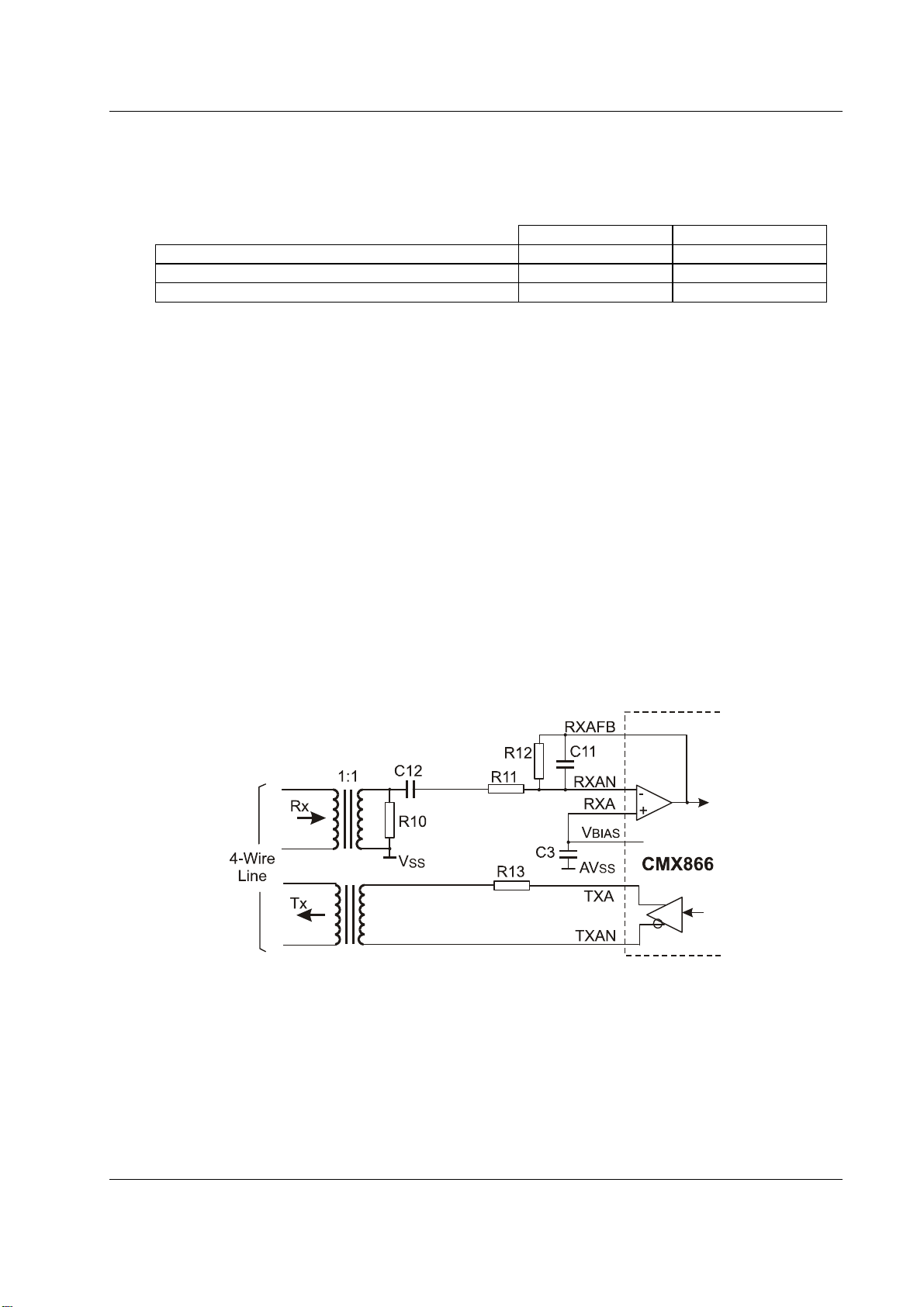
4-Wire Line Interface
Figure 4b shows an interface for use with a 600Ω4-wire line. The line terminations are provided by R10
and R13, high frequency noise is attenuated by C11 while R11 and R12 set the receive signal level into
the modem. Transmit and receive line level settings and the value of R11 are as for the 2-wire circuit.
R10, 13
600ΩC3 See Figure 2
R11 See text C11 100pF
R12
100kΩC12 33nF
Resistors ±5%, Capacitors ±20%
Figure 4b 4-Wire Line Interface Circuit
Questo manuale è adatto per i seguenti modelli
1
Indice