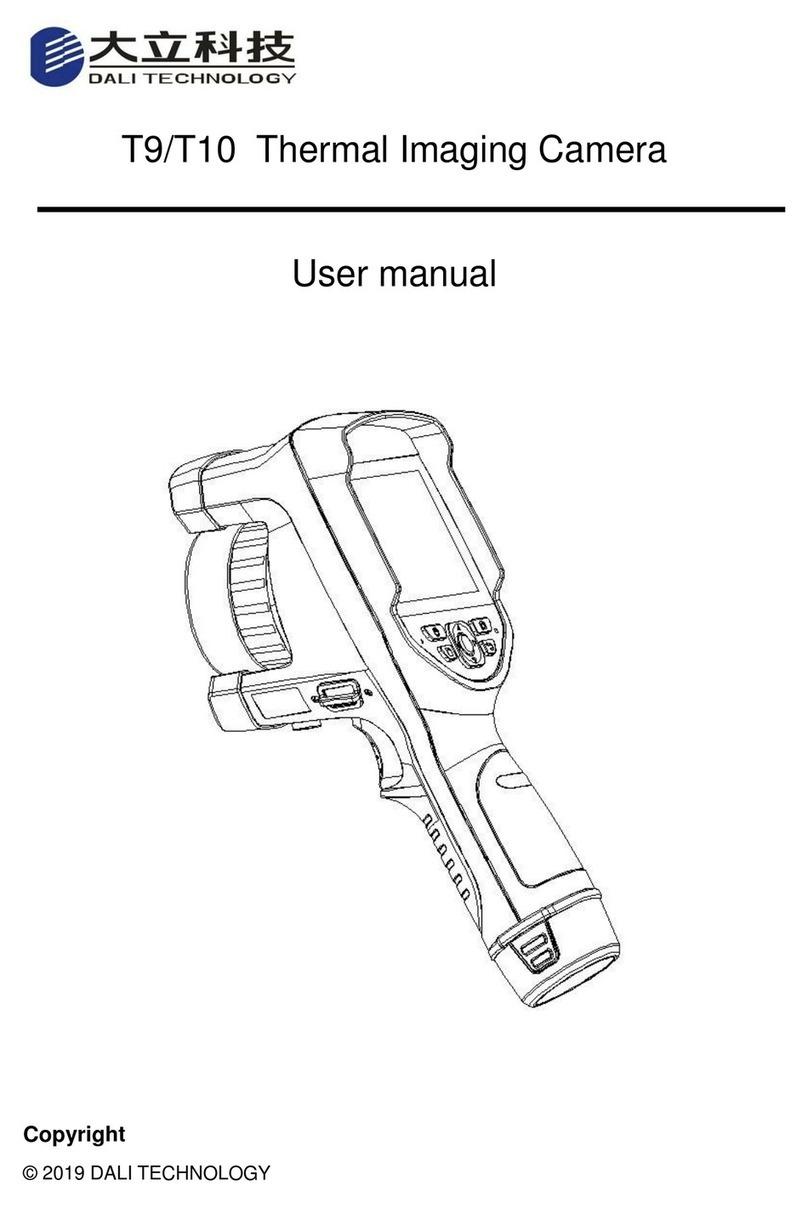
Dali LT3 Manuale utente

LT3/LT7
Thermal Image Camera
User Manual
ZHEJIANG DALI TECHNOLOGY CO LTD

1
LT3/LT7 Thermal Image Camera User Manual
DALI
Warnings, Cautions and Notes
Definitions
WARNING Could cause bodily injury or death.
CAUTION Could cause damage to equipment or permanent loss of data.
NOTE provides useful information to the operator.
Important Information-Read before using the Instrument
WARNING - Laser Radiation is emitted from this device. Do Not stare into Laser
Beam. Class 2 Laser, 635 nm, 0.9mW.
CAUTION - Never point the lens directly toward a strong radiation source (ie. Sun,
direct or reflected laser beam, etc ), with power on or power off, as damage may
result to the thermal detector used inside. Permanent damage may result!
CAUTION - The original shipping carton should be kept for use for future
transportation. Do not drop, shake or impact the thermal imager excessively, in use
or during transportation.
CAUTION - Store the unit in its original case in a cool, dry, well-ventilated area
away from strong electromagnetic fields.
CAUTION - Protect the surface of the lens from being stained or damaged by
foreign objects such as sludge or chemicals. Please replace the lens cap after use.
CAUTION - Please remember to backup image data regularly to avoid losing
important data.
NOTE - For maximum measurement accuracy, allow 3 to 5 minutes for camera to
stabilize after initial power up.
NOTE - Each camera is factory calibrated. It is recommended that calibration be
performed every 12 months.
CAUTION - Do not open case. Unit does not contain any user serviceable parts.
Repair should be performed by factory authorized technicians only.

2
LT3/LT7 Thermal Image Camera User Manual
DALI
Contents
Warnings, Cautions and Notes 1
1 Introduction 4
1.1 Standard accessories 6
1.2 Optional accessories 6
2 Camera overview 7
2.1 Function keys 7
2.2 Interface 11
3 Basic operation 12
3.1 Battery Installation and Replacement 12
3.1.1 Inserting or removing battery 12
3.1.2 Replacing battery 13
3.2 Battery safety and usage 14
3.3 Quick access 15
3.3.1 Capture an image 15
3.3.2 Temperature measurement 15
3.3.3 Freeze and save image 16
3.3.4 Viewing stored Images 16
3.3.5 Export saved images 17
4 Operation guide 18
4.1 Graphic interface description 18
4.1.1 Screen graphic interface 18
4.1.2 Main menu 19
4.1.3 Dialog box 19
4.1.4 Prompt box interface 20
4.2 Measurement 20
4.3 Auto/Manually 21
4.4 Setup menu 22
4.4.1 Measuring Setup 22
4.4.2 Adjustment setup 23
4.4.3 Analysis setup 24
4.4.4 Date/Time setup 25

3
LT3/LT7 Thermal Image Camera User Manual
DALI
4.4.5 System setup 25
4.4.6 System Info 27
4.4.7 Factory Default 27
4.5 File 28
4.5.1 Open 28
4.5.2 Save 29
4.5.3 Save Setting 31
4.5.4 Auto Save 32
4.5.5 Delete 32
4.5.6 Format 33
5 Technical specifications 34
Troubleshooting 36
Appendix A 37
Common material emissivity(FYI) 37
Appendix B 38
Factory default parameter setting table 38

4
LT3/LT7 Thermal Image Camera User Manual
DALI
1 Introduction
Thank you for choosing DALI Instruments “LT3” or “LT7” hand-held
infrared thermal imager.
Model Identification
LT3 imagers use the detector with 25um 160×120, and measurement range
from -20℃~ +350℃
LT7 imagers use the detector with 25um 384×288, and measurement range
from -20℃~ +650℃
Features
LT3\LT7 include the following features:
User selectable Auto or manual level and span control
℃ , ℉or K measurement scale
11 user selectable color palettes
9 user selectable languages
Hot temperature spot measurement
Cold temperature spot measurement
4 removable spot measurements
High temperature Alarm setting
T Reflect - Reflected temperature compensation
2X digital zoom
Freeze screen for viewing current image
Video Output NTSC or PAL
3 Areas measurements
2 lines measurements
Image storage via TF card
CMOS visible image and storage
Audio recording
Isotherm Alarm
T Correct Measurement Offset correction
Built in Emissivity Table list of common materials

5
LT3/LT7 Thermal Image Camera User Manual
DALI
Upgrades and Options
LT3<7 Series models are factory upgradeable for Wide Angle or Telephoto
Lenses.
Applications:
Preventive maintenance
● Power industry: Power line and power facility thermal state checking;
problem and defect diagnosis.
● Electrical system: Identify potential circuit overloads.
● Mechanical system: Reduce downtime and avoid catastrophic failure.
Construction science
● Roof: Quick identification of water penetration problems.
● Structure: Commercial and residential energy audits.
● Moisture detection: Determine root cause of moisture and mildew.
● Evaluation:Evaluate the resolution to ensure the area completely dry.
Others
● Iron and steel industry: Inspect steel refining and rolling processes; diagnose
hot-blast stove defects; detect the embryo temperature of armor plate, etc.
● Fire fighting: Forest fire prevention and detection of latent ignition source.
Preventive detection on specific materials of auto-ignition. Detection of potential
spark ignition sources.
● Medical: Human body surface temperature detection and screening.
● Petro/chemical: Oil pipeline status inspection; material surface temperature
detection; insulation inspection; power equipment status, etc.

6
LT3/LT7 Thermal Image Camera User Manual
DALI
1.1 Standard accessories
Infrared thermal image camera (with wrist strap)
Carrying case
Video out cable
Lithium batteries(2)
User manual, Infrared report and analysis software system CD
Lithium battery charger
Lens cap
TF card
TF card reader
USB cable
1.2 Optional accessories
External 0.5x wide-angle lens
External 2x telescopic lens
Sun Shield patch
European standard plug, British standard plug, Australia standard plug
Power adapter(with power cable and plug)
User Manual, Report Software User Manual

7
LT3/LT7 Thermal Image Camera User Manual
DALI
2 Camera overview
2.1 Function keys

8
LT3/LT7 Thermal Image Camera User Manual
DALI
[1] Power key
Press and hold the Power Key for > 3 seconds to power on/off the camera.
Note: After powering off, please wait ten seconds before powering the camera on
again.
[2] Select/Auto key (Marked “A”)
The “A” or attribute button performs 2 functions.
a) The first function is modification of selected parameters. It is obtained by a quick
press and release (less than 2 seconds), with this functions to modify their parameters.
Subsequent presses will “scroll” through the available parameters. The selected
function will be highlighted in yellow. The functions include:
● Measurement points, areas, and lines
Cursors and lines - pressing the arrow keys will move their position. Pressing the
Menu key will pop up the attribute box. Pressing the C key will delete the selected
parameter.
Areas – Arrow keys adjust the attribute specified in the pop up attribute box.
Pressing the Menu key will pop up the attribute box. In this box, the user can select to
adjust either position or size of the area. After selection, the arrows will then adjust the
attribute.
● Color Palette
Pressing the left or right arrows will scroll through the available color palettes,
displaying their name above the palette. The selected palette will become active after
about 3 seconds of selecting it and will be set as the default power on palette.
● Level/Span values
Pressing the left or right arrow will reduce or increase the Span and pressing the up
or down arrow will reduce or increase the Level. If the unit is in Automatic mode,
modifying any of these parameters will select Manual mode.
b)The second function performed is to force an internal calibration cycle. This is
performed by pressing and holding the A key for 5 seconds or more. The camera will
make automatic correction to get the most accurate thermal measurement.
[3] Cancel/Camera key (Marked “C”)
● Pressing and releasing the C key cancels the present operation when in Menu
mode.
● Pressing and releasing the C key when an image is frozen or being viewed from

9
LT3/LT7 Thermal Image Camera User Manual
DALI
memory, will return to real-time measurement status.
● When not in menu mode or parameter editing, pressing and releasing the C key
will toggle between the thermal image and the visible CCD camera image.
● When a parameter is selected, such as a measurement cursor, pressing the C key
will delete the highlighted measurement.
[4] Freeze/Save key (Marked “S”)
Used for freezing or saving thermal image. Press the key once to freeze the image.
Press Confirm to save the image or Press C to return to real-time measurement. If Voice
recording is enabled, Voice comment dialog box will display.
[5] Menu/Confirm key (bar)
Includes Up, Down, Left, Right and Menu/Confirm (center) keys. Function varies
with operation mode.
In Menu mode, it is used for menu selection. Up and Down keys are for same level
of menu operation. Left and Right keys are for different levels menu operation. Confirm
key (center) is to activate the menu and confirm the choice.
In Image mode, press Up or Down key to activate X2 digital zoom. The screen will
display “X2” in the upper left corner. Press Up or Down key to return to the original
image.
In Spot Measurement editing mode (activated immediately after adding a spot or
by selecting via the A key), press the Menu key to pop up the attribute box. Press four
navigation keys to move the spot location.
In line temperature measurement editing mode (activated immediately after adding
a line or by selecting via the A key), press the Menu key to pop up the attribute box.
If measurement line is horizontal, press Up and Down keys to move the line location;
press Left and Right keys to move the reference line. If measurement line is vertical, press
Left and Right keys to move the line; press Up and Down keys to move the reference
line.
In area measurement editing mode (activated immediately after adding an area or
by selecting via the A key), press the Confirm key to pop up the attribute box. Select
in the attribute box the parameter to be edited, either size or position. Press the four
navigation keys to move the area location or change the size of the area.
[6] Trigger/Shortcut key
The trigger key serves as a shortcut to access the following functions:
Questo manuale è adatto per i seguenti modelli
1
Indice
Altri manuali Dali Telecamera termica