
Delta ShopMaster BS100 Manuale utente

INSTRUCTION MANUAL
9" Bench Band Saw
(Model BS100)
PART NO. A03049 - 03-05-04
Copyright © 2004 Delta Machinery
ESPAÑOL: PÁGINA 25
To learn more about DELTA MACHINERY
visit our website at: www.deltamachinery.com.
For Parts, Service, Warranty or other Assistance,
please call 1-800-223-7278 (In Canada call 1-800-463-3582).
2
Indicates an imminently hazardous situation which, if not avoided, will result in death or serious injury.
Indicates a potentially hazardous situation which, if not avoided, could result in death or serious injury.
Indicates a potentially hazardous situation which, if not avoided, may result in minor or moderate injury.
Used without the safety alert symbol indicates potentially hazardous situation which, if not avoided, may
result in property damage.
This manual contains information that is important for you to know and understand. This information relates to protect-
ing YOUR SAFETY and PREVENTING EQUIPMENT PROBLEMS. To help you recognize this information, we use the
symbols to the right. Please read the manual and pay attention to these sections.
SAFETY GUIDELINES - DEFINITIONS
SOME DUST CREATED BY POWER SANDING, SAWING, GRINDING, DRILLING, AND OTHER
CONSTRUCTION ACTIVITIES contains chemicals known to cause cancer, birth defects or other reproductive harm.
Some examples of these chemicals are:
· lead from lead-based paints,
· crystalline silica from bricks and cement and other masonry products, and
· arsenic and chromium from chemically-treated lumber.
Your risk from these exposures varies, depending on how often you do this type of work. To reduce your exposure to
these chemicals: work in a well ventilated area, and work with approved safety equipment, always wear MSHA/NIOSH
approved, properly fitting face mask or respirator when using such tools.
GENERAL SAFETY RULES
READ AND UNDERSTAND ALL WARNINGS AND OPERATING INSTRUCTIONS BEFORE
USING THIS EQUIPMENT. Failure to follow all instructions listed below, may result in electric shock,
fire, and/or serious personal injury or property damage.
IMPORTANT SAFETY INSTRUCTIONS
Woodworking can be dangerous if safe and proper operating procedures are not followed. As with all machinery, there
are certain hazards involved with the operation of the product. Using the machine with respect and caution will
considerably lessen the possibility of personal injury. However, if normal safety precautions are overlooked or ignored,
personal injury to the operator may result. Safety equipment such as guards, push sticks, hold-downs, featherboards,
goggles, dust masks and hearing protection can reduce your potential for injury. But even the best guard won’t make
up for poor judgment, carelessness or inattention. Always use common sense and exercise caution in the workshop.
If a procedure feels dangerous, don’t try it. Figure out an alternative procedure that feels safer. REMEMBER: Your
personal safety is your responsibility. For additional information please visit our website www.deltamachinery.com.
This machine was designed for certain applications only. Delta Machinery strongly recommends that this
machine not be modified and/or used for any application other than that for which it was designed. If you have any
questions relative to a particular application, DO NOT use the machine until you have first contacted Delta to determine
if it can or should be performed on the product.
Technical Service Manager
Delta Machinery
4825 Highway 45 North
Jackson, TN 38305
(IN CANADA: 505 SOUTHGATE DRIVE, GUELPH, ONTARIO N1H 6M7)

3
GENERAL SAFETY RULES
1. FOR YOUR OWN SAFETY, READ THE INSTRUC-
TION MANUAL BEFORE OPERATING THE
MACHINE. Learning the machine’s application,
limitations, and specific hazards will greatly
minimize the possibility of accidents and injury.
2. USE CERTIFIED SAFETY EQUIPMENT. Eye
protection equipment should comply with ANSI
Z87.1 standards, hearing equipment should
comply with ANSI S3.19 standards, and dust mask
protection should comply with MSHA/NIOSH
certified respirator standards. Splinters, air-borne
debris, and dust can cause irritation, injury, and/or
illness.
3. DRESS PROPERLY. Do not wear tie, gloves, or
loose clothing. Remove watch, rings, and other
jewelry. Roll up your sleeves. Clothing or jewelry
caught in moving parts can cause injury.
4. DO NOT USE THE MACHINE IN A DANGEROUS
ENVIRONMENT. The use of power tools in damp
or wet locations or in rain can cause shock or
electrocution. Keep your work area well-lit to
prevent tripping or placing arms, hands, and
fingers in danger.
5. MAINTAIN ALL TOOLS AND MACHINES IN PEAK
CONDITION. Keep tools sharp and clean for best and
safest performance. Follow instructions for lubricating
and changing accessories. Poorly maintained tools and
machines can further damage the tool or machine and/or
cause injury.
6. CHECK FOR DAMAGED PARTS. Before using the
machine, check for any damaged parts. Check for
alignment of moving parts, binding of moving
parts, breakage of parts, and any other conditions
that may affect its operation. A guard or any other
part that is damaged should be properly repaired
or replaced. Damaged parts can cause further
damage to the machine and/or injury.
7. KEEP THE WORK AREA CLEAN. Cluttered areas and
benches invite accidents.
8. KEEP CHILDREN AND VISITORS AWAY. Your shop is
a potentially dangerous environment. Children and visitors
can be injured.
9. REDUCE THE RISK OF UNINTENTIONAL STARTING.
Make sure that the switch is in the “OFF” position
before plugging in the power cord. In the event of
a power failure, move the switch to the “OFF”
position. An accidental start-up can cause injury.
10. USE THE GUARDS. Check to see that all guards
are in place, secured, and working correctly to
prevent injury.
11. REMOVE ADJUSTING KEYS AND WRENCHES
BEFORE STARTING THE MACHINE. Tools, scrap
pieces, and other debris can be thrown at high
speed, causing injury.
12. USE THE RIGHT MACHINE. Don’t force a
machine or an attachment to do a job for which it
was not designed. Damage to the machine and/or
injury may result.
13. USE RECOMMENDED ACCESSORIES. The use
of accessories and attachments not recom-
mended by Delta may cause damage to the
machine or injury to the user.
14. USE THE PROPER EXTENSION CORD. Make
sure your extension cord is in good condition.
When using an extension cord, be sure to use one
heavy enough to carry the current your product will
draw. An undersized cord will cause a drop in line
voltage, resulting in loss of power and overheating.
See the Extension Cord Chart for the correct size
depending on the cord length and nameplate
ampere rating. If in doubt, use the next heavier
gauge. The smaller the gauge number, the heavier
the cord.
15. SECURE THE WORKPIECE. Use clamps or a vise to
hold the workpiece when practical. Loss of control
of a workpiece can cause injury.
16. FEED THE WORKPIECE AGAINST THE DIRECTION
OF THE ROTATION OF THE BLADE, CUTTER, OR
ABRASIVE SURFACE. Feeding it from the other
direction will cause the workpiece to be thrown out
at high speed.
17. DON’T FORCE THE WORKPIECE ON THE
MACHINE. Damage to the machine and/or injury
may result.
18. DON’T OVERREACH. Loss of balance can make
you fall into a working machine, causing injury.
19. NEVER STAND ON THE MACHINE. Injury could occur if
the tool tips, or if you accidentally contact the cutting tool.
20. NEVER LEAVE THE MACHINE RUNNING UNATTEN-
DED. TURN THE POWER OFF. Don’t leave the machine
until it comes to a complete stop. A child or visitor could
be injured.
21. TURN THE MACHINE “OFF”, AND DISCONNECT THE
MACHINE FROM THE POWER SOURCE before
installing or removing accessories, before adjusting
or changing set-ups, or when making repairs. An
accidental start-up can cause injury.
22. MAKE YOUR WORKSHOP CHILDPROOF WITH
PADLOCKS, MASTER SWITCHES, OR BY
REMOVING STARTER KEYS. The accidental
start-up of a machine by a child or visitor could
cause injury.
23. STAY ALERT, WATCH WHAT YOU ARE DOING,
AND USE COMMON SENSE. DO NOT USE THE
MACHINE WHEN YOU ARE TIRED OR UNDER
THE INFLUENCE OF DRUGS, ALCOHOL, OR
MEDICATION. A moment of inattention while
operating power tools may result in injury.
24. THE DUST GENERATED by certain woods and
wood products can be injurious to your health.
Always operate machinery in well-ventilated areas,
and provide for proper dust removal. Use wood
dust collection systems whenever possible.
FAILURE TO FOLLOW THESE RULES MAY RESULT IN SERIOUS INJURY.

4
ADDITIONAL SAFETY RULES FOR
BAND SAWS
1. DO NOT OPERATE THIS MACHINE UNTIL it is
assembled and installed according to the
instructions.
2. OBTAIN ADVICE from your supervisor,
instructor, or another qualified person if you are
not familiar with the operation of this tool.
3. FOLLOW ALL WIRING CODES and recommended
electrical connections.
4. USE THE GUARDS WHENEVER POSSIBLE. Check
to see that they are in place, properly adjusted,
secured, and working correctly.
5. USE PROPER BLADE SIZE and type.
6. ADJUST THE UPPER BLADE GUIDE so that it is
about 1/8" above the workpiece.
7. PROPERLY ADJUST the blade tension, tracking,
blade guides, and blade support bearings.
8. KEEP ARMS, HANDS, AND FINGERS away from
the blade.
9. AVOID AWKWARD OPERATIONS and hand
positions where a sudden slip could cause a hand
to move into the blade.
10. NEVER START THE MACHINE before clearing the
table of all objects (tools, scrap pieces, etc.).
11. NEVER START THE MACHINE with the workpiece
against the blade.
12. HOLD WORKPIECE FIRMLY against the table. DO
NOT attempt to saw a workpiece that does not have
a flat surface against the table.
13. HOLD WORKPIECE FIRMLY and feed into blade at
a moderate speed.
14. NEVER REACH UNDER THE TABLE while the
machine is running.
15. TURN THE MACHINE “OFF” to back out of an
uncompleted or jammed cut.
16. MAKE “RELIEF” CUTS prior to cutting long curves.
17. TURN THE MACHINE “OFF” and wait for the blade
to stop prior to cleaning the blade area, removing
debris near the blade, removing or securing
workpiece, or changing the angle of the table. A
coasting blade can be dangerous.
18. NEVER PERFORM LAYOUT, ASSEMBLY, or set-
up work on the table/work area when the machine is
running.
19. TURN THE MACHINE “OFF” AND DISCONNECT
THE MACHINE from the power source before
installing or removing accessories, before adjusting
or changing set-ups, or when making repairs.
20. TURN THE MACHINE “OFF”, disconnect the
machine from the power source, and clean the
table/work area before leaving the machine. LOCK
THE SWITCH IN THE “OFF” POSITION to prevent
unauthorized use.
21. ADDITIONAL INFORMATION regarding the safe
and proper operation of power tools (i.e. a safety
video) is available from the Power Tool Institute,
1300 Sumner Avenue, Cleveland, OH 44115-2851
(www.powertoolinstitute.com). Information is also
available from the National Safety Council, 1121
Spring Lake Drive, Itasca, IL 60143-3201. Please
refer to the American National Standards Institute
ANSI 01.1 Safety Requirements for Woodworking
Machines and the U.S. Department of Labor OSHA
1910.213 Regulations.
SAVE THESE INSTRUCTIONS.
Refer to them often
and use them to instruct others.
FAILURE TO FOLLOW THESE RULES MAY RESULT IN SERIOUS INJURY.
5
A separate electrical circuit should be used for your machines. This circuit should not be less than #12 wire and should
be protected with a 20 Amp time lag fuse. If an extension cord is used, use only 3-wire extension cords which have 3-
prong grounding type plugs and matching receptacle which will accept the machine’s plug. Before connecting the
machine to the power line, make sure the switch is in the “OFF” position and be sure that the electric current is of the
same characteristics as indicated on the machine. All line connections should make good contact. Running on low
voltage will damage the machine.
DO NOT EXPOSE THE MACHINE TO RAIN OR OPERATE THE MACHINE IN DAMP LOCATIONS.
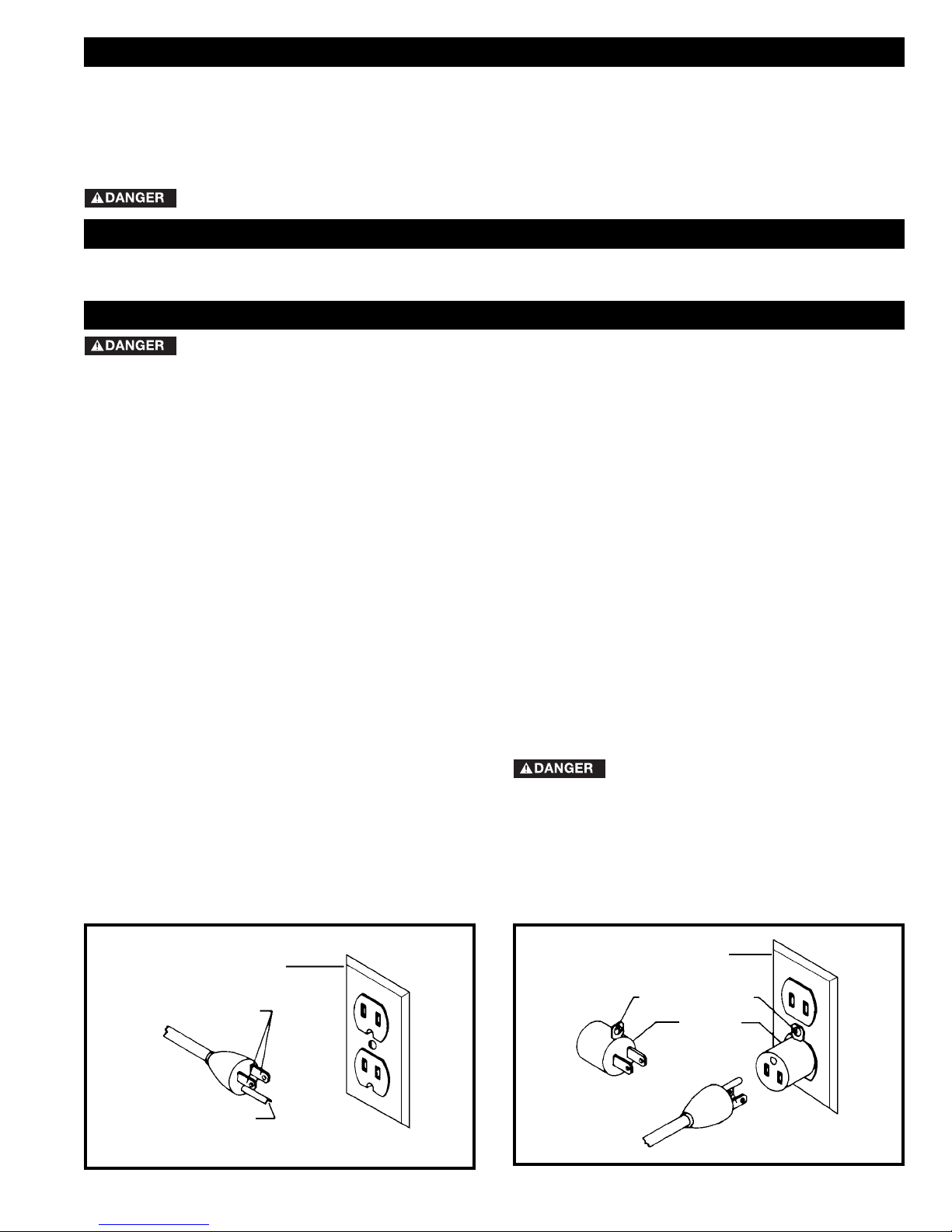
Fig. A Fig. B
GROUNDED OUTLET BOX
CURRENT
CARRYING
PRONGS
GROUNDING BLADE
IS LONGEST OF THE 3 BLADES
GROUNDED OUTLET BOX
GROUNDING
MEANS
ADAPTER
2. Grounded, cord-connected machines intended for use
on a supply circuit having a nominal rating less than 150
volts:
If the machine is intended for use on a circuit that has an
outlet that looks like the one illustrated in Fig. A,the
machine will have a grounding plug that looks like the plug
illustrated in Fig. A. A temporary adapter, which looks like
the adapter illustrated in Fig. B, may be used to connect
this plug to a matching 2-conductor receptacle as shown
in Fig. B if a properly grounded outlet is not available. The
temporary adapter should be used only until a properly
grounded outlet can be installed by a qualified electrician.
The green-colored rigid ear, lug, and the like, extending
from the adapter must be connected to a permanent
ground such as a properly grounded outlet box. Whenever
the adapter is used, it must be held in place with a metal
screw.
NOTE: In Canada, the use of a temporary adapter is not
permitted by the Canadian Electric Code.
IN ALL CASES, MAKE CERTAIN THE
RECEPTACLE IN QUESTION IS PROPERLY
GROUNDED. IF YOU ARE NOT SURE HAVE A
QUALIFIED ELECTRICIAN CHECK THE RECEPTACLE.
1. All grounded, cord-connected machines:
In the event of a malfunction or breakdown, grounding
provides a path of least resistance for electric current to
reduce the risk of electric shock. This machine is
equipped with an electric cord having an equipment-
grounding conductor and a grounding plug. The plug must
be plugged into a matching outlet that is properly installed
and grounded in accordance with all local codes and
ordinances.
Do not modify the plug provided - if it will not fit the outlet,
have the proper outlet installed by a qualified electrician.
Improper connection of the equipment-grounding
conductor can result in risk of electric shock. The
conductor with insulation having an outer surface that is
green with or without yellow stripes is the equipment-
grounding conductor. If repair or replacement of the
electric cord or plug is necessary, do not connect the
equipment-grounding conductor to a live terminal.
Check with a qualified electrician or service personnel if
the grounding instructions are not completely
understood, or if in doubt as to whether the machine is
properly grounded.
Use only 3-wire extension cords that have 3-prong
grounding type plugs and matching 3-conductor
receptacles that accept the machine’s plug, as shown in
Fig. A.
Repair or replace damaged or worn cord immediately.
POWER CONNECTIONS
MOTOR SPECIFICATIONS
Your machine is wired for 120 volt, 60 HZ alternating current. Before connecting the machine to the power source,
make sure the switch is in the “OFF” position.
GROUNDING INSTRUCTIONS
THIS MACHINE MUST BE GROUNDED WHILE IN USE TO PROTECT THE OPERATOR FROM
ELECTRIC SHOCK.

6
EXTENSION CORDS
Use proper extension cords. Make sure your extension cord is in good condition and is a 3-wire
extension cord which has a 3-prong grounding type plug and matching receptacle which will accept the machine’s
plug. When using an extension cord, be sure to use one heavy enough to carry the current of the machine. An
undersized cord will cause a drop in line voltage, resulting in loss of power and overheating. Fig. D, shows the correct
gauge to use depending on the cord length. If in doubt, use the next heavier gauge. The smaller the gauge number,
the heavier the cord.
Fig. D
MINIMUM GAUGE EXTENSION CORD
RECOMMENDED SIZES FOR USE WITH STATIONARY ELECTRIC MACHINES
Ampere Total Length Gauge of
Rating Volts of Cord in Feet Extension Cord
0-6 120
up to
25 18 AWG
0-6 120 25-50 16 AWG
0-6 120 50-100 16 AWG
0-6 120 100-150 14 AWG
6-10 120
up to
25 18 AWG
6-10 120 25-50 16 AWG
6-10 120 50-100 14 AWG
6-10 120 100-150 12 AWG
10-12 120
up to
25 16 AWG
10-12 120 25-50 16 AWG
10-12 120 50-100 14 AWG
10-12 120 100-150 12 AWG
12-16 120
up to
25 14 AWG
12-16 120 25-50 12 AWG
12-16 120 GREATER THAN 50 FEET NOT RECOMMENDED
OPERATING INSTRUCTIONS
FOREWORD
Delta ShopMaster Model BS100 is a built for precision and performance. The Delta ShopMaster Model BS100 comes
with a powerful 1/3 HP motor, rack and pinion upper blade guide assembly, table tilting assembly, and a flexible lamp.
UNPACKING AND CLEANING
Carefully unpack the machine and all loose items from the shipping container. Remove the protective coating from all
unpainted surfaces. This coating may be removed with a soft cloth moistened with kerosene (do not use acetone, gasoline
or lacquer thinner for this purpose). After cleaning, cover the unpainted surfaces with a good quality household floor paste
wax.
NOTICE: THE MANUAL COVER PHOTO ILLUSTRATES THE CURRENT
PRODUCTION MODEL. ALL OTHER ILLUSTRATIONS ARE REPRESENTATIVE
ONLY AND MAY NOT DEPICT THE ACTUAL COLOR, LABELING OR
ACCESSORIES AND MAY BE INTENDED TO ILLUSTRATE TECHNIQUE ONLY.
7
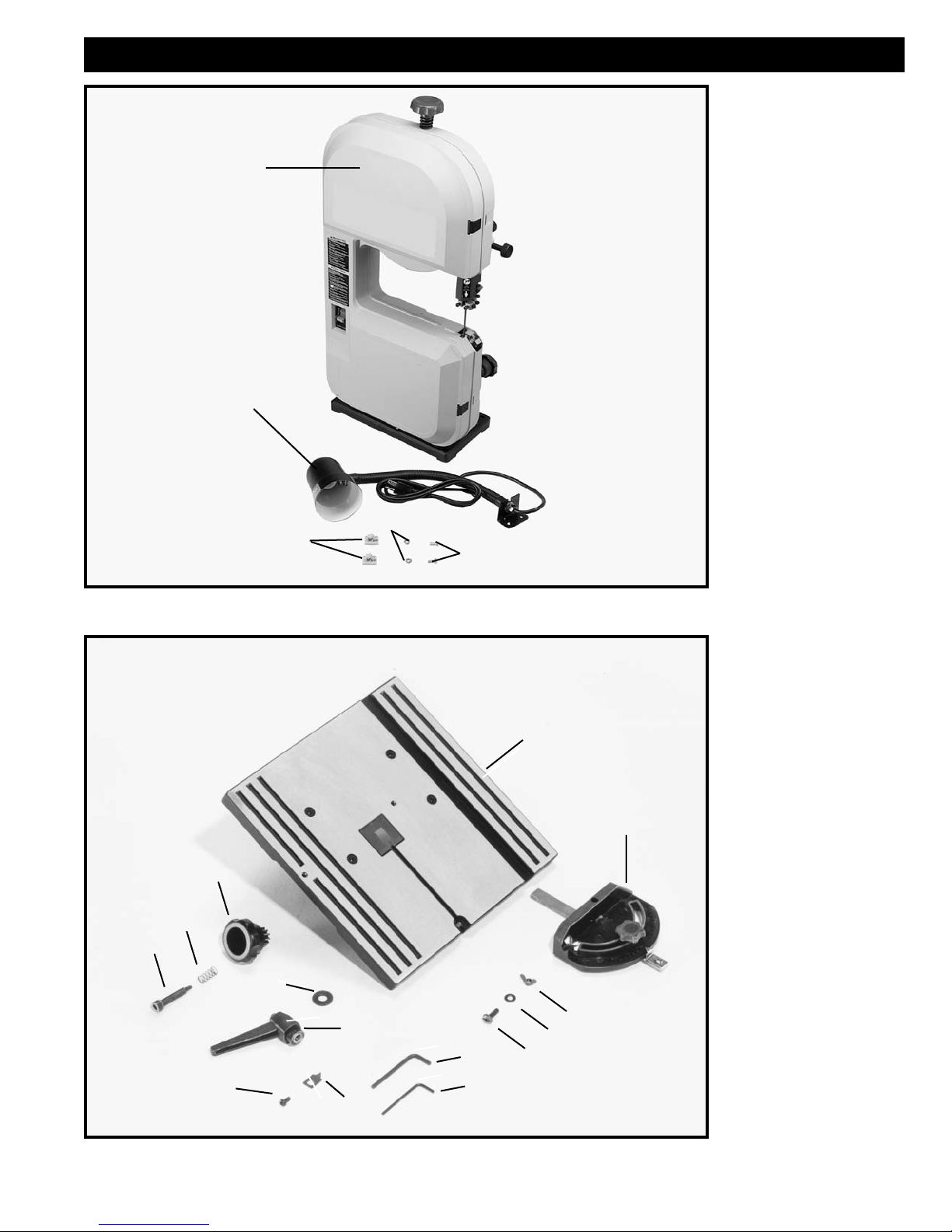
9" BENCH BAND SAW PARTS
1 - Band Saw
2 - Lamp
3 - Lamp Cord Clamps
(2)
4 - 1/4" Lockwashers (2)
5 - M6x1x12mm Cap
Head Screws (2)
Fig. 2
6 - Table
7 - M6x1 Wing Nut
8 - M6 Flat Washer
9 - M6x1x30mm Pan
Head Screw
10 - 4mm Hex Wrench
11 - 3mm Hex Wrench
12 - Pointer
13 - M5x.8x10mm Pan
Head Screw
14 - M10 Flat Washer
15 - Lever Assembly
16 - Pinion Knob
17 - Spring
18 - Special Screw
19 - Miter Guage
Fig. 3
6
7
8
9
10
11
12
13
15
14
16
17
18
1
2
34
5
19
(Optional)

8
ASSEMBLY
Fig. 4
ASSEMBLING TABLE
TO MACHINE
1. Locate table locking lever (shown disassembled)
Fig. 4, M10 flat washer (B) and 4mm wrench (C).
2. Using the 4mm wrench (C) Fig. 4, supplied, remove
screw (D) and spring (E) from handle (A) and remove
handle from nut (G). Do not lose spring (E).
3. Place table (H) Fig. 5, onto the band saw frame so
that stud (J) Fig. 6, and keepers (K) protrude through the
slot of trunnion (L) Fig. 7.
4. Open hinged door. (See section “OPENING AND
CLOSING DOOR”.)
5. While pressing in on stud (M) Fig. 8 with a pencil,
place an M10 flat washer (B) Fig. 7, onto stud and thread
nut (G) onto stud as shown in Fig. 7.
Fig. 5
FOR YOUR OWN SAFETY, DO NOT
CONNECT THE MACHINE TO THE POWER SOURCE
UNTIL THE MACHINE IS COMPLETELY
ASSEMBLED AND YOU READ AND UNDERSTAND
THE ENTIRE OWNER’S MANUAL.
Fig. 6
Fig. 8Fig. 7
B
G
E
D
C
A
J
K
K
L
B G
M
H

9
Fig. 9
Fig. 10
Fig. 11
6. Locate pinion knob (N) Fig. 9, spring (O), and special
screw (P).
7. Position pinion knob (N) Fig. 10, onto the back of
saw so that the teeth on the pinion knob (N) engage the
teeth on the trunnion (R). Fasten in place with special
screw (P) and spring using the supplied 4mm wrench.
8. Fasten pointer (S) Fig. 11, to the back of band saw
using the M5x.8x10mm pan head screw (T).
9. Place locking handle (F) Fig. 4, onto stud (G). Place
spring (E) Fig. 4, inside hole of lock handle and fasten in
place with screw (D) as shown in Fig. 11. NOTE: Handle
(F) is spring-loaded and can be repositioned on the stud
by pulling out the handle and repositioning it on the nut.
10. Insert M6x1x30mm screw (W) Fig. 12, down through
hole in table, as shown, and place an M6 flat washer (Z)
onto the M6x1x30mm screw (W) and thread the M6x1
wing nut (X) onto screw (W) and tighten securely.
N
O
P
R
N
P
F
S
T
D
Fig. 12
W
Z
X
10
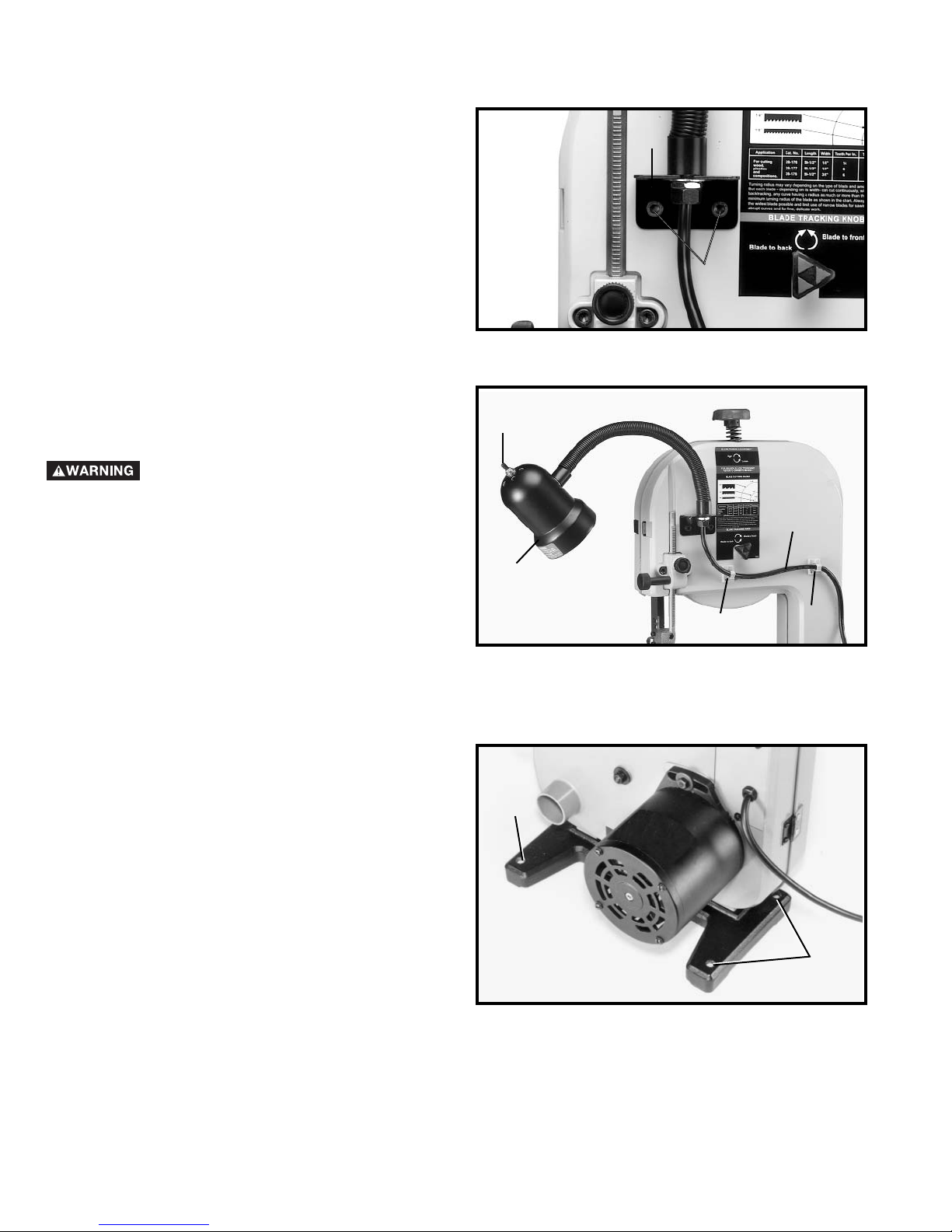
1. Fasten the lamp bracket (A) Fig. 13, to the top cover
of the machine, using two M6x1x12mm cap head
screws (B) and 1/4" lockwashers as shown.
2. Peel backing from cord clamps (C) Fig. 13A, and
apply one clamp at each of the locations shown. Make
certain the lamp cord is routed out of the way of the
blade, then secure cord (D) to cord clamps (C) as shown
in Fig. 13A.
3. The flexible lamp operates independently of the
band saw. To turn the lamp on and off, rotate switch (E)
Fig. 13A.
To reduce the risk of fire, use 40 watt or less, 120 volt,
reflector track type light bulb (not
supplied). A standard household light bulb should not be
used. The reflector track type light bulb should not
extend below the lamp shade.
ATTACHING LAMP TO
MACHINE
Fig. 13A
E
F
CC
D
Fig. 14
FASTENING BAND SAW
TO SUPPORTING SURFACE
If during operation there is any tendency for the machine
to tip over, slide, or “walk” on the supporting surface, the
machine must be secured to the supporting surface.
Four holes are provided in the band saw base for this
purpose, three of which are shown at (A) Fig. 14.
A
A
Fig. 13
A
B
Indice
Altri manuali Delta Sega

Delta
Delta 40-540 Manuale utente

Delta
Delta SHOPMASTER SM200L Manuale utente

Delta
Delta 15'' scroll saw Manuale utente

Delta
Delta 36-225 Manuale utente

Delta
Delta 36-475 Manuale utente

Delta
Delta TS350 Manuale utente

Delta
Delta 36-465 Manuale utente

Delta
Delta 28-400 Manuale utente

Delta
Delta 36-255 Manuale utente

Delta
Delta 36-725 Manuale utente

Delta
Delta 36-477 Manuale utente

Delta
Delta ShopMaster TS300 Manuale utente

Delta
Delta ShopMaster S26-262LS Manuale utente

Delta
Delta Homecraft PM-1694 Manuale

Delta
Delta 26-2240 Manuale utente

Delta
Delta Platinum Edition 28-263 Manuale utente

Delta
Delta 36-751 Manuale utente

Delta
Delta 40-560 Type II Manuale utente

Delta
Delta 40-690 Manuale utente

Delta
Delta MS450 Manuale utente


