The material contained in this document is the property of Electronics & Innovation Ltd., it is subject
to change without notice.
August 2012 Page 4 of 12 Revision C
b. Remove the two M4-10 screws located on each side of the cover nearest
the front panel.
c. Attach the rack mounting brackets to the sides of the unit using the screws
removed in step (b).
2.5 Mains Lead Connection
The unit comes supplied with a 6 foot mains cord.
2.6 Cooling
When the 411LA is enclosed by an external cabinet, provisions must be made to ensure
an adequate flow of cooling air to the unit. Ambient temperature of the air must not
exceed 40° C.
2.7 Proceed as follows:
(i) Ensure that there is at least 3” / 7.5 cm clearance at the rear of unit for air flow.
(ii) Ensure RF input voltage is not excessive
a. The 1 V rms indicated maximum input voltage is 5 times the level of the
input signal required to achieve maximum output. Input voltages in excess
of 2 volts peak may permanently damage the instrument.
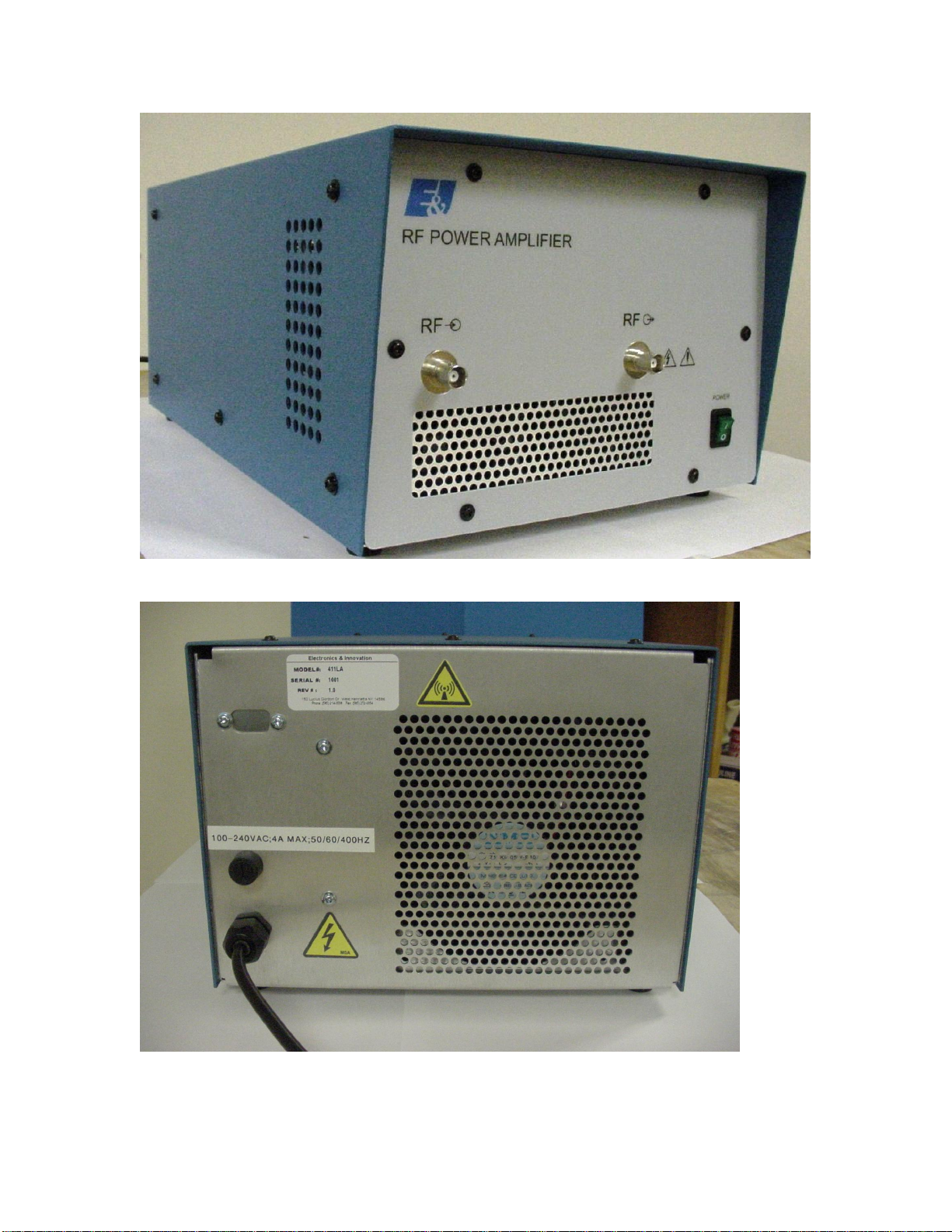
(iii) Connect the output via a 50 ohm coaxial lead and BNC plug to the load.
(iv) Connect the input signal via a 50 ohm coaxial lead and BNC plug to the input
connector.
Chapter 3 Technical Description
3.1 GENERAL DESCRIPTION
The E&I Model 411LA is a linear Class A amplifier capable of increasing the output of any
signal generator, frequency synthesizer, sweep generator or laboratory signal source
from 150 kHz to 300 MHz. The Model 411LA is completely protected against damage due
to load mismatch provided that the input RF level does not exceed 1 VRMS or 1.4V peak.
If the attached signal source is capable of generating substantially more than this input
voltage, please use caution in adjusting it. The Model 411LA will saturate well before the
maximum input voltage and there will be no increase in output power at that point. The
411LA is unconditionally stable. Any impedance can be connected to the input and output
of the amplifier, without causing oscillation. The 411LA will deliver its rated power to any
load impedance regardless of match. Load mismatch will cause RF power to reflect back
to the amplifier. The unit is designed to withstand 100% reflected power (a pure