18063 Rev E 06/17 (800) 234-4239 networketi.com 5 of 16Environmental Technology, Inc.
Model EDH–4 Rev E Installation and Operation Manual
INTRODUCTION
Please read this manual for information on the EDH–4 prior to installing, operating or servicing the unit.
Purpose of EDH–4
The EDH–4 Air Dehydrator maintains waveguides, air dielectric coaxial cable and other related compo-
nents used in earth stations, terrestrial UHF, microwave communication systems and the like. It prevents the
accumulation of moisture in dielectric lines by maintaining optimal pressure and humidity of the air in the
line. The EDH–4 enhances the reliability of a station’s signal output through supplying low pressure dry air.
The EDH–4 is intended for use in small volume C, X, Ku and Ka band applications. For larger applications,
please contact Customer Service for information on the ADH NETCOM family of automatic air dehydrators.
Unpressurized dielectric transmission lines allow the entry of moist ambient air through leaking seals,
penetrations and cracks. Consider the line passing from one environment to another, such as when enter-
ing a shelter from the antenna outside. Perhaps there is a change in existing external ambient conditions,
such as a weather front, or nightfall. These pressure and/or temperature changes in the air supply may lead
to moisture condensation within the transmission environment. This is normally the result of the ambient
temperature dropping below the dew point. Water in transmission lines causes corrosion, voltage arcing and
increased voltage standing wave ratio (VSWR). These conditions reduce system performance.
Description
The EDH–4 Air Dehydrator is an economical, manually regenerative air dehydrator for waveguide envi-
ronments. Air is pressurized by a twin head vibratory pump and then dehydrated by passing it through an
absorption unit containing a drying agent. The dried air is then delivered to the communications equipment
through a 1/4" (6.35 mm) hose barb fitting. The EDH–4 works best supplying dry air in a flowing system,
where the dehydrator completely replaces the air on a regular basis
The EDH–4 provides dry air regulated between 0.3 psig (20.7 mbar) and 0.5 psig (34.5 mbar), delivering
6.0 standard cubic feet of air per hour (2.8 l/m). Under normal conditions, the output dew point of the air is
-40°C.
Physically, the EDH–4 occupies a space 11.625" wide × 7.0" deep × 4.814" high (295.3 mm wide ×
177.8 mm deep × 122.3 mm high); three spaces of a standard relay rack.
Pressure display is user selectable to International Symbol of Units (Le Système International d’Unités, or
SI) or English customary units. Both pressure and alarm information are shown on a wide viewing angle LED
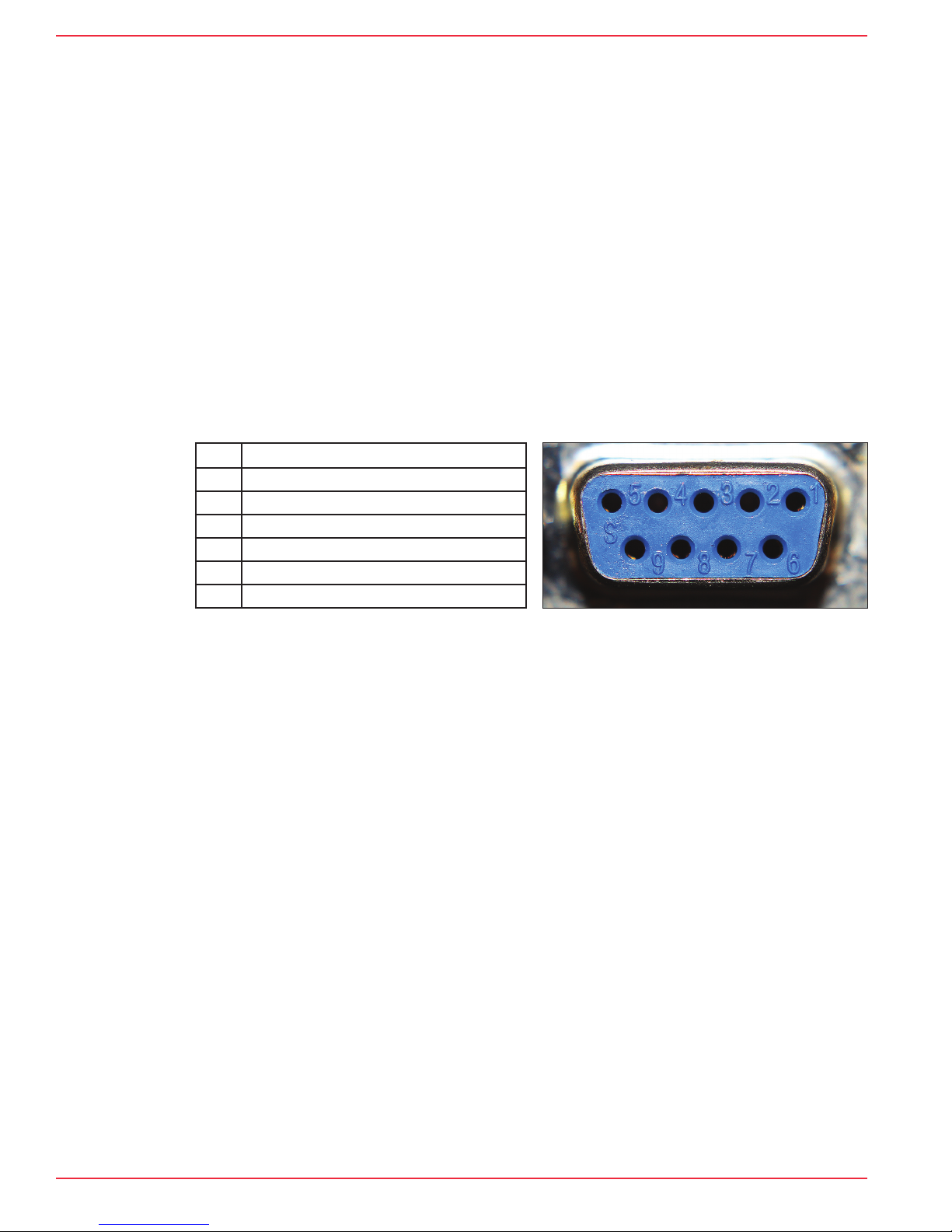
digital display. The EDH–4 makes use of two alarm relays. The first alarm relay is a renew desiccant alarm;
the second alarm relay indicates one or more alarms. The desiccant contains an orange coating which turns
white when the desiccant requires renewal.
The moisture is removed from the drying agent manually. Users must manually renew or replace the
desiccant as required. This operation is needed typically every six months to two years, depending on sys-
tem leakage and environmental conditions.
Figure 2. EDH–4
Components
Figure 1.
EDH–4’s
rechargeable
or replaceable
desiccant
Desiccant
Compartment
(viewable through
window)
Pressure/Alarm
Display
Air
Outlet
Power
Entry
Alarm Relays
(DB-9)