ETH-messtechnik DRVL Manuale utente

tel. +49 (0)79 72 93 10-0
hagstrasse 10 . D-74417 gschwend
Operator manual
English
messtechnik
DRVL
Option „F“
with base/foot

messtechnik gmbh
2
©ETH messtechnik gmbh
This operator manual is not a quality agree-
ment or durability guarantee as set out in
Section 443 of the German Civil Code.
Specification changes, typing and printing
errors reserved.

messtechnik gmbh
3
Inhalt
Important instructions: ...................................................................................................4
1. Preliminaries ...............................................................................................................5
2. Applicability and instructions for use ..........................................................................5
3. Description and functionality of the device ...............................................................6
3.1 Torsional shaft .....................................................................................................6
3.2 Enclosure .............................................................................................................6
3.3 Principle of operation .........................................................................................6
3.4 Disturbances and their compensation.................................................................7
4. Conditions on location ................................................................................................ 8
4.1 Ambient temperature..........................................................................................8
4.2 Moisture and dust................................................................................................8
4.3 Chemical effects...................................................................................................8
4.4 Deposits ..............................................................................................................8
5. Mechanical installation................................................................................................9
5.1 Precautions to be taken when assembling the transducer..................................9
5.2 General assembly guidelines ...............................................................................9
5.3 Additional parts and suggested values for the installation .....................................10
6. The measurement-chain setup..................................................................................11
7. Electrical connection .................................................................................................12
7.1 Wiring instructions.............................................................................................13
7.2 Connectors.........................................................................................................13
7.3 Pin assignment for the connectors ....................................................................14
7.4 Control activation ..............................................................................................14
7.5 Extension cables ................................................................................................14
7.6 The power supply ..............................................................................................14
8. Pin assignment .........................................................................................................15
8.1 DRVL standard cable ..........................................................................................15
8.2 DRVL robot cable ...............................................................................................16
9. Measurement outputs ..............................................................................................17
10. Recalibration............................................................................................................17
11. Disposal ...................................................................................................................17
12. Datasheet DRVL.......................................................................................................18
12.1 Electrical Specifications....................................................................................18
12.2 Mechanical Dimensions DRVL-F.......................................................................19
12.3 Technical Specifications DRVL ..........................................................................20

messtechnik gmbh
4
Important instructions:
The model DRVL torque transducer can be deployed as a component in a test
bench, for example.
The installation position of the drive and transducer sides should be taken into
account in applications where mass is critical.
Please note that in order to achieve greater sensitivity the transducer
has not been designed with the safety factors 2 to 20 that are common in me-
chanical engineering.
Please pay special attention to the specified overload factors.
Where there is a risk of personal injury or damage to equipment due to mechani-
cal failure leading to breakage, the user of the device must put in place adequate
safety measures (e.g., covers and guards, and overload protections). All applicab-
le accident prevention regulations must be followed.
The torque transducer is not approved for use in hazardous areas.
Opening or disassembling the transducer during the warranty period
will void the warranty.

messtechnik gmbh
5
1. Preliminaries
The torque transducers are made of different shaft materials to suit the loads.
Torque transducers measure torque in the unit Nm.
Please refer to the relevant data sheet for the current technical specifications.
www.eth-messtechnik.de
2. Applicability and instructions for use
The torque transducers measure clockwise and counterclockwise loads. In case
of clockwise load, the output signal is positive.
The full-scale value is printed on the device label.
The torque transducers can measure both static and dynamic torques. The low
masses and high torsional stiffness are particularly beneficial in this context.
Please refer to the data sheet for the specified signal rise for the transducer.
The torque transducers need no maintenance as they are fitted with contactless
outputs. Their electrical outputs can be transmitted to remote test benches,
where they can be displayed, recorded, processed and used for control opera-
tions.
The torque transducers are precision devices and should be handled carefully
when transported and when being installed to prevent them being damaged by
shocks or if they fall to the ground. Torque peaks above the rated overload can
severely damage the torsional shaft. These peaks must be intercepted and absor-
bed if they cannot be avoided.
The limits for the permissible mechanical, thermal and electrical stresses are
detailed in the data sheet. They must be strictly observed. Please consider these
limits when designing, installing and operating the measurement setup.

messtechnik gmbh
6
3. Description and functionality of the device
3.1 Torsional shaft
The torsional shaft is constructed with special aluminum or hardened carbon
steel to suit the full-scale value.
Strain gauges attached to the torsional shaft sense the shaft torsion, which is
proportional to the torque and is within its elastic range. The strain gauges are
arranged as a Wheatstone bridge circuit. The force is transmitted via cylindrical
shaft extensions with smooth shaft extensions or a featherkey as per DIN 6885.
A pulse disk for speed or rotation angle measurement can be fitted to the torsio-
nal shaft if needed. Please refer to the data sheet for more details.
3.2 Enclosure
The enclosure for the torque transducer is made of high-strength aluminum; the
enclosure surface is hard-anodized to protect it. The torsional shaft is supported
in the enclosure with two deep-grooved ball bearings. The transducer can either
be base mounted or flange mounted. An electronics module for conditioning
and analyzing the signal for torque, speed or angle of rotation is installed in the
enclosure.
3.3 Principle of operation
The torsional shaft, and thus the strain gauges, are elastically deformed by the
torsional force. The ohmic resistances of the strain gauges change proportional
to their change in length. The electronics module is connected in series and it
transfers the measurements by means of optical frequency modulation to the
enclosure.
The signal is then converted by the external electronics unit to an analog voltage
that is proportional to the change in frequency. Those signals and frequency
output are available as an electrically isolated signal for further processing.
The pulse disk on the torsional shaft is sampled with an encoder in the enclosure.
Two waveforms are available for analysis: (1) a square wave with 60 pulses/turn
for the speed option, and (2) two square waves offset by 90° with 360 pulses/
turn for the angle of rotation option.The direction of rotation can be detected
with the angle of rotation option. Channel A leads channel B by 90° for clockwise
rotation.

messtechnik gmbh
7
3.4 Disturbances and their compensation
Flexural, axial and radial forces are disturbances and, hence, should be avoided.
We recommend the use of clamping hub couplings. They must be selected to
suit the operating conditions.
Shielded cables should be used for the electrical connections. The electroma-
gnetic compatibility (EMC)of the torque transducers are tested for compliance
with EN 55011:2011.
The immunity of the torque transducers to noise is tested to the following stan-
dards:
• 61000-4-2:2009
• 61000-4-3:2009
• 61000-4-4:2009
• 61000-4-5:2009
• 61000-4-6:2009
• 61000-4-8:2009

messtechnik gmbh
8
4. Conditions on location
4.1 Ambient temperature
For best results, the device must be operated within the nominal temperature
range. The best operating conditions are constant and, if necessary, slowly
changing temperatures. The specified temperature errors apply if the tempera-
ture does not change faster than 5K/h. One-sided thermal radiation or cooling
should be avoided and appropriate technical preventive measures taken, if
necessary.
4.2 Moisture and dust
The torque transducers comply with protection type rating IP40 as per DIN
40050.
Note: There should be no moisture inside the transducer connector
4.3 Chemical effects
The torque transducers are not protected against chemical effects. They must
not be used in caustic or corrosive environments.
4.4 Deposits
Dirt, dust or other foreign substances should not accumulate so that they can
enter the bearing or the connectors.

messtechnik gmbh
9
5. Mechanical installation
5.1 Precautions to be taken when assembling the transducer
• Handle the transducer carefully.
• IMPORTANT!
While assembling the couplings, don’t overload the transducer, even
temporarily. It is highly suggested to connect the transducer electri
cally first and monitor the torque signal in order to prevent exceeding
the torque range!
• Axial and radial misalignments must be avoided.
• Make sure the enclosure is correctly connected electrically to
the grounded parts.
5.2 General assembly guidelines
The drive and transducer sides should not be swapped, otherwise measurements
(readings) will be invalidated during accelerations, for example.
When reading the device label, the drive side is on the right and the transducer
side on the left of the transducer. There is a small cavity in the cover on the mea-
surement side.
Flexural, axial and radial forces are disturbances that cause incorrect measure-
ments
Be careful with the thermal expansion of the assembly.
Measuring side mark
Direction of rotation for positive indication

messtechnik gmbh
10
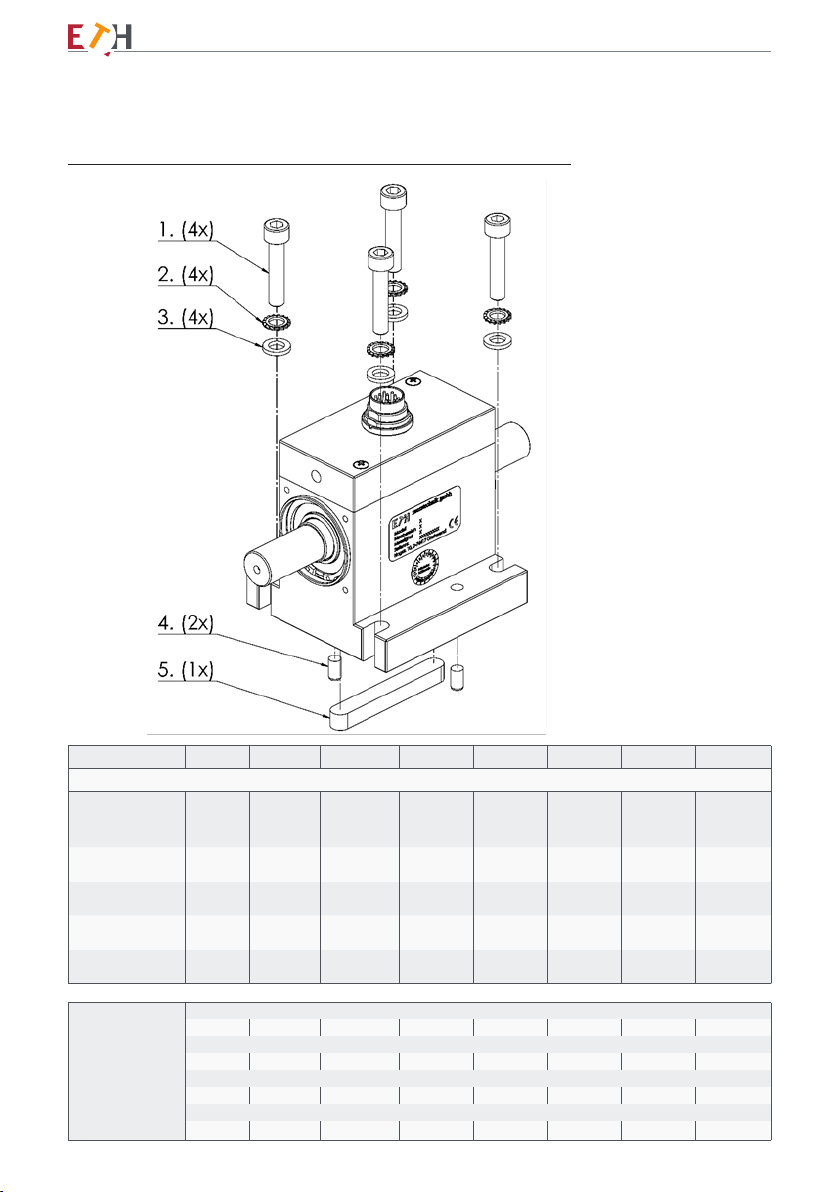
5.3 Additional parts and suggested values for the installation
Model DRVL-F DRVL-I-F DRVL-Ib-F DRVL-II-F DRVL-III-F DRVL-IV-F DRVL-V-F DRVL-VI-F
Addional parts:
1. Hexagon socket
head cap screw
(DIN912-8.8-Zn)
M5x25 M5x25 M6x30 M6x30 M8x35 M10x45 M12x55 M16x80
2. Fan washer
(DIN6798 A-Zn) 5,3 5,3 6,4 6,4 8,4 10,5 13 17
3. Plain washer
(DIN433-4.8-Zn) 5,3 5,3 6,4 6,4 8,4 10,5 13 17
4. Straight pin
(DIN6325) 4m6x8 4m6x8 5m6x10 5m6x10 6m6x12 8m6x16 10m6x20 12m6x24
5. Parallel key
(DIN6885 A) 6x6x50 6x6x50 8x7x60 8x7x60 10x8x60 10x8x60 10x8x80 10x8x100
Suggested
values for the
installaon:
Maximum fastening torque of the screws at the base onto steel (Nm)
5,0 5,0 8,6 8,6 21,0 40,8 71,4 190,0
Maximum fastening torque of the screws at the base onto aluminum (Nm)
5,8 5,8 9,9 9,9 24,1 40,8 82,3 164,5
Maximum fastening torque of the screws onto the ange (Nm)
0,6 1,0 1,0 1,0 2,6 8,6 -- --
Minimum installaon depth of the straight pins into the sensor (mm)
4 4 5 5 6 8 10 12
Altri manuali per DRVL
1
Questo manuale è adatto per i seguenti modelli
8
Indice
Altri manuali ETH-messtechnik Trasduttore
Manuali Trasduttore popolari di altre marche

Mianyang Weibo Electronic
Mianyang Weibo Electronic WB Series Manuale utente

ProMinent
ProMinent Dulcometer DMT Manuale utente

MKS
MKS MicroPirani 925 Series Come usare

WIKA
WIKA WU-20 Manuale utente

Alcatel Vacuum Technology
Alcatel Vacuum Technology BARATRON 622A Manuale utente

Camille Bauer
Camille Bauer SIRAX CH-5610 Manuale utente