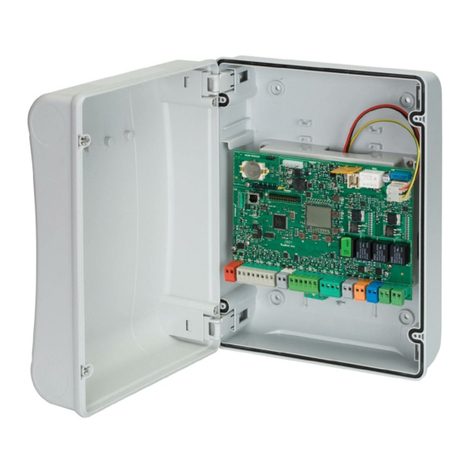
FAAC Estate Swing E-SL 1800 Manuale utente

E-SL 1800

CE DECLARATION OF CONFORMITY FOR MACHINES
(DIRECTIVE 2006/42/EC)
Manufacturer: FAAC S.p.A.
Address: Via Calari, 10 - 40069 Zola Predosa BOLOGNA - ITALY
Declares that: Operator mod. C720 - C721
is built to be integrated into a machine or to be assembled with other machinery to create a machine under the provisions of
Directive 98/37/EC;
conforms to the essential safety requirements of the following EEC directives:
2006/95/EC Low Voltage Directive
2004/108/EC Electromagnetic Compatibility Directive
and also declares that it is prohibited to put into service the machinery until the machine in which it will be
integrated or of which it will become a component has been identified and declared as conforming to the
conditions of Directive 2006/42/EEC and subsequent amendments.
Bologna, 01-12-2010
The Managing Director
A. Marcellan
1) ATTENTION! To ensure the safety of people, it is important
that you read all the following instructions. Incorrect installation
or incorrect use of the product could cause serious harm to
people.
2) Carefully read the instructions before beginning to install the prod-
uct.
3) Do not leave packing materials (plastic, polystyrene, etc.) within
reach of children as such materials are potential sources of danger.
4) Store these instructions for future reference.
5) This product was designed and built strictly for the use indicated
in this documentation. Any other use, not expressly indicated here,
could compromise the good condition/operation of the product and/or
be a source of danger.
6) FAAC declines all liability caused by improper use or use other
than that for which the automated system was intended.
7) Do not install the equipment in an explosive atmosphere: the
presence of inflammable gas or fumes is a serious danger to safety.
8) The mechanical parts must conform to the provisions of Stand-
ards EN 12604 and EN 12605.
For non-EU countries, to obtain an adequate level of safety, the
Standards mentioned above must be observed, in addition to nation-
al legal regulations.
9) FAAC is not responsible for failure to observe Good Technique in
the construction of the closing elements to be motorized, or for any
deformation that may occur during use.
10) The installation must conform to Standards EN 12453 and EN
12445.
For non-EU countries, to obtain an adequate level of safety, the
Standards mentioned above must be observed, in addition to nation-
al legal regulations.
11) Before attempting any job on the system, cut out electrical pow-
er. 12) The mains power supply of the automated system must be
fitted with an all-pole switch with contact opening distance of 1/8 in.
or greater. Use of a 6A thermal breaker with all-pole circuit break is
recommended.
13) Make sure that a differential switch with threshold of 0.03 A is
fitted upstream of the system.
14) Make sure that the earthing system is perfectly constructed and
connect metal parts of the closure to it.
15) The automated system is supplied with an intrinsic anti-crushing
safety device consisting of a torque control. Nevertheless, its tripping
threshold must be checked as specified in the Standards indicated at
point 10.
16) The safety devices (EN 12978 standard) protect any danger
areas against mechanical movement Risks, such as crushing, drag-
ging, and shearing.
17) Use of at least one indicator-light (e.g. FAACLIGHT ) is recom-
mended for every system, as well as a warning sign adequately se-
cured to the frame structure, in addition to the devices mentioned at
point “16”.
18) FAAC declines all liability as concerns safety and efficient opera-
tion of the automated system, if system components not produced by
FAAC are used.
19) For maintenance, strictly use original parts by FAAC.
20) Do not in any way modify the components of the automated sys-
tem.
21) The installer shall supply all information concerning manual op-
eration of the system in case of an emergency and shall hand over to
the user the warnings handbook supplied with the product.
22) Do not allow children or adults to stay near the product while it is
operating.
23) Keep remote controls or other pulse generators away from chil-
dren, to prevent the automated system from being activated involun-
tarily.
24) Transit is permitted only when the automated system is idle.
25) The user must not attempt any kind of repair or direct action
whatever and contact qualified personnel only.
26) Check at least every 6 months the efficiency of the system, par-
ticularly the efficiency of the safety devices (including, where fore-
seen, the operator thrust force) and of the release devices.
27) Anything not expressly specified in these instructions is not
permitted.
WARNINGS FOR THE INSTALLER
GENERAL SAFETY OBLIGATIONS
1

1 GENERAL REMARKS 3
2 DESCRIPTION AND TECHNICAL SPECIFICATIONS 3
3 DIMENSIONS 4
4 ELECTRIC EQUIPMENT (standard system) 4
5 INSTALLATION OF AUTOMATED SYSTEM 4
5.1 PRELIMINARY CHECKS 4
5.2 MASONRY FOR FOUNDATION PLATE 5
5.3 MECHANICAL INSTALLATION 6
5.4 INSTALLING THE RACK 7
5.4.1 STEEL RACK TO WELD (Fig.11) 7
5.4.3 NYLON RACK TO SCREW (Fig. 13) 7
5.4.2 STEEL RACK TO SCREW (Fig. 12) 7
6 OPERATIONAL START-UP 8
6.1 ELECTRONIC BOARD CONNECTION 8
6.1.1 EARTHING 8
6.1.2 ELECTRONIC EQUIPMENT 8
6.2 POSITIONING OF LIMIT SWITCHES 9
7 TESTING THE AUTOMATED SYSTEM 9
8 OPERATOR RELEASE/LOCK 9
9 MAINTENANCE 10
10 REPAIR 10
11 ACCESSORIES 10
11.1 BATTERY KIT 10
11.2 RADIO MODULE 10
CONTENTS
2

C720-C721 / E-SL1800
We thank you for choosing our products. We are certain that they will fully meet your needs with respect to the performance that have been
designed for.
These products have been designed and built to control vehicle access. AVOID ANY DIFFERENT USE.
Read this manual provided with the product carefully because it provides important information on safety,
installation, use and maintenance.
1 GENERAL REMARKS
These instructions apply to the following models:
C720 - C721 / E-SL 1800
The above-mentioned models are electromechanical operators designed for sliding gates with different features and technical
specifications.
A practical and functional mechanical lock that acts directly on the motor ensures the gate is locked when the operator is not
working and, therefore, no electric lock needs to be installed.
A convenient manual release device allows the gate to be maneuvered in the event of a power cut, if emergency batteries are
not installed or if the operator is not in service.
These operators, in addition to having different features and technical specifications, also differ as to the following compo-
nents: motor (larger in the C721), transformer (larger in the C721), pinion (different materials), release lever (different colors).
These assembly instructions apply to both models, unless otherwise specified.
2 Description and Technical Specifications
1. Cover casing
2. Motor lock
3. Link cover
4. Motor release handle
5. Transformer
6. Foundation plate
7. Cable passage holes
8. Pinion and pinion cover
9. Electronic board
Model C720 / E-SL 1800 C721
Power Supply 120V—50 Hz 230V—50 Hz
Max. Absorbed power (W) 170 290
Thrust pinion (N) 320 530
Max. Torque (Nm) 18 30
Type of pinion Z28 module 4 Z28 module 4
Gate max. recommended length (m) 15 15
Max. leaf weight (Kg) 400 800
Gate spped (m/min) Min 8 / Max 18 Min 8 / Max 18
Limit switch type Magnetic Magnetic
Clutch Electronic Electronic
Operating Temperature (°C) -20 + 55 -20 + 55
Gearmotor weight (kg) 6 10
Protection class IP44 IP44
Gearmotor dimensions See Fig. 02 See Fig. 02
Use frequency Residential Residential
3

Dimensions
The dimensions and electrical preparations (standard system) are the same for operator C720 / E-SL 1800 and for operator
C721.
5 INSTALLATION OF AUTOMATED SYSTEM
5.1 PRELIMINARY CHECKS
To ensure safety and an efficiently operating automated system, make sure the following conditions are observed:
The gate structure must be suitable for automation. The following are necessary in particular: wheel diameter must be in pro-
portion to the weight of the gate to be automated, an upper guide must be provided, plus mechanical limit switches to pre-
vent the gate derailing.
The gate slide track must be linear and horizontal.
Manual movement of the gate must be easy throughout its travel.
The soil must permit sufficient stability for the foundation plinth.
There must be no pipes or electric cables in the plinth excavation area.
If the gearmotor is exposed to passing vehicles, install, if possible, adequate means of protection against accidental impact.
Check if an efficient earthing is available for connection to the gearmotor.
If the elements checked do not meet the above requirements, arrange to ensure their compliance
4

5.2 MASONRY FOR FOUNDATION PLATE
1. Assemble the foundation plate as shown in Fig. 4.
2. The foundation plate must be located as shown in
Fig. 5 (right closing) or Fig. 6 (left closing) to en-
sure the rack and pinion mesh correctly.
3. Prepare a foundation plinth as shown in Fig. 7 and wall in the founda-
tion plate, supplying one or more sheaths for routing electric cables
through the hole in the foundation plate.
Using a spirit level, check if the plate is perfectly level.
Wait for the cement to set.
4. Lay the electric cables for connection to the accessories and power
supply as shown in Fig. 3.
To facilitate the connections in the control unit, pull out the
leads by at least 30 cm from the hole on the plate.
5

5.3 MECHANICAL INSTALLATION
1. Remove the cover casing by loosening the two suitable side bolts and lifting it (Fig. 8).
2. Position the operator on the foundation plate using the nuts and washers provided as shown in Fig. 9. During this operation,
pass the cables though openings in the motor casing (see Fig. 9 re. 1).
Fig. 8 and Fig. 9 refer to operator C720 /E-SL1800
3. Adjust the height of the gearmotor and the distance from the gate with reference to the dimensions in Fig. 10.
Operation required for correct fastening of the rack and to keep open the option of new adjustments.
4. Secure the gearmotor to the plate by tightening the fastening nuts.
5. Prepare the gearmotor for manual operating mode as described in
paragraph 8.
6

5.4 INSTALLING THE RACK
5.4.1 STEEL RACK TO WELD (Fig.11)
1. Place the three threaded pawls on the rack ele-
ment, positioning them at the top of the slot. In this
way, the slot play will enable any adjustments to be
made.
2. Manually take the leaf into its closing position.
3. Lay the first piece of rack level on the pinion and
weld the threaded pawl on the gate as shown in
Fig. 14.
4. Move the gate manually, checking if the rack is
resting on the pinion, and weld the second and third
pawls.
5. Bring another rack element near to the previous
one, using a piece of rack (as shown in Fig. 15), to
synchronize the teeth of the two elements.
6. Move the gate manually and weld the three thread-
ed pawls, thus proceeding until the gate is fully cov-
5.4.2 STEEL RACK TO SCREW (Fig. 12)
1. Manually take the leaf into its closing position.
2. Lay the first piece of rack level on the pinion and place the
spacer between the rack and the gate, positioning it at the top
of the slot. In this way, the slot play will enable any adjustments
to be made.
3. Mark the drilling point on the gate. Drill a 1/4 in. hole and apply
thread with a 3/8 in. male tap. Screw the bolt.
4. Move the gate manually, checking if the rack is resting on the
pinion, and repeat the operations at point 3.
5. Bring another rack element near to the previous one, using a
piece of rack (as shown in figure 15) to synchronize the teeth of
the two elements.
6. Move the gate manually and carry out the securing operations
as or the first element, thus proceeding until the gate is fully
covered.
5.4.3 NYLON RACK TO SCREW (Fig. 13)
1. Manually take the leaf into its closing position.
2. Lay the first piece of the rack level on the pinion and mark the
drilling point on the gate; drill 1/4 in. and screw in the self-
tapping screw provided with its reinforcing plate.
3. Move the gate manually, checking if the rack is resting on the
pinion, and repeat the operations at point 2.
4. Couple another rack element and fit to the previous element.
5. Move the gate manually and carry out the securing operations
as for the first element, thus proceeding until the gate is fully
covered.
7

Important notes on rack installation:
Make sure that, during the gate travel, all the rack
elements do not exit the pinion.
Do not, on any account, weld the rack elements ei-
ther to the spacers or to each other.
When the rack has been installed, to ensure it mesh-
es correctly with the pinion, we advise you to lower
the gearmotor position by about 1/16 - 1/8 in. by ad-
justing the nuts (Fig.16 re. 1).
Do not use grease or other lubricants between rack
and pinion (Fig. 16)
Manually check if the gate regularly reaches the me-
chanical limit switches and make sure there is no
friction during gate travel.
6 OPERATIONAL START-UP
6.1 ELECTRONIC BOARD CONNECTION
Before attempting any work on the control
board (connections, programming, mainte-
nance), always turn off power.
Observe points 10, 11, 12, 13, 14 of the
GENERAL SAFETY OBLIGATIONS.
Follow the instructions in Fig. 3 to arrange
the cables in the ducts and make the electrical connections
with the selected accessories.
Always separate power cables from control and safety ca-
bles (push-button, receiver, photocells, etc.).
Use separate sheaths in order to avoid any electrical inter-
ference.
Fig. 17 refers to operator C720 /E-SL 1800
6.1.2 ELECTRONIC EQUIPMENT
The electronic control equipment in the gearmotors is fastened
to a mount (Fig. 18 re. 1) with a clear cover (Fig. 18 re. 2).
The board programming buttons are positioned on the cover
(Fig.18 re. 3) and this makes it possible to program the board
without having to remove the cover.
To connect and program the control unit correctly, ob-
serve the specific instructions.
8

6.2 POSITIONING OF LIMIT SWITCHES
To ensure correct positioning of the limit switch magnets, the control unit must be installed and correctly connected with all con-
trol and safety accessories .
The operator is equipped with a magnetic limit switch sensor built directly into the electronic control board.
The gate is stopped, during opening or closure, at the moment when the polarized magnet secured to the upper part of the rack
activates the sensor.
Assemble both magnets as shown in Fig. 19.
Prepare the operator for manual operating mode as described in chapter 8 and power the system.
To position the limit switch on the rack, refer to the electronic equipment instructions.
To avoid damage to the operator and/or interruptions in the operation of the automated system, approximately 1 5/8 in.
must be left from the mechanical limit switches.
7 TESTING THE AUTOMATED SYSTEM
Once the operator has been installed, carry out a thorough oper-
ational check of all accessories and connected safety devices.
Press-fit the plastic covers of the operator fastening bolts, ensur-
ing that the arrow is facing the gate (Fig. 20 re. 1), insert the cov-
er casing (Fig. 20 re. 2) and fasten it by the two suitable side
bolts (Fig. 20 re. 3).
Give the Customer the "User Guide" and explain the correct oper-
ation and use of the gearmotor, highlighting potential high-risk
areas of the automated system.
8 OPERATOR RELEASE/LOCK
During the release/lock manoeuvre, take care to prevent an in-
voluntary pulse from operating the gate.
Proceed as follows to release the gearmotor:
1. Turn the release clockwise as shown in Fig. 21 re. 1. The release
lever will move slightly away from the operator body (Fig. 21 re.
2)
2. Fully lower the release lever to the mechanical stop Fig. 21 re. 3.
3. Carry out the opening or closing manoeuvre manually.
9
Questo manuale è adatto per i seguenti modelli
2
Indice
Altri manuali FAAC Pannello di controllo

FAAC
FAAC 412 Compact Manuale utente

FAAC
FAAC 415 L LS Manuale utente

FAAC
FAAC 455 D Manuale del proprietario

FAAC
FAAC E124 Manuale utente

FAAC
FAAC E024 U Manuale utente

FAAC
FAAC E720 Manuale utente

FAAC
FAAC SDK EVO Manuale utente

FAAC
FAAC E145 Manuale utente

FAAC
FAAC 455 D Manuale utente

FAAC
FAAC 450 MPS Control Panel Manuale utente