
Forney 75468 Manuale utente

800-521-6038 WWW.FORNEYIND.COM 1
owner’s manual
WARNING: Before attempting to operate your new tank, please read these instructions thoroughly. You will need these instructions for
the safety warnings, precautions, assembly, operation, maintenance procedures and diagrams. Keep the instructions in a safe, dry
place for future reference. This product may contain chemicals known to the State of California to cause cancer, birth defects or
other reproductive harm (CA Prop. 65). Wash hands after use.
The warnings, cautions and instructions discussed in this operating manual cannot cover all possible conditions or situations that could
occur. It must be understood by the operator that common sense and caution are factors which cannot be built into this product, but
must be supplied by the operator.
CAUTION: Always take care when using this air tank. Keep away from children. Wear eye protection in work area at all times. Use
correct type and size of tool for each job.
CAT. NO. 75468
800-521-6038 WWW.FORNEYIND.COM 32 800-521-6038 WWW.FORNEYIND.COM
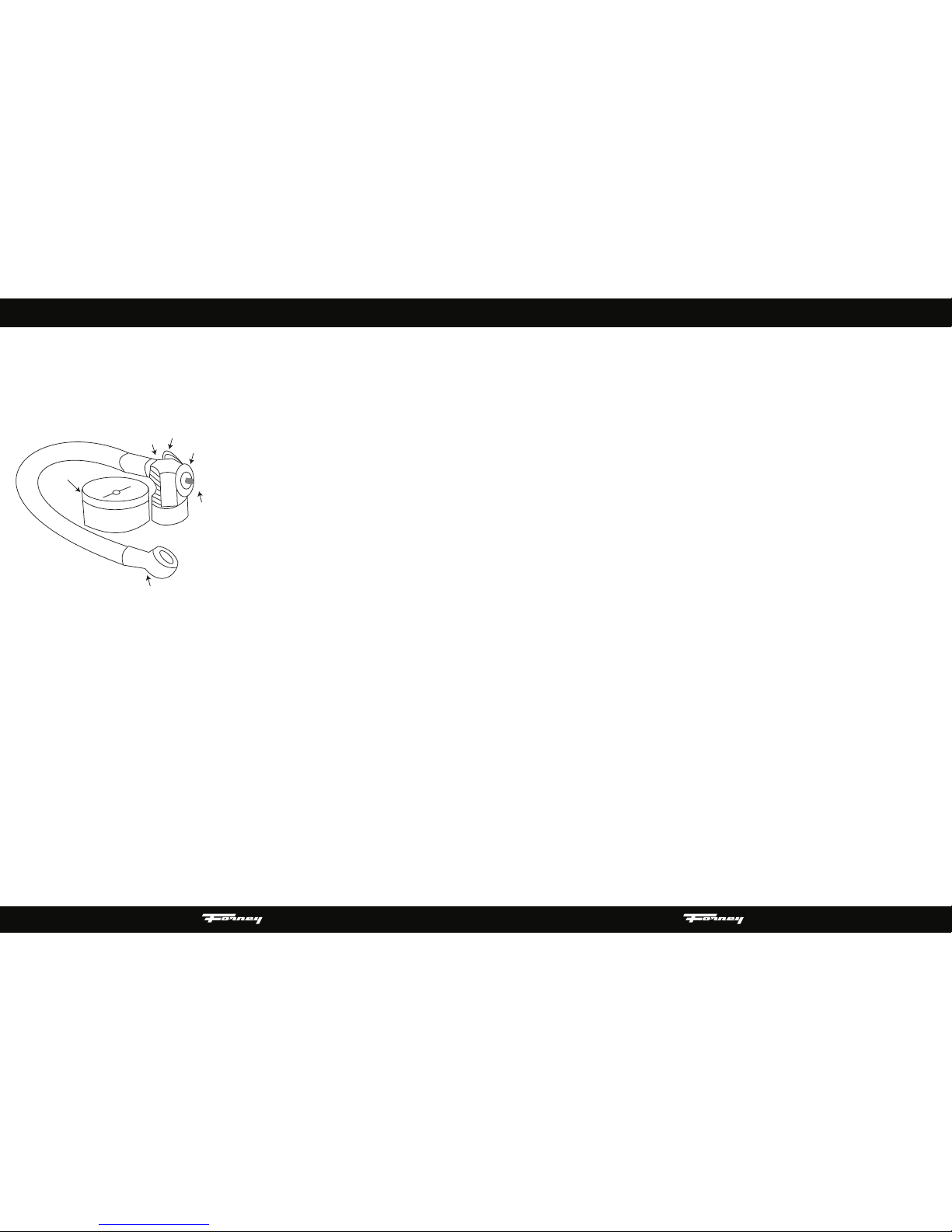
TANK COMPONENTS
Assembly
The air hose, pressure gauge
and brass air manifold set are
assembled on the tank by the
fittings or bolts before putting into
service.
Operation
To Fill Air Tank:
Take this tank to a source of
clean, dry, compressed air. (Full
service gas station, truck stop,
etc. or any low pressure air
compressor available.) The
recommended fill pressure is
Use air chuck from the
air source to connect with
filler valve. Watch pressure
gauge and make sure
maximum air pressure does
3. Open air shut-off valve
(clockwise) to allow air to
flow into air hose.
To Inflate Tires
Connect the tire chuck to
tire valve, and inflate the
tire until tire pressure meets
manufacturer recommended
pressure.
Warning: The pressure gauge
on the tank does not indicate
the pressure in the object being
filled. Use a separate gauge to
check the object being inflated.
GENERAL SAFETY GUIDELINES
The following safety precautions
must be followed at all times along
with any other existing safety rules.
Read all manuals included
with this product carefully. Be
thoroughly familiar with the
controls and the proper use of
the equipment.
Inspect carefully for any
damage that may have
occurred during transit.
3. Only persons well acquainted
with these safety rules should
be allowed to use the air tool.
4.
5. Check air hoses for weakness
or any leakage before each
use. Make sure all connections
are secure.
6. This tank is designed to
connect with a low pressure
air compressor which is rated
7. Release air pressure by pulling
safety relief ring before
replacing parts.
8. Never attempt to repair or
modify this tank. Welding,
drilling or any other
modification will weaken the
tank resulting in damage and
possible explosion.
9. This tank is not equipped and
should not be used to supply
breathing air.
Maintenance
Remove accumulated
condensation in tank
periodically to prevent rusting.
Turn tank upside down
with manifold at the lowest
point and use low internal
pressure to force the water
through relief valve. (Further
instructions in Troubleshooting
information).
Brass Air
Manifold
Safety Relief
Valve Air Shut-o
Valve
Filler Valve
Pressure
Gauge
Tire Chuck

4800-521-6038 WWW.FORNEYIND.COM
PROBLEM POSSIBLE CAUSES SUGGESTED ACTION
Tank loses air
pressure
Air leaks Use mild soapy water to locate leak
Tank leaks Replace tank
Tank will not
hold enough air
Gauge is not reading correctly
Compressed air source is under
Check air pressure at fill stem with tire
pressure gauge.
Tank fills slowly Filler valve is obstructed or
damaged.
Low volume air output at source.
Inspect opening for foreign material, clean
or replace filler valve
Can not get air
out of tank
Low tank pressure.
Hose shutoff valve is closed
3. Chuck is damaged.
Increase tank pressure to exceed pressure
in item being inflated
Turn knob on manifold clockwise to open.
3. Replace hose/chuck assembly.
Water in tank Contaminated compressed air source Hold tank upside down with manifold tilted
air pressure and liquid are fully drained. Refill
with clean, dry air.
Chuck leaks Chuck is dirty and not sealing Clean dirt from chuck, close hose shutoff valve
or replace hose/chuck assembly.
Hose leaks Hose is damaged.
Hose connection to manifold is
loose.
Replace hose/chuck assembly.
Remove hose, apply thread sealant and
tighten fitting into place.
Gauge leaks Gauge is damaged.
Gauge connection is loose.
Replace gauge.
Remove gauge, apply thread sealant and
tighten.
Manifold leaks Manifold is damaged or relief
valve is defective.
Manifold connection is loose.
Replace manifold.
Remove manifold, apply thread sealant
and tighten.
TROUBLESHOOTING
Indice


