Safety
4
•Read All Instructions –All the safety and operating
instructions of your Fosgate Audionics equipment should be
read before power is applied to the equipment.
•Retain Owner's Manual –These safety and operating
instructions should be retained for future reference.
•Heed Warnings –All warnings on the unit and in the
operating instructions should be adhered to,
•Follow Instructions –All operating and use instructions
should be followed.
•Cleaning –Unplug the unit from the wall outlet before
cleaning. The unit should be cleaned only as recommended
by the manufacturer.
•Attachments –Do not use attachments not recommended by
the unit manufacturer as they may cause hazards.
•Water and Moisture –Do not use the unit near water-for
example, near a bath tub, wash bowl, kitchen sink, or
laundry tub; in a wet basement; or near a swimming pool.
•Accessories –Do not place the unit on an unstable cart,
stand, tripod, bracket, or table. The unit may fall, causing
serious injury to a child or adult, and serious damage to
the unit. Any mounting of the unit should follow the
manufacturer's instructions, and should use a mounting
accessory recommended by the manufacturer.
•Ventilation –Slots and openings in the cabinet are provided
for ventilation and to ensure reliable operation of the unit and
to protect it from overheating, and these openings must not
be blocked or covered. The openings should never be
blocked by placing the unit on a bed, sofa, rug, or other
similar surface. The unit should not be placed in a built-in
installation such as a bookcase or rack unless proper
ventilation is provided. There should be free space of at least
6 inches (16cm) and an opening behind the unit,
•Grounding or Polarization –The unit may be equipped with
a polarized alternating current line plug (a plug having one
blade wider than the other). This plug will fit into the power
outlet only one way. This is a safety feature. If you cannot
insert the plug fully into the outlet, try reversing the plug. If
the plug should still fail to fit, contact a licensed electrician to
replace your obsolete outlet. Do not defeat the safety purpose
of the polarized plug.
•Power Sources –The unit should be operated only from the
type of power source indicated on the marking label. If you
are not sure of the type of power supplied to your home,
consult your unit dealer or local power company.
•Power-Cord Protection –Power-supply cords should be
routed so that they are unlikely to be walked on or pinched
by items placed upon or against them, paying particular
attention to cords where they enter a plug, or a convenience
receptacle, and the point where they exit from the unit.
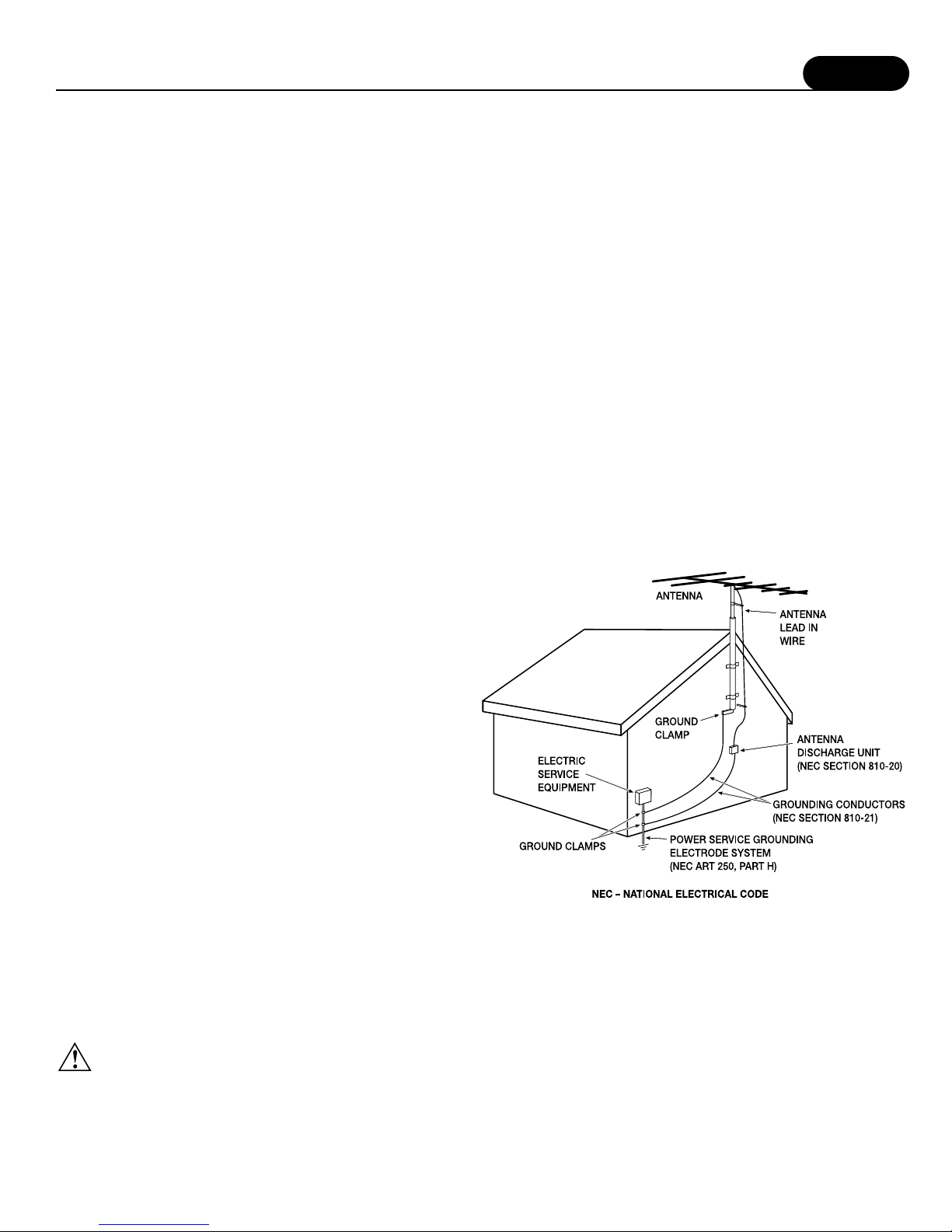
•Outdoor Antenna Grounding –If an outside antenna or
cable system is connected to the unit, be sure the antenna or
cable system is grounded so as to provide some protection
against voltage surges and built-up static charges. Article 810
of the National Electrical Code, ANSI/NFPA 70, provides
information regarding proper grounding of the mast and
supporting structure, grounding of the lead-in wire to an
antenna-discharge unit, size of grounding conductors,
location of antenna-discharge unit, connection to grounding
electrodes, and requirements for the grounding electrode,
•Lightning –For added protection for the unit during a
lightning storm, or when it is left unattended and unused for
long periods of time, unplug it from the wall outlet and
disconnect the antenna or cable system. This will prevent
damage to the unit due to lightning and power-line surges.
•Power Lines –An outside antenna system should not be
located in the vicinity of overhead power lines or other
electric light or power circuits, or where it can fall into such
power lines or circuits. When installing an outside antenna
system, take extreme care to keep from touching such power
lines or circuits as contact with them might be fatal.
•Overloading –Do not overload wall outlets, extension cords,
or integral convenience receptacles as this can result in a risk
of fire or electric shock.
•Object and Liquid Entry –Never push objects of any kind
into the unit through openings as they may touch dangerous
voltage points or short-out parts that could result in a fire or
electric shock. Never spill liquid of any kind on the unit.
•Servicing –Do not attempt to service the unit yourself as
opening or removing covers may expose you to dangerous
voltage or other hazards. Refer all servicing to qualified
service personnel.
•Damage Requiring Service –Unplug the unit from the wall
outlet and refer servicing to qualified service personnel under
the following conditions:
When the power-supply cord or plug is damaged,
If liquid has been spilled, or objects have fallen into the unit,
If the unit has been exposed to rain or water,
If the unit does not operate normally by following the operating
instructions. Adjust only those controls that are covered by the
operating instructions as an improper adjustment of other
controls may result in damage and will often require extensive
work by a qualified technician to restore the unit to its normal
operation,
If the unit has been dropped or damaged in any way, and
great care should be exercised in handling, and the unit
should be examined by qualified service personnel.
When the unit exhibits a distinct change in performance-this
indicates a need for service.
•Replacement Parts –When replacement parts are required,
be sure the service technician has used replacement
parts specified by the manufacturer or have the same
characteristics as the original part. Unauthorized substitutions
may result in fire, electric shock, or other hazards.
•Safety Check –Upon completion of any service or repairs to
the unit, ask the service technician to perform safety checks
to determine that the unit is in proper operation condition.
CAUTION: To reduce the risk of electric shock, do not remove the
cover. No user service-able parts inside. Refer to qualified personnel.
WARNING: To reduce the risk of fire or electric shock, do not expose
this appliance to rain or moisture.
The lightning flash with arrowhead symbol within an
equilateral triangle is intended to alert the user to the
presence of uninsulated “dangerous voltage”within the
product’s enclosure, that may be of sufficient magnitude to
constitute a risk of electric shock to persons.
The exclamation point within an equilateral triangle is
intended to alert the user of the presence of important
operating and maintenance (servicing) instructions in the
literature accompanying the appliance.
NOTICE –IMPORTANT SAFETY INFORMATION –PLEASE READ FIRST