
Hach GS1440 Manuale utente

DOC023.97.80656
GS1440, GS2440EX H2S
Sensor
05/2023, Edition 2
User Manual
Manuel d'utilisation
Manual del usuario
Manual do Usuário
用户手册
取扱説明書
사용 설명서

Table of Contents
English..............................................................................................................................3
Français......................................................................................................................... 25
Español.......................................................................................................................... 48
Português...................................................................................................................... 71
中文................................................................................................................................. 93
日本語........................................................................................................................... 113
한국어........................................................................................................................... 135
.................................................................................................................................. 156
.............................................................................................................................. 177
2

Table of Contents
1 Specifications on page 3
2 General information on page 5
3 Attach the cable guard on page 10
4 Installation on page 12
5 Maintenance on page 19
6 Troubleshooting on page 22
7 Parts and accessories on page 23
Section 1 Specifications
Specifications are subject to change without notice.
Table 1 General specifications
Specification Details
Dimensions (L x D) 240 mm (9.4 in.), Ø 48.3 mm (1.9 in.)
Weight 1.36 kg (3.00 lb)
Enclosure Stainless steel EN 1.4404 (316L), IP68
Mounting Free hanging, in pipe or in air flow cell
Pollution degree 2 (sensor), 4 (installation environment)
Protection class III
Overvoltage category I
Environmental conditions Indoor and outdoor use
Power requirements 12 to 28 VDC (4–20 mA loop) supplied by the CAx440EX field transmitter, a
CDx440sc digital sc gateway or a device
Operating temperature 0 to 40 °C (32 to 104 °F)
Storage temperature 0 to 60 °C (32 to 140 °F)
Humidity 0 to 100% relative humidity
Altitude 2000 m (6562 ft) maximum
Depth in water 10 m (32.8 ft) maximum
pH of water pH 9 maximum; H2S fully converted to non-detectable sulfide forms above
pH 9.
Pressure 3 bar (44 psi) maximum
Calibration gas 1000 ppm
Cables Polyurethane, IP68; 5, 10 or 30 m (16.4, 32.8 or 98.4 ft)
Output signals RS-232 and 4–20 mA
4–20 mA range 0–5 mg/L or 0–1000 ppm (user configurable)
Certifications—GS1440 and
GS2440EX
CE, UKCA, FCC, ISED, RCM, KC
ATEX—GS2440EX Certificate: ETL22ATEX0113X
II 1 G Ex ia IIC T4 Ga
Power/4-20 mA: Ui: 30 V, Ii: 100 mA, Ci: 22 nF Li: 100 µH Pi: 0.70 W
RS-232: Ui: 20 V, Ii: 100mA, Ci: 0 nF Li: 0 µH, Pi: 0.30 W
Tamb: -20 to +60 °C
English 3

Table 1 General specifications (continued)
Specification Details
UKEX—GS2440EX Certificate: ITS22UKEX0506X
II 1 G Ex ia IIC T4 Ga
-20 °C ≤ Ta ≤ +60 °C
IECEx—GS2440EX Certificate: IECEx ETL 22.0003X
Ex ia IIC T4 Ga
Tamb: -20 to +60 °C
North America—GS2440EX Certificate: ETL21CA104799609X
Class I Zone 0 AEx ia IIC T4 Ga
Class I Division 1 Groups A–D T4
Ex ia IIC T4 Ga
Tamb: -20 to +60 °C
Warranty 1 year
Table 2 Performance specifications
Specification Details
Measurement range in water 0 to 5 mg/L H2S
Measurement range in air 0 to 1000 ppm H2S
Accuracy ± 5% full scale (discrete measurement accuracy, 90-second purge of
1000 ± 20 ppm H2S standard after one-point calibration)
Response time (t90) < 30 seconds
Detection limit 1% full scale
Table 3 Interferences
Gas Interference
level
in gas (%) 1
Interference
level
in liquid (%) 2
Gas Interference
level
in gas (%)1
Interference
level
in liquid
(%)2
Methane (CH4) 0 0 Hydrogen (H2) 0.8 96
Carbon dioxide (CO2) 0 0 Carbon monoxide (CO) 0.6 77
Nitrogen (N2) 0 0 Dimethyl sulfide
((CH3)2S))
18 18
Oxygen (O2) 0 0 Methyl mercaptan
(CH3SH)
174 44
Air (O2, N2, Ar) 0 0 Ethyl mercaptan
(C2H6S)
13 14
Nitrous oxide (N2O) 0 0 Sulfur dioxide (SO2) 40 1
Ammonia (NH3) 0 0
1Given as a signal for the interfering species in % of H2S signal at equal partial pressures.
2Given as a signal for the interfering species in % of H2S signal at equal molar concentrations.
4 English

Section 2 General information
In no event will the manufacturer be liable for damages resulting from any improper use of product or
failure to comply with the instructions in the manual. The manufacturer reserves the right to make
changes in this manual and the products it describes at any time, without notice or obligation.
Revised editions are found on the manufacturer’s website.
2.1 Safety information
The manufacturer is not responsible for any damages due to misapplication or misuse of this product
including, without limitation, direct, incidental and consequential damages, and disclaims such
damages to the full extent permitted under applicable law. The user is solely responsible to identify
critical application risks and install appropriate mechanisms to protect processes during a possible
equipment malfunction.
Please read this entire manual before unpacking, setting up or operating this equipment. Pay
attention to all danger and caution statements. Failure to do so could result in serious injury to the
operator or damage to the equipment.
Make sure that the protection provided by this equipment is not impaired. Do not use or install this
equipment in any manner other than that specified in this manual.
2.1.1 Use of hazard information
D A N G E R
Indicates a potentially or imminently hazardous situation which, if not avoided, will result in death or serious injury.
WARNING
Indicates a potentially or imminently hazardous situation which, if not avoided, could result in death or serious
injury.
CAUTION
Indicates a potentially hazardous situation that may result in minor or moderate injury.
N O T I C E
Indicates a situation which, if not avoided, may cause damage to the instrument. Information that requires special
emphasis.
2.1.2 Precautionary labels
Read all labels and tags attached to the instrument. Personal injury or damage to the instrument
could occur if not observed. A symbol on the instrument is referenced in the manual with a
precautionary statement.
This symbol, if noted on the instrument, references the instruction manual for operation and/or safety
information.
Electrical equipment marked with this symbol may not be disposed of in European domestic or public
disposal systems. Return old or end-of-life equipment to the manufacturer for disposal at no charge to
the user.
2.1.3 Confined space precautions
D A N G E R
Explosion hazard. Training in pre-entry testing, ventilation, entry procedures, evacuation/rescue
procedures and safety work practices is necessary before entering confined spaces.
English 5

The information that follows is supplied to help users understand the dangers and risks that are
associated with entry into confined spaces.
On April 15, 1993, OSHA's final ruling on CFR 1910.146, Permit Required Confined Spaces, became
law. This standard directly affects more than 250,000 industrial sites in the United States and was
created to protect the health and safety of workers in confined spaces.
Definition of a confined space:
A confined space is any location or enclosure that has (or has the immediate potential for) one or
more of the following conditions:
• An atmosphere with an oxygen concentration that is less than 19.5% or more than 23.5% and/or a
hydrogen sulfide (H2S) concentration that is more than 10 ppm.
• An atmosphere that can be flammable or explosive due to gases, vapors, mists, dusts or fibers.
• Toxic materials which upon contact or inhalation can cause injury, impairment of health or death.
Confined spaces are not designed for human occupancy. Confined spaces have a restricted entry
and contain known or potential hazards. Examples of confined spaces include manholes, stacks,
pipes, vats, switch vaults and other similar locations.
Standard safety procedures must always be obeyed before entry into confined spaces and/or
locations where hazardous gases, vapors, mists, dusts or fibers can be present. Before entry into a
confined space, find and read all procedures that are related to confined space entry.
2.2 Compliance and certification
CAUTION
This equipment is not intended for use in residential environments and may not provide adequate protection to
radio reception in such environments.
Canadian Radio Interference-Causing Equipment Regulation, ICES-003, Class A:
Supporting test records reside with the manufacturer.
This Class A digital apparatus meets all requirements of the Canadian Interference-Causing
Equipment Regulations.
Cet appareil numérique de classe A répond à toutes les exigences de la réglementation canadienne
sur les équipements provoquant des interférences.
FCC Part 15, Class "A" Limits
Supporting test records reside with the manufacturer. The device complies with Part 15 of the FCC
Rules. Operation is subject to the following conditions:
1. The equipment may not cause harmful interference.
2. The equipment must accept any interference received, including interference that may cause
undesired operation.
Changes or modifications to this equipment not expressly approved by the party responsible for
compliance could void the user's authority to operate the equipment. This equipment has been tested
and found to comply with the limits for a Class A digital device, pursuant to Part 15 of the FCC rules.
These limits are designed to provide reasonable protection against harmful interference when the
equipment is operated in a commercial environment. This equipment generates, uses and can
radiate radio frequency energy and, if not installed and used in accordance with the instruction
manual, may cause harmful interference to radio communications. Operation of this equipment in a
residential area is likely to cause harmful interference, in which case the user will be required to
correct the interference at their expense. The following techniques can be used to reduce
interference problems:
1. Disconnect the equipment from its power source to verify that it is or is not the source of the
interference.
2. If the equipment is connected to the same outlet as the device experiencing interference, connect
the equipment to a different outlet.
3. Move the equipment away from the device receiving the interference.
6 English

4. Reposition the receiving antenna for the device receiving the interference.
5. Try combinations of the above.
2.2.1 Hazardous location
WARNING
Explosion hazard. The GS1440 sensor is not approved for use in hazardous locations.
The GS2440EX sensor is compliant with ATEX (EU), UKEX (UK), IECEx and North American
(US/Canada) hazardous location requirements. Refer to Table 1 on page 3. It is important for the
user to obey all of the conditions of use to keep safety compliance.
• The GS2440EX sensor is an isolated metal part with a maximum capacitance of 97.2 pF on the
enclosure screws. Make sure to use grounding or installation conditions that prevent electrostatic
charging of the GS2440EX sensor. Refer to the instruction manual from the manufacturer for
instructions on how to prevent electrostatic charging.
• The GS2440EX sensor must not be disassembled.
• If the GS2440EX sensor is installed in a hazardous location, it is the responsibility of the end user
to select the correct barriers to use with the sensor.
• Obey all ATEX, UKEX, IECEx, North American Classification Certificate specifications and the
national and local regulations.
• Obey the safety warnings of the other intrinsically safe (Ex) equipment installed near the sensor.
2.2.2 EMI (electro-magnetic interference)
The GS1140 and GS2440EX sensors are compliant with the certifications that follow:
• EU EMC Directive 2014/30/EU
• UKCA Electromagnetic Compatibility Regulations 2016
• FCC Part 15B
• ICES-003
2.3 Icons used in illustrations
Manufacturer supplied parts Do not use tools
2.4 Intended use
The GS1440 and GS2440EX sensors are intended for use by wastewater professionals to monitor
levels of hydrogen sulfide (H2S) in liquids and air. The GS1440 and GS2440EX sensors are not
intended to measure other types of dissolved sulfide, such as HS- or S2-. Typical installation locations
are primary wastewater treatment, wastewater collection and wastewater conveyance systems.
2.5 Product overview
D A N G E R
Do not use the GS1440 or GS2440EX sensor as a safety device to identify the hydrogen sulfide
concentration in an area. Obey all applicable regulations and occupational health and safety
precautions before entry into confined spaces and toxic hazard environments. Get advice from the
occupational health and safety department at the workplace or the government regulatory body to
identify the possible hazards and safety standards.
English 7

N O T I C E
Do not point the measuring end of the sensor up or damage to the sensor can occur (e.g., during storage,
transport, calibration, installation and operation).
Keep the sensor at 0 to 40 °C (32 to 104 °F) or damage to the sensor will occur.
The GS1440 and GS2440EX sensors continuously measure the hydrogen sulfide (H2S)
concentration in liquids and air. Refer to Figure 1.
The sensor is used with a device that supplies 4–20 mA loop power to the sensor and receives the
sensor measurements as a 4–20 mA analog signal or RS-232 digital signal.
The GS1440 is made for use in non-hazardous locations. The GS2440EX is made for use in
hazardous locations.
Figure 1 GS1440 and GS2440EX
1 Membrane 5 RS-232 connector
2 Sensor cap 6 Grounding screw (M6)
3 Status LED3 (Table 4)7 Power/4–20 mA connector
4 Attachment hook
Table 4 Status LED
Color Status
Green, one flash The 4–20 mA analog output represents 0–5 mg/L (liquids).
Green, two flashes The 4–20 mA analog output represents 0–1000 ppm (air).
Green and red flashes The sensor is in calibration/configuration mode.
Red, flashes Temporary (with calibration cap attached): Calibration was not successful.
Continuous (without calibration cap attached): There is a problem with the sensor.
3The status LED continuously flashes while power is supplied to the sensor.
8 English

2.6 Product components
Make sure that all components have been received. Refer to Figure 2. If any items are missing or
damaged, contact the manufacturer or a sales representative immediately.
Figure 2 Product components
1 Storage tube 2 GS1440 or GS2440EX sensor
2.7 Accessories
Figure 3 shows the accessories for the sensor. Refer to Parts and accessories on page 23 for
ordering information.
English 9
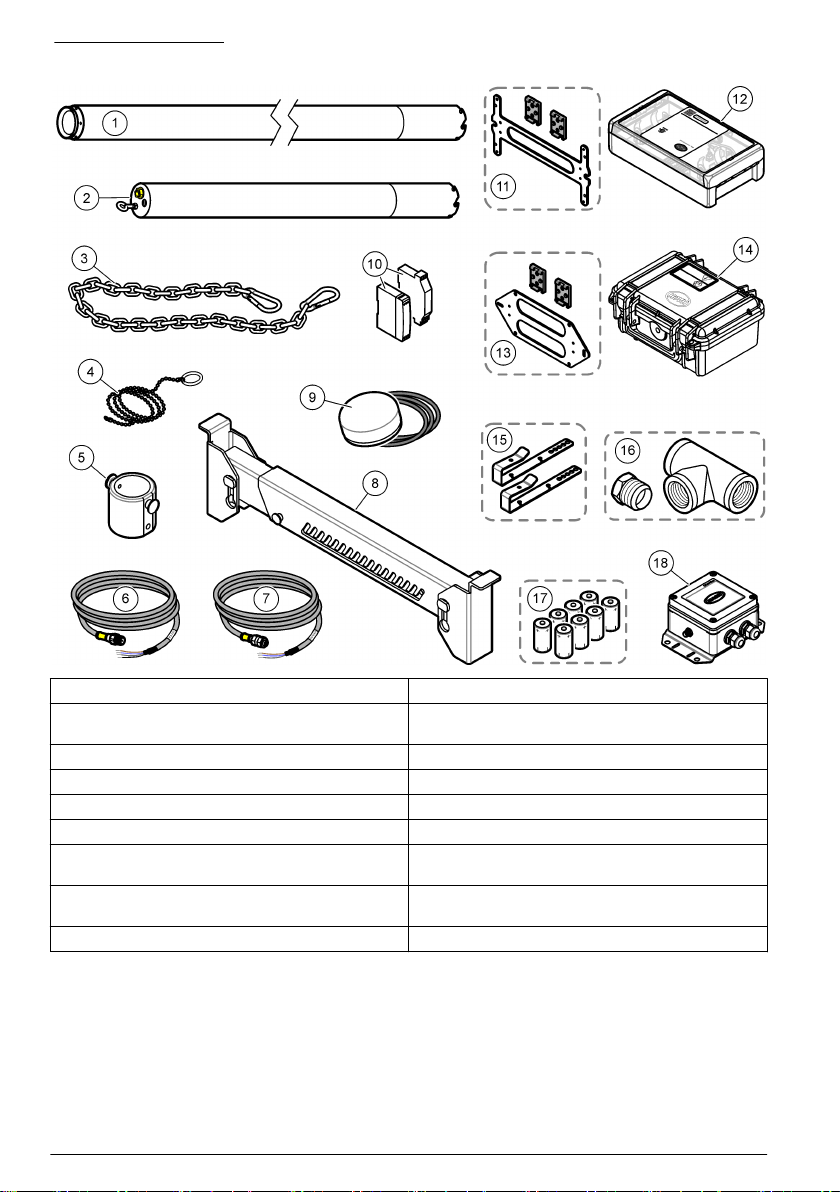
Figure 3 Accessories
1 Cable guard extension 10 Power/4–20 mA barrier with power supply
2 Cable guard 11 Mounting bracket for wall or DIN rail, USA and
Canada
3 Suspension chain with carabiners 12 CAx440EX field transmitter, USA and Canada
4 Cable pull-through tool 13 Mounting bracket for wall or DIN rail, EU and UK
5 Air flow cell 14 CAx440EX field transmitter, EU and UK
6 RS-232 sensor cable 15 Crossbeam clamps
7 Power/4–20 mA sensor cable 16 Adapter for inline mounting and Tee, 1 ¼-inch
BSPT or NPT
8 Crossbeam for manholes 17 Batteries for CAx440EX field transmitter (non-
rechargeable)
9 External antenna for CAx440EX field transmitter 18 CDx440sc gateway for SC Controller
Section 3 Attach the cable guard
If the sensor will be installed in water (or if an increase in the water level could put the sensor in
water), attach the cable guard to the sensor to prevent damage to the sensor connectors and cables.
If the sensor cables are already installed in the cable guard, refer to the illustrated steps in Figure 4
to attach the sensor cables and cable guard.
10 English
Altri manuali per GS1440
1
Questo manuale è adatto per i seguenti modelli
1
Indice
Lingue:
Altri manuali Hach Sensore di sicurezza


