
Hilti SJD 6-A22 Manuale utente

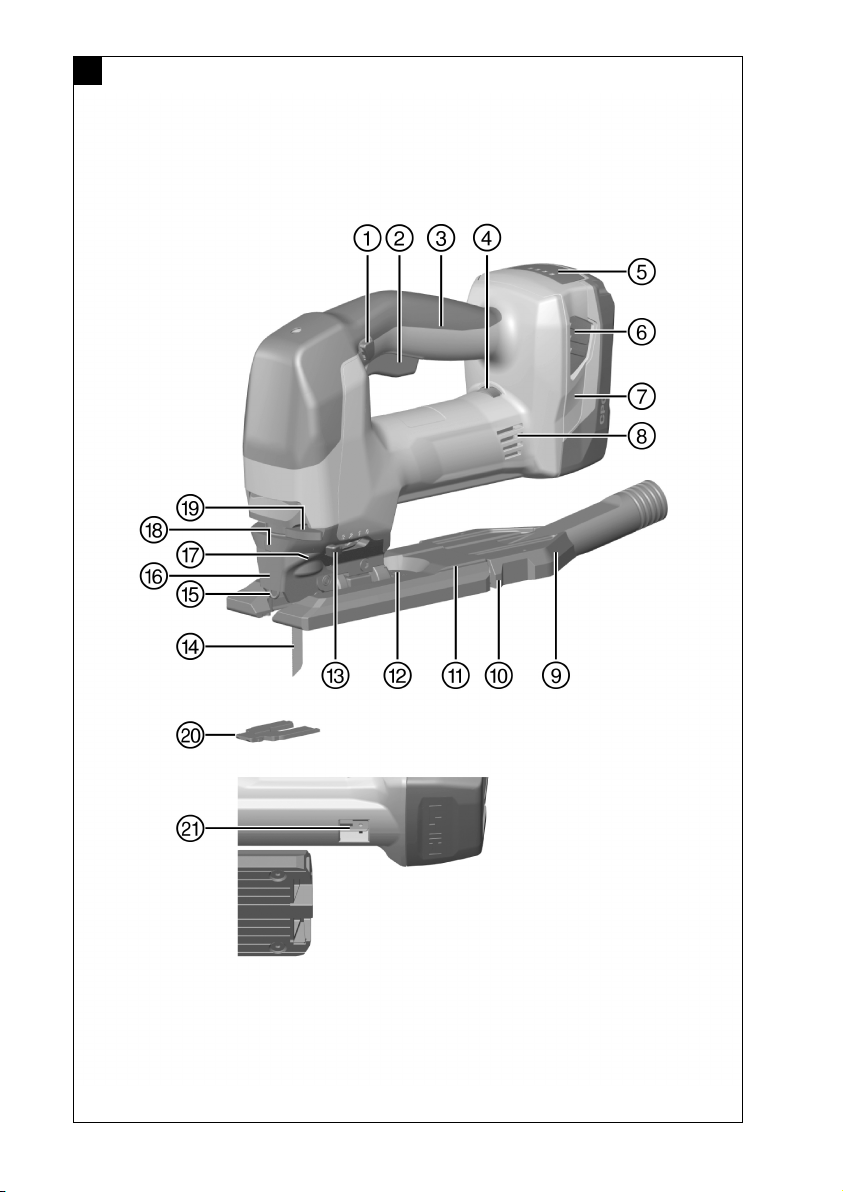
1

2
3
4
5
6
7
8
9


*2150253* 2150253 English 1
Original operating instructions
1 Information about the documentation
1.1 About this documentation
• Read this documentation before initial operation or use. This is a prerequisite for safe, trouble-free
handling and use of the product.
• Observe the safety instructions and warnings in this documentation and on the product.
• Always keep the operating instructions with the product and make sure that the operating instructions
are with the product when it is given to other persons.
1.2 Explanation of symbols used
1.2.1 Warnings
Warnings alert persons to hazards that occur when handling or using the product. The following signal words
are used:
DANGER
DANGER !
▶Draws attention to imminent danger that will lead to serious personal injury or fatality.
WARNING
WARNING !
▶Draws attention to a potential threat of danger that can lead to serious injury or fatality.
CAUTION
CAUTION !
▶Draws attention to a potentially dangerous situation that could lead to personal injury or damage to the
equipment or other property.
1.2.2 Symbols in the documentation
The following symbols are used in this document:
Read the operating instructions before use.
Instructions for use and other useful information
Dealing with recyclable materials
Do not dispose of electric equipment and batteries as household waste
1.2.3 Symbols in the illustrations
The following symbols are used in illustrations:
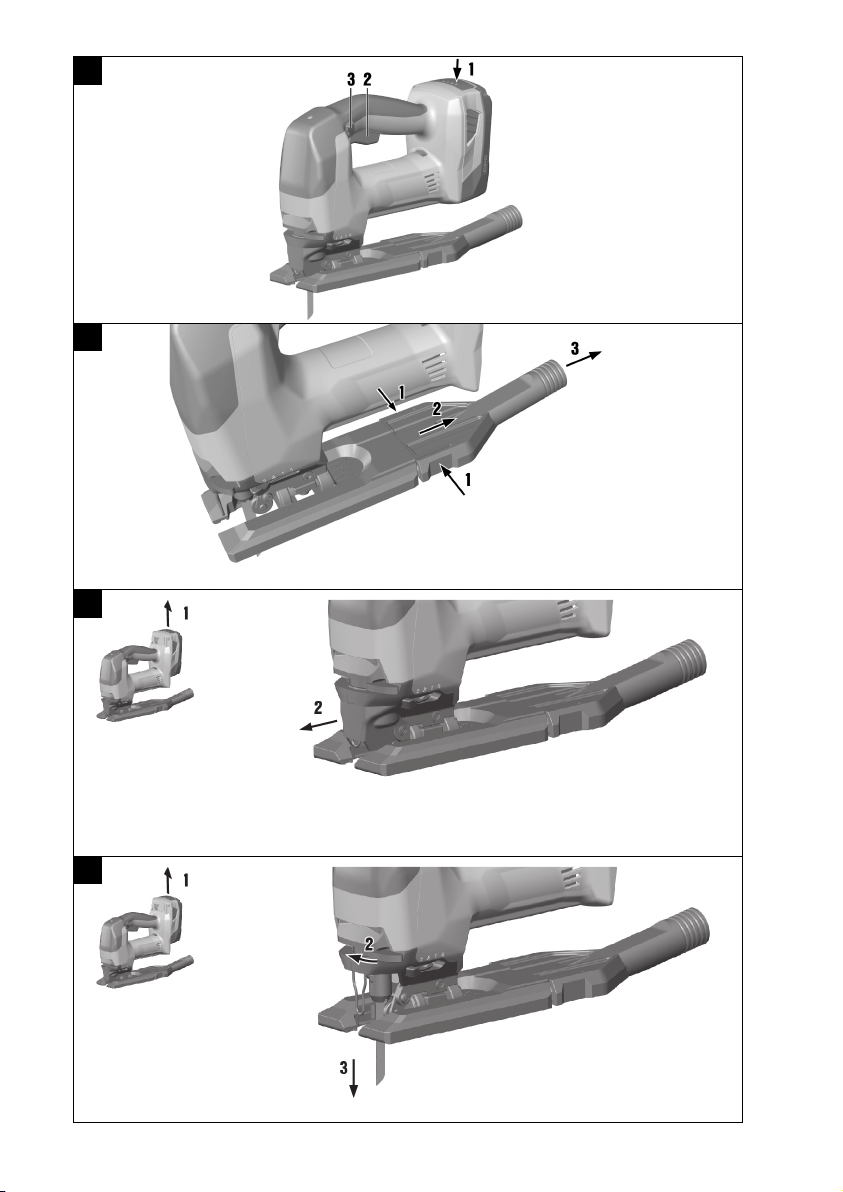
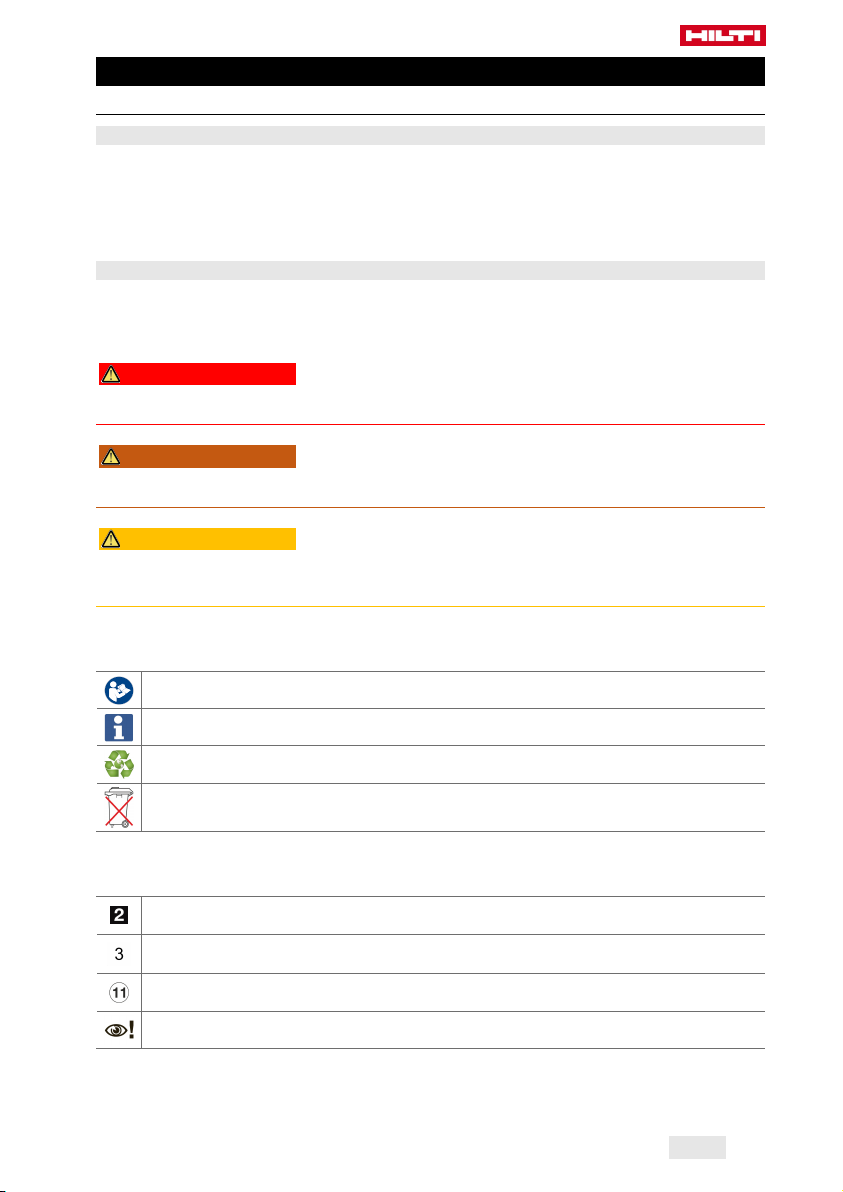
These numbers refer to the corresponding illustrations found at the beginning of these operating
instructions
The numbering reflects the sequence of operations shown in the illustrations and may deviate
from the steps described in the text
Item reference numbers are used in the overview illustrations and refer to the numbers used in
the product overview section
This symbol is intended to draw special attention to certain points when handling the product.

2 English 2150253 *2150253*
1.3 Product-dependent symbols
1.3.1 Symbols on the product
The following symbols can be used on the product:
Stroke rate under no load
Direct current (DC)
The product supports wireless data transmission compatible with iOS and Android platforms.
Li-ion battery
Hilti Li-ion battery type series used. Observe the information given in the section headed In-
tended use.
Never use the battery as a striking tool.
Do not drop the battery. Never use a battery that has suffered an impact or is damaged in any
other way.
1.4 Product information
products are designed for professional users and only trained, authorized personnel are
permitted to operate, service and maintain the products. This personnel must be specifically informed
about the possible hazards. The product described and its ancillary equipment can present hazards if used
incorrectly by untrained personnel or if used not in accordance with the intended use.
The type designation and serial number are printed on the type identification plate.
▶Write down the serial number in the table below. Always quote this information when you contact a Hilti
representative or Hilti Service to inquire about the product.
Product information
Orbital-action jig saw SJD 6-A22
Generation 01
Serial no.
1.5 Declaration of conformity
We declare, on our sole responsibility, that the product described here complies with the applicable directives
and standards. A copy of the declaration of conformity can be found at the end of this documentation.
The technical documentation is filed here:
Hilti Entwicklungsgesellschaft mbH | Tool Certification | Hiltistrasse 6 | 86916 Kaufering, Germany
2 Safety
2.1 General power tool safety warnings
WARNING Read all safety warnings, instructions, illustrations and specifications provided with this
power tool. Failure to follow all instructions listed below may result in electric shock, fire and/or serious injury.
Save all warnings and instructions for future reference.
The term "power tool" in the warnings refers to your mains-operated (corded) power tool or battery-operated
(cordless) power tool.
Work area safety
▶Keep work area clean and well lit. Cluttered or dark areas invite accidents.
▶Do not operate power tools in explosive atmospheres, such as in the presence of flammable
liquids, gases or dust. Power tools create sparks which may ignite the dust or fumes.
▶Keep children and bystanders away while operating a power tool. Distractions can cause you to lose
control.

*2150253* 2150253 English 3
Electrical safety
▶Power tool plugs must match the outlet. Never modify the plug in any way. Do not use any adapter
plugs with earthed (grounded) power tools. Unmodified plugs and matching outlets will reduce risk of
electric shock.
▶Avoid body contact with earthed or grounded surfaces, such as pipes, radiators, ranges and
refrigerators. There is an increased risk of electric shock if your body is earthed or grounded.
▶Do not expose power tools to rain or wet conditions. Water entering a power tool will increase the
risk of electric shock.
▶Do not abuse the cord. Never use the cord for carrying, pulling or unplugging the power tool. Keep
cord away from heat, oil, sharp edges or moving parts. Damaged or entangled cords increase the
risk of electric shock.
▶When operating a power tool outdoors, use an extension cord suitable for outdoor use. Use of a
cord suitable for outdoor use reduces the risk of electric shock.
▶If operating a power tool in a damp location is unavoidable, use a residual current device (RCD)
protected supply. Use of an RCD reduces the risk of electric shock.
Personal safety
▶Stay alert, watch what you are doing and use common sense when operating a power tool. Do
not use a power tool while you are tired or under the influence of drugs, alcohol or medication. A
moment of inattention while operating power tools may result in serious personal injury.
▶Use personal protective equipment. Always wear eye protection. Protective equipment such as a
dust mask, non-skid safety shoes, hard hat or hearing protection used for appropriate conditions will
reduce personal injuries.
▶Prevent unintentional starting. Ensure the switch is in the off-position before connecting to power
source and/or battery pack, picking up or carrying the tool. Carrying power tools with your finger on
the switch or energising power tools that have the switch on invites accidents.
▶Remove any adjusting key or wrench before turning the power tool on. A wrench or a key left
attached to a rotating part of the power tool may result in personal injury.
▶Do not overreach. Keep proper footing and balance at all times. This enables better control of the
power tool in unexpected situations.
▶Dress properly. Do not wear loose clothing or jewellery. Keep your hair and clothing away from
moving parts. Loose clothes, jewellery or long hair can be caught in moving parts.
▶If devices are provided for the connection of dust extraction and collection facilities, ensure these
are connected and properly used. Use of dust collection can reduce dust-related hazards.
▶Do not let familiarity gained from frequent use of tools allow you to become complacent and ignore
tool safety principles. A careless action can cause severe injury within a fraction of a second.
Power tool use and care
▶Do not force the power tool. Use the correct power tool for your application. The correct power tool
will do the job better and safer at the rate for which it was designed.
▶Do not use the power tool if the switch does not turn it on and off. Any power tool that cannot be
controlled with the switch is dangerous and must be repaired.
▶Disconnect the plug from the power source and/or remove the battery pack, if detachable, from
the power tool before making any adjustments, changing accessories, or storing power tools.
Such preventive safety measures reduce the risk of starting the power tool accidentally.
▶Store idle power tools out of the reach of children and do not allow persons unfamiliar with the
power tool or these instructions to operate the power tool. Power tools are dangerous in the hands
of untrained users.
▶Maintain power tools and accessories. Check for misalignment or binding of moving parts,
breakage of parts and any other condition that may affect the power tool’s operation. If damaged,
have the power tool repaired before use. Many accidents are caused by poorly maintained power
tools.
▶Keep cutting tools sharp and clean. Properly maintained cutting tools with sharp cutting edges are
less likely to bind and are easier to control.
▶Use the power tool, accessories and tool bits etc. in accordance with these instructions, taking
into account the working conditions and the work to be performed. Use of the power tool for
operations different from those intended could result in a hazardous situation.
▶Keep handles and grasping surfaces dry, clean and free from oil and grease. Slippery handles and
grasping surfaces do not allow for safe handling and control of the tool in unexpected situations.

4 English 2150253 *2150253*
Battery tool use and care
▶Recharge only with the charger specified by the manufacturer. A charger that is suitable for one type
of battery pack may create a risk of fire when used with another battery pack.
▶Use power tools only with specifically designated battery packs. Use of any other battery packs may
create a risk of injury and fire.
▶When battery pack is not in use, keep it away from other metal objects, like paper clips, coins,
keys, nails, screws or other small metal objects, that can make a connection from one terminal to
another. Shorting the battery terminals together may cause burns or a fire.
▶Under abusive conditions, liquid may be ejected from the battery; avoid contact. If contact
accidentally occurs, flush with water. If liquid contacts eyes, additionally seek medical help. Liquid
ejected from the battery may cause irritation or burns.
▶Do not use a battery pack or tool that is damaged or modified. Damaged or modified batteries may
exhibit unpredictable behaviour resulting in fire, explosion or risk of injury.
▶Do not expose a battery pack or tool to fire or excessive temperature. Exposure to fire or temperature
above 130° C (265 °F) may cause explosion.
▶Follow all charging instructions and do not charge the battery pack or tool outside the temperature
range specified in the instructions. Charging improperly or at temperatures outside the specified range
may damage the battery and increase the risk of fire.
Service
▶Have your power tool serviced by a qualified repair person using only identical replacement parts.
This will ensure that the safety of the power tool is maintained.
▶Never service damaged battery packs. Service of battery packs should only be performed by the
manufacturer or authorized service providers.
2.2 Safety instructions for reciprocating saws
▶Hold the power tool by insulated gripping surfaces, when performing an operation where the
cutting accessory may contact hidden wiring. Cutting accessory contacting a "live" wire may make
exposed metal parts of the power tool "live" and could give the operator an electric shock.
▶Use clamps or another practical way to secure and support the workpiece to a stable platform.
Holding the workpiece by hand or against your body leaves it unstable and may lead to loss of control.
2.3 Additional safety instructions
Personal safety
▶Use the power tool only when it is in technically faultless condition.
▶Never tamper with or modify the tool in any way.
▶Keep the grips clean and dry.
▶Suitable protective glasses, ear protection and protective gloves must be worn while the power tool is in
use.
▶Wear protective gloves when changing the accessory tool. Touching the accessory tool presents a risk
of injury (cuts or burns).
▶Wear eye protection. Flying fragments present a risk of injury to the body and eyes.
▶Do not look directly into the light source (LEDs) incorporated in the power tool and do not direct the light
at other persons’ faces. This presents a risk of dazzling or eye damage.
▶Before beginning the work, check the hazard classification of the dust that will be produced. Use an
industrial vacuum cleaner with an officially approved protection classification in compliance with locally
applicable dust protection regulations.
▶Make sure that the workplace is well ventilated and, where necessary, wear a respirator appropriate for
the type of dust generated. Contact with or inhalation of the dust may cause allergic reactions and/or
respiratory or other diseases to the operator or bystanders. Certain kinds of dust are classified as
carcinogenic such as oak and beech dust, especially in conjunction with additives for wood conditioning
(chromate, wood preservative). Material containing asbestos may be handled only by specialists.
▶Take breaks between working and do physical exercises to improve the blood circulation in your fingers.
Exposure to vibration during long periods of work can lead to disorders of the blood vessels and nervous
system in the fingers, hands and wrists.
Electrical safety
▶Before beginning work, check the working area for concealed electric cables or gas and water pipes.
External metal parts of the power tool may give you an electric shock if you damage an electric cable
accidentally.
Altri manuali per SJD 6-A22
2
Indice
Altri manuali Hilti Utensili elettrici

Hilti
Hilti DX36 M Manuale utente

Hilti
Hilti TE 300-A36 Manuale utente

Hilti
Hilti SCM 22-A Manuale utente

Hilti
Hilti HIT-HY 170 Manuale utente

Hilti
Hilti TE 500 Manuale utente

Hilti
Hilti TE 50 Manuale utente

Hilti
Hilti NCR 060 II-A22 Manuale utente

Hilti
Hilti DX 462 Manuale utente

Hilti
Hilti WSC 70-A36 Manuale utente

Hilti
Hilti WSJ 750 Manuale utente

Hilti
Hilti DX 9-ENP Manuale utente

Hilti
Hilti TE505 Manuale utente

Hilti
Hilti TE1 Manuale utente

Hilti
Hilti SIW 9-A22 Manuale utente

Hilti
Hilti DX462CM/HM Manuale utente

Hilti
Hilti NCV 10-22 Manuale utente

Hilti
Hilti TE 500 Manuale utente

Hilti
Hilti TE 500 Manuale utente

Hilti
Hilti SID 14-A Manuale utente

Hilti
Hilti TE 60-22 Manuale utente


