Hugyfot Housing Manuale utente

Hugyfot Housing for Nikon D80 1User manual
Hugyfot camera housings
Nikon D80
Picture: Jordi Chias
User manual

Hugyfot Housing for Nikon D80 2User manual
Dear Dive buddy,
Regardless which model of Hugyfot you hold in you hand, you can be sure that it
is not only the best housing on the market but also the best looking one. Hugyfot
builds underwater housings for cameras as well as lighting systems since 1953.
The story began at a time when the first regulators were build and all the diving
equipment still had to be designed.
During the last decade, Hugyfot has invested a lot in new technologies. Together
with the emphasising of the ergonomical design, this investment has changed the
market of underwater housings. Recognition and a very high quality standard have
made the Hugyfot brand known throughout the world.
Underwater photography is our life.
Happy Diving!
Hugyfot nv - Industrielaan 30 Zuid III - 9320 Erembodegem - Belgium
All rights are reserved for HUGYFOT. Also on all copies.

Hugyfot Housing for Nikon D80 3User manual
Contents
1. Preface .....................................� 4
2. Techical information .� 5
3. Hugyfot for Nikon D80 ........................................................................................................................... 6
4. Opening and closing the housing .............................................................................................. 7
5. Port with bayonet catch ........................................................................................................................ 8
6. Flash connections ........� 9
7. Mounting the camera .......................................................................................................................... 11
8. Operation of the leakage indicator ........................................................................................ 13
9. Maintenance and service ................................................................................................................ 14
10. Photo practice ..............� 16
11. Accessories .....................� 18
WARRANTY
HUGYFOT NV guarantees for the actual status of techniques an impecca-
ble usage for 2 years. In order to be able to claim this warranty, this user
manual is to be followed unconditionally and the housing is to be used
in a professional way. Faults and imperfections will be fixed by HUGYFOT
during this period of warranty. All resulting damages are NOT INCLUDED
in this claim. Damages due to transportation can not be claimed from
HUGYFOT and remain under full responsability of the owner. The owner
has to forward his claim to the transport company itself in order to avoid
the loss of his right of claim.

Hugyfot Housing for Nikon D80 4User manual
First dive is a checkdive without the camera in the housing.
Check all buttons under water.
1. Preface
A camera in an underwater housing offers a lot of advantages to the profes-
sional and amateur underwater photographer:
impeccable exposure due to the use of the most modern exposure
techniques of the camera;
direct view on the subject, very short reaction time and swift image
processing;
exact and swift focusing due to the autofocus objective;
parallax faults no longer exist because one looks through the objective
(all settings are displayed on the LCD-screen);as the camera can also
be used on land, a second camera is not needed.
As housings and flashes have a long lifetime and are quite expensive, some
time should be invested in looking around to find the right equipment. Do-
ing this in cooperation with a professional salesman is probably the best
solution.
Different criteria determine the final choice of the camera:
recording technique (viewfinder, controls, …);
functionality and comfort (design of the housing, control switches and
their ergonomical position, …);
price.
Also: some elements that determine ones choice when buying a safari
camera are not important at all when purchasing a camera for “underwater”
use. Cameras are always designed for “on land” use. Therefore HUGYFOT
always designs its housings from the divers’ ergonomical point of view and
translates this through the controls.

Hugyfot Housing for Nikon D80 5User manual
2. Techical information
1. Front shell - 2. Exposure lever - 3. Neoprene handstrap - 4. Aperture control - 5. On/Off
switch - 6. Ball-and-socket joint for mounting flash arm - 7. External flash connections -
8. Zoom/focus control - 9. Ergonomic grip with ball-and-socket joint for mounting flash arm -
10. AF/MF switch (optional) - 11. Lens release (optional) - 12. Port
13. Back shell - 14. Countersunk bolt - 15. Mode dial - 16. Push buttons (Exposure compen-
sation/AF settings/...) - 17. Shutter speed control - 18. AF lock (optional) - 19. Menu push buttons -
20. LCD screen - 21. Viewfinder
1
3
5
6
7
8
4
12
2
14
15
21
14
16
192013
10
11
17
18
9
19

Hugyfot Housing for Nikon D80 6User manual
3. Hugyfot for NikonD80
It is a trend in underwater photography to use a digital camera that can be
used by the amateur as well as by the professional.
Nothing is as simple as taking pictures with the automatic settings of the
Nikon D80. One can choose to take control himself and set each para meter
to his own preference. The sensitive exposure lever is integrated in the front
shell which is a part of the patented Hugyfot-grip. This enables one-hand
photography. With this sensitive lever the exposure lever of the camera can
be slightly squeezed so the camera is activated. All the settings then become
visible on the LCD-screen. One-hand photography, taking pictures during a
drift dive or point-shooting with the flash in the other hand are “child’s play”
thanks to the HUGYFOT design. Just as easy is the manipulation of the
zoom on the left side, the diaphragm and the shutter speed.
All parameters can be changed through the menu driven system, this can
be operated through the buttons on the back of the housing. The big LCD-
screen of the camera is entirely visible through the integrated window on
the back of the housing. Any flash can be connected through the standard
Nikonos contact.
The sensitive
exposure lever is
integrated in the
front shell which
is a part of the

Hugyfot Housing for Nikon D80 7User manual
4. Opening and closing the housing
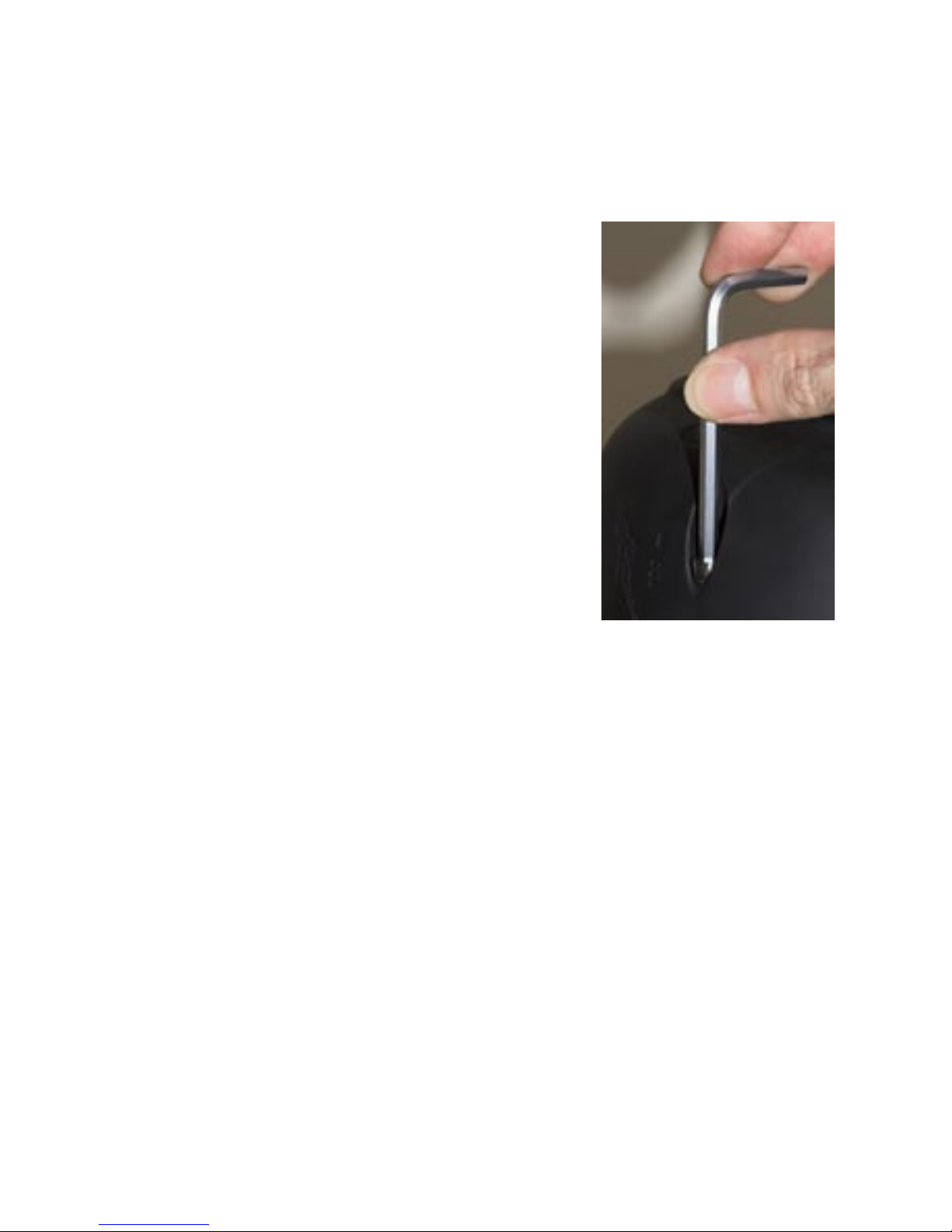
The HUGYFOT Nikon D80 housing is opened and closed by means of 2 built-in
countersunk bolts.
This guarantees the safest way of closing. Only
with the right key you can open and close the
housing. A curious buddy cannot open the
housing by accident. Herewith we exclude the
unwanted opening of the housing. To seal the
housing, the socket screw key is inserted into
the countersunk bolt with the extended part and
then turned by the shorter part until the shells
are squeezed to one another. Further squeezing
the screws hasn’t got any sense and can only
damage the thread. At a depth of 6 meters the
hydrostatic pressure takes over and keeps all
the o-rings under pressure. Always check the
tension on the bolts before diving if the housing
wasn’t opened in between two dives.
First maintenance command:
The screws, and more specific the tread, must
be kept very clean at all times. The main o-ring
merely lies in the o-ring groove. It can be removed by blowing it out with com-
pressed air, by using a credit card or by rubbing two pieces of paper towards
each other against the o-ring so the o-ring pops out of his groove. Never use
a metal object or any other hard material: by doing this you can DAMAGE the
O-ring and the groove.
Second maintenance command:
Whenever the o-ring is dirty or misted up, it must be removed from its
groove (see first command) and cleaned up with soap (do not use corrosive
or chemical degreasers). Afterwards clean it with clear water.
O-rings have to be dried up with a clean cloth (do not squeeze) or by air.
Grease the O-rings (except the main red o-ring) by using HUGYFOT grease.
Pull the o-ring gently through your fingers without stretching it! O-ring
grooves, housing and shell edges have to be cleaned with a clean cloth.
To seal the housing, the sock-
et screw key is inserted into
the countersunk bolt with the
extended part.

Hugyfot Housing for Nikon D80 8User manual
5. Port with bayonet catch
The front port bayonet catch is a secure and fast method to connect the dif-
ferent ports to the HUGYFOT Nikon D80 housing.
The port has a mark which has to be positioned opposite to the mark at the
left of the housing when mounting and demounting the port. To actually
close the port it has to be turned clockwise until the mark on the port is op-
posite to the mark on top of the housing. To demount the port it has to be
turned counter clockwise until the mark on the port is opposite to the mark
on the left of the housing.
When mounting the port, mind that it is held exactly in the middle of the
port mounting. Only then you can press the port so it slides nicely into the
port mounting. Check whether the port is closed properly before turning it
towards the marking on top of the housing. (secure position).
Third maintenance command:
The o-ring around the port can be removed from its groove by pressing it
with 2 fingers.
Port mounting, o-ring groove and bayonet catch have to be cleaned with a
wet cloth. Afterwards let everything dry.
Clean the inside of the portglas with water and soap. Never scrub it with a
cloth. Rinse it with fresh water and let it dry, or dry it with compressed air.
Grease the O-rings with HUGYFOT grease by gently pulling it through your
fingers without stretching it! Put it back into their grooves.
A
BC
When mounting the port,
A and C must be opposite
to each other. Make sure
that the port is held ex-
actly in the middle of the
port mounting. Then turn
the port clockwise until B
and C are opposite to each
other.

Hugyfot Housing for Nikon D80 9User manual
6. Flash connections
Hugyfot housings can be equiped with Nikonos 5-pins or S-6 flash connec-
tions. These flash connections are plugged into a circuit board inside the
housing. An optional TTL-converter is also available.
The flash connection can be shut off by
using a small protection cap which can be
removed by turning it counter clockwise.
The cap has 2 o-rings which have to be
cleaned together with the thread. After-
wards, slightly grease o-ring and thread.
The flash plug also has to be serviced.
Slightly grease the o-rings and thread and
keep the flash contacts dry.
The multiple socket in the housing has
a small ridge. The projecting part of the
connection has a groove with the same
measurements as the ridge of the connec-
tion. Be sure that, whenever plugging the
connection into the socket, the groove and
the ridge fit well together. Only then the
connection is well positioned. Press the
plug gently into the contact. Then turn it
clockwise to tighten it. Whenever the flash
connection has to be removed from a wet
housing it always has to be positioned downwards. If not, the remaining
water can work its way into the flash connection. In that case, the water has
to be removed immediately by using an absorbing paper. Do not close the
flash connection when it is not entirely dry.
Fourth maintenance command:
Keep the inside of the plug dry and clean. The o-rings, the plug and the
thread need to be clean and slightly greased. DO NOT use the housing with
an open multiple socket: this can cause leakage and corrosion!
Be sure that, whenever plugging the
connection into the socket, the groove
and the ridge fit together well.

Hugyfot Housing for Nikon D80 10 User manual
Hugyfot Strobe Connections
The Hugyfot strobe connections are integrated in the leakage detector
circuit board. This circuit board runs on a single 3.6 Volt 1/2 AA Lithium
battery. The main parts of this system are described as below.
Standard setup .
External strobe connection(s) A is (are) connected to D and/or E on leakage detector. Hotshoe B is connected to
C on leakage detector. X is used for firmware upload.
Setup with TTL converter .
External strobe connection(s) A is (are joined and) connected to D on leakage detector. Connection E on leakage
detector is joined with connection F on TTL converter. Hotshoe B is connected to H on TTL converter. G is power
supply on TTL converter.
In case you run out of batteries, a backup system is provided. TTL control will no longer be available!
Backup for standard setup .
External strobe connection(s) A is (are) connected to J and/or K on backup circuit board. Hotshoe B is connected
to I on backup circuit board.
Backup for setup with TTL converter .
External strobe connection(s) A is (are joined and) connected to J or K on leakage detector. Hotshoe B is con-
nected to I on backup circuit board.
External strobe connection
Nikonos 5-pin or S6-pin
Internal camera hotshoe
Nikon or Canon
Hugyfot leakage detector with integrated
strobe connections Nikon or Canon
Battery holder for
3.6 V 1/2AA Lithium battery
+ -
TTL Converter Backup
A B
D
E
C
G
H
F
J
K
I
X
Questo manuale è adatto per i seguenti modelli
1
Indice
Altri manuali Hugyfot Accessori per fotocamere

Hugyfot
Hugyfot Hugyfot 50D Manuale utente

Hugyfot
Hugyfot Vision Xs HDMI Monitor Manuale utente

Hugyfot
Hugyfot HFN-D810 Manuale utente

Hugyfot
Hugyfot Pro Manuale utente

Hugyfot
Hugyfot Vision Sony RX100 IV/V Manuale utente

Hugyfot
Hugyfot camera housings Manuale utente

Hugyfot
Hugyfot Vision Hero 5 Manuale utente

Hugyfot
Hugyfot Vision Xs Manuale utente

Hugyfot
Hugyfot Vision Xs Manuale utente

Hugyfot
Hugyfot 450D - EOS Rebel XSi Manuale utente