
IGD 2-Wire Systems Istruzioni per il montaggio

2-WIRE SYSTEMS
2 - W i r e G a s D e t e c t i o n S y s t e m I n s t a l l e r s G u i d e V 4 . 5 1
Triton House
Crosby Street
Stockport
SK2 6SH
England
Tel: +44 (0)161 483 1415
Fax: +44 (0) 161 484 2345
Email: [email protected]
Website: www.internationalgasdetectors.com
Addressable
2-Wire
FS646773
REF: T550-INST V4.51
EMS696504
1
2-WIRE
GAS DETECTION
www.internationalgasdetectors.com
Display
&
Volt Free
Relay
Analogue in
Analogue in
Sounder
Output
Digital Out
Digital Out
or
or
Gas
Gas
Detector
Detector
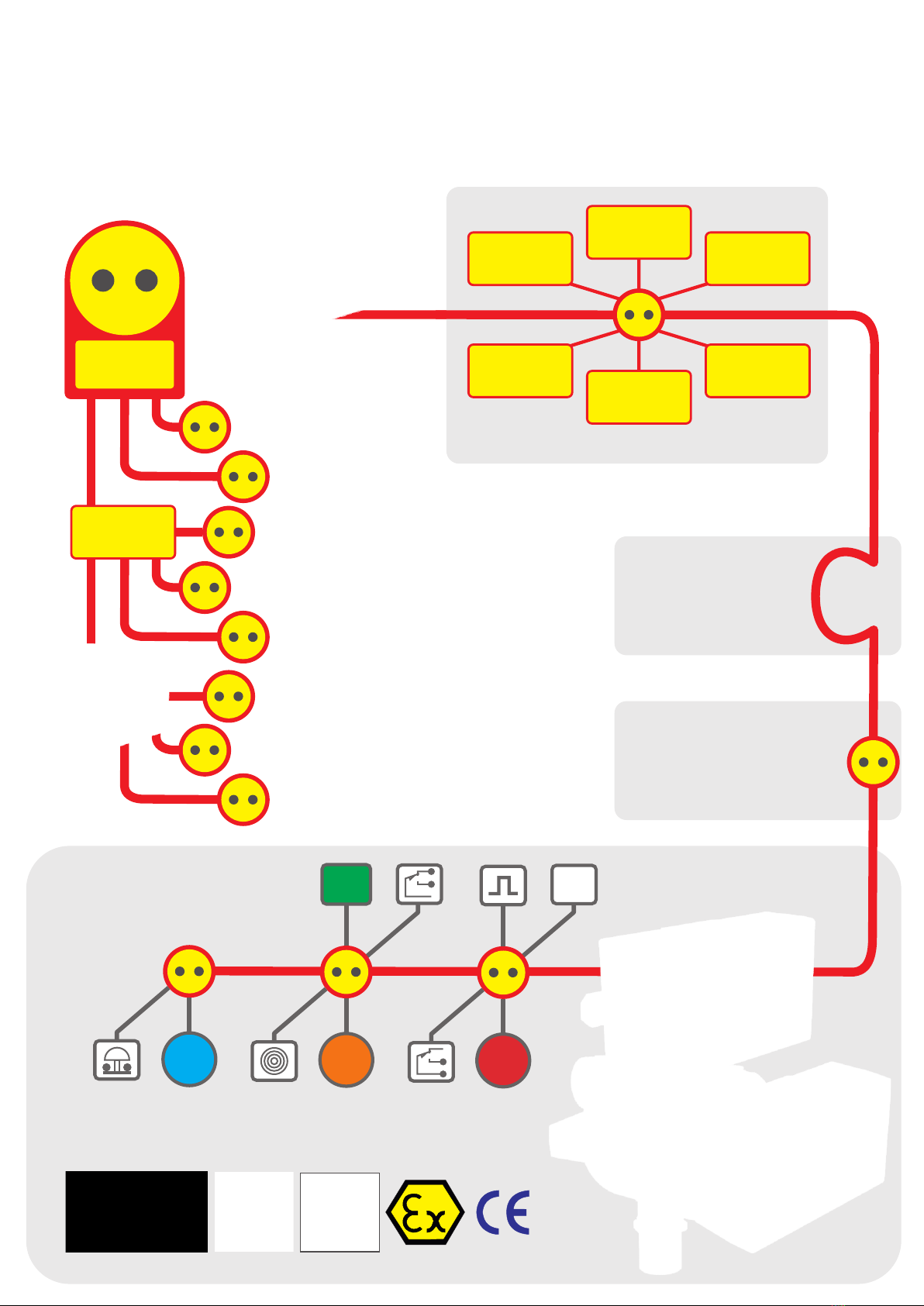
Each Detector Node Has Multiple I/O
ALL
OK
First Fit Cabling
Fit Detector Nodes
Fit Additional Devices
Where You Need Them
Safety Assured
CO H2S LPG
4-20
Addressable
2-Wire
HUB
APP Based Setup and Service Tools
No Specific Cable Type
No Cable Polarity
2 Core Cable Connects Detector Nodes
350 Detector Nodes/Devices Possible
Communicate over 3000M Possible
Cascade Hubs or Control Panels
Modbus and Bacnet Compatible
BlueTooth
Ethernet
USB
Battery Backup
FS646773

2
Interaction Between the Gas Detection System and Other Systems
Clear Indication to workers That a Gas Hazard Exists and the Action They Must Take
All Gas Detectors shipped from IGD are pre-calibrated. It is not always necessary to re-calibrate a
newly installed system on site but it is recommended that commissioning is undertaken.
Commissioning should be undertaken by persons trained to do so. Commissioning should ensure that
the system performs and interfaces correctly to all connected devices, host systems and operates to
the required cause and effect.
Failure to follow this installers guide could compromise operation of the 2-Wire gas detection system
so please follow the enclosed information carefully.
A competent person is someone who has sufficient training and experience or knowledge and other
qualities that allow them to assist you properly. The level of competence required will depend on the
complexity of the situation and the particular help you need.
IGD’s gas detection systems are capable of installation by electrical installation engineers. Design of
a system is not covered in this guide and should be undertaken by a competent person. The design
should include:
IGD can provide help to design systems where help is required and can also provide training for
surveyors, specifiers, designers and installers.
This installers guide is intended for the use of system specifiers, surveyors, designers and installers.
The intention of this guide is to provide information for the correct installation of IGD’s range of 2-Wire
gas detection systems. This guide indicates correct cabling practice, types of cabling which can be
used and options available to correctly design and install a 2-wire gas detection system. This guide is
not intended as a design or specification guide, these are available separately.
Note that System control panels, detector nodes, battery backup modules and power boosters are all
supplied with their own manuals. Their general specifications and performances are available both in
their individual manuals and published data sheets. This data is not reproduced in this guide.
The Nature of the Gas Hazard and Appropriate Placement of Detectors
The Necessary Safe Operating Procedures That Must be in Place
IGD are available to answer question using our on-line ticketing system available through our website.
NOTE that ATEX equipment has specific requirements for cable protection and glanding to housings.
These requirements are detailed in manuals for such equipment available through our website.
Systems should be designed and installed by competent persons. A competent person being defined
by the UK Health and Safety Executive as:
Introduction

3
SECTION 1
MOUNTING DETAILS FOR EQUIPMENT

4
Tocsin 750 Physical
Installation Cables
FRONT VIEW
382mm
292mm
72mm
120.5mm
134mm
20mm
48.5mm
Front Face
Top Face
Side Face
56.5mm
30mm
10 off 20mm
Cable Entries
360mm
Supported Installation Cables 2 Core 1.5mmSQ or 2.5mmSQ See IGD Cable System Calculator
Typically SWA, MICC, FP200, SY, CY, H03VVH2-F Mains Cable Screened, screened or Similar
Note 150W and 24V DC Versions Can be
Flush mounted into walls up to the front face flange
300W Versions have active ventilation and must be
surface mounted allowing 100mm clearance all round
Note that the rear case can be rotated to allow
20mm entries to face either up or down
Addressable
2-Wire

5
TOCSIN 650 PHYSICAL
Installation Cables
FRONT VIEW
382mm
292mm
72mm
120.5mm
134mm
20mm
48.5mm
Front Face
Top Face
Side Face
56.5mm
30mm
10 off 20mm
Cable Entries
360mm
Supported Installation Cables 2 Core 1.5mmSQ or 2.5mmSQ See IGD Cable System Calculator
Typically SWA, MICC, FP200, SY, CY, H03VVH2-F Mains Cable Screened, screened or Similar
Addressable
2-Wire
Note 150W and 24V DC Versions Can be
Flush mounted into walls up to the front face flange
300W Versions have active ventilation and must be
surface mounted allowing 100mm clearance all round
Note that the rear case can be rotated to allow
20mm entries to face either up or down

6
Mounting Details and Dimensions Safe Area Versions
Gas Detector Types
Mounting Details and Dimensions ATEX Versions
172
158
76
48
43
86
98 18
5
20mm Entries Top, Bottom & Either Side
Note TOC-750-AN3 Shown
Detectors, Annunciators and
Nodes Share Common
Mounting Details
145.0
126.0 128.5
COVER SECURING SCREW
M20 x 1.5
40.0
25.0
Ø7.0
EXTERNAL EARTH
MKIII FLAMMABLE
GAS DETECTOR
SHOWN
40.0
Ø110
128.0
The ATEX version uses IGD’s JB3 series ATEX EXD terminal enclosure. Please note that cable glanding
and sealing must conform to ATEX requirements which is more fully described in the ATEX JB3 manual
Relative response to Methane @ 4.4% Vol = 100% LEL Equivalent to 55% LEL N-Butane
Refer to individual data sheets for specific data relevant to available gas detectors, types,
accuracies and sensitivities available.
For pellistor type gas detectors complying to BS EN 60079-29-0 and 1, these general purpose
flammable gas detectors are suitable for Methane and LPG detection in the range 0-100% LEL.

7
FRONT VIEW
382mm
292mm
72mm
120.5mm
134mm
20mm
48.5mm
Front Face
Bottom Face
Side Face
56.5mm
30mm
10 off 20mm
Cable Entries
360mm
Battery Backup Modules
TOC-750-BAT1 7AH Battery Backup with 150W PSU
TOC-750-BAT2 17AH Battery Backup with 300W PSU
460mm
292mm
115mm
20mm
Front Face
Bottom Face
Side Face
25mm
60mm
95mm
4 off 20mm
Cable Entries

8
SECTION 2
SITING GAS DETECTORS

9
Gas detectors usually fall into two groups for placement
Each site should be surveyed and assessed on its own merits. This document presents general
guidance only.
1. Plant Protection. Typically flammable gas detectors fall into this category. Aside from asphyxiation
flammable gases are typically not directly toxic and so detectors are placed strategically where the gas is
expected to accumulate based on its relative density to air (lighter or heavier)
Note that in many cases both life safety and plant protection sensors may be appropriate on a site. For
example a plant using liquid helium may have plant protection sensors at high level to ventilate roof
spaces in the event of leaks. However in the event of ventilation failure Helium could accumulate down
towards the zone where personnel operate. In this case a second set of life safety sensors would be
appropriate.
2. Life Safety Systems. Here the concern is that a toxic or asphyxiant gas is directly hazardous to
personnel and so the gas detection is placed based on the normal operating zone for the people present
Lighter than air gases, detectors placed at highest ceiling points
Consider fitting collector cones at lower level for gas bottle stores
boiler plant and gas meters (see separate application note).
400mm
1000mm
1800mm
Life Safety Zone
Consider ceiling divisions, follow rules for smoke detectors
Methane, Helium, Hydrogen, Ammonia etc
LPG, CO2
CO, CO2, O2
H2S, NO2, NO
HCN, HCL, HF
NH3 etc
Consider fitting splash/dust guards to protect low level sensors
Consider sensors in under floor areas/voids/drains where heavier than air gases are present
LPG 0-100%LEL
SN:20235-1-1 ADD:4110
GAS DETECTOR
LPG 0-100%LEL
SN:20235-1-1 ADD:4110
GAS DETECTOR
Siting Gas Detectors
Indice
Altri manuali IGD Rilevatore di gas


