JVC MX-J300 Manuale utente

SERVICE MANUAL
COMPACT COMPONENT SYSTEM
No.20818
Jul. 2000
COPYRIGHT 2000 VICTOR COMPANY OF JAPAN, LTD.
MX-J300
MX-J300
Flow of functional operation
unit TOC read
Maintenance of laser pickup
Replacement of laser pickup
Description of major ICs
Area Suffix
J
CU.S.A.
Canada
Contents
Safety Precautions
Important for laser products
Preventing static electricity
Disassembly method
Adjustment method
1-2
1-3
1-4
1-5
1-24
1-27
1-28
1-28
1-29
COMPACT
DIGITAL AUDIO
CD
3
CD
2
CD
1
STANDBY
VOLUME
CD
1
CD
2
CD
3
PLAY& EXCHANGER
FM /AM
CD
PLAY
REC/PLAY
AUTO REVERSE
EJECT
COMPACT
DIGITALAUDIO
TAPE
COMPU
PLAY
CONTROL
FULL - LOGIC CONTROL
1 BIT
DUAL D/A CONVERTER
AUX
PHONES
PANELOPEN / CLOSE
POWERED ROLLING PANEL
MX-J300
+
–
EJECT
POWER
1
/CLEAR
CD
TAPE
CLOCK TIMER POWER
SLEEP
SELECT
–+
RM-SMXJ300VREMOTE CONTROL
2 3
4 5 6
AUX
FM/AM
FM MODE
PLAY MODE
CD3CD2CD1
A – TAPE - B
REC PAUSE
SOUND
MODE VOLUME ACTIVE
BASS EX.
SHIFT
7 8 9
10
+
10
SET

MX-J300
1-2
Safety Precautions
1.This design of this product contains special hardware and many circuits and components specially
for safety purposes. For continued protection, no changes should be made to the original design
unless authorized in writing by the manufacturer. Replacement parts must be identical to those
used in the original circuits. Services should be performed by qualified personnel only.
2. Alterations of the design or circuitry of the product should not be made. Any design alterations of
the product should not be made. Any design alterations or additions will void the manufacturer`s
warranty and will further relieve the manufacture of responsibility for personal injury or property
damage resulting therefrom.
3. Many electrical and mechanical parts in the products have special safety-related characteristics.
These characteristics are often not evident from visual inspection nor can the protection afforded
by them necessarily be obtained by using replacement components rated for higher voltage,
wattage, etc. Replacement parts which have these special safety characteristics are identified in
the Parts List of Service Manual. Electrical components having such features are identified by
shading on the schematics and by ( ) on the Parts List in the Service Manual. The use of a
substitute replacement which does not have the same safety characteristics as the recommended
replacement parts shown in the Parts List of Service Manual may create shock, fire, or other
hazards.
4. The leads in the products are routed and dressed with ties, clamps, tubings, barriers and the
like to be separated from live parts, high temperature parts, moving parts and/or sharp edges
for the prevention of electric shock and fire hazard. When service is required, the original lead
routing and dress should be observed, and it should be confirmed that they have been returned
to normal, after re-assembling.
5. Leakage currnet check (Electrical shock hazard testing)
After re-assembling the product, always perform an isolation check on the exposed metal parts
of the product (antenna terminals, knobs, metal cabinet, screw heads, headphone jack, control
shafts, etc.) to be sure the product is safe to operate without danger of electrical shock.
Do not use a line isolation transformer during this check.
Plug the AC line cord directly into the AC outlet. Using a "Leakage Current Tester", measure
the leakage current from each exposed metal parts of the cabinet , particularly any exposed
metal part having a return path to the chassis, to a known good earth ground. Any leakage
current must not exceed 0.5mA AC (r.m.s.)
Alternate check method
Plug the AC line cord directly into the AC outlet. Use an AC voltmeter having, 1,000 ohms
per volt or more sensitivity in the following manner. Connect a 1,500 10W resistor paralleled by
a 0.15 F AC-type capacitor between an exposed
metal part and a known good earth ground.
Measure the AC voltage across the resistor with the
AC voltmeter.
Move the resistor connection to eachexposed metal
part, particularly any exposed metal part having a
return path to the chassis, and meausre the AC
voltage across the resistor. Now, reverse the plug in
the AC outlet and repeat each measurement. voltage
measured Any must not exceed 0.75 V AC (r.m.s.).
This corresponds to 0.5 mA AC (r.m.s.).
Warning
1.This equipment has been designed and manufactured to meet international safety standards.
2. It is the legal responsibility of the repairer to ensure that these safety standards are maintained.
3. Repairs must be made in accordance with the relevant safety standards.
4. It is essential that safety critical components are replaced by approved parts.
5. If mains voltage selector is provided, check setting for local voltage.
Good earth ground
Place this
probe on
each exposed
metal part.
AC VOLTMETER
(Having 1000
ohms/volts,
or more sensitivity)
1500 10W
0.15 F AC TYPE
!
CAUTION
Burrs formed during molding may be left over on some parts of the chassis. Therefore,
pay attention to such burrs in the case of preforming repair of this system.

MX-J300
1-3
Important for laser products
1.CLASS 1 LASER PRODUCT
2.DANGER : Invisible laser radiation when open and inter
lock failed or defeated. Avoid direct exposure to beam.
3.CAUTION : There are no serviceable parts inside the
Laser Unit. Do not disassemble the Laser Unit. Replace
the complete Laser Unit if it malfunctions.
4.CAUTION : The compact disc player uses invisible
laserradiation and is equipped with safety switches
whichprevent emission of radiation when the drawer is
open and the safety interlocks have failed or are de
feated. It is dangerous to defeat the safety switches.
5.CAUTION : If safety switches malfunction, the laser is able
to function.
6.CAUTION : Use of controls, adjustments or performance of
procedures other than those specified herein may result in
hazardous radiation exposure.
!
CAUTION
Please use enough caution not to
see the beam directly or touch it
in case of an adjustment or operation
check.

MX-J300
1-4
Preventing static electricity
1. Grounding to prevent damage by static electricity
Electrostatic discharge (ESD), which occurs when static electricity stored in the body, fabric, etc. is discharged,
can destroy the laser diode in the traverse unit (optical pickup). Take care to prevent this when performing repairs.
2. About the earth processing for the destruction prevention by static electricity
In the equipment which uses optical pick-up (laser diode), optical pick-up is destroyed by the static electricity of
the work environment.
Be careful to use proper grounding in the area where repairs are being performed.
2-1 Ground the workbench
Ground the workbench by laying conductive material (such as a conductive sheet) or an iron plate over
it before placing the traverse unit (optical pickup) on it.
2-2 Ground yourself
Use an anti-static wrist strap to release any static electricity built up in your body.
3. Handling the optical pickup
1. In order to maintain quality during transport and before installation, both sides of the laser diode on the
replacement optical pickup are shorted.After replacement, return the shorted parts to their original condition.
(Refer to the text.)
2. Do not use a tester to check the condition of the laser diode in the optical pickup.The tester's internal power
source can easily destroy the laser diode.
4. Handling the traverse unit (optical pickup)
1. Do not subject the traverse unit (optical pickup) to strong shocks, as it is a sensitive, complex unit.
2. Cut off the shorted part of the flexible cable using nippers, etc. after replacing the optical pickup. For specific
details, refer to the replacement procedure in the text.Remove the anti-static pin when replacing the traverse
unit. Be careful not to take too long a time when attaching it to the connector.
3. Handle the flexible cable carefully as it may break when subjected to strong force.
4. It is not possible to adjust the semi-fixed resistor that adjusts the laser power. Do not turn it
Conductive material
(conductive sheet) or iron plate
(caption)
Anti-static wrist strap
Attention when traverse unit is decomposed
1. Remove the disk stopper and T. bracket on the CD changer mechanism
assembly.
2. Disconnect the harness from connector on the CD motor board.
3. CD traverse unit is put up as shown in Fig.1.
4. Solder is put up before the card wire is removed from connector CN601
on the CD servo control board as shown in Fig. 2.
(When the wire is removed without putting up solder, the CD pick-up
assembly might destroy.)
5. Please remove solder after connecting the card wire with CN601 when
you install picking up in the substrate.
*Please refer to "Disassembly method" in the text for pick-up and how to
detach the CD traverse mechanism.
Soldering
Fig.1
Fig.2
CD changer
mechanism
assembly
CD traverse
unit
Flexible cable

MX-J300
1-5
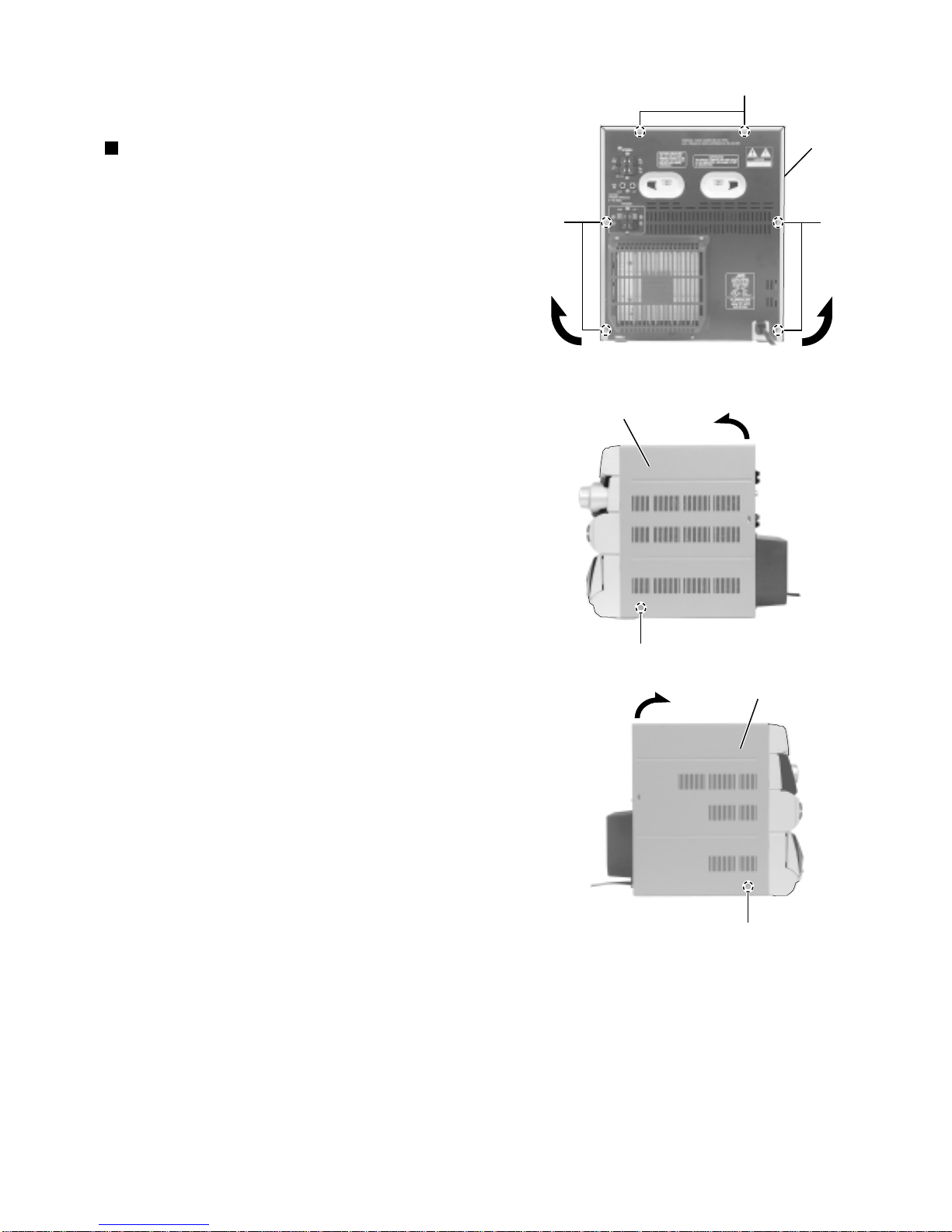
Remove the six screws Aattaching the metal cover
on the back of the body.
Remove the two screws Bon both sides of the body.
Remove the metal cover from the body while lifting
up the rear part of the metal cover.
1.
2.
3.
<Main body>
Removing the metal cover(See Fig.1 to 3)
Disassembly method
Fig.3
Fig.2
Fig.1
Metal cover
A
A
A
Metal cover
B
Metal cover
B

MX-J300
1-6
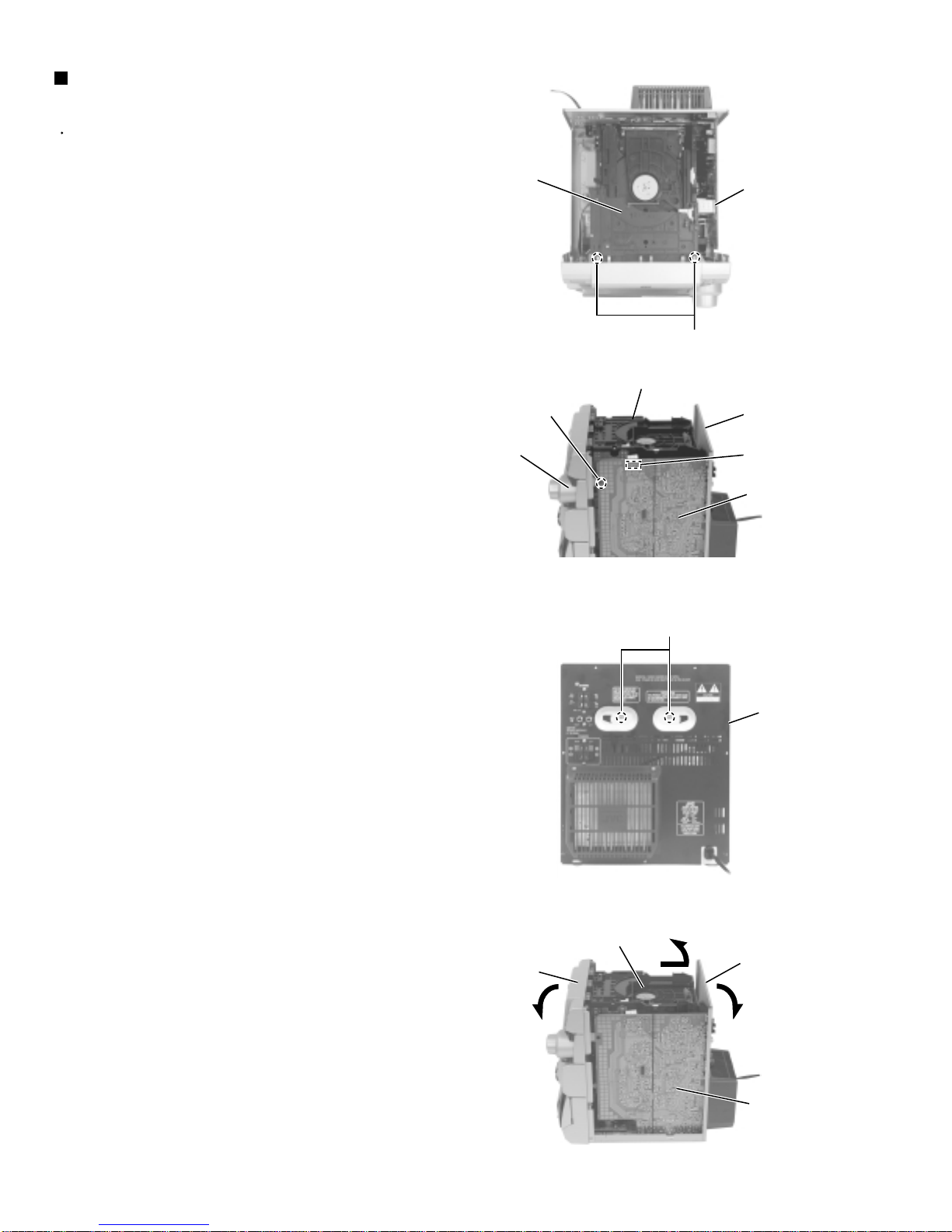
Prior to performing the following procedures, remove
the metal cover.
Remove the two screws Cattaching the CD changer
mechanism assembly on the top of the body.
Disconnect the card wire from connector CN303 on
top of the main board.
Remove the plastic rivet afixing the main board to
the front panel assembly on the left side of the body.
Remove the two screws Dfrom the rear panel.
Detach upward the rear part of the CD changer
mechanism assembly while pulling the front panel
assembly and the rear panel outward, then pull out
the front part backward and upward.
1.
2.
3.
4.
5.
Removing the CD changer mechanism
assembly (See Fig.4 to 7)
Fig.6
Fig.5
Fig.4
Fig.7
Pull outward
C
Main board
CN303
Plastic rivet a
CN303
CD changer mechanism assembly
Rear panel
Front panel
assembly
D
Rear panel
CD changer
mechanism
assembly
CD changer mechanism
assembly
Rear panel
Front panel
assembly
Pull outward
Main board
Main board

MX-J300
1-7
Prior to performing the following procedures, remove
the metal cover and the CD changer mechanism
assembly.
Disconnect the card wires from connector CN301,
CN304, CN305 and the harness from CN302 on the
inside of the main board.
Turn over the body and remove the two screws E.
Release the joint bon the bottom of the body and
the joints cand don both sides of the body using a
screwdriver, and detach the front panel assembly
toward the front.
1.
2.
3.
Removing the front panel assembly
(See Fig.8 to 12)
Fig.10
Fig.9
Fig.8
Fig.11
Fig.12
Main board
Front panel
assembly
Main board
CN301
CN304
CN305
CN302
CN901A,CN901B
EFront panel
assembly
Joint b
Front panel
assembly
Joint c
Front panel
assembly Joint d
(Bottom)

MX-J300
1-8
Prior to performing the following procedures, remove
the metal cover and the CD changer mechanism
assembly.
It is not necessary to remove the front panel
assembly.
Remove the two screws Fand the rear cover on the
back of the body.
Remove the four screws Gand the six screws H
attaching the main board and the heat sink to the
rear panel.
Remove the screw Iattaching the rear panel to the
base chassis.
Release the lower two joints eand fon both sides of
the rear panel using a screwdriver and detach the
rear panel backwards.
1.
2.
3.
4.
Removing the rear cover and the rear
panel (See Fig.13 to 16)
Fig.13
Fig.14
Fig.15
Fig.16
I
Rear panel
H
G
Rear panel
FF
Rear cover
G
G
H
Rear panel Joint e
Rear panel
Joint f
(To Earth bracket)

MX-J300
1-9
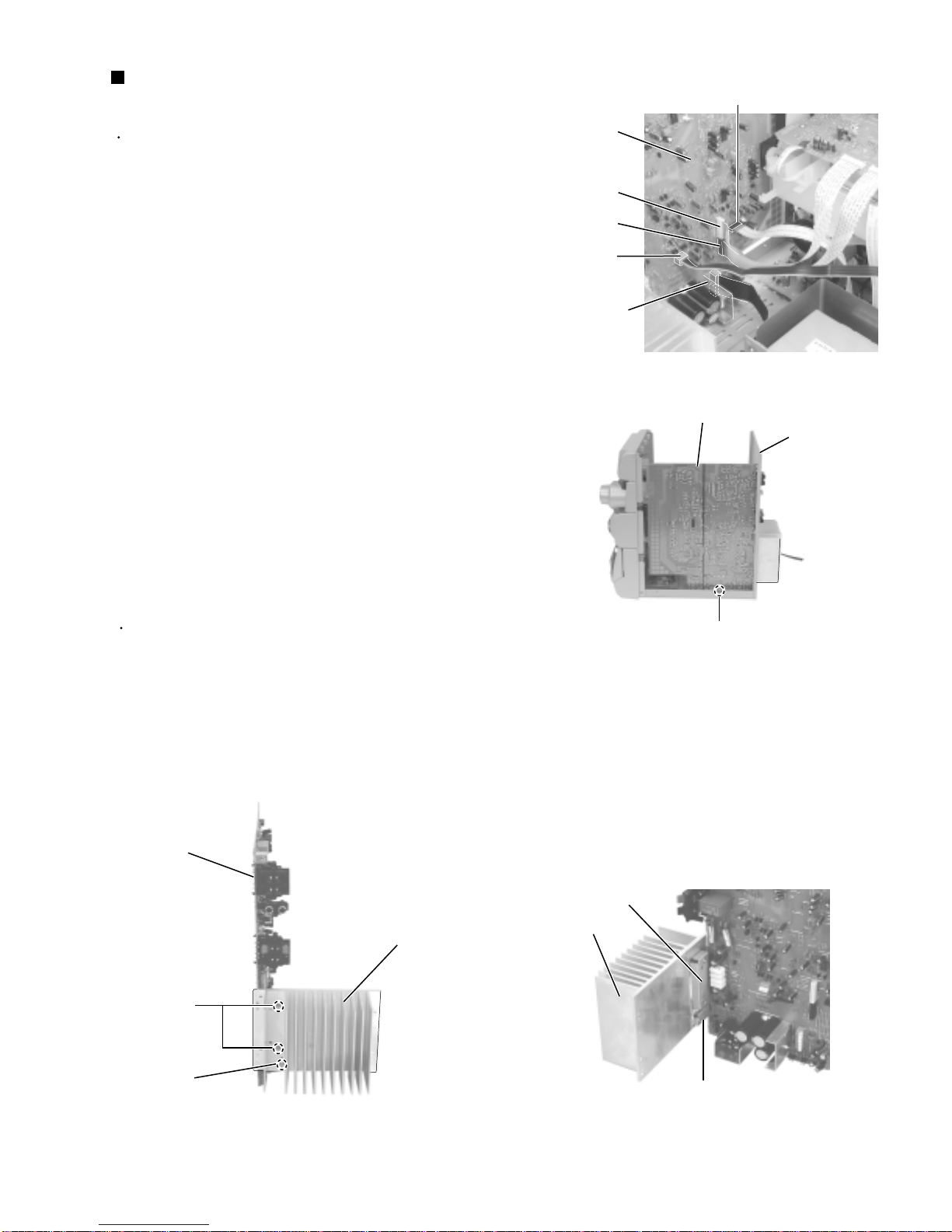
Prior to performing the following procedures, remove
the metal cover, the CD changer mechanism
assembly and the rear cover, rear panel.
It is not necessary to remove the front panel
assembly.
Disconnect the card wires from connector CN301,
CN304, CN305 and the harnesses from CN302,
CN901A and CN901B on the inside of the main
board.
From the right side of the body, remove the screw J
attaching the main board to the base chassis.
1.
2.
Removing the main board
(See Fig.17 to 20)
Prior to performing the following procedure, remove
the rear panel.
Remove the two screws Kand the screw Lattaching
the heat sink to the main board. Remove the IC
bracket 1 and 2 on the back of the heat sink.
Pull out the heat sink toward you.
1.
2.
~To remove the heat sink from
the main board~
Fig.17
Fig.18
J
Rear panel
Main board
Main board
CN301
CN304
CN305
CN302
CN901A,CN901B
Fig.19
Heat sink
K
L
Main board
Fig.20
Heat sink
IC bracket 2
IC bracket 1

MX-J300
1-10
Prior to performing the following procedure, remove
the metal cover and the CD changer mechanism
assembly.
Disconnect the harness from connector CN901A and
CN901B on the inside of the main board.
Cut off the tie band gof the power transformer
assembly and unsolder the power cord.
(Make sure to bundle the wires after repair.)
Remove the four screws Mattaching the power
transformer assembly.
When removing the power transformer assembly
with the power cord, remove the rear panel and pull
out the power cord stopper from the bottom chassis
upward.
1.
2.
3.
Removing the power transformer
assembly (See Fig.21 to 23)
Fig.21
Fig.22
Fig.23
M
Power transformer assembly
Tie band g
CN901A,CN901B
MPower transformer
assembly
Tie band g
Tie band g
Power transformer
assembly
Power cord stopper
Rear panel
Altri manuali per MX-J300
2
Indice
Altri manuali JVC Sistema di altoparlanti

JVC
JVC MX-K1 Manuale utente

JVC
JVC SP-MXKB1 Manuale utente

JVC
JVC MX-K50 Guida per l'amministratore

JVC
JVC MX-G500 Manuale utente

JVC
JVC 0305MWMMDWBET Manuale utente

JVC
JVC MX-KC50 Manuale utente

JVC
JVC HX-GX7 Manuale utente

JVC
JVC CA-FSH300 Manuale utente

JVC
JVC VS-DT6R Manuale utente

JVC
JVC MX-SK1 Manuale utente

JVC
JVC MX-D602T Manuale utente

JVC
JVC MX-KB4 Manuale utente

JVC
JVC LVT1348-001A Manuale utente

JVC
JVC SX-XD55 Manuale utente

JVC
JVC 0303NYMCREBETEN Manuale utente

JVC
JVC SP-UXQD9S Manuale utente

JVC
JVC CA-EXA5 Manuale utente

JVC
JVC EX-P1 Manuale utente

JVC
JVC FS-X 3 Manuale utente

JVC
JVC ca-mxkb4 Guida rapida