Kelvin Diesels J Guida rapida

9/26/2017 Service Manual Model J
http://www.sky-net.org.uk/kelvin/diesel/j_range/man/index.html 1/17
English Instruction Book No. 18
Copyright © 1962 Kelvin Diesels PLC
KELVIN-DIESEL ENGINES
The Running and Repairing of
Model "J"
SPECIAL NOTE
Damage due to rust is not covered by guarantee. The deck above the engine should
be perfectly watertight. Any engine room skylight or hatch should be aft of the engine.
If bilge water or salt spray is permitted to reach the flywheel, extensive damage to the
engine is certain see paragraphs 81 and 96. An engine should be wiped down with oil
once a week.
*CAUTION.--Before starting a new engine or an engine which has been standing
for some time, make sure that (a) crankcase and reverse gear case contain lubricating
oil; (b) governor case is filled with diesel fuel ; (c) fuel pump and pipes are free of air
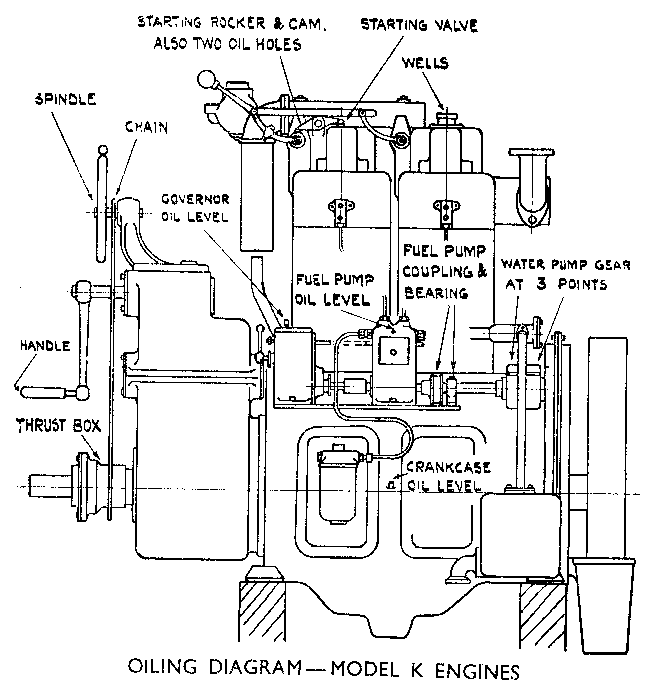
(36); (d) points shown on oiling diagram are attended to; (e) oil is splashed by hand
over the crankshaft bearings. After starting, test the oil circulating system by opening
the oil test cock (9).
NOTE.--THESE INSTRUCTIONS APPLY TO ENGINES PROPERLY
INSTALLED IN VESSELS WHICH OPERATE IN NORMAL WATERS. IN DIRTY
WATERS WHERE SAND, SEAWEED, JELLYFISH OR REFUSE MAY FOUL THE
COOLING SYSTEM, SPECIAL CARE MUST BE TAKEN TO KEEP THE WATER
INLET CLEAR AND THE WATER PASSAGES IN THE ENGINE MUST BE
FREQUENTLY AND REGULARLY CLEANED OUT. EVEN A TEMPORARY
STOPPAGE OF THE COOLING WATER MAY CAUSE OVERHEATING AND
SUBSEQUENT DAMAGE.
1. WHILE it is not necessary to read this instruction book right through, it is
essential before starting a new engine to read those paragraphs marked thus, *. In
order to avoid repetition, a system of cross-references is used: a symbol "(35) " in the
instruction means "here refer to paragraph 35." No subsequent adjustment or repair to
the engine should be carried out without reference to this book. Any advice we can
give is at your service whether you are the original purchaser of the engine or not.
When writing, do not omit to quote the number of the engine stamped on the
nameplate, and which should be filled in above.
*2. TOOL BOXES.--A box of tools accompanies each engine. It is closed with a lead
seal, and, if delivered with the seal broken, its contents should be checked with the list
to be found in the engine catalogue. Provide a convenient dry place for the tool box,

9/26/2017 Service Manual Model J
http://www.sky-net.org.uk/kelvin/diesel/j_range/man/index.html 2/17
and hang the following on nails driven into the bulkhead: (a) 2 finger pins to tighten
water pump gland; (b) small brass box spanner for carburettor jet.
3. REPLACEMENTS.--All the parts of current models are usually in stock, also the
parts of our older models for which there is a regular demand. Please describe the
parts which you require in the terms of the spares list which is contained in the tool
box. We can supply boxes containing a selection of spares suitable for customers in
remote districts; contents and price as per spares list. To England, Scotland, Northern
Ireland, Isle of Man and the Channel Islands, goods not exceeding fifteen pounds (in
each package) may be sent by post C.O.D. (cash on delivery). Buyers abroad may
have goods sent C.O.D. if they satisfy themselves that the system is available.
4. IMPROVEMENTS.--We make improvements from time to time and, where
possible, we make them applicable to engines already despatched. If you wish to
know whether any improvements have been added since your engine was made and
the cost of supplying them, quote the number of the engine to us.
*5. FUEL.--The engines are tested on Shell Mex Diesolite, but will run on any of the
oils marketed in this country as Diesel Oil, Gas Oil, Diesoleum, or Gasoleum,
provided that the viscosity does not exceed 40 seconds Redwood No. 1 at 100°
Fahrenheit and the oil remains fluid at 20° Fahrenheit. As Diesel fuels are variable, it
is desirable to draw a sample in a glass from every consignment. Oil having fine
sediment in suspension has a dull appearance, but clean oil is brilliant even although
dark in colour. Suitable fuel oils are obtainable from
THE SHELL MEX and B.P. LTD., Shell Mex House, Victoria Embankment. London,
W.C.2.
THE ESSO PETROLEUM CO.. LTD., 83 Albert Embankment, London, S.E.11.
THE REGENT OIL COMPANY, LTD., 117 Park Street, London, W.1.
You are recommended to write direct for the name of your nearest dealer.
*6. LUBRICATION is the most important care of an oil engine. Use only a
proprietary oil of good quality and see that it is delivered to you with the maker's seal
intact. We cannot indicate all the brands which are suitable, but the oils mentioned are
used by our customers.
*7. LUBRICATING SYSTEM.--The oil supply is contained within the crankcase
and below the reach of the cranks, An oil pump in the sump supplies a drip nozzle
situated above each revolving crank, and a pipe leading to each bearing. The surplus is
led into the timing wheel case. An oil test cock (9) serves to indicate whether the
system is working. The oil level must be maintained between the marks "full" and
"low" on the dip rod. The crankcase should be cleaned out once in 300 hours or more
often if there is any tendency for soot or sediment to accumulate. When the crankcase
has been pumped out (12) the oil pump (11) may become air locked, and it is
necessary to make sure that it is working (9) before running the engine for any length
of time. The sump holds l 1/4 gallons.

9/26/2017 Service Manual Model J
http://www.sky-net.org.uk/kelvin/diesel/j_range/man/index.html 3/17
*8. OIL DRIPS.--The gauze strainer situated in the bottom of the crankcase is
sufficiently close to catch anything which would choke the drip nozzles; nevertheless,
it is advisable to inspect the drips occasionally. This may be done by turning the
engine with the sparking plugs slackened. The nozzles are removable, they differ in
size; each is numbered, the largest should be forward. The nozzles are graded in size
to suit a shaft rake of 1 inch in 18 inches, but are suitable for rakes up to 1 in 9. The
rake will normally increase when under way, and 1 in 9 is the maximum permissible
in this condition.
*9 OIL TEST COCK.--To test the oil circulating pump, open the little cock on
crankcase inspection door, when oil should drip from it slowly at all engine speeds.
10. OIL HOLES.--In each bearing will be found an oil hole. See that it remains clear.
11. OIL PUMP.--The strainer is visible when the oil has been pumped out. Examine it
to time to see that it remains clear.
12. CRANKCASE PUMP.--This pump has no valves and must be operated as
follows :- the cut in the handle must be towards the engine on the upstroke and
towards the pipe on the downstroke. If the pump will not start put a little oil in by the
air hole to seal the piston.
*13. DAILY ATTENTION (see oiling diagram).--(a) Open the cock on the sump of
the fuel tank to discharge water and sediment: (b) try the oil test cock (9); (c) fill the
oil wells on the cylinders; (d) oil the pump gear at three points, the starting valves, the
operating cams, and the coupling of the Bosch pump. Check the level of the oil in the
crankcase, reverse gear case and governor (46).
14. WEEKLY ATTENTION.--Draw a sample of oil from the crankcase by means of
the pump (12), using a clear glass bottle to detect the presence of water. If the oil has
become fouled by water or sediment, renew it. Discoloration is not harmful. Examine
the water pump strainer (66). Oil the starting handle by the hole at the end.
15. MONTHLY ATTENTION.--(a) Test the oil drips (8); (b) clean out the crankcase
if the sediment is up to the strainer or the oil requires renewal; (c) tighten the packing
gland of the water pump with the finger pins provided (69); (d) tighten the gland of
the governor if leaking (46); (e) clean the fuel filter (37); (f) renew the oil in the
reverse gear once in 300 hours of running; (g) grease the thrust box with the grease
gun supplied.
16. ANNUALLY.--A hard working engine should be over- hauled once a year, and
the overhaul should be sufficiently extensive to make every part good for another
year's service. The practice of running an engine until trouble develops is equivalent
to overhauling by instalments, a costly method.
Before starting the work remove all surplus gear out of the engine room. Provide, if
possible, a work bench, a paraffin wash tray and cotton waste. Wash down the engine
with paraffin to loosen the nuts and soften the rust. Order all necessary replacements
by telegraph to avoid delay. Proceed as follows.

9/26/2017 Service Manual Model J
http://www.sky-net.org.uk/kelvin/diesel/j_range/man/index.html 4/17
(a) Withdraw the pistons (74). Service the ring grooves if necessary (75). If the
piston pins are slack, it may be necessary to renew both pistons and pins. Measure the
cylinder wear (63). If the liners are renewed it will pay to renew the pistons and the
rings unless these are in first-class condition.
(b) Remove the cylinder heads (68) and wash out the water passages. Remove the
inlet water connections to the cylinders and see that the pipes and passages are clear.
Withdraw the valves and renew, or re-machine, any which are badly worn (72). If the
valve seats cannot be restored by grinding borrow a cutter from us. Examine one or
more of the valve plungers. Avoid disturbing the compression chambers (70).
(c) Examine and tighten, if necessary, the bearings of the crankshaft. See that the
flywheel bolts are secure (78).
(d) Clean out the exhaust manifold and silencer.
(e) Clean the magneto. Adjust the contact breaker (52) and renew the wires if not
good for a year's service.
(f) Clean the injectors and nozzles (39), the fuel filter (37); blow through the fuel
pipes; drain the water and sediment from the tanks.
(g) Clean the oil filter, and the oil nipples.
(h) Drain the governor case and refill it with Diesel fuel. Add packing to the gland
if necessary.
(j) If the valves or valve seats of the water pump are badly worn renew them.
Examine the valve springs. Tighten the verrule which is within the pump ram (69).
Renew the packing.
(k) Detach the shaft coupling; examine the clutch thrust bearing and renew it if
damaged by rust (96). Examine the reverse gear. Renew the chain if it is striking
anywhere. See that the ahead clutch is secure on the crankshaft (89). Examine all
bolts. Rejoint the case with cement; check the alignment of the shaft and raise the
engine, if necessary, on levelling washers obtainable from us.
(1) Examine the propeller (100) and the Cutless rubber bearing. Renew the packing
in the stuffing box (99).
(m) Scrape the rust off the engine and the tanks, if necessary, and repaint with
Kelvin paint.
17. STARTING BY HAND AND PETROL.--Open injector drains (42). Remove
magneto stopping terminal from its pin. Put reverse gear at neutral. Set governor lever
in mid position. Turn chang-over valves to petrol. Put petrol in carburettor (49). Prime
cylinders with petrol oil mixture (21). 5 to 10 squirts per cylinder ascertain correct
quantity by trial. Pull engine over compression by handle. When engine starts, turn
one changeover valve to Diesel and close its injector drain. When the cylinder fires
repeat the operation for the remaining cylinders but consume all the petrol in the

9/26/2017 Service Manual Model J
http://www.sky-net.org.uk/kelvin/diesel/j_range/man/index.html 5/17
carburettor. Put the sparking plugs out of action by placing the stopping terminal on
its pin. If the engine does not take Diesel fuel, suspect an air lock (36).
18. STARTING BY ELECTRIC STARTER AND PETROL.--Proceed as in (17)
but, instead of using starting handle, press starter button. When engine fires, release
button.
19. STARTING BY HAND WITHOUT PETROL.-- Close injector drains (42).
Decompress all cylinders. Turn engine by starting handle until speed is attained then
quickly put one cylinder on full compression. When engine starts repeat the operation
for all cylinders.
If starting is difficult, prime all the cylinders heavily with oil. The effect of this is
two-fold
(a) The volume of the combustion chamber is reduced and the compression
pressure thereby increased.
(b) Leakage past the piston is reduced.
If the engine is easily turned use lubricating oil for this purpose, but if the engine is
stiff to turn use fuel oil.
20. STARTING BY ELECTRIC STARTER WITH OUT PETROL.--Proceed as
in (19) but, instead of using starting handle, press starter button. When engine fires,
release button.
*21. PETROL/OIL MIXTURE.--Should be in the proportion of 16 to 1. This is
equivalent to adding one pint of lubricating oil to 2 gallons of petrol.
*22. STOPPING.--Slow the engine to half speed. Put the reverse gear at neutral and
slacken the sparking plugs. Open. one injector drain and quickly turn its change-over
lever to the petrol position. Repeat operation for each cylinder.
*23. IDLING.--The engine may be run without load for any length of time provided
that it is run slowly. If permitted to run at speed without load, the cylinder will cool
down and the engine will knock (76).
24. ENGINE FIRES PRIMING AND STOPS.-- Petrol spray jet choked (48);
carburettor empty.
25. ENGINE NOT FIRING PRIMING.--(a) Sparking plugs damp (61); (b) engine
overprimed-turn with sparking plugs slackened; (c) carburettor over-filled (49); (d)
stopping wire not detached; (e) impulse starter not in action; (f) lack of spark (59); (g)
magneto contact breaker stuck (52); (h) magneto wrongly set (51).
26. ENGINE RUNS IRREGULARLY.--(a) Clean filter: if two filters are used
change over to the second filter; (b) air in the fuel system: open the cock at the
forward end of the fuel pump; if this stops the engine the filter is choked; (c) injector
valve sticking (43); (d) valve clearance not correct (71); (e) valve stems sticking-fill
the oil wells with fuel oil; (f) examine the feed pump if one is fitted.

9/26/2017 Service Manual Model J
http://www.sky-net.org.uk/kelvin/diesel/j_range/man/index.html 6/17
*27. ENGINE RUNS BACKWARDS.--If the change-over valve is turned to Diesel
before the engine has attained sufficient speed on petrol, it is possible for the engine to
run backwards. When this occurs, the engine draws its air supply through the silencer
and along with it water and soot. This condition can be avoided by allowing the
engine to run on petrol for several seconds before turning the change-over valve.
28. ENGINE KNOCKING.--If the knock is within the crankcase, look for something
loose, misplaced or hot. A knock within the cylinder is usually due to the jackets
being too cold. This occurs if the engine is run at speed without load. If that is not the
cause, drain the cylinders by the drain caps and examine the water regulator (65). If
the knock is at the water pump (64).
Caution.--If the knock is at a big end, the engine must be stopped at once or the
crankshaft will be damaged beyond repair.
29. ENGINE TIGHT TO TURN.--If the tightness developed during the process of
starting the engine, it is probably due to the excessive use of petrol, which washes the
lubricating oil from the cylinders (21).
*30. ENGINE FLOODED.--The exhaust must discharge slightly above sea level.
The silencer must be above the point of discharge. No part of the pipe may be above.
the silencer. The best arrangement is to give the pipe a gradual fall through out its
length from silencer to point of discharge. If these conditions have not been fulfilled
report the arrangement and the engine number.
31. SMOKE AT THE EXHAUST.--(a) Cylinders too cold due to the engine being
run at speed with the clutch out (23); (b) oil level above the full mark (7); (c) injector
valve stuck (39); (d) injection point too late (40); (e) the brass stop on the fuel pump
control rod out of position (34); (f) injection pressure adjustment wrong (41).
32. CYLINDERS TOO HOT.--At all speeds the waterpipes leading upward from the
cylinder barrel should be as hot as the hand can bear. The cylinder head should be
cooler. If these conditions are not met (a) examine the strainer (66), (b) open the water
regulator (65), but before doing so drain the cylinders. Permit no water to fall on the
pump shaft; (c) salt may have accumulated in the silencer where the water pipe enters
from the cylinders. This may be cleared by a wire inserted through a door on the top;
(d) the water outlets from the cylinder heads may be choked with salt.
33. COMPRESSION CHAMBER RUNS HOT.--(a) Lack of clearance between end
of starting valve stem and rocker (70); (b) starting valve not seating properly.
34. FUEL PUMP.--The internal parts of the fuel pump are accurately finished to the
finest limits. They stand up to their work indefinitely if protected from water and grit.
The absence of a water trap on the tank or neglect to tap it regularly will quickly ruin
the pump. The filter must be cleaned regularly (37). The pipe between the filter and
the fuel pump must be scrupulonsly clean before assembling. Do not attempt to
dismantle the fuel pump without reference to the C.A.V. Instruction Book supplied in
the tool box. The brass stop on the control rod prevents excessive discharge from the

9/26/2017 Service Manual Model J
http://www.sky-net.org.uk/kelvin/diesel/j_range/man/index.html 7/17
pump. Its position was carefully adjusted on test to suit the power output stated in the
catalogue. Do not attempt to move it or disturb the seal.
*35 FUEL PUMP LUBRICATION.--The pump is lubricated by fuel oil and
therefore no attention to lubrication is required.
36. AIR LOCK.--Before attempting to start for the first time a new engine, or an
engine which has been overhauled or has had its fuel system opened, it is necessary to
ensure that all air has been removed from the pump and fuel pipes. Open the cock at
the front end of the fuel pump and turn the engine by hand until fuel flows out freely
without air bubbles. Then close the cock, open all the injector drains, and again turn
the engine until fuel overflows from the governor into the drain bottle. Close the
drains and start the engine.
If the engine runs irregularly, inspect the injector nozzles one by one (39).
37. FILTER.--The filter should not be dismantled and cleaned without reference to
the C.A.V. Instruction Book supplied in the tool box. If two filters are fitted use one at
a time and run until the engine staggers; then change to the second and clean the first
so that it is ready. No water will collect in the filter if the drain cock on the fuel tank is
regularly tapped.
38. INJECTOR FUNCTION.--The valve in the injector nozzle should remain closed
until the oil pressure exceeds the compression pressure. The valve should then open
and close promptly when injection has ceased.
39. INJECTOR NOZZLE.--To inspect this first remove the injector from the
cylinder, then unscrew the steel cap nut by means of the vice at rear end of crankcase.
If the valve cannot be withdrawn from the nozzle with the fingers, soak it in paraffin
but use no tool which might damage it. The valve is a very close fit in the nozzle, and,
while good for its work, cannot stand rough handling. Avoid touching it with gritty
hands or with cotton, as the slightest trace of either is sufficient to make it stick. The
nozzles and valves are not interchangeable and must be kept together. If one is
damaged both must be renewed; a spare nozzle with valve should be carried. Avoid
mixing the injector parts. Deal with the injectors one at a time.
40. INJECTION POINT.--The injection should commence a little before the piston
reaches the top of its stroke. If the injection is too soon, the engine will knock. If too
late, it will lack power or show smoke at the exhaust. The mark on the flywheel
indicates the commencement of injection which was found best on test, but a change
of fuel might call for some adjustment which should be made at the pump coupling-
half a mark at a time.
Should the fuel pump be removed, re-connect it as follows:-- (a) turn the engine
until No. 1 Cylinder blows at the sparking plug; (b) adjust the flywheel to bring
"Injection" mark central; (c) turn pump by coupling until marks on coupling and
pump coincide; (d) couple the pump to its driving shaft; (e) if this does not give an
exact result use the adjustment on the coupling.

9/26/2017 Service Manual Model J
http://www.sky-net.org.uk/kelvin/diesel/j_range/man/index.html 8/17
41. INJECTOR ADJUSTMENT.--When sent out the injectors were adjusted for a
pressure of 90 atmospheres. (100 atmospheres for engines which start without petrol).
The pressure is controlled by brass washers below the hexagon brass plug. The figure
stamped on the plug represents the combined thickness of the washers. The parts must
not be interchanged. An appliance to test injectors is available at C.A.V. Service
Stations.
42. INJECTOR DRAIN VALVE.--The hand screw on the injector is the drain valve.
When this is open, no fuel passes into the cylinder.
43. INJECTOR VALVE STICKING.--This may be due to fine sediment in the fuel
(5) or to wrong adjustment (41).
44. DRAIN BOTTLE FILLING UP MORE RAPIDLY.-- This is due to the injector
valves not seating properly or to wear of the valves (39).
45. GOVERNOR ACTION.--The speed of the engine is controlled by the amount of
fuel discharged by the pumps The discharge from the pumps is controlled by the
governor. The action of the governor is controlled by the hand lever.
*46 GOVERNOR, CARE OF.--As the governor does not act when the case contains
insufficient oil, it is essential to make certain that the oil level is maintained (see
instruction plate on governor). If the engine is running, the case can be filled by
opening one of the injector drain valves (42). If the engine is stopped, the filling must
be done through the hinged cover; use diesel fuel. Should the engine run away, stop it
by opening the injector drains.
Tighten the packing gland from time to time to avoid loss of oil by leakage. When
the gland is fully tightened up, add a portion of the metallic packing which will be
found in the tool box.
Excessive tightening of the packing gland may cause sufficient heat to boil away
the oil and thereby put the governor out of action.
47. GOVERNOR ADJUSTMENT.--The movement of the hand lever is limited by
two stops. The upper one controls the maximum speed and the lower one the
minimum speed. The upper one is adjusted for 1,000 r.p.m. at which speed the engine
develops its rated horse power, provided that the propeller is not of excessive size.
The lower stop should be adjusted to give a speed, without load, of 220 r.p.m. with
engine cold.
48. CARBURETTOR.--The spherical casting at the rear of the engine is the
carburettor. It contains nothing but a spray jet which may be removed for cleaning by
means of the brass box spanner provided applied through the plug at the bottom.
*49. PETROL CAN.--This should contain petrol-oil mixture which is poured into the
gauze covered well of the carburettor. It gives a measured quantity suitable for one
start. Avoid filling above gauze level (21).

9/26/2017 Service Manual Model J
http://www.sky-net.org.uk/kelvin/diesel/j_range/man/index.html 9/17
50. MAGNETO, CARE OF.--Allow no oil to drip on to the magneto as this causes
rapid wear of the platinum contacts. The magneto requires only three drops of oil once
a month.
51. MAGNETO SETTING.--If the magneto is removed it must be re-set as follows -
(a) turn the engine until No. 1 Cylinder blows at the sparking plug; (b) adjust mark on
fly wheel central; (c) remove door from magneto case also covet from end of
magneto; (d) lay No.1 sparking plug on top of magneto and oscillate armature by
gearwheel until plug sparks; (e) mesh gearwheel so that break occurs when mark on
flywheel is central.
52. MAGNETO CONTACT BREAKER.--The moving arm of certain makes is
liable to become stuck in damp climates owing to the swelling of its fibre bush.
Remove the arm, polish and oil the pin; scrape out the fibre bush with the square tail
of a small file or other suitable instrument. The fibre pad on the end of the arm should
be oiled, but no oil must reach the platinum contacts. If any spare parts are carried a
complete contact breaker should be included.
53. MAGNETO CONTACT BREAKER GAP.--The contact points are platinum
tipped and gradually wear further apart with the result that the gap increases. A gauge
is attached to the magneto spanner; try it in the gap, and, if necessary, adjust the
screw. If the contact points wear rapidly (50).
54. MAGNETO DISTRIBUTOR.--Some distributors have carbon brushes which
wear. The dust produced must be removed from time to time. When the brushes are
worn down they should be renewed. The stretching of the spring serves temporarily in
taking up wear.
55. MAGNETO REPLACEMENTS.--Owing to the great variety of magnetos which
we have been obliged to supply, we cannot keep stock of all magneto
replacements,and buyers are advised to communicate direct with the magneto maker,
taking care to quote the number of the magneto if it bears one. A magneto sent to the
maker should be labelled with the owner's name and its despatch advised to the maker.
BOSCH MAGNETOS.
Bosch Limited,
Larden Road, Acton,
London, W.3.
SIMMS MAGNETOS.
Simms Motor Units Ltd.,
Oak Lane,
East Fincley,
London, N.2.
LUCAS MAGNETOS.
Joseph Lucas, Ltd.,
Great King Street,
Birmingham, 9.
B.T.H. MAGNETOS
British Thomson Houston
Co., Ltd.,
Alma Street,
Coventry.
56. IMPULSE STARTER PRINCIPLE.--Revolving with the magneto are two
pawls. These project when the engine is turned and recede when it attains about 100
r.p.m. The projecting ends of the pawls engage with a latch which arrests the rotation
of the armature and stretches a pair of springs. At a certain point the latch releases the
pawl and the springs impart to the armature a rapid motion which causes the magneto
to produce a spark however slowly the engine is turned.
57. IMPULSE STARTER TEST.--When the engine is turned by hand, the impulse
starter should produce a click. The action may be observed by removing the cover

9/26/2017 Service Manual Model J
http://www.sky-net.org.uk/kelvin/diesel/j_range/man/index.html 10/17
from the end of the magneto. If the device is not working, remove the inspection door
and examine the springs.
58. SPARKING PLUG, CARE OF.--Porcelain plugs must be handled with care. A
spanner carelessly applied may produce in the porcelain an invisible crack which in
time holds moisture and causes the plug to short. The thread of the sparking plug
should be oiled.
59. SPARKING PLUG TEST.--Take out plug, lay it on engine so that its body alone
makes contact, turn engine by hand. If no spark results (60).
60. SPARKING PLUG ADJUSTMENT.--The spark gap becomes wider with use,
and the points should be bent to maintain the gap between .016" and .020". The size
of the spark is in proportion to the width of the gap. A spark too small may fail to start
the engine, but a gap too wide may fail to produce a spark.
*61. SPARKING PLUGS DAMP.--The combustion of air and petrol produces water
vapour, some of which condenses on the sparking plugs. The sparking plugs supplied
by us are so arranged that this water can be blown off before starting by turning the
engine by hand with the sparking plug handles slackened one half turn. Note that this
cannot be done with ordinary sparking plugs.
62. SPARKING PLUG ON CRANKCASE.--Certain engines are fitted with
magnetos which produce more sparks than are required. The superfluous sparks are
led by cable to a sparking plug carried in a holder on top of the crankcase. This plug
and its connections must be kept in working order or the magneto may be damaged.
63. CYLINDER LINER.--When the internal diameter, about 3/4" from the top,
exceeds 4.265" the liner should be renewed. If you have no micrometer, make a length
bar of iron wire about 3/16" and a fit for the liner at the top. With this and a set of
"feelers" it is possible to measure the diameter where the wear occurs. The liners are
pressed into the cylinder and may be withdrawn upwards, without removing the
cylinders, by means of a tool loaned on request (114).
*64. AIR COCK.--On the air chamber of the water pump will be found an air cock.
This should be opened for a moment occasionally to fill the air chamber and so
prevent water hammer. It is necessary to close the sea cock while doing so.
65. WATER REGULATOR.--This is automatic in action. Withdraw the valve
occasionally to see that it is free. Control is by a restricting plate fixed between the
regulator and the flange of the small pipe. The size stamped on the regulator indicates
the original size of the hole in the restricting plate. Restriction bushes within the
water- connections distribute the water equally.
*66. WATER PUMP STRAINER.--This should be cleared regularly. To run until it
chokes is dangerous. The strainer requires little attention at sea, but frequent attention
if the engine is run with the boat at rest in shallow water, especially if the reverse gear
has been in action as that stirs up the water.
Indice