LG RK1D Manuale utente

OWNER’S MANUAL
Home Speaker
System
Please read this manual carefully before operating
your set and retain it for future reference.
MODEL
RK1D
www.lg.com
Copyright © 2019 LG Electronics Inc. All Rights Reserved.
MFL70840204
1905_Rev01

1 Getting Started
Getting Started
2
Getting Started
1
Safety Information
CAUTION
RISK OF ELECTRIC SHOCK
DO NOT OPEN
CAUTION: TO REDUCE THE RISK OF ELECTRIC
SHOCK DO NOT REMOVE COVER (OR BACK)
NO USER-SERVICEABLE PARTS INSIDE REFER
SERVICING TO QUALIFIED SERVICE PERSONNEL.
This lightning ash with arrowhead
symbol within an equilateral
triangle is intended to alert the
user to the presence of uninsulated
dangerous voltage within the
product’s enclosure that may be of
sufcient magnitude to constitute
a risk of electric shock to persons.
The exclamation point within an
equilateral triangle is intended
to alert the user to the presence
of important operating and
maintenance (servicing)
instructions in the literature
accompanying the product.
WARNING: TO PREVENT FIRE OR ELECTRIC SHOCK
HAZARD, DO NOT EXPOSE THIS PRODUCT TO RAIN
OR MOISTURE.
CAUTION: The apparatus should not be exposed to
water (dripping or splashing) and no objects lled
with liquids, such as vases, should be placed on the
apparatus.
WARNING: Do not install this equipment in a
conned space such as a book case or similar unit.
CAUTION: Do not use high voltage products around
this product. (ex. Electrical swatter) This product may
malfunction due to electrical shock.
CAUTION: Do not block any ventilation openings.
Install in accordance with the manufacturer’s
instructions.
Slots and openings in the cabinet are provided
for ventilation and to ensure reliable operation of
the product and to protect it from over heating.
The openings shall be never be blocked by placing
the product on a bed, sofa, rug or other similar
surface. This product should not be placed in a built-
in installation such as a bookcase or rack unless
proper ventilation is provided or the manufacturer’s
instruction has been adhered to.
NOTICE: For safety marking information including
product identication and supply ratings, please refer
to the main label on the bottom or the other surface
of the product.

Getting Started
3
Getting Started
1
CAUTION concerning the Power Cord
The Power Plug is the disconnecting device. In case
of an emergency, the Power Plug must remain readily
accessible.
Check the specication page of this owner’s manual
to be certain of the current requirements.
Do not overload wall outlets. Overloaded wall outlets,
loose or damaged wall outlets, extension cords, frayed
power cords, or damaged or cracked wire insulation
are dangerous. Any of these conditions could result
in electric shock or re. Periodically examine the
cord of your device, and if its appearance indicates
damage or deterioration, unplug it, discontinue use of
the device, and have the cord replaced with an exact
replacement part by an authorized service center.
Protect the power cord from physical or mechanical
abuse, such as being twisted, kinked, pinched, closed
in a door, or walked upon. Pay particular attention to
plugs, wall outlets, and the point where the cord exits
the device.
This device is equipped with a portable battery or
accumulator.
How to Safely remove the batteries or the battery
pack from the equipment:
To Remove the old batteries or battery pack, follow
the assembly steps in reverse order. To prevent
contamination of the environment and bring on
possible threat to human and/or animal health, the
old batteries or the battery pack must be put in an
appropriate container at designated collection points.
Do not dispose of batteries or battery pack together
with other waste. It is recommended that you use
local, free reimbursement systems batteries or
battery packs, (may not be available in your area). The
batteries or the battery pack should not be exposed
to excessive heat such as sunshine, re or the like.
CAUTION: No naked ame sources, such as lighted
candles, should be placed on the apparatus.
Symbols
~Refers to alternating current (AC).
0Refers to direct current (DC).
Refers to class II equipment.
1Refers to stand-by.
!Refers to “ON” (power).
Refers to dangerous voltage.

Table of Contents
4
Table of Contents
1 Getting Started
2 Safety Information
6 Unique Features
7 Playable file Requirement
7 – Music file requirement
7 – Compatible USB Devices
7 – USB device requirement
8 Remote control
10 Top / Front panel
11 Side / Rear panel
2 Connecting
13 Optional Equipment Connection
13 – AUX IN Connection
13 – PORT. IN Connection
13 – Listening to music from your portable player
or external device
14 – USB Connection
3 Operating
15 Basic Operations
15 – USB Operations
16 – Selecting a folder
and an MP3/WMA file
17 Using BLUETOOTH® wireless technology
17 – Listening to music stored on the Bluetooth
devices
20 Radio Operations
20 – Listening to the radio
20 – Improving poor FM reception
20 – Presetting the Radio Stations
20 – Deleting all the saved stations
21 Sound adjustment
21 – Setting the sound mode
21 Other Operations
21 – Turn off the sound temporarily
22 – Auto power down
22 – AUTO POWER On
23 – Auto function change

Getting Started
6
Getting Started
1
Unique Features
BLUETOOTH®
Listens to music stored on your Bluetooth device.
Portable In
Listens to music from your portable device. (MP3,
Notebook, etc.)

Getting Started
7
Getting Started
1
Playable file
Requirement
Music file requirement
MP3/WMA le compatibility with this unit is limited
as follows.
ySampling frequency : within 32 to 48 kHz (MP3),
within 32 to 48 kHz (WMA)
yBit rate : within 32 to 320 kbps (MP3),
40 to 192 kbps (WMA)
yMaximum les : 999
yMaximum folders : 99
yFile extensions : “.mp3”/ “.wma”
yCertain MP3/WMA les may not be played
depending on the type or format of the le.
Compatible USB Devices
yMP3 Player : Flash type MP3 player.
yUSB Flash Drive :
Devices that support USB2.0 or USB1.1.
yThe USB function of this unit does not support all
USB devices.
USB device requirement
yDevices which require additional program
installation when you have connected it to a
computer, are not supported.
yDo not extract the USB device while in operation.
yFor a large capacity USB, it may take longer than a
few minute to be searched.
yTo prevent data loss, back up all data.
yIf you use a USB extension cable or USB hub, the
USB device is not recognized.
yUsing NTFS le system is not supported. (Only
FAT(16/ 32) le system is supported.)
yThis unit recognizes up to 999 les.
yExternal HDD, Card readers, Locked devices, or
hard type USB devices are not supported.
yUSB port of the unit cannot be connected to PC.
The unit cannot be used as a storage device.
ySome USB may not work with this unit.

Getting Started
8
Getting Started
1
Remote control
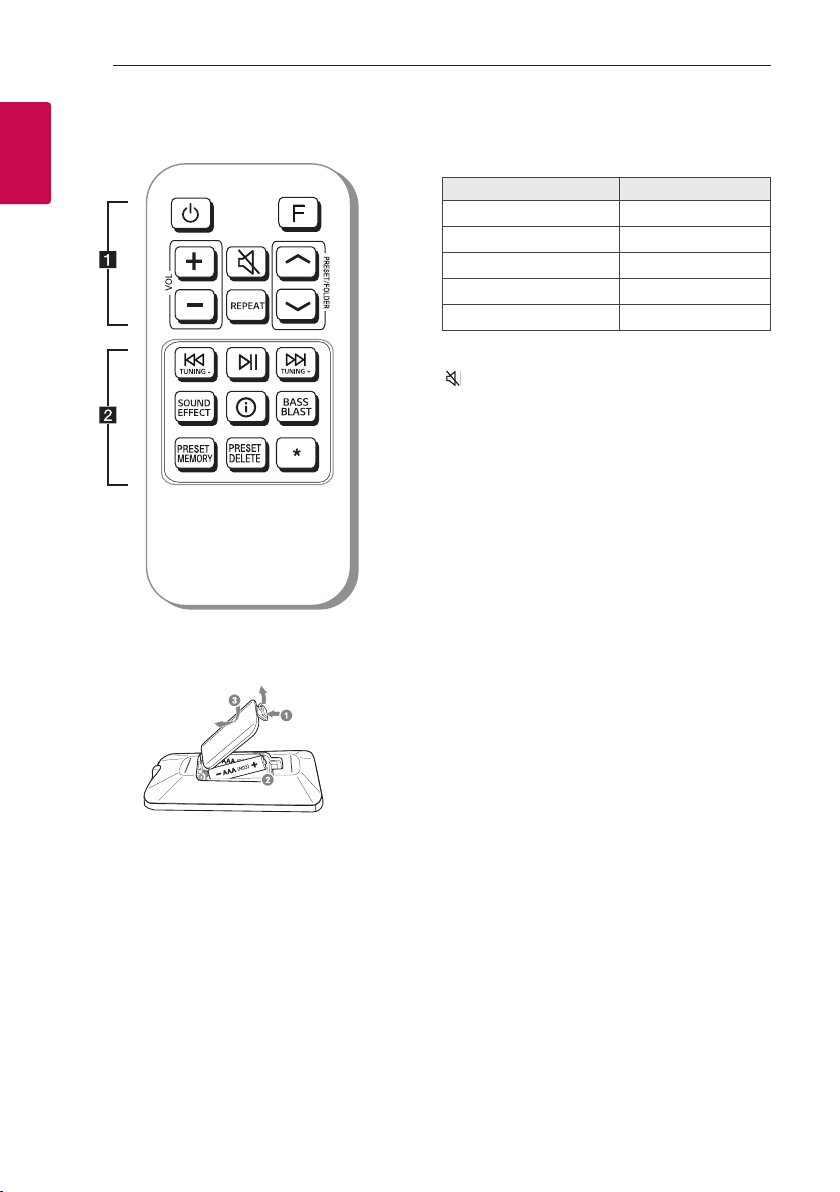
Replacement of battery
Remove the battery cover on the rear of the remote
control, and insert the battery with 4and 5
matched correctly.
• • • • • • • • • • • • • • a • • • • • • • • • • • • •
1(Standby) : Turns the power on or off.
F (Function) : Selects the function and input source.
Input source / Function Display
USB USB
AUX input AUX
Portable input PORTABLE
Bluetooth BT
Radio FM
VOL (Volume) +/- : Adjusts speaker volume.
SLEEP RDS/SET
CLOCK ALARM PTY
(Mute) : Mutes the sound.
REPEAT : Listens to your les repeatedly or
randomly.
PRESET/FOLDER W/S:
- Chooses a preset number for a radio station.
- Searches for a folder of MP3/WMA les. When a
USB containing MP3/WMA les in several folders
is being played, press PRESET/FOLDER W/S to
select the folder you want to play.

Getting Started
9
Getting Started
1
• • • • • • • • • • • • • • b • • • • • • • • • • • • •
TUNING-/+ : Selects the radio stations.
C / V(Skip/Search)
- Skips backward or forward.
- Searches for a section within a le.
N (Play/Pause)
- Starts or pauses playback.
- Selects stereo/mono.
SOUND EFFECT : Chooses sound impressions.
J(Information):
- Sees information about your music. An MP3 le
often come with ID3 tag. The tag gives the Title,
Artist, Album or Time information.
- Sees Bluetooth device name of the unit in BT
READY.
- Sees the name of connected all Bluetooth device
in Bluetooth mode.
BASS BLAST (or BASS BLAST+) : Press to select
BASS effect directly.
PRESET MEMORY : Stores radio stations.
(Page 20.)
PRESET DELETE : Deletes all the saved stations.
(Page 20.)
? :This button is not available.

Getting Started
10
Getting Started
1
Top / Front panel
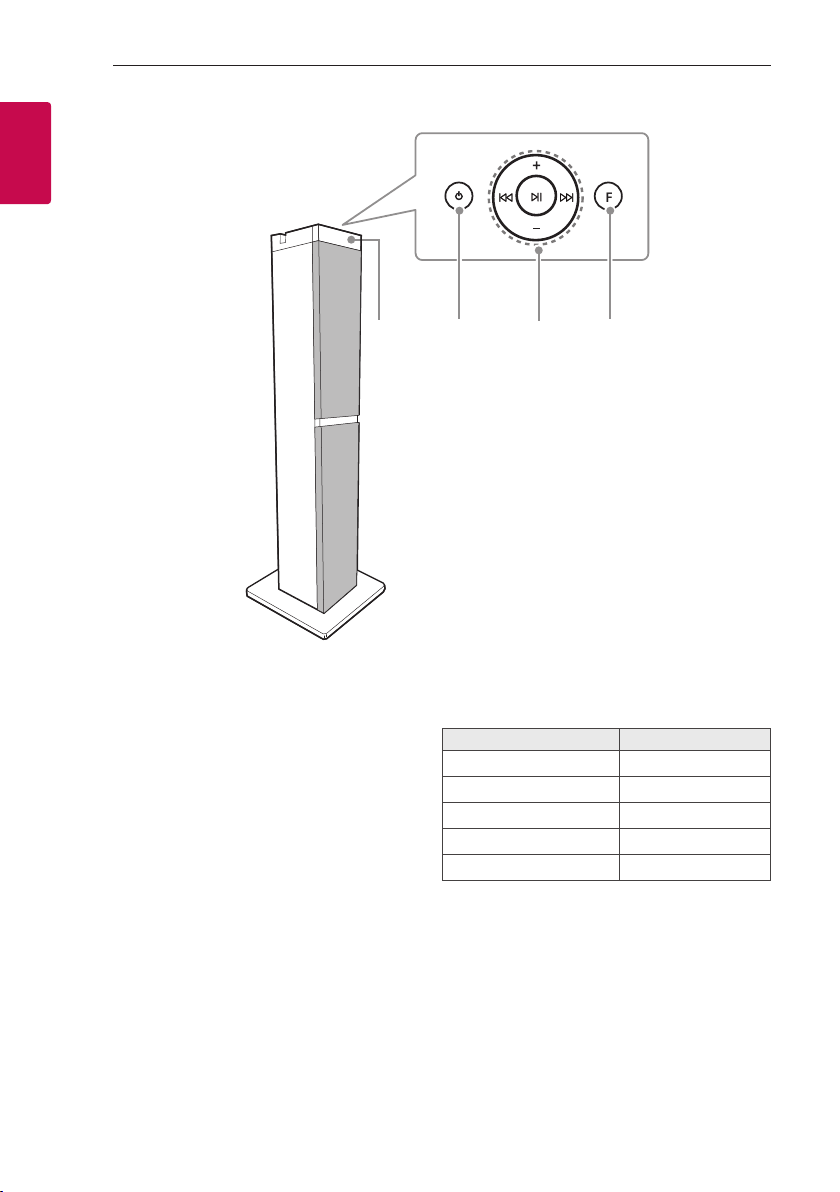
a
Display window
b1(Standby)
Turns the power on or off.
c
C/V(Skip/Search)
- Skips backward or forward.
-Searches for a section within a file.
- Selects the radio stations.
+/-
Adjusts speaker volume.
N (Play/Pause)
- Starts or pauses playback.
- Selects stereo/mono.
dF (Function)
Selects the function and input source.
Input source / Function Display
USB USB
AUX input AUX
Portable input PORTABLE
Bluetooth BT
Radio FM
F
abd
c
Altri manuali per RK1D
1
Indice
Altri manuali LG Sistema di altoparlanti