Application Note 124
AN124-1
an124f
July 2009
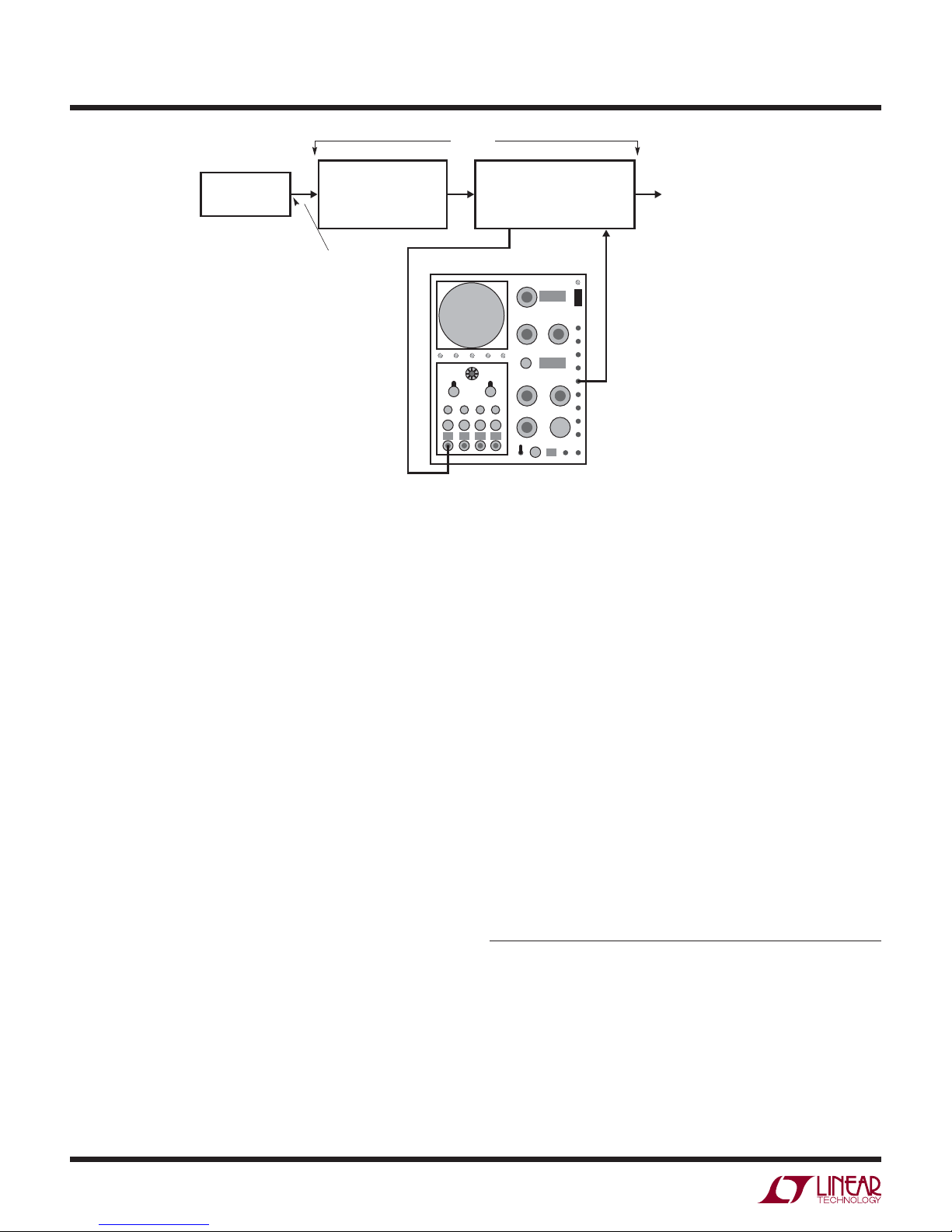
testing scheme includes a low noise pre-amplifier, filters
andapeak-to-peaknoisedetector.Thepre-amplifiers160nV
noise floor, enabling accurate measurement, requires
special design and layout techniques. A forward gain of
106permits readout by conventional instruments.
Figure 3’s detailed schematic reveals some considerations
required to achieve the 160nV noise floor. The references
DC potential is stripped by the 1300μF, 1.2k resistor
combination; AC content is fed to Q1. Q1-Q2, extraordi-
narily low noise J-FET’s, are DC stabilized by A1, with A2
providing a single-ended output. Resistive feedback from
A2 stabilizes the configuration at a gain of 10,000. A2’s
output is routed to amplifier-filter A3-A4 which provides
0.1Hz to 10Hz response at a gain of 100. A5-A8 comprise
a peak-to-peak noise detector read out by a DVM at a
scale factor of 1 volt/microvolt. The peak-to-peak noise
detectorprovideshigh accuracy measurement,eliminating
tedious interpretation of an oscilloscope display. Instanta-
neous noise value is supplied by the indicated output to a
monitoring oscilloscope. The 74C221 one-shot, triggered
by the oscilloscope sweep gate, resets the peak-to-peak
noise detector at the end of each oscilloscope 10-second
sweep.
Figure 1. LTC6655 Accuracy and Temperature Coefficient Are Characteristic of High Grade, Low Voltage References.
0.1Hz to 10Hz Noise, Particularly Noteworthy, Is Unequalled by Any Low Voltage Electronic Reference
Introduction
Frequently, voltage reference stability and noise define
measurement limits in instrumentation systems. In par-
ticular, reference noise often sets stable resolution limits.
Reference voltages have decreased with the continuing
drop in system power supply voltages, making reference
noise increasingly important. The compressed signal
processing range mandates a commensurate reduction
in reference noise to maintain resolution. Noise ultimately
translatesintoquantizationuncertainty in AtoDconverters,
introducing jitter in applications such as scales, inertial
navigation systems, infrared thermography, DVMs and
medical imaging apparatus. A new low voltage reference,
the LTC6655, has only 0.3ppm (775nV) noise at 2.5VOUT.
Figure 1 lists salient specifications in tabular form. Ac-
curacy and temperature coefficient are characteristic of
high grade, low voltage references. 0.1Hz to 10Hz noise,
particularly noteworthy, is unequalled by any low voltage
electronic reference.
Noise Measurement
Special techniques are required to verify the LTC6655’s ex-
tremely low noise. Figure 2’s approach appears innocently
straightforward but practical implementation represents a
highorderdifficultymeasurement.This0.1Hzto 10Hz noise
775 Nanovolt Noise Measurement for A Low Noise
Voltage Reference
Quantifying Silence
Jim Williams
LTC6655 Reference Tabular Specifications
SPECIFICATION LIMITS
Output Voltages 1.250, 2.048, 2.500, 3.000, 3.300, 4.096, 5.000
Initial Accuracy 0.025%, 0.05%
Temperature Coefficient 2ppm/°C, 5ppm/°C
0.1Hz to 10Hz Noise 0.775μV at VOUT = 2.500V, Peak-to-Peak Noise is within this Figure in 90% of 1000 Ten Second Measurement Intervals
Additional Characteristics 5ppm/Volt Line Regulation, 500mV Dropout, Shutdown Pin, ISUPPLY = 5mA, VIN = VO+ 0.5V to 13.2VMAX,
IOUT(SINK/SOURCE) = ±5mA, ISHORT Circuit = 15mA.
L, LT, LTC, LTM, Linear Technology and the Linear logo are registered trademarks of Linear
Technology Corporation. All other trademarks are the property of their respective owners.