
Liscarroll Engineering LE-200 Manuale utente

EST. 1973
Installation and Operating Instructions
for Installers and Service Engineers
Universal Tank Controller:
LE-200
Simply Better . . . by Design
2
Notes

3
LE-200
4 Appliance description
5 Safety
5 - Intended use
6 Installation
6 - Installation of housing
6 - Intended Use
7 - Fitting the sensor
7 - Changing the sensor cable length
7 - Electrical connection
8 - Connection diagram
9 Technical data
9 - Control
9 - Sensor
10 Operating levels
11 Operation of working level
11 - Operation
11 - Button functions
12 - Meaning of LEDs
13 - Operating modes
13 - Cooling mode
14 - Deep cool
14 - Stirring in Cooling Mode
14 - Cleaning Mode
14 - Quick wash
14 - Descale
15 Cleaning program description
15 - Cleaning Cycle
15 - Manual stop of the cleaning
16 - Power failure during the cleaning process
16 - Service functions for testing the cleaning cycle
17 Adjusting of Parameters in General
18 Adjustment of Cleaning Step Times
19 Parameters
19 - General Cooling Parameters
19 - Extended Cooling Parameters
20 - Cleaning Parameters
21 - Cleaning Parameters Main Wash
21 - Cleaning Parameters Descale
22 - Cleaning Parameters Quick Wash
22 - Input/Output Test Parameters
22 - Input/Output Test Parameters
23 Fault Indication on the Display
24 Water and Detergent Usage - 30 mins
25 Water and Detergent Usage - 50 mins
26 Water and Detergent Usage - 75 mins
27 Water and Detergent Usage - Descale 30 mins
28 Water and Detergent Usage - Descale 50 mins
29 Water and Detergent Usage - Descale 75 mins
30 Other information
30 - Function “Intermediate stirring”
30 - “Continuous stirring” function
30 - Setting the actual value correction
31 - Procedure following power failure
32 & 33 - General measures when using electronic control systems
34 Backup Cooling Functions
35 CAREL Easy Milk Chiller
35 - Setting the Setpoint (desired temperature)
36 - Default Parameters CAREL
37 - Default Parameters CAREL
38 - TechnicalSpecications
38 - Wiring Diagram
39 - How to use the Programming Key
40 Appendix 1 - Main Wiring Diagram
41 Appendix 2 - Card Wiring Diagram
42 Appendix 3 - Wash Program -v- Tank Size
Contents

4
Appliance Description
The LE-200 is a universal tank control unit combining a modern milk cooling
regulator and a complete cleaning program control system in one.
This combined with the backup cooling function provided by the Carel Thermostat
makes the LE200 controller the most robust system in the market.
The control unit is on stand-by. The display shows ‘OFF’ and all output replays are
deactivated. In the OFF mode the agitator can be switched on and off by pressing
a button. In parameter [C25] a time can be set after which the agitator switches off
automatically. The following operating modes can only be selected from the OFF
mode. It is not possible to switch directly from one of them to another.
CAUTION: The control unit is live even when switched off.
The LE-200 has 2 adjustable target Temperatures.
(1) T1 is the STANDARD selection (Default 4 °C)
(2) T2 is the DEEP COOL selection (Default 2 °C)
The current milk temperature, as measured, is permanently displayed. If the milk
temperature exceeds the selected target temperature (T1 or T2) by the differential
value, the compressor relay and agitator are automatically activated. Once the
target temperature is reached, the compressor switches off, while the agitator
continues to operate for the pre-set ‘after-stirring’ time.
The DEEP COOL function also has an adjustable time setting (Default 30 minutes)
and the LE-200 will automatically switch back to T1 when this time is reached.
During non-cooling periods the agitator switches on at pre-set intervals in order
to ensure an even temperature throughout the milk. Independently of this a short
or long ‘intermediate stirring’ period can be selected during cooling by pressing a
button.
Ifthedelayedstartisactivated(parameter[P62]),coolingstartsfortherstmilking
after a delay. If the cooling button is pressed twice, cooling starts immediately.
The cleaning timer controls water intake by time.
The LE-200 has the following built-in programs to cater for all tank sizes and to
allow for varying on-farm conditions.
(1) MAIN WASH ALKALINE: 3 Programs: 30 Minute, 50 Minute, 75 Minute
(2) DESCALE WASH (Alk + Acid): 3 Programs: 33 Minute, 50 Minute, 75 Minute
(3) Quick WASH: 2 Cycles : 3 Programs: 8 Minute, 12 Minute, 18 Minute
All running times (pump and detergent injection) can be set separately. Detergent
switchover from alkaline to descale can also be set. The LE-200 controls the various
processes and times needed for a thorough wash fully automatically.
Following a power failure, the control unit restarts in the mode in which it was
operating before the outage.
The control unit has various operating modes:
OFF mode
(with continuous stirring function)
COOLING mode
CLEANING mode
4

5
LE-200
Safety
These operating instructions contain important technical and safety information.
Please read carefully before installation and before any work on or with the
regulator.
The universal tank control must be installed by an authorised specialist observing
local safety regulations.
Access to the environment when connected must be restricted to specialised
personnel.
The universal tank control contains live components and must not be opened up.
lt must not be used if the housing or connection terminals are damaged.
Nouidsmustpenetratethehousing.
The universal tank control may not be exported to the USA without the
manufacturer’s express permission.
Intended use
The universal tank control is ready for use once the parameters have been set.
lt should not be used before this has been done as this might result in damage to
the plant and the item to be cooled or heated.
Thedeviceisttedwitharesistancetemperaturesensor.
The device must not be installed in potentially explosive atmospheres.
TheuniversaltankcontroltypeLE-200fulllstheECrequirementsfor
electromagnetic compatibility (EMC) and the Low Voltage Directive (LVD).
The safety components meet the VDE regulations.
!

6
Installation
Forxingthehousingpleasefollowtheinstructions:
• Place the seal carefully in the groove. Ensure it is not twisted.
• Insert the housing from the front through the switchboard cut-out and
fasten using the screws provided.
• Carry out the electrical wiring and sensor connection in accordance
with the following description.
Drilling diagram
4
It is essential not to install the device under the following conditions:
• severe jolting or vibration
• permanent contact with water
• relative humidity of more than 90%
• sharplyuctuatingtemperatures(condensation)
• operation in an aggressive atmosphere (ammonia or sulphur fumes)
- risk of oxidation
• operation in the immediate vicinity of radio transmitters with high levels
of spurious radiation.
Installation of Housing
Intended use

7
LE-200
Installation
Before connecting ensure that the mains voltage is the same as indicated on the
device’s type plate.
Incorrect electrical connection can cause damage to the tank control and to the
equipment.
The mains voltage should not be switched on until all components including the
sensor are connected.
No appliances with current levels in excess of the maximum values indicated on the
relays should be connected to the relay contacts Use contactors.
DownstreamcontactorsmustbettedwithanRCprotectioncircuit.
!
lf it is necessary to shorten or lengthen the sensor cable on installation
(orifasensorotherthantheonesuppliedistobetted),the
“actual value correction” parameter must be adjusted accordingly.
See the section “Setting the actual value correction”.
The sensor cable must not be chafed or kinked.
There must be no substantial mechanical pressure on the sensor tube.
Do not place the sensor and the high-voltage cable in the same cable conduit
(not even within the switchbox).
Temperature range sensor cable -10°C .. +70°C
!
Fitting the sensor
Changing the sensor
cable length
Electrical connection

8
Installation
• Electrical connections must be as shown in the diagram below.
• Use cable bushes.
• Make sure that cables cannot chafe.
• Observe relay current rating.
• In all cases use contactors for pump and compressor.
• Do not feed digital inputs with external voltage! Use potential-free switches.
Note: see wiring diagram in Appendix 1
Connection diagram

9
LE-200
Technical Data
Control
Operating voltage 230V AC +/-10%, 50 Hz
Relay contacts 10 performance relays
max. switching current each 5A AC1 - 250V AC
max. switching voltage 250V AC - 50 Hz
Display 13 mm LED - Display, 3 digits
LED switching status displays 3 mm
Display range -99 .. 999
Number of Sensors 1
Sensor type KTY 81-210
Sensorcablelength 2metres(orasrequired)
Measurement range -5° .. +70°C
Temperature resolution 0,1°C
Control mode two-step-controller
Hysteresis* 0,1 K .. 10,0 K (standard adjusting 0,7 K)
Water detection via level monitor (optionally)
Target temperature T1* standard adjusting 4°C
Target temperature T2* standard adjusting 4°C
Digital inputs 3 (via optocoupler)
Connection Push-in screw connections for cables up to 2.5 mm²
Housing FEG 106/175 M
- front dimension 106 x 175 mm
- front panel cut out 156 x 96 mm
- insertion depth 45 mm
Protection (housing front) IP 65
Environmentspecications:
- Operation temperature 0° .. +50°C
- Storage temperature -20° .. +70°C
- max. humidity 75% (no dew)
Sensor
Sensor element KTY sensor
Bush material 1.4301(V2A)
Bush length 40 mm
Bush diameter 6.0 mm +/- 0.1
Cable material PVC
Measurement range -10 .. 70° C
Cable length Standard 2 metres
Protection type IP 65
Sensorsotherthanourstandardtypeareavailableonrequest
Some of the options are shown here.
10
Operating Levels
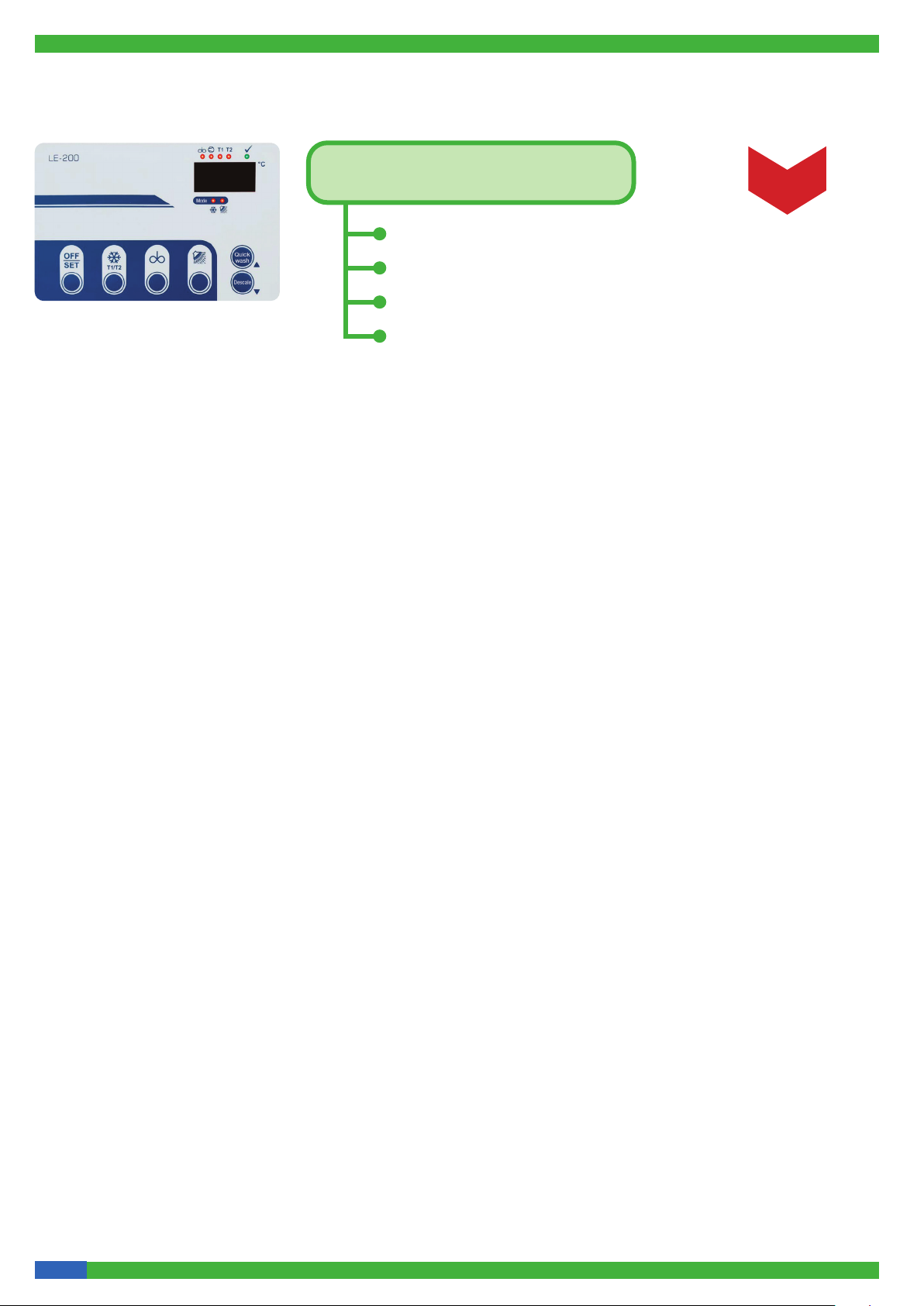
Code: 212
Code: 345
Code: 567
Code: 0E5
Operation of the LE-200 takes place at various levels:
Working level:
… for normal daily operation.
• OFF mode = control unit switched off.
• Start cooling mode.
• Start cleaning mode.
The subsidiary parameters are accessed by entering a code in order to
avoid their accidental alteration.
General cooling parameters
Parameters such as target values, hysteresis etc. are set here.
Extended cooling parameters
Forprogrammingthecontrolunit’sindividualtank-speciccoolingfunctions.
Extended cleaning parameters
Forprogrammingthecontrolunit’sindividualtank-speciccleaningfunctions.
I/O test parameters
Used to test the relay output relays.
CODE
Working level
for normal daily operation
General cooling parameters
Extended cooling parameters
Extended cleaning parameters
I/O test parameters
Indice
Altri manuali Liscarroll Engineering Controllori


