
Lowrance 15 Manuale utente

1
PPP-15 Portable Power
Pack with transducer
installed. Shown with
the X67C IceMachine.
Pub. 988-0147-871
PPP-15
Portable Power Pack
Installation Instructions
This ice fishing power pack is designed for use with the following products:
LowranceX67C sonar and M68C sonar/GPS combo.
Even though it was designed for ice fishing, this
power pack can also extend your sonar's use into
warm weather angling. It's ideal for fishing from
a dock or pier. Crappie fishermen who tie up to
drowned trees will find the PPP-15 useful for
that type of stationary fishing as well.
With an optional portable Skimmer
transducer, you can run the unit in your own
boat, or take it along as a second sonar in a
friend's boat. The versatile color sonars that are
compatible with the PPP-15 have scrolling chart
displays as well as flasher displays, making
them fully functional for both boat trolling and
stationary use.
The PPP-15 package includes: freeze resistant
power pack carry bag, base plate, quick
release mounting bracket, rechargeable gel
cell battery, battery charger, ice fishing
transducer, transducer mounting rod, swing
arm and adjustment lock for holding the
mounting rod, and the nuts and bolts needed
to assemble the power pack.
When assembled, the pack is designed to fit comfortably inside a typical
5-gallon plastic bucket. This power pack can also use an optional bat-
tery adapter that holds eight "D" size batteries.
You can assemble everything without tools, but it's easiest if you have a
screwdriver, and perhaps a small adjustable wrench or pair of wire pliers.
INSTALL MOUNTING BRACKET
1. Attach the quick release mounting bracket to the base with the two
nylon nuts and bolts. See the following figure.

2
Secure mounting bracket to base plate as shown at left, and slide the
battery straps through the slots on either side of the tray.
2. Slide the Velcrostraps through the slots on either side of the bat-
tery tray as shown in the preceding figure.
BATTERY CARE
Battery charger's indicator light glows red when charging, green when
battery is fully charged. To charge, attach red connector to red (posi-
tive) contact and black connector to black (negative) contact.
Make sure the battery is fully charged before you use the PPP-15 for
the first time. When fully discharged, it takes approximately nine hours
to recharge the battery. Under ordinary operating conditions, the bat-
tery will run your unit with the backlight on for approximately 24
hours before it needs recharging. (Battery capacity will vary depending
on the temperature and water depth.)
To charge the battery, plug the charger into a 110 VAC electrical outlet,
then connect the red lead to the red battery contact and connect the
black lead to the black battery contact. When you plug in the charger,
the indicator light glows green to indicate it is receiving power. When
you connect the battery, the light turns red, showing it is charging.
When the light turns green again, the battery is fully charged.
Velcro straps
Charger
Red connector
Black
connector
Indicator light
Nylon nut and bolt for mounting bracket.
Battery
Battery
3
You can recharge the battery after every fishing trip, even if the bat-
tery was not fully discharged. This will always keep the unit ready for
your next fishing expedition. Disconnect the battery when stored for
long periods of time. You should also consider charging the battery once
a month while in storage. Your sonar's Ice Flasher page includes a bat-
tery gauge so you can monitor how much power you have remaining.
BATTERY INSTALLATION
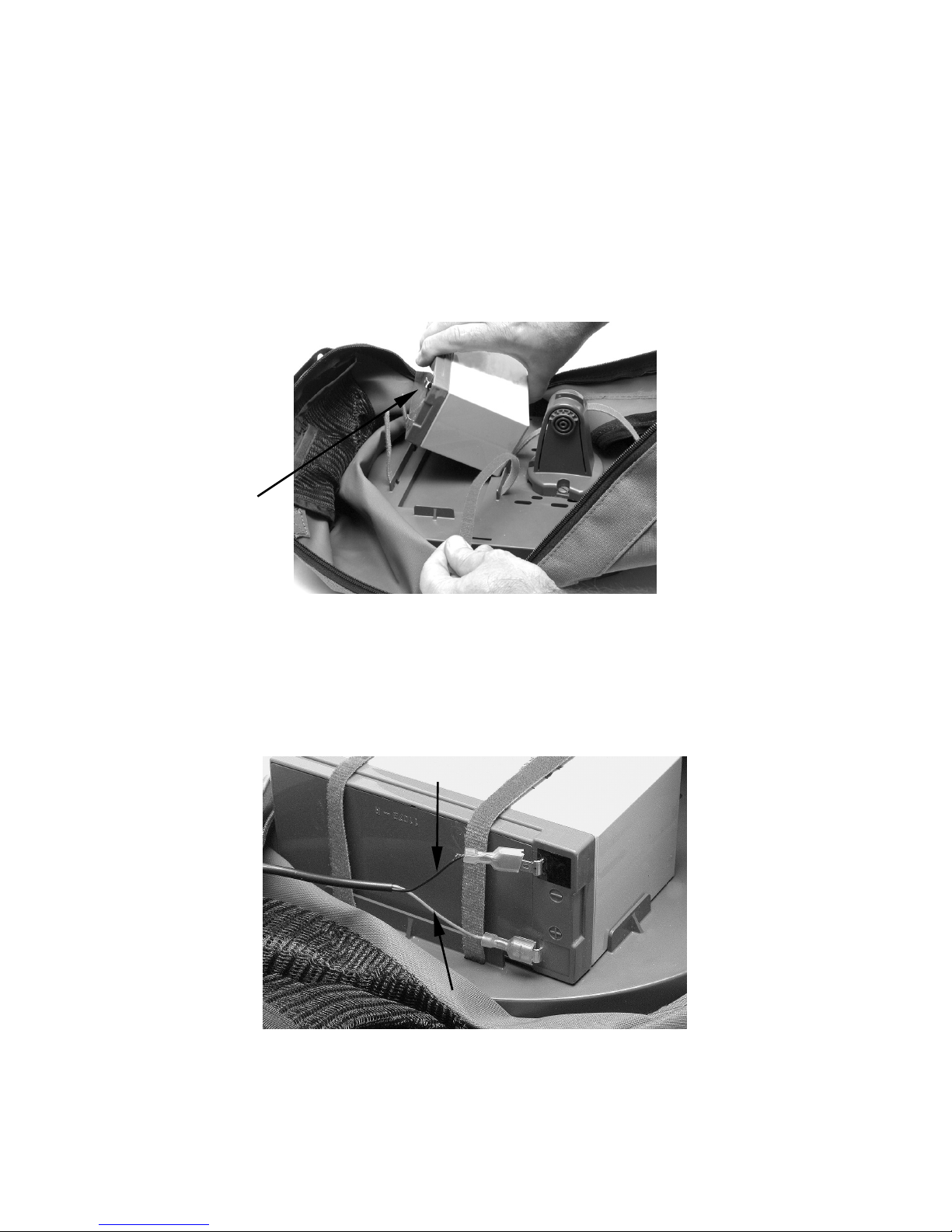
1. Position the battery in the battery tray with the contacts pointed to-
ward the rear of the base plate, away from the mounting bracket.
Place battery into battery tray as shown.
2. Secure the battery in the tray with the Velcro straps.
3. Attach the power leads from the power/transducer cable to the bat-
tery contacts or terminals. Connect the red wire to the red or positive
terminal and connect the black wire to the black or negative terminal.
Battery shown connected to sonar unit's power leads.
4. Plug the cable's uniplug push-on connector into the socket on the
back of the sonar unit. See the following figure.
Battery
contacts
Red wire
Black wire

4
Connect the sonar unit to the power/transducer.
CAUTION:
When using the sonar in a saltwater environment, we strongly
recommend that you unplug the red and black power connectors
from the battery terminals when the unit is not in use. When the
unit is turned off but still connected to a power supply, electroly-
sis can occur in the power cable plug. This may result in corro-
sion of the plug body along with the electrical contacts in the ca-
ble and the unit's power socket.
Optional D cell battery adapter. Connect black to black and red to red.
MOUNTING THE UNIT
1. After the power cable is attached, hold the sonar unit vertically and slide
it onto the bracket from above. (The back of the unit should be touching the
front of the bracket as you lower it into position.) As you push down, the
unit will lock into place with a distinct click.
Plug in here.

5
Mount the sonar: slide the unit onto the bracket from above. To adjust
view: press and release spring-loaded ratchets while tilting the unit.
2. To adjust the viewing angle, pinch the quick-release mount's ratchets
with one hand, then tilt the unit with your other hand. Release the
ratchets and the unit locks into the new position. To remove the unit
from the PPP-15, press the ratchets and lift the unit off the bracket.
(An optional quick release mounting bracket and an optional swivel
base are available for mounting your sonar in a boat.)
3. Turn the sonar unit on. If it works, turn it off and finish assembling
the ice fishing transducer. If it doesn't work, make sure the power leads
are firmly connected to the battery terminals. Also make sure the lead
colors match the battery terminal colors (red positive to positive and
black negative to negative).
If it still doesn't work, check the battery voltage. Most complaints we
hear about portable units result from batteries that have not been
charged. If you are using the optional D dry cell battery adapter, be
sure you use fresh batteries. In cold weather the efficiency of dry cell
batteries drops with the temperature. We find it a good idea to have the
batteries and the sonar unit good and warm before we leave home. (If
you are using disposable D batteries, always remove them from the
power pack when storing the unit because dead batteries can leak and
corrode the contacts of the battery adapter.)
If the batteries do lose a charge, you can sometimes restore them by
placing them in a warm room or car interior. A better way is to replace
them with batteries that have been kept warm.
WARNING:
Never heat batteries over an open flame or direct hot air
onto them. A fire or explosion could result.
Ratchet

6
MOUNTING THE TRANSDUCER
1. Slip the washer onto the transducer rod, followed by the transducer and
the wing nut.
Assembled transducer, attached to the mounting rod.
2. The wing nut should be tightened enough to hold the transducer on the
rod, but it should be loose enough to allow the transducer to swing freely.
This allows the transducer to self-position itself straight down, for ideal ice
fishing performance.
3. Grasp the assembled transducer and rod in one hand and thread the
swing arm's socket end onto the rod.
Insert mounting rod through swing arm's socket, as shown.
4. Snap the red rubber adjustment lock onto the rod and screw it into the
swing arm's threaded socket. As the lock is screwed in, it tightens on the
mounting rod, holding it in place.

7
Snap adjustment lock onto transducer mounting rod as shown, then
screw it into the swing arm's socket.
If you find the adjustment lock is too hard to turn, consider adding a small
amount of petroleum jelly or silicone lubricant to the adjustment lock's
threads. This will help the lock to turn more easily, which may be neces-
sary in very cold environments.
5. Slip the assembled transducer rod and swing arm into the ratcheted
swing arm socket on the front of the base plate.
Mount swing arm in ratcheted socket on base plate.
To adjust transducer depth, loosen the adjustment lock, slide the rod up or
down, then retighten. To adjust lateral position in your fishing hole, simply
nudge the arm to one side or another, then lightly press down on the arm's
ratchet end to engage the ratchets. See the following figure.

8
Adjust transducer position by either loosening the red adjustment lock
(for height), or rotating the swing arm (side to side). Press lightly on
the ratchet end to hold the arm in position and resist side movement.
Tip:
When landing a fish, push the arm to one side or just grab the
swing arm, lift it out of your fishing hole and lay it to one side.
OPTIONAL PORTABLE TRANSDUCER ASSEMBLY
Assemble the Skimmer transducer and portable mounting bracket as
shown in the following illustrations. (Skimmers are available with
built-in temperature sensors, which allow your unit to display water
temperature.)
Make sure there is one washer on each side of the transducer, inside the
bracket. Slide the other washer over the end of the bolt and screw on the nut.
Screw the suction cup onto the bracket using the supplied screw and
flat washer. Tie the nylon cord through the hole in the top of the
bracket. When using the transducer, tie the other end of the nylon cord
to the boat. This will help prevent losing the transducer if it comes off.
Ratchet end

9
Portable transducer assembly: rear view (left) and side view (right.)
Clean the chosen area of the hull before attaching the suction cup. Lo-
cate the transducer on the hull as shown in the following figure. Don't
let the bracket extend below the hull, because water pressure against it
can cause the suction cup to come off at speed.
NOTE:
For optimum operation, the portable transducer should be adjusted
so that it is parallel to the ground. For more information on this,
see the segment in the unit's operation manual on Transducer Ori-
entation and Fish Arches.
Moisten the suction cup, then press it onto the hull as firmly as possi-
ble. Tie the nylon cord to the boat and set the power pack and sonar unit in
a location for easy viewing. Your portable sonar is now ready for use.
Portable transducer installed on boat transom.
Tie
nylon
cord
here
Washer
Washer
Nut
Bolt
Screw
Suction
cup
Transducer
Hull
10
STOWING FOR TRANSPORT
There is room inside the power pack bag for the portable transducer as
well as the ice fishing transducer and the battery charger.
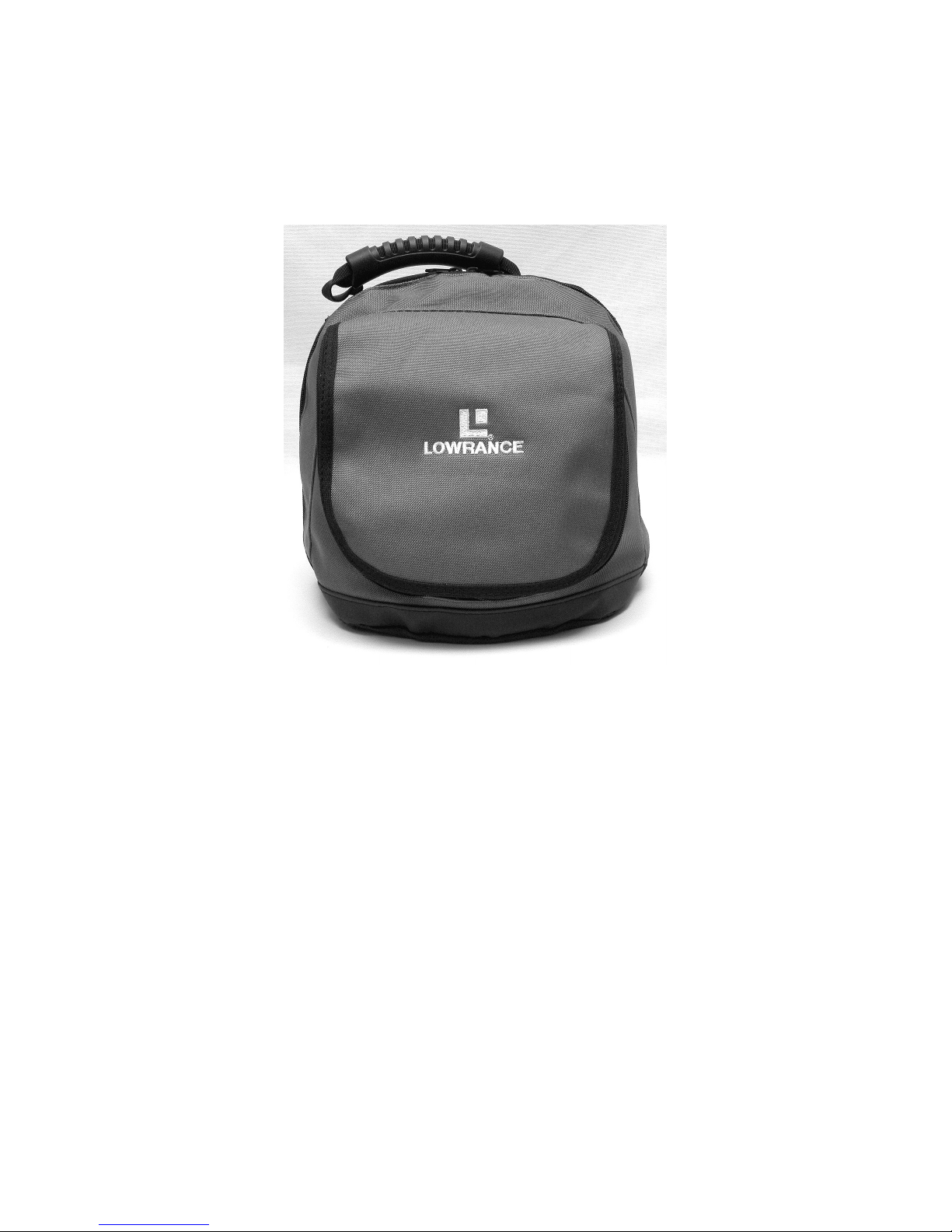
Fold the transducer against the rod, so it will fit inside the bag. Zip up
the openings and your equipment is ready for transport.
PPP-15 ready for travel.
Questo manuale è adatto per i seguenti modelli
1
Indice
Altri manuali Lowrance Gruppo di alimentazione


