
Macrovision Corporation PC Manuale utente
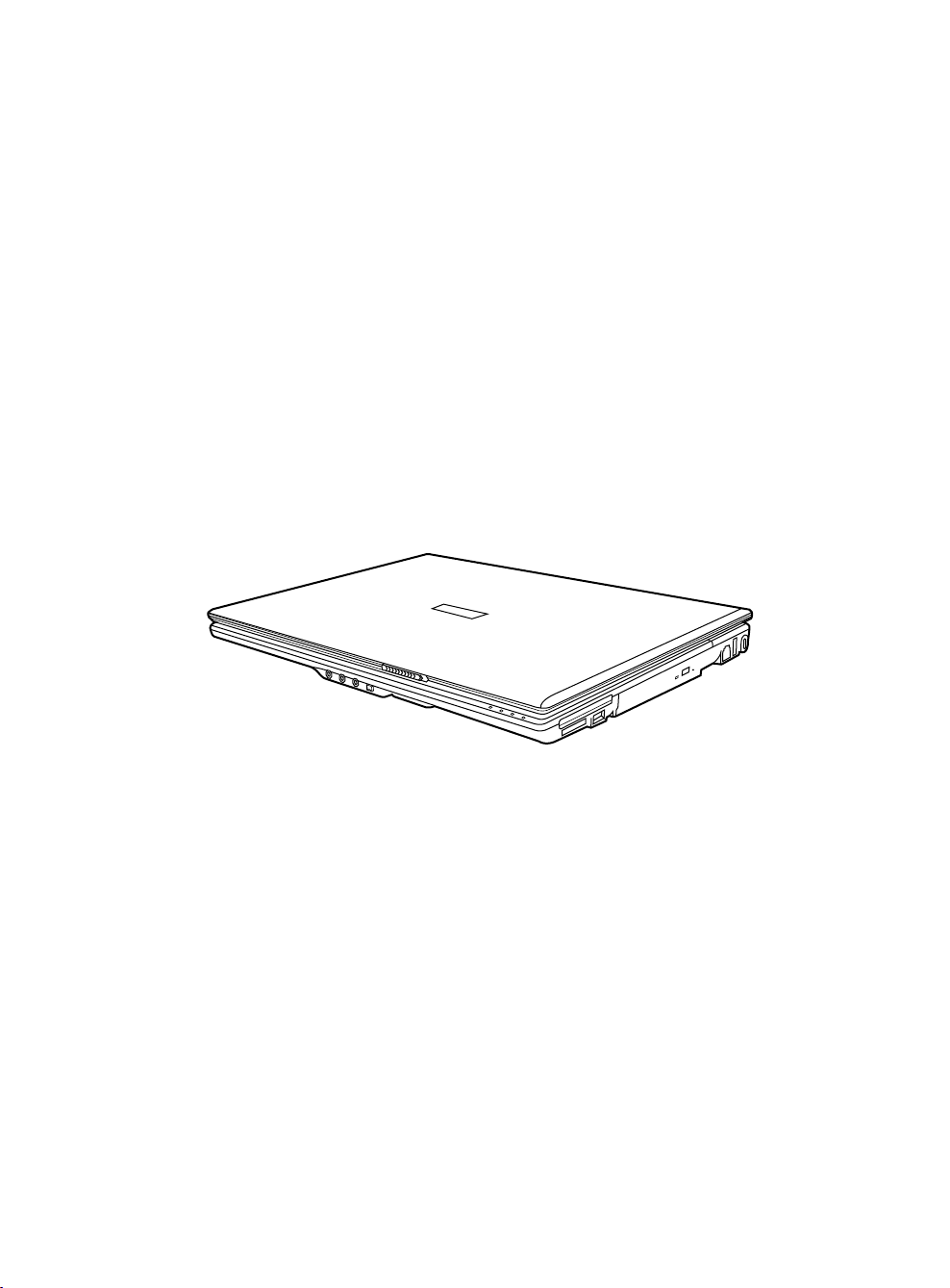
USER’S MANUAL
April 2007
ENGLISH

2
CONTENTS
BEFORE YOU START ............................................................................................. 5
Make sure you have everything ..................................................................................... 5
Familiarize yourself with the computer ........................................................................ 6
OPENING THE DISPLAY PANEL ................................................................................ 6
FRONT OVERVIEW .................................................................................................... 7
LEFT SIDE OVERVIEW .............................................................................................. 9
RIGHT SIDE OVERVIEW .......................................................................................... 11
BACK OVERVIEW ..................................................................................................... 12
BOTTOM OVERVIEW ................................................................................................ 12
GETTING STARTED ............................................................................................. 13
Power Sources ............................................................................................................. 13
CONNECTING THE POWER ADAPTERS ............................................................... 13
RECHARGING THE BATTERY ................................................................................. 14
Starting Your Notebook................................................................................................. 15
POWER ON .............................................................................................................. 15
Status Indicators ...................................................................................................... 16
Using Function Keys ................................................................................................ 18
Using the TouchPad................................................................................................. 19
Memory Module Upgrade......................................................................................... 20
TROUBLESHOOTING ........................................................................................... 21
Identifying the Problem................................................................................................. 21
APPENDIX ............................................................................................................ 22
Notebook Specifications .............................................................................................. 22
3
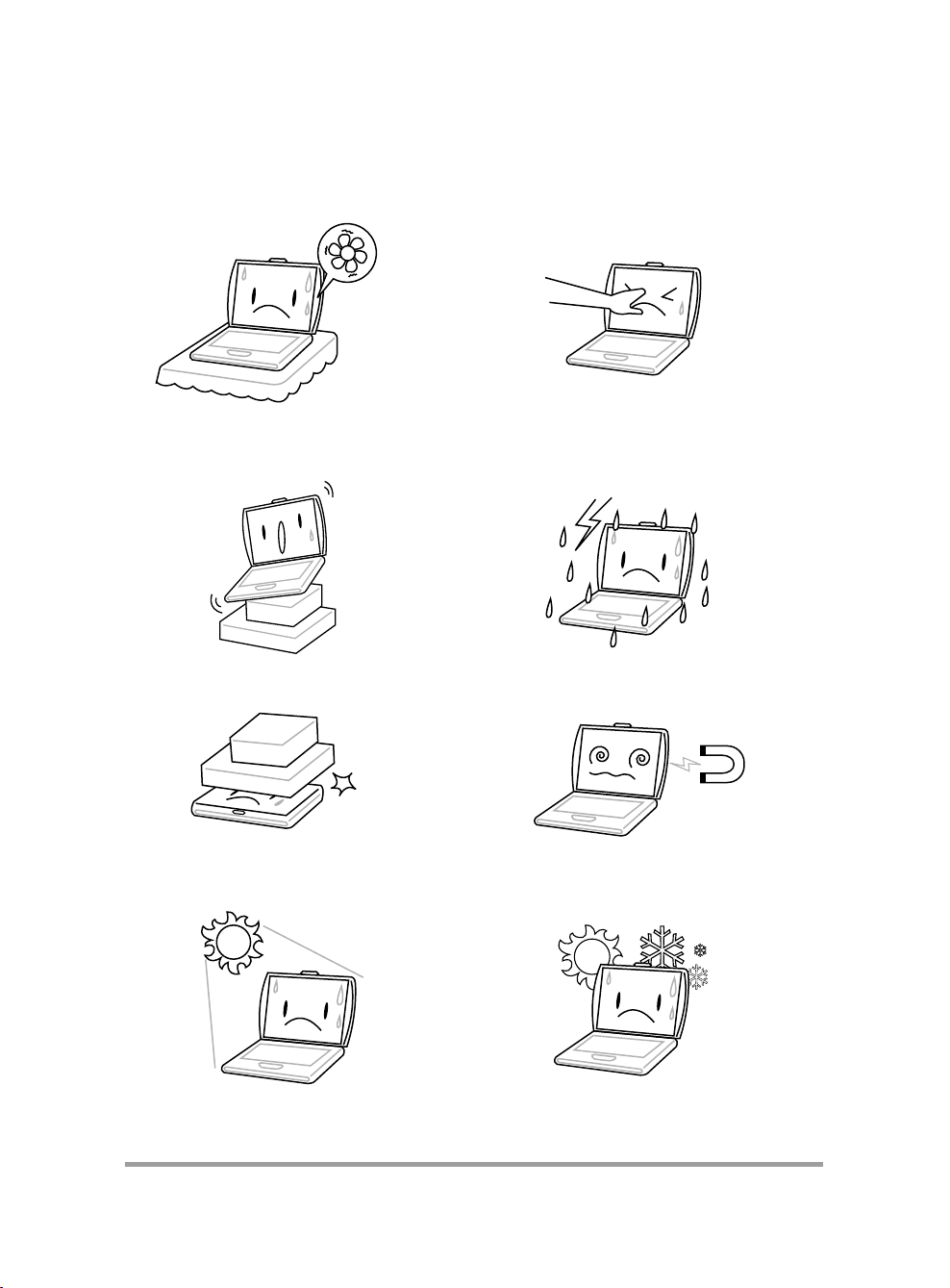
TAKING CARE OF YOUR NOTEBOOK PC
DO NOT place or drop objects on the computer
and DO NOT apply heavy pressure on it.
DO NOT subject the computer to magnetic
fields.
To prevent possible overheating of the computer's
processor, make sure you don't block the open-
ings provided for ventilation.
DO NOT press or touch the display panel.
DO NOT place on uneven or unstable work
surfaces.
DO NOT use your notebook computer under
harsh conditions.
DO NOT expose to direct sunlight. DO NOT use or store in extreme temperatures.
4
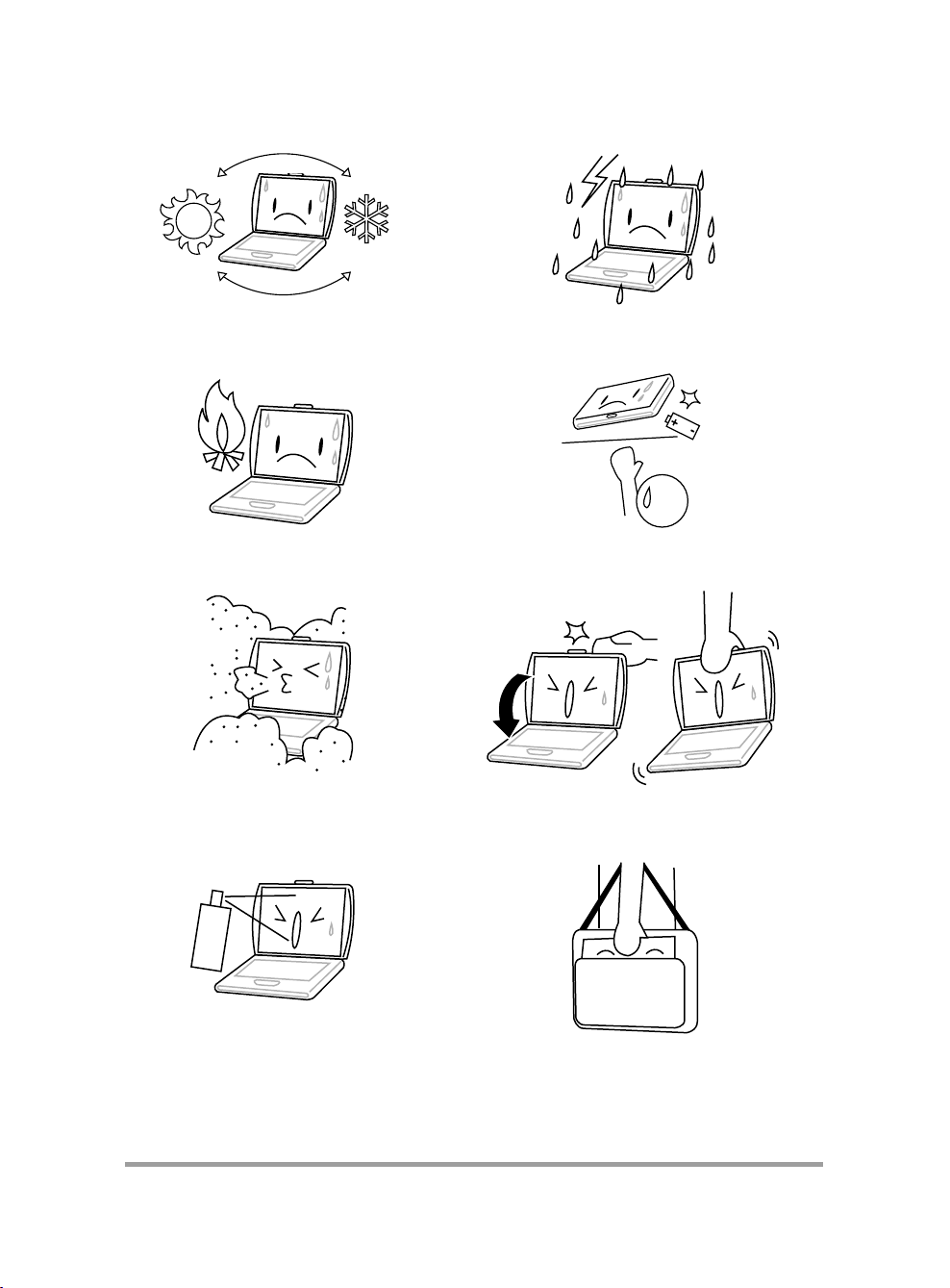
DO NOT expose to dust and/or corrosive
chemicals.
DO NOT spray water or any other cleaning fluids
directly on the display.
DO NOT slam your notebook shut and never
pick up or hold your notebook by the display.
If you are traveling with your computer, remem-
ber to carry it as hand luggage. Do not check it in
as baggage.
DO NOT place near fire or other sources of heat. DO NOT tamper with the batteries. Keep them
away from children.
Avoid sudden changes in temperature or humid-
ity by keeping it away fromA/C and heating vents.
DO NOT expose the computer to rain or
moisture.

5
BEFORE YOU START
Make sure you have everything
When you receive your notebook PC, unpack it carefully, and check to make sure you have all the
items listed below. For a pre-configured model you should have the following:
• Notebook Computer
• Lithium-Ion battery
• AC adapter with power cord
• Driver and Applications CD
• Quick Start Guide or User Guide
Depending upon the configuration of your notebook, you may also need following items:
• DVD / CD-RW Combo Application CD
• Dual DVD+/-RW Application CD
• Super Multi DVD RW Application CD
Once you have checked and confirmed that your notebook system is complete, read through the
following pages to learn about all of your notebook components.
BEFORE YOU START
6
1
2
Familiarize yourself with the computer
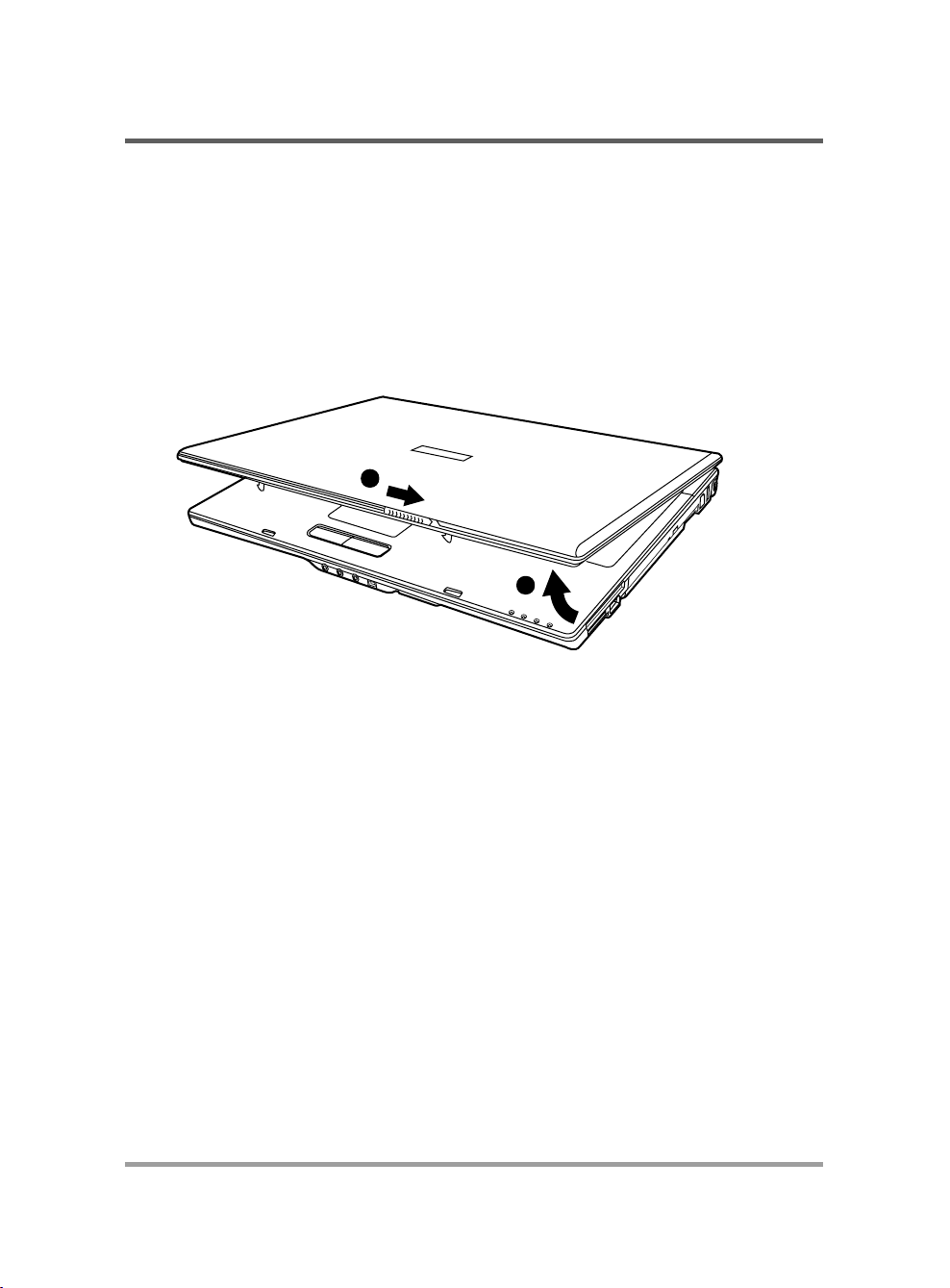
OPENING THE DISPLAY PANEL
To open, slide the latch and then simply lift the lid up.
When closing it, be sure not to slam it shut.
BEFORE YOU START
7
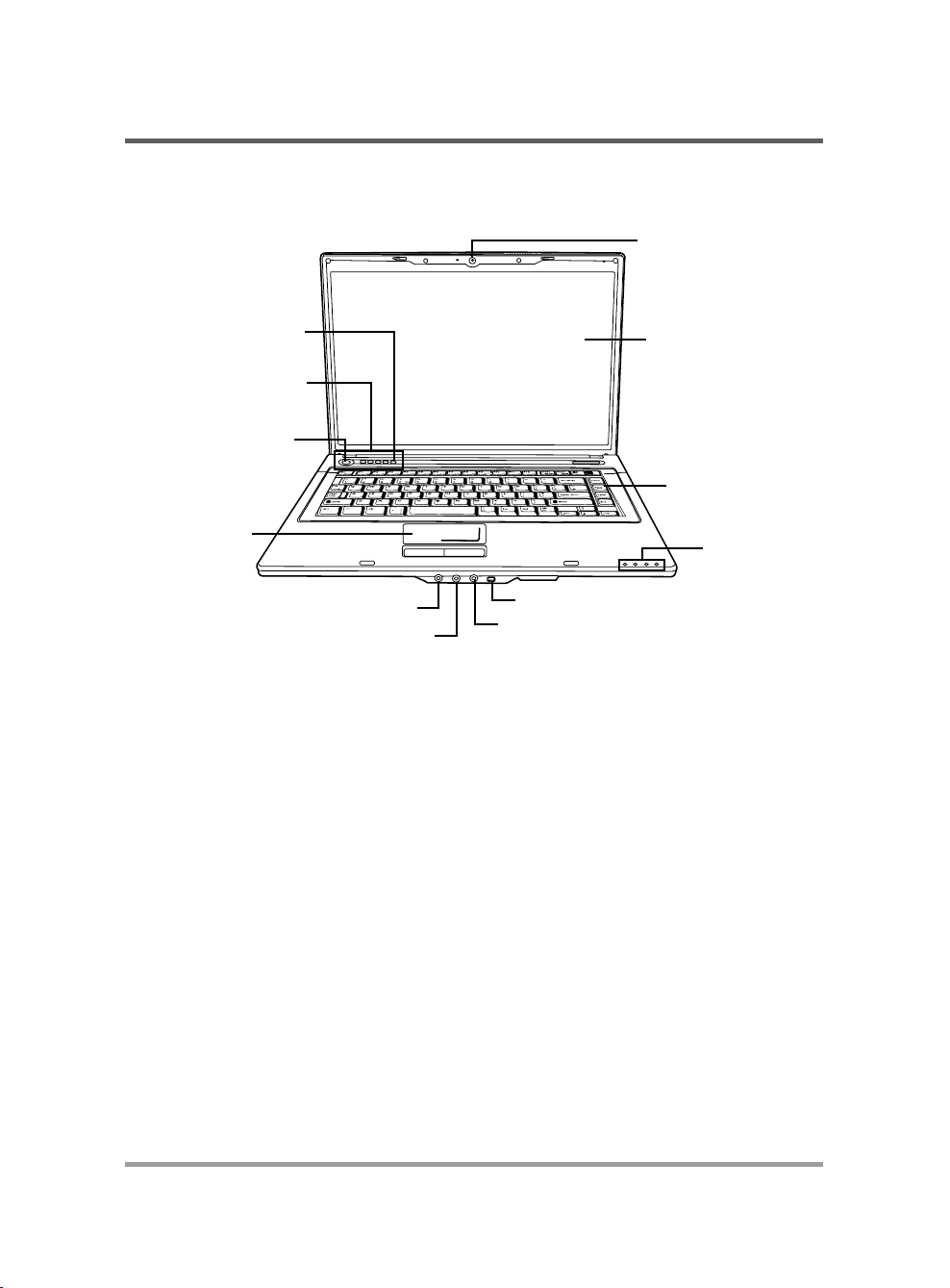
Display Panel
Suspend/
Power On Button
Keyboard
Status Indicator
Lights
Headphone Jack
Line-In Jack
TouchPad
Pointing Device
Quick Start Buttons
Wireless LAN
IEEE 1394 Port
Microphone Jack
FRONT OVERVIEW
The following is an overview of the front of the notebook.
Camera
The built-in 1.3 Mega pixel camera allows you to snap a photo or create a video chat or video
conference within just a click. (This feature depends on your configuration.)
Display Panel
The display panel is a color LCD panel with back lighting for the display of text and graphics.
Keyboard
A full-size keyboard with dedicated Windows®keys.
Status Indicator Lights
The Status indicator lights correspond to specific operating modes. These modes are: Caps lock,
Num Lock, Hard drive Activity (HDD), Wireless Activity, Power on/Suspend status, Battery/
AC Adapter status, and Media reader Activity.
IEEE 1394 Port
The 1394 port is used to connect between your and a peripheral such as a digital video camera.
Camera

BEFORE YOU START
8
Microphone Jack
The microphone jack allows you to connect an external mono microphone.
Line-In Jack
The line-in jack allows you to connect external audio recording and playback devices.
Headphone Jack
The headphone jack allows you to connect headphones or external speakers and amplifiers.
TouchPad Pointing Device
The TouchPad pointing device is a mouse-like cursor control with two buttons and a touch
sensitive movement pad.
Suspend/Power On Button
This button turns your notebook on and off as well as puts it to sleep. (See Suspend/Power On
Button in the Power On section for more information.)
Quick Start Buttons
The six quick start buttons allow you to launch your favorite Wireless network, Internet and E-
mail applications with the press of a button. You can also engage the computer's Silent and Mute
modes by press Silence and Mute button.
Wireless LAN
The Wireless LAN button enables and disables Wireless LAN activity.
Array Microphone
The built-in array microphone is an omni-directional audio input device. It allows for the stereo
reception and transmission of voice and/or other audio data to any program capable of accepting
such input.
Stereo Speakers
The built-in dual speakers allow for stereo sound.
BEFORE YOU START
9
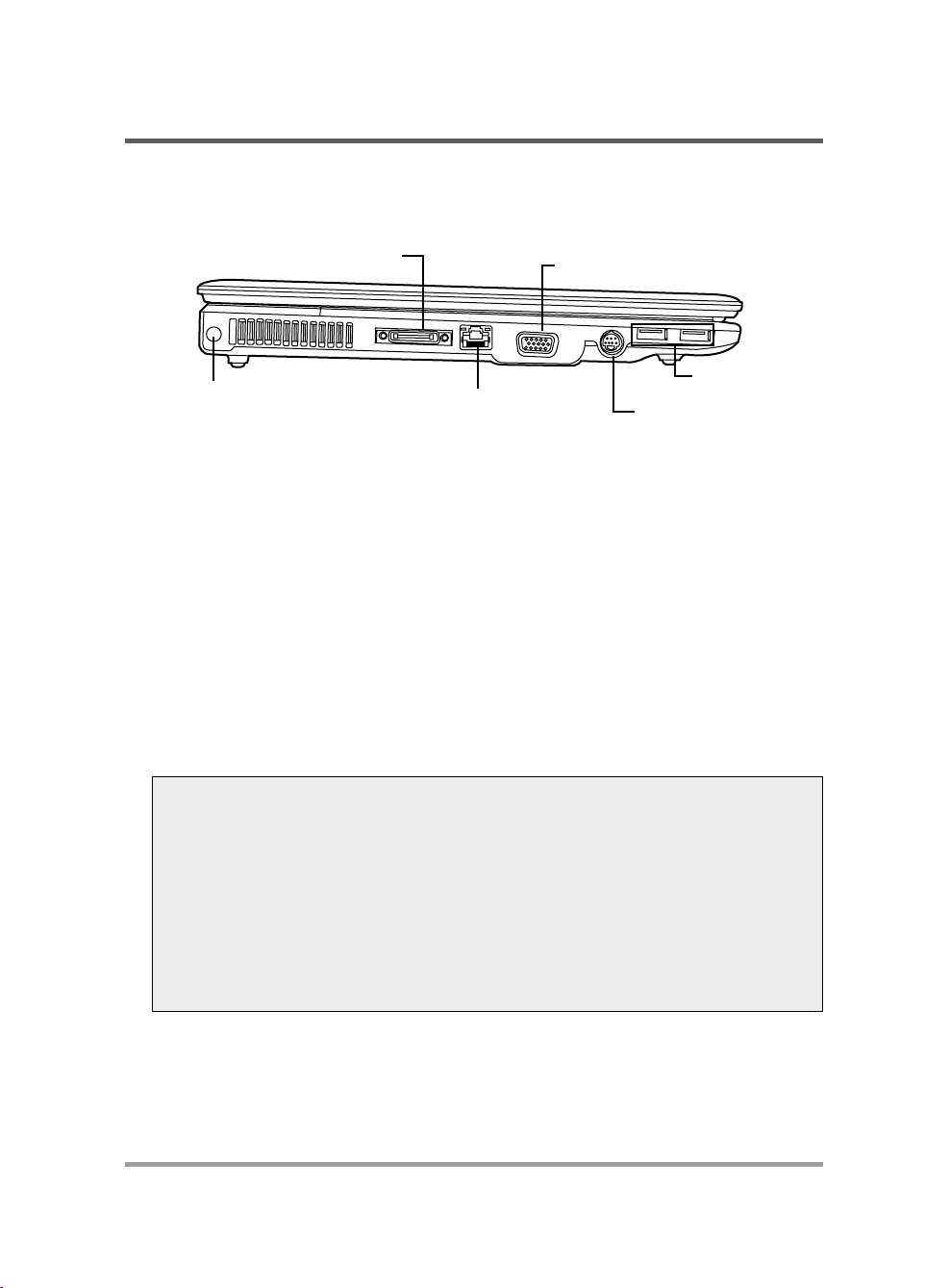
Power Adapter Port
Port Replicator Interface External Monitor/DVI Port
USB Ports
S-Video/TV Out Port
LAN (RJ-45) Port
LEFT SIDE OVERVIEW
The following is a brief description of the left side of the notebook.
Power Adapter Port
The power adapter port allows you to plug in the AC adapter to power your notebook and charge
the internal Lithium-Ion battery.
Port Replicator Interface
The Port Replicator Interface allows you to connect additional peripheral devices to your com-
puter through a "universal" port, as it were. The Port Replicator itself contains all the necessary
additional ports, and connects to your computer through a single port on the left side of the
computer. (Not available in all configurations.)
LAN (RJ-45) Port
The LAN port is designed to support a 10/100 or 10/100/1000(option) Base-TX standard RJ-45 plug.
Depending on your configuration:
External Monitor Port
The external monitor port allows you to connect an external monitor.
Or
DVI Port
The DVI port allows you to connect an external monitor or television to the computer using
a Digital Video Interface cable.
BEFORE YOU START
10
S-Video/TV Out Port
The S-video/TV out port allows you to connect to video devices such as, a television, projector,
or a VCR, to your computer.
USB Ports
The USB ports allow you to connect Universal Serial Bus devices. They support v2.0 of the USB
standard, which allows data exchange rates as high as 480 Mb/s.
Altri manuali per PC
1
Indice
Altri manuali Macrovision Corporation Computer portatile

Macrovision Corporation
Macrovision Corporation M350C MILANO Manuale utente

Macrovision Corporation
Macrovision Corporation 17W29U Manuale utente

Macrovision Corporation
Macrovision Corporation PC Manuale utente

Macrovision Corporation
Macrovision Corporation M270S viperM Manuale utente

Macrovision Corporation
Macrovision Corporation T200V Manuale utente

Macrovision Corporation
Macrovision Corporation T200C Manuale utente


