Makita 3601B Manuale utente

3601B
EN Router INSTRUCTION MANUAL 7
ZHCN 雕刻机 使用说明书 13
ID Frais Tangan PETUNJUK PENGGUNAAN 19
MS Penghala MANUAL ARAHAN 26
VI Máy Phay Cầm Tay Hoạt
Động Bằng Động Cơ Điện TÀI LIỆU HƯỚNG DẪN 33
TH 39

1
2
1
2
1
1
2
1
2
3
44
2
Fig.6
1
23
4
Fig.1
Fig.2
Fig.3
Fig.4
Fig.5
Fig.7
Fig.8
2

12
3
4
1
2
1
2
3
4
5
6
7
1
2
345
6
3
1
2
1
2
Fig.9
Fig.10
Fig.11
Fig.12
Fig.13
Fig.14
Fig.15
Fig.16
3

1
2
3
4
5
123
54
1
1
2
1
2
R
Fig.17
Fig.18
Fig.19
Fig.20
Fig.21
Fig.22
Fig.23
Fig.24
4

Fig.25
Fig.26
Fig.27
Fig.28
Fig.29
Fig.30
Fig.31
Fig.32
5

Fig.33
Fig.34
Fig.35
Fig.36
6

7ENGLISH
ENGLISH (Original instructions)
SPECIFICATIONS
Model 3601B
Collet chuck capacity 12 mm or 1/2"
No load speed (min-1)23,000 or 26,000 (See Nameplate on the tool)
Overall height 190 mm
Net weight 3.6 kg
Safety class /II
• Due to our continuing programme of research and development, the specications herein are subject to change
without notice.
• Specications may dier from country to country.
• Weight according to EPTA-Procedure 01/2003
Symbols
The following show the symbols used for the equip-
ment. Be sure that you understand their meaning before
use.
Read instruction manual.
DOUBLE INSULATION
Only for EU countries
Do not dispose of electric equipment
together with household waste material! In
observance of the European Directive, on
Waste Electric and Electronic Equipment
and its implementation in accordance with
national law, electric equipment that have
reached the end of their life must be col-
lected separately and returned to an envi-
ronmentally compatible recycling facility.
Intended use
The tool is intended for ush trimming and proling of
wood, plastic and similar materials.
Power supply
The tool should be connected only to a power supply
of the same voltage as indicated on the nameplate,
and can only be operated on single-phase AC supply.
They are double-insulated in accordance with European
Standard and can, therefore, also be used from sockets
without earth wire.
General Power Tool Safety Warnings
WARNING Read all safety warnings and all
instructions. Failure to follow the warnings and instruc-
tions may result in electric shock, re and/or serious
injury.
Save all warnings and instruc-
tions for future reference.
The term “power tool” in the warnings refers to your
mains-operated (corded) power tool or battery-operated
(cordless) power tool.
Work area safety
1. Keep work area clean and well lit. Cluttered or
dark areas invite accidents.
2. Do not operate power tools in explosive atmo-
spheres, such as in the presence of ammable
liquids, gases or dust. Power tools create sparks
which may ignite the dust or fumes.
3. Keep children and bystanders away while
operating a power tool. Distractions can cause
you to lose control.
Electrical safety
4. Power tool plugs must match the outlet. Never
modify the plug in any way. Do not use any
adapter plugs with earthed (grounded) power
tools. Unmodied plugs and matching outlets will
reduce risk of electric shock.
5. Avoid body contact with earthed or grounded
surfaces such as pipes, radiators, ranges and
refrigerators. There is an increased risk of elec-
tric shock if your body is earthed or grounded.
6. Do not expose power tools to rain or wet con-
ditions. Water entering a power tool will increase
the risk of electric shock.
7. Do not abuse the cord. Never use the cord for
carrying, pulling or unplugging the power tool.
Keep cord away from heat, oil, sharp edges
or moving parts. Damaged or entangled cords
increase the risk of electric shock.
8. When operating a power tool outdoors, use an
extension cord suitable for outdoor use. Use of
a cord suitable for outdoor use reduces the risk of
electric shock.
9. If operating a power tool in a damp location
is unavoidable, use a residual current device
(RCD) protected supply. Use of an RCD reduces
the risk of electric shock.
10. Use of power supply via a RCD with a rated
residual current of 30 mA or less is always
recommended.

8ENGLISH
Personal safety
11. Stay alert, watch what you are doing and use
common sense when operating a power tool.
Do not use a power tool while you are tired or
under the inuence of drugs, alcohol or med-
ication. A moment of inattention while operating
power tools may result in serious personal injury.
12. Use personal protective equipment. Always
wear eye protection. Protective equipment such
as dust mask, non-skid safety shoes, hard hat, or
hearing protection used for appropriate conditions
will reduce personal injuries.
13. Prevent unintentional starting. Ensure the
switch is in the o-position before connecting
to power source and/or battery pack, picking
up or carrying the tool. Carrying power tools with
your nger on the switch or energising power tools
that have the switch on invites accidents.
14. Remove any adjusting key or wrench before
turning the power tool on. A wrench or a key left
attached to a rotating part of the power tool may
result in personal injury.
15. Do not overreach. Keep proper footing and
balance at all times. This enables better control
of the power tool in unexpected situations.
16. Dress properly. Do not wear loose clothing or
jewellery. Keep your hair, clothing, and gloves
away from moving parts. Loose clothes, jewel-
lery or long hair can be caught in moving parts.
17. If devices are provided for the connection of
dust extraction and collection facilities, ensure
these are connected and properly used. Use of
dust collection can reduce dust-related hazards.
Power tool use and care
18. Do not force the power tool. Use the correct
power tool for your application. The correct
power tool will do the job better and safer at the
rate for which it was designed.
19. Do not use the power tool if the switch does
not turn it on and o. Any power tool that cannot
be controlled with the switch is dangerous and
must be repaired.
20. Disconnect the plug from the power source
and/or the battery pack from the power tool
before making any adjustments, changing
accessories, or storing power tools. Such pre-
ventive safety measures reduce the risk of starting
the power tool accidentally.
21. Store idle power tools out of the reach of chil-
dren and do not allow persons unfamiliar with
the power tool or these instructions to operate
the power tool. Power tools are dangerous in the
hands of untrained users.
22. Maintain power tools. Check for misalignment
or binding of moving parts, breakage of parts
and any other condition that may aect the
power tool’s operation. If damaged, have the
power tool repaired before use. Many accidents
are caused by poorly maintained power tools.
23. Keep cutting tools sharp and clean. Properly
maintained cutting tools with sharp cutting edges
are less likely to bind and are easier to control.
24. Use the power tool, accessories and tool bits
etc. in accordance with these instructions, tak-
ing into account the working conditions and
the work to be performed. Use of the power tool
for operations dierent from those intended could
result in a hazardous situation.
Service
25. Have your power tool serviced by a qualied
repair person using only identical replacement
parts. This will ensure that the safety of the power
tool is maintained.
26. Follow instruction for lubricating and chang-
ing accessories.
27. Keep handles dry, clean and free from oil and
grease.
ROUTER SAFETY WARNINGS
1. Hold power tools by insulated gripping sur-
faces when performing an operation where
the cutting tool may contact hidden wiring or
its own cord. Contact with a “live” wire will make
exposed metal parts of the tool “live” and shock
the operator.
2. Use clamps or another practical way to secure
and support the workpiece to a stable plat-
form. Holding the work by hand or against your
body leaves it unstable and may lead to loss of
control.
3. Wear hearing protection during extended
period of operation.
4. Handle the bits very carefully.
5. Check the bit carefully for cracks or damage
before operation. Replace cracked or damaged
bit immediately.
6. Avoid cutting nails. Inspect for and remove all
nails from the workpiece before operation.
7. Hold the tool rmly with both hands.
8. Keep hands away from rotating parts.
9. Make sure the bit is not contacting the work-
piece before the switch is turned on.
10. Before using the tool on an actual workpiece,
let it run for a while. Watch for vibration or
wobbling that could indicate improperly
installed bit.
11. Be careful of the bit rotating direction and the
feed direction.
12. Do not leave the tool running. Operate the tool
only when hand-held.
13. Always switch o and wait for the bit to come
to a complete stop before removing the tool
from workpiece.
14. Do not touch the bit immediately after opera-
tion; it may be extremely hot and could burn
your skin.
15. Do not smear the tool base carelessly with
thinner, gasoline, oil or the like. They may
cause cracks in the tool base.
16. Draw attention to the need to use cutters of the
correct shank diameter and which are suitable
for the speed of the tool.

9ENGLISH
17. Some material contains chemicals which may
be toxic. Take caution to prevent dust inhala-
tion and skin contact. Follow material supplier
safety data.
18. Always use the correct dust mask/respirator
for the material and application you are work-
ing with.
SAVE THESE INSTRUCTIONS.
WARNING: DO NOT let comfort or famil-
iarity with product (gained from repeated
use) replace strict adherence to safety
rules for the subject product. MISUSE or
failure to follow the safety rules stated in
this instruction manual may cause serious
personal injury.
FUNCTIONAL
DESCRIPTION
CAUTION:
• Always be sure that the tool is switched o and
unplugged before adjusting or checking function
on the tool.
Adjusting the depth of cut
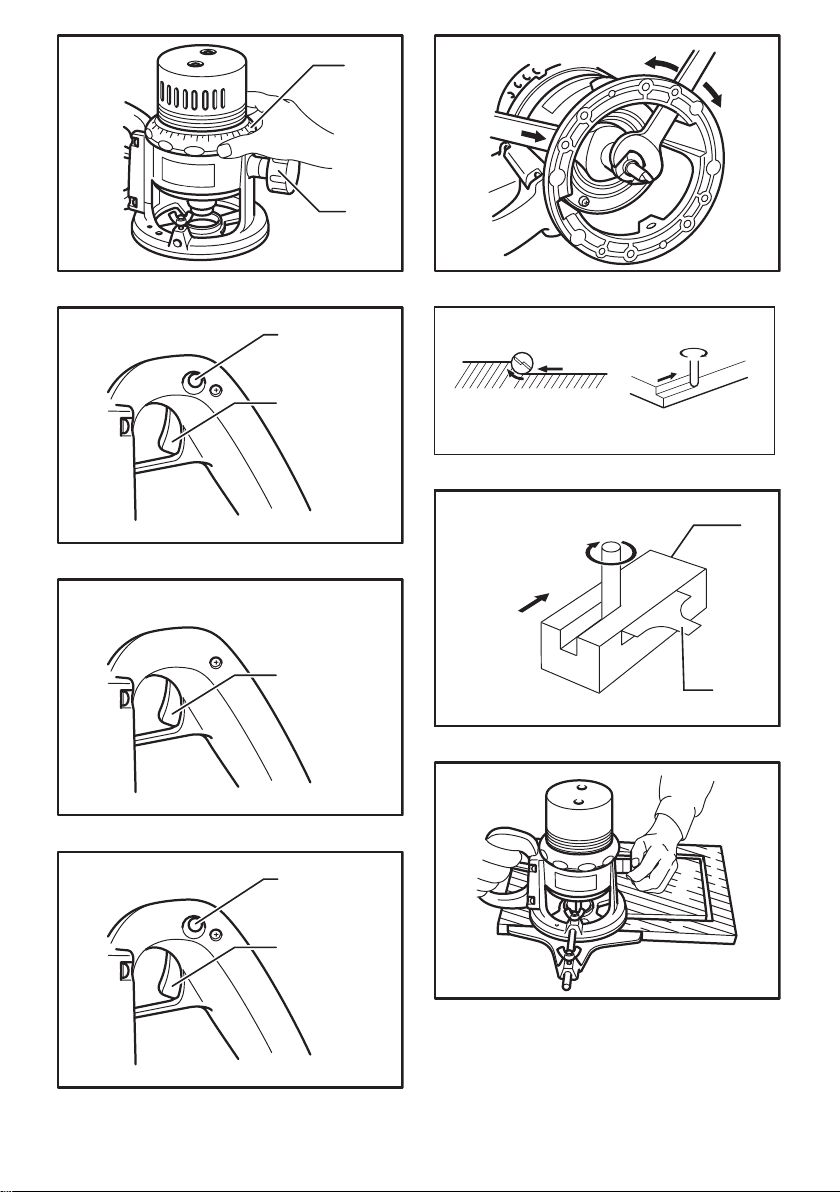
► Fig.1: 1. Scale ring 2. Knob
Place the tool on a at surface. Turn the scale ring until
it makes contact with the base. Loosen the knob. Turn
the scale ring until the bit just touches the at surface.
Tighten the knob. Place the tool on its side and turn the
scale ring counterclockwise (when viewing the tool from
the top) until the desired depth of cut is obtained. One
full turn of the scale ring is equal to 5 mm change in
depth setting. Loosen the knob and move the tool base
until it makes contact with the scale ring. Then tighten
the knob securely.
CAUTION:
• Since excessive cutting may cause overload of
the motor or diculty in controlling the tool, the
depth of cut should not be more than 15 mm at
a pass when cutting grooves. When you wish
to cut grooves more than 15 mm deep, make
several passes with progressively deeper bit
settings.
Switch action
► Fig.2: 1. Lock button 2. Switch trigger
CAUTION:
• Before plugging in the tool, always check to see
that the switch trigger actuates properly and
returns to the “OFF” position when released.
For tool with lock button
To start the tool, simply pull the switch trigger. Release
the switch trigger to stop.
For continuous operation, pull the switch trigger and
then push in the lock button.
To stop the tool from the locked position, pull the switch
trigger fully, then release it.
For tool without lock button
To start the tool, simply pull the switch trigger. Release
the switch trigger to stop.
► Fig.3: 1. Switch trigger
For tool with lock-o button
To prevent the switch trigger from being accidentally
pulled, a lock-o button is provided.
To start the tool, depress the lock-o button and pull the
switch trigger. Release the switch trigger to stop.
► Fig.4: 1. Lock-o button 2. Switch trigger
ASSEMBLY
CAUTION:
• Always be sure that the tool is switched o and
unplugged before carrying out any work on the
tool.
Installing or removing the bit
► Fig.5
CAUTION:
• Install the bit securely. Always use only the
wrenches provided with the tool. A loose or
overtightened bit can be dangerous.
• Do not tighten the collet chuck without inserting
a bit or install smaller shank bits without using a
collet sleeve. Either can lead to breakage of the
collet chuck.
Insert the bit all the way into the collet chuck and with-
draw it very slightly (approx. 2 mm). Then tighten the
collet chuck securely with the two wrenches. When
using smaller shank bits, rst insert the appropriate
collet sleeve into the collet chuck, then install the bit as
mentioned above.
To remove the bit, follow the installation procedure in
reverse.

10 ENGLISH
OPERATION
Set the tool base on the workpiece to be cut without the
bit making any contact. Then turn the tool on and wait
until the bit attains full speed. Move the tool forward
over the workpiece surface, keeping the tool base ush
and advancing smoothly until the cutting is complete.
When doing edge cutting, the workpiece surface should
be on the left side of the bit in the feed direction.
► Fig.6: 1. Workpiece 2. Bit revolving direction
3. View from the top of the tool 4. Feed
direction
NOTE:
• Moving the tool forward too fast may cause
a poor quality of cut, or damage to the bit or
motor. Moving the tool forward too slowly may
burn and mar the cut. The proper feed rate will
depend on the bit size, the kind of workpiece
and depth of cut. Before beginning the cut on
the actual workpiece, it is advisable to make a
sample cut on a piece of scrap lumber. This will
show exactly how the cut will look as well as
enable you to check dimensions.
• When using the straight guide or the trimmer
guide, be sure to install it on the right side in the
feed direction. This will help to keep it ush with
the side of the workpiece.
► Fig.7: 1. Feed direction 2. Bit revolving direction
3. Workpiece 4. Straight guide
Straight guide
► Fig.8
The straight guide is eectively used for straight cuts
when chamfering or grooving.
To install the straight guide, insert the guide bar into
the holes in the tool base until the notch in the guide
bar reaches just under the wing bolt (B). Then tighten
wing bolt (B). Loosen the wing bolt (A) and adjust the
distance between the bit and the straight guide. At the
desired distance, tighten the wing bolt (A) to secure the
straight guide in place.
► Fig.9: 1. Wing bolt (B) 2. Wing bolt (A) 3. Straight
guide 4. Guide bar
When cutting, move the tool with the straight guide ush
with the side of the workpiece.
Templet guide (Accessory)
► Fig.10
The templet guide provides a sleeve through which
the bit passes, allowing use of the tool with templet
patterns.
To install the templet guide, screw the templet guide on
the base plate.
► Fig.11: 1. Base plate 2. Templet guide
Secure the templet to the workpiece. Place the tool on
the templet and move the tool with the templet guide
sliding along the side of the templet.
► Fig.12: 1. Bit 2. Base 3. Templet 4. Workpiece
5. Distance (X) 6. Outside diameter of the
templet guide 7. Templet guide
NOTE:
• The workpiece will be cut a slightly dierent
size from the templet. Allow for the distance (X)
between the bit and the outside of the templet
guide. The distance (X) can be calculated by
using the following equation:
Distance (X) = (outside diameter of the templet
guide - bit diameter) / 2
Trimmer guide (Accessory)
► Fig.13
Trimming, curved cuts in veneers for furniture and the
like can be done easily with the trimmer guide. The
guide roller rides the curve and assures a ne cut.
Install the trimmer guide on the tool base with the wing
bolts (B). Loosen the wing bolt (A) and adjust the dis-
tance between the bit and the trimmer guide by turning
the ne adjusting screw (1.5 mm per turn). At the
desired distance, tighten the wing bolt (A) to secure the
trimmer guide in place. When adjusting the guide roller
up or down, loosen the wing bolt (C). After adjusting it,
tighten the wing bolt (C) securely.
► Fig.14: 1. Wing bolt (B) 2. Fine adjusting screw
3. Wing bolt (A) 4. Trimmer guide 5. Wing
bolt (C) 6. Guide roller
When cutting, move the tool with the guide roller riding
the side of the workpiece.
► Fig.15: 1. Bit 2. Guide roller 3. Workpiece
Connecting a vacuum
cleaner
► Fig.16: 1. Vacuum hose 2. Vacuum cleaner
► Fig.17: 1. Screwdriver 2. Screw 3. Hole 4. Vacuum
hose 5. Router base
Connect a vacuum hose to the tool and further connect
another end of it to the vacuum cleaner. Secure the
hose to the router base with a screw in the gure.
► Fig.18: 1. Hose 2. Joint 3. Vacuum hose 4. Outer
diameter ø32 mm 5. Inner diameter ø38 mm
Connect another end of the hose to the vacuum cleaner
hose of 38 mm in inner diameter using a joint.
MAINTENANCE
CAUTION:
• Always be sure that the tool is switched o and
unplugged before attempting to perform inspec-
tion or maintenance.
• Never use gasoline, benzine, thinner, alcohol
or the like. Discoloration, deformation or cracks
may result.
Altri manuali per 3601B
6
Indice
Lingue:
Altri manuali Makita Utensili elettrici

Makita
Makita JN1601 Manuale utente

Makita
Makita 6924N Manuale utente

Makita
Makita 6922NB Manuale utente

Makita
Makita 1911 Manuale utente

Makita
Makita HM1317C Manuale utente

Makita
Makita XWT15 Manuale utente

Makita
Makita JS3200 Manuale utente

Makita
Makita 6915D Manuale utente

Makita
Makita DTW700 Manuale utente

Makita
Makita 6924N Manuale utente

Makita
Makita HM1800 Manuale utente

Makita
Makita BHR202 Manuale utente

Makita
Makita DTM40 Manuale utente

Makita
Makita XSJ05 Manuale utente

Makita
Makita BJS160 Manuale utente

Makita
Makita DJS800Z Manuale utente

Makita
Makita HM0860C Manuale

Makita
Makita ST113D Manuale utente

Makita
Makita 4322 Manuale utente

Makita
Makita DJV182 Manuale utente