Beginnings
The very earliest equalizers were very simple and primitive by
todays standards. Yes, simpler than the hi-fi "bass" and "treble"
controls we grew up with. The first tone controls were like the tone
controls on an electric guitar. They used only capacitors and
potentiometers and were extremely simple. Passive simply means
no "active" (powered) parts and active parts include transistors,
FETs, tubes and ICs where gain is implied. "Passive" also implies
noboostis possible-only cut.Themost recent"purelypassive EQ"
we know of was the EQ-500 designed by Art Davis and built by a
numberofcompaniesincludingUnitedRecordingandAltecLansing.
Ithada10dBinsertionloss.Notubes. It had boostandcutpositions
but boost just meant less loss. Manley Labs re-created this vintage
piece and added a tube gain make-up amp for that 10 dB or make-
up gain to restore unity levels. It has a certain sweetness too.
Youhaveprobablyheardofpassivecrossoversandactivecrossovers
in respect to speakers or speaker systems. Each has advantages.
Almost all hi-fi speakers use a passive crossover mounted in the
speaker cabinet. Only one amp is required per speaker. Again,
passive refers to the crossover using only capacitors, inductors and
resistors. Active here refers to multiple power amplifiers.
Oneofthemaindesigngoals of the MassivePassivewastouseonly
capacitors, inductors and resistors to change the tone. Pultecs do it
this way too and many of our favorite vintage EQs also relied on
inductors and caps. In fact, since op-amps became less expensive
than inductors, virtually every EQ that came out since the mid '70's
substituted ICs for inductors. One is a coil of copper wire around a
magneticcoreandtheotherisprobably20ormoretransistors.Does
the phrase "throwing out the baby with the bath water" ring a bell?
Another design goal was to avoid having the EQ in a negative
feedbackloop.Baxandallinventedthecommoncircuitthatdidthis.
It simplified potentiometer requirements, minimised the number of
parts and was essentially convenient. Any EQ where "flat" is in the
middleof thepot's range and turning thepot oneway boostsand the
otherwaycutsisavariationoftheoldBaxandallEQ.Pultecsarenot
this way. Flat is fully counter-clockwise. For the Massive Passive,
Baxandall was not an option. The classical definition of "passive"
has little to do with "feedback circuits" and we are stretching the
definition a bit here, however, it certainly is more passive this way.
Weonlyuse amplificationtoboostthesignal.FlatGain!Whatgoes
iniswhatcomesout.Ifwedidn'tuseanyamplifiers,youwouldneed
toreturn the signal to amic pre because the EQcircuit eats about 50
dB of gain. Luckily, you don't have to think about this.
We visited a few top studios and asked "what do you want from a
newEQ?"Theyunanamously asked for"clickswitchfrequencies",
"character" rather than "clinical" and not another boring, modern
sterile EQ. They had conventional EQs all over the console and
wanted something different. They had a few choice gutsy EQs with
"click frequencies" that were also inductor/capacitor based (which
is why the frequencies were on a rotary switch). Requests like
"powerful", "flexible", "unusual" and "dramatic" kept coming up.
We started with these goals: modern parametric-like operation,
passive tone techniques through-out, and features different from
anything currently available and, most importantly, it had to sound
spectacular.
"The Super-Pultec"
Manley Labs has been building a few versions of the Pultec-style
EQs for many years as well as an updated version of the EQ-500
(anothervintageEQ).Theseareclassic passive EQscombinedwith
Manley's own gain make-up amplifiers. Engineers loved them but
we often heard requests for a Manley Parametric EQ with all the
modern features but done with tubes. Another request we had was
fora"Super-Pultec".Webrieflyconsideredcombiningthe"bestof"
Pultecsinto a newproduct but theidea of somebands onlyboosting
andsomeonlycuttingcouldonlybejustifiedinanauthenticvintage
re-creation and not a new EQ.
ThenextchallengewastomakeanEQthatsoundedasgoodorbetter
than a Pultec. With all the hundreds of EQs designed since the
Pultec, none really beat them for sheer fatness. We knew why. Two
reasons. EQP1-A's have separate knobs for boost and cut. People
tend to use both at the same time. You might think that this would
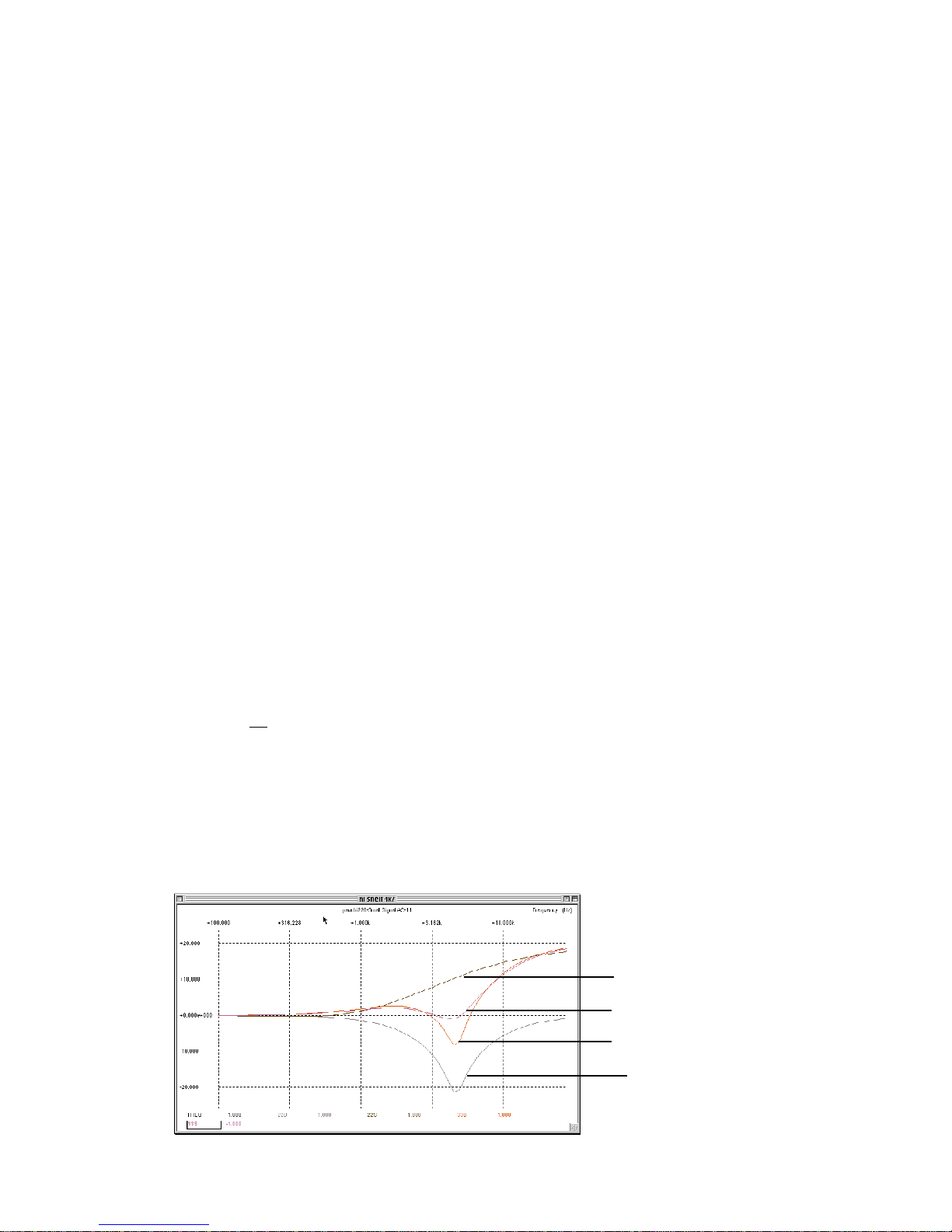
just cancel out - wrong.... You get what is known as the "Pultec
Curve" . The deep lows are boosted, the slope towards "flat"
becomes steeper, and a few dB of dip occurs in the low mids. The
second reason for the fatness and warmth was the use of inductors
and transformers that saturate nicely combined with vacuum tubes
for preserving the headroom and signal integrity.
Couldweusea"bandwidthcontrol"tosimulatethe"PultecCurve(s)?
The Pultec curve is officially a shelf and shelf EQs don't have a
"bandwidthorQknob"-onlythebellcurves.So,ifwebuiltapassive
parametric where each band could switch to shelf or bell and used
that"bandwidth"knobintheshelfmodeswecouldnotonlysimulate
the Pultecs but add another parameter to the "Parametric EQ" We
found that we could apply the "Pultec Curve" to the highs with
equally impressive results. This is very new.
TheMassivePassivediffersfromPultecsinseveralimportantareas.
Rather than copy any particular part of a Pultec, we designed the
"Massivo"fromthegroundup.Asmentioned,each band being able
to boost or cut and switch from shelf to bell is quite different from
Pultecs. This required a different topology than Pultecs which like
most EQs utilize a "series" connection from band to band. The
Massive Passive uses a "parallel" connection scheme.
Aseriesconnectionwouldimplythatforeachband's20dBofboost,
there is actually 20 dB (more in reality) of loss in the flat settings.
Yeah, that adds up to over 80 dB, right there, and then there is
significantlossesinvolvedifoneintendstousethesamecomponents
tocutandtoboost.Andmorelossesinthefilterand"gaintrim".That
much loss would mean, that much gain, and to avoid noise there
would need to be gain stages between each band and if done with
tubes would end up being truly massive, hot and power hungry.
Instead, we used a parallel topology. Not only are the losses much
more reasonable (50 dB total!) but we believe it sounds more
"natural"and"musical".InmanywaystheMassivePassiveisavery
unusual EQ, from how it is built, to how it is to operate and most
importantly how it sounds.
We designed these circuits using precise digital EQ simulations,
SPICE3 for electronic simulations, and beta tested prototypes in
major studios and mastering rooms for opinions from some of the
best "ears" in the business.
9