90589 Rev B.3 4/13 Page 5 of 12
3.4 Use in measurement system
After the vibration measuring system (consisting of the P702B power unit/amplifier, accelerometer,
readout instrument and connecting cables) is prepared as discussed above, the following procedure is
recommended to put the system into operation.
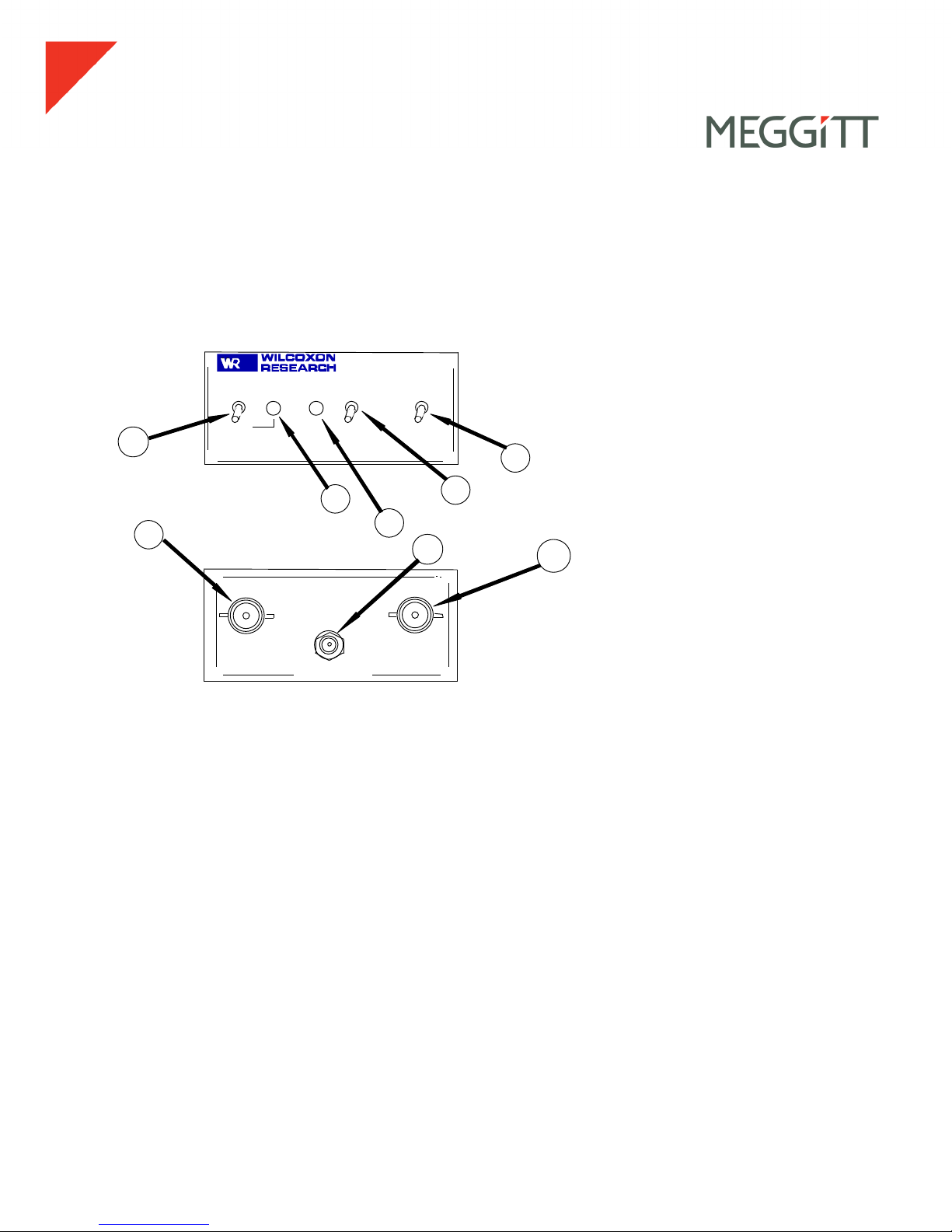
Set the gain range switch to the desired value of 1, 10, or 100 depending on the acceleration range or the
velocity range and the sensitivity of the accelerometer. The output of the P702B is limited to 6 Volts, so
this will limit the output for any sensitivity/gain combination.
For vibration measurements in ‘g’ values, use an accelerometer as the input. Set the
ACCeleration/VELocity switch to the ACC position. For a typical Wilcoxon Research accelerometer (like
model 793, with a sensitivity of 100 mV/g) a 10g vibration level would produce a 1 Volt output at the
sensor.
The formula for this is Vout = sensitivity x vibration level x gain (assuming no integration). In this example,
the output voltage is calculated as follows:
Sensitivity = 0.100 Volts (100 mV)
Vibration level = 10g
Gain = X1
Vout = 0.100 x 10 x 1 = 1 Volt
If Vout exceeds 6 Volts, the red FAULT indicator will light. If all other reasons for the fault have been
eliminated (see sections 3.1 and 4.3) the cause may be:
Too much gain selected on the P702B, and/or
In the lowest gain setting (X1), a less sensitive accelerometer may be required to lower the
output voltage fed to the P702B so the output voltage drops below 6 Volts.
If a signal proportional to velocity is desired, set the ACCeleration/VELocity switch to VEL. In this
position, the input signal is integrated to velocity with a calibrated output sensitivity of 100 mV/in/sec for a
100 mV/g accelerometer.
If a velocity transducer is the input to the P702B with the selector switch in the ACCeleration (no
integration) position, the output will be proportional to velocity with a sensitivity equal to the sensitivity of
the velocity transducer. Gains of X10 and X100 may be applied to this signal as long as the output
voltage of the P702B does not exceed 6 Volts.
If the selector switch is set to velocity (single integration) with a velocity transducer as the input signal, the
output will be proportional to displacement. For a 100 mV/in/sec velocity transducer, the calibrated output
sensitivity of the P702B will be 38.6 mV/mil.
Note: If the P702B power unit/amplifier is to be used in connection with a high Impedance charge-type
accelerometer rather than the internally amplified transducers, a charge converter accessory (CC701) is
required. The specifications of the CC701 should be consulted to insure compatibility with the selected
accelerometer.
Note: If the P702B power unit/amplifier is to be used with another accelerometer with integral amplifier
(not a Wilcoxon Research type), its specifications must be compatible with those of the P702B.