Ryobi ERT1400RG Manuale operativo

PLUNGE ROUTER
OWNER’S OPERATING MANUAL
ERT1400RG

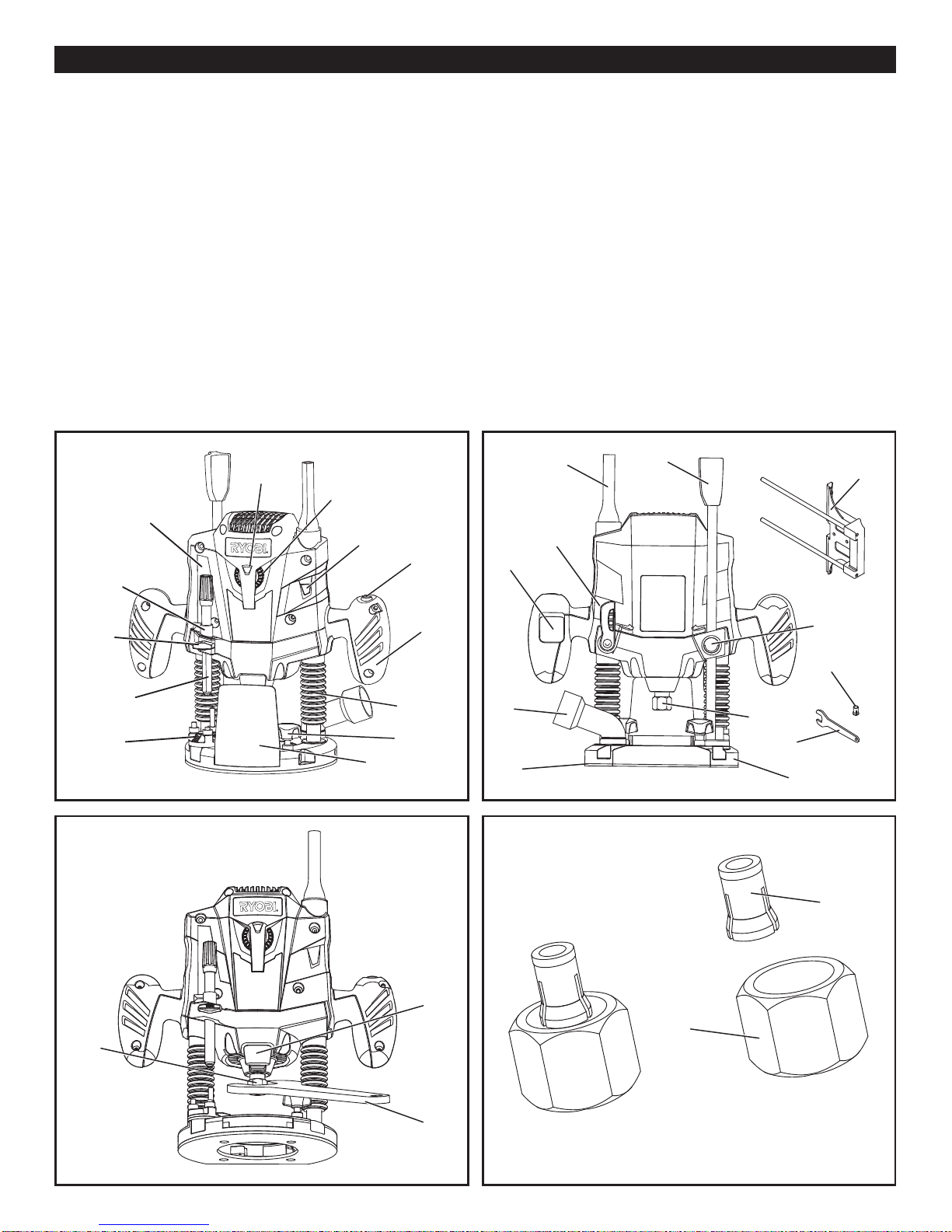
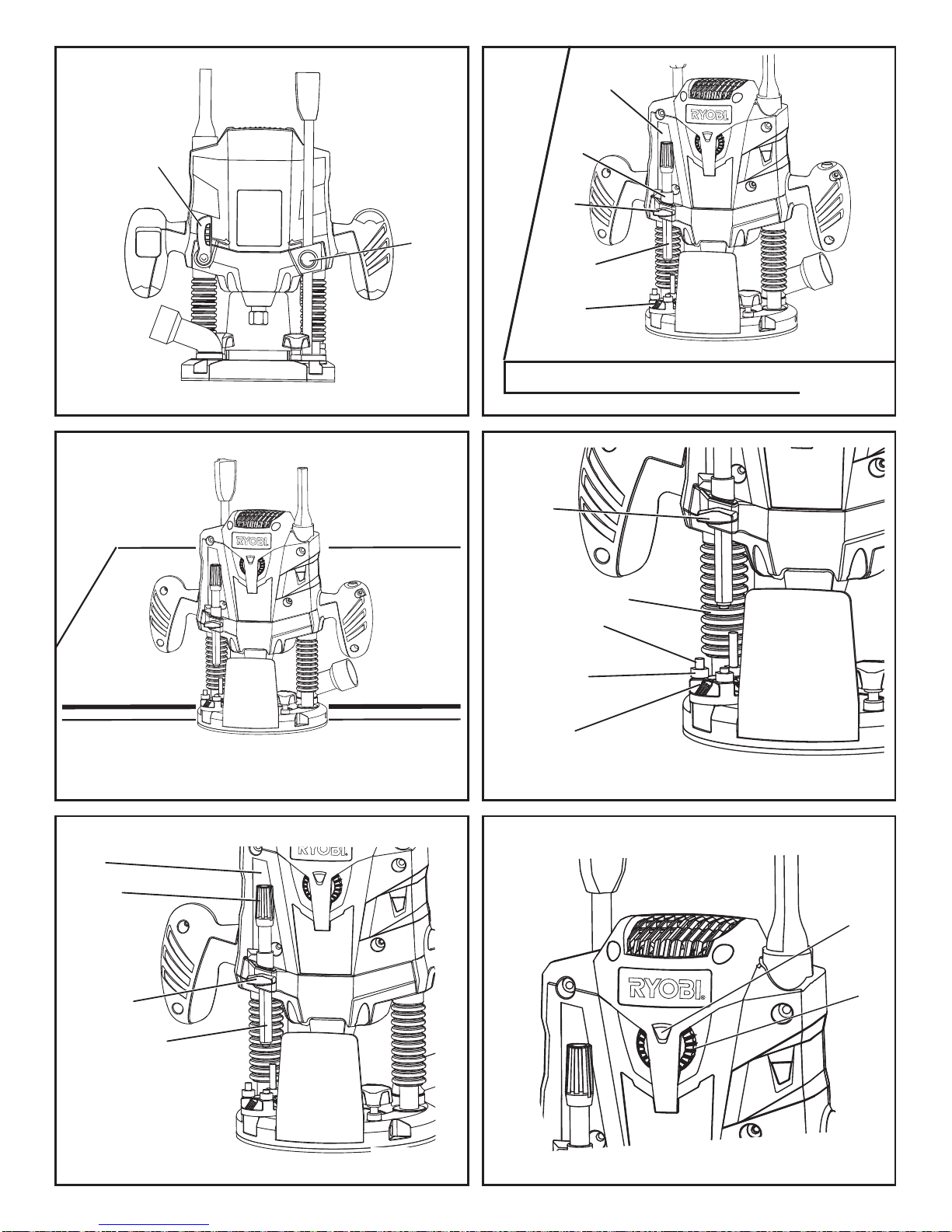
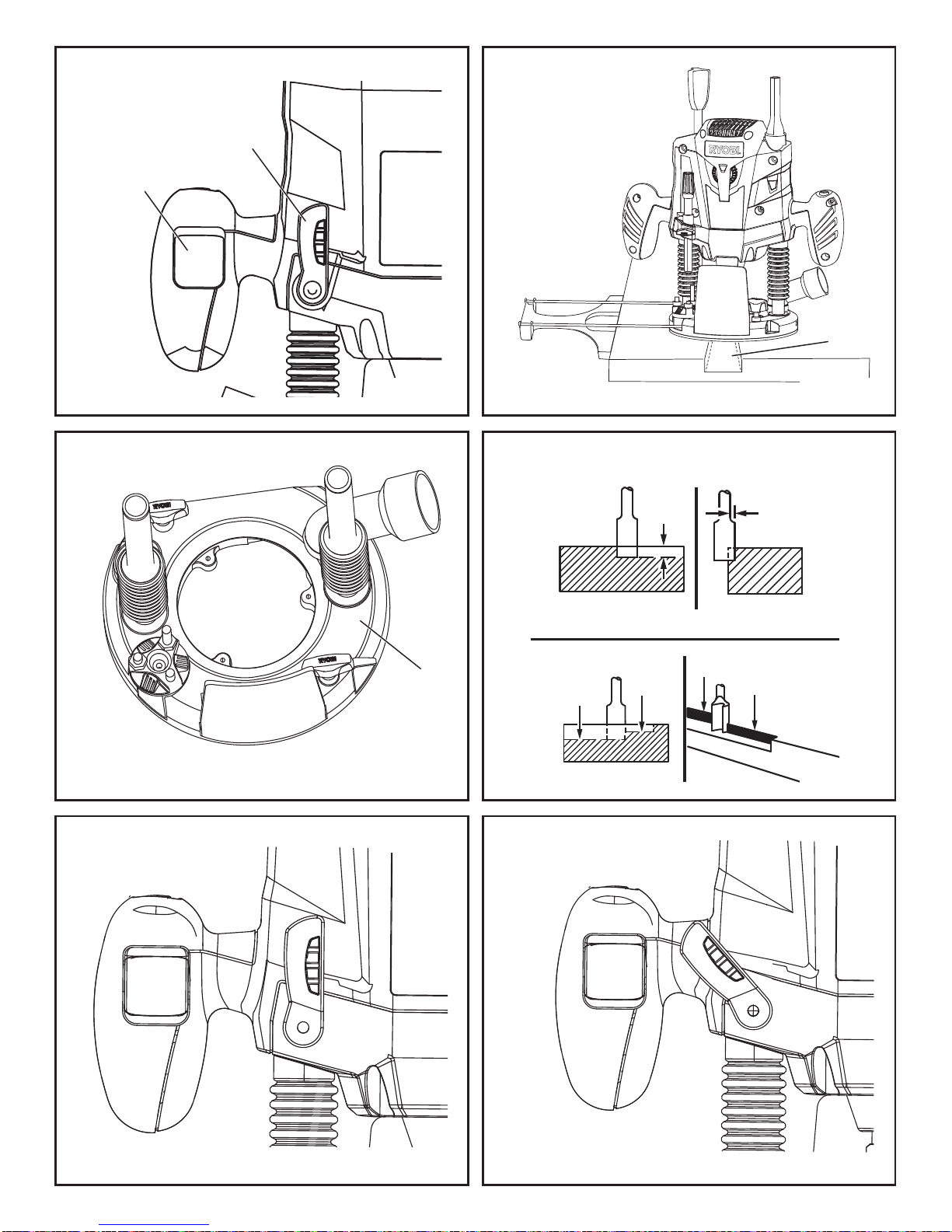
1. Speed selection sight window
2. Variable speed control selector
3. Handle
4. Lock-off button
5. Spindle lock button
6. Parallel guide lock knob
7. Chip shield
8. Depth stop
9. Stop bar
10. Stop bar lock knob
11. Zero reset indicator
12. Scale
13. Power cord
14. Plunge lock lever quick release button
15. Switch
16. Router base
17. Sub-base
18. Spanner
19. Parallel guide
20. Collet nut
21. Threaded post
22. Collet
23. Workpiece
24. Dust port
25. Depth of cut
26. Width of cut
27. 1st pass
28. 2nd pass
29. Fine height adjuster knob
30. Fine height adjuster quick release button
31. Live tool indicator
32. Template guide
33. Screw
34. Nut
DESCRIPTION
Fig. 1 Fig. 2
Fig. 3 Fig. 4
12
11
10
9
8
20
5
18
4
12
13 29
14
15
24
17 16
20
21
30
22
22
20
18
19
31
3
6
7

Fig. 7 Fig. 8
Fig. 9 Fig. 10
14
30
1
2
12
11
10
10
11
33
9
9
9
34
12
10
8
9
8
Fig. 5 Fig. 6

Fig. 13 Fig. 14
Fig. 15 Fig. 16
Fig. 11 Fig. 12
14
16
23
15
25 26
27
28
28 27

Fig. 17
32

Important!
It is essential that you read the instructions in this manual before
operating this machine.
Subject to technical modifications.

1
English
GENERAL POWER TOOL SAFETY WARNINGS
WARNING
Read all safety warnings and all instructions. Failure
tofollowthewarningsandinstructionsmayresultinelectric
shock, fire and/or serious injury.
Save all warnings and instructions for future
reference.
The term “power tool” in the warnings refers to your
mains-operated (corded) power tool or battery-operated
(cordless) power tool.
1. WORK AREA
a. Keep work area clean and well lit. Cluttered or
dark areas invite accidents.
b. Do not operate power tools in explosive
atmospheres, such as in the presence of
flammable liquids, gases, or dust. Power tools
create sparks which may ignite the dust or fumes.
c. Keep children and bystanders away while
operating a power tool. Distractions can cause
you to lose control.
2. ELECTRICAL SAFETY
a. Power tool plugs must match the outlet. Never
modify the plug in any way. Do not use any
adaptor plugs with earthed (grounded) power
tools. Unmodified plugs and matching outlets will
reduce risk of electric shock.
b. Avoid body contact with earthed or grounded
surfaces such as pipes, radiators, ranges and
refrigerators. There is an increased risk of electric
shock if your body is earthed or grounded.
c. Do not expose power tools to rain or wet
conditions. Water entering a power tool will
increase the risk of electric shock.
d. Do not abuse the cord. Never use the cord for
carrying, pulling or unplugging the power tool.
Keep cord away from heat, oil, sharp edges
or moving parts. Damaged or entangled cords
increase the risk of electric shock.
e. When operating a power tool outdoors, use an
extension cord suitable for outdoor use. Use of
a cord suitable for outdoor use reduces the risk of
electric shock.
f. If operating power tools in a damp location
is unavoidable, use a residual current device
(RCD) protected supply. Use of an RCD reduces
the risk of electric shock.
3. PERSONAL SAFETY
a. Stay alert, watch what you are doing and
use common sense when operating a power
tool. Do not use a power tool while you are
tired or under the influence of drugs, alcohol
or medication. A moment of inattention while
operating power tools may result in serious
personal injury.
b. Use personal protective equipment. Always
wear eye protection. Protective equipment such
as dust mask, non-skid safety shoes, hard hat, or
hearing protection used for appropriate conditions
will reduce personal injuries.
c. Prevent unintentional starting. Ensure the
switch is in the off-position before connecting
to power source and/or battery pack, picking
up or carrying the tool. Carrying power tools with
your finger on the switch or energising power tools
that have the switch on invites accidents.
d. Remove any adjusting key or wrench before
turning the power tool on. A wrench or a key left
attached to a rotating part of the power tool may
result in personal injury.
e. Do not overreach. Keep proper footing and
balance at all times. This enables better control
of the power tool in unexpected situations.
f. Dress properly. Do not wear loose clothing or
jewellery. Keep your hair, clothing and gloves
away from moving parts. Looseclothes,jewellery
or long hair can be caught in moving parts.
g. If devices are provided for the connection of
dust extraction and collection facilities, ensure
these are connected and properly used. Use of
dust collection can reduce dust-related hazards.
4. POWER TOOL USE AND CARE
a. Do not force the power tool. Use the correct
power tool for your application. The correct
power tool will do the job better and safer at the
rate for which it was designed.
b. Do not use the power tool if the switch does not
turn it on and off. Any power tool that can not be
controlled with the switch is dangerous and must
be repaired.
c. Disconnect the plug from the power source
and/or the battery pack from the power tool
before making any adjustments, changing
accessories, or storing power tools. Such
preventive safety measures reduce the risk of
starting the power tool accidentally.
d. Store idle power tools out of the reach of
children and do not allow persons unfamiliar
with the power tool or these instructions
to operate the power tool. Power tools are

2
English
dangerous in the hands of untrained users.
e. Maintain power tools. Check for misalignment
or binding of moving parts, breakage of parts
and any other condition that may affect the
power tools operation. If damaged, have the
power tool repaired before use. Many accidents
are caused by poorly maintained power tools.
f. Keep cutting tools sharp and clean. Properly
maintained cutting tools with sharp cutting edges
are less likely to bind and are easier to control.
g. Use the power tool, accessories and tool bits
etc., in accordance with these instructions and
in the manner intended for the particular type
of power tool, taking into account the working
conditions and the work to be performed. Use
of the power tool for operations different from
intended could result in a hazardous situation.
5. SERVICE
a. Have your power tool serviced by a qualified
repair person using only identical replacement
parts. This will ensure that the safety of the power
tool is maintained.
SPECIAL SAFETY RULES
Hold tool by insulated gripping surfaces when
performing an operation where the cutting tool
may contact hidden wiring or its cord. Contact with
a “live” wire will make exposed metal parts of the tool
“live” and shock the operator.
Know your power tool. Read operator’s manual
carefully. Learn its applications and limitations, as well
as the specific potential hazards related to this tool.
Following this rule will reduce the risk of electric shock,
fire, or serious injury.
Always wear safety glasses. Everyday eyeglasses
have only impact-resistant lenses; they are NOT
safety glasses. Following this rule will reduce the risk
of serious personal injury.
Protect your lungs. Wear a face or dust mask if the
operation is dusty. Following this rule will reduce the
risk of serious personal injury.
Protect your hearing. Wear hearing protection during
extended periods of operation. Following this rule will
reduce the risk of serious personal injury.
Inspect tool cords periodically and, if damaged,
have repaired at your nearest Factory Service Center
or other Authorized Service Organisation.
Constantly stay aware of cord location. Following
this rule will reduce the risk of electric shock or fire.
Check damaged parts. Before further use of the
tool, a guard or other part that is damaged should
be carefully checked to determine that it will operate
properly and perform its intended function. Check for
alignment of moving parts, binding of moving parts,
breakage of parts, mounting, and any other conditions
that may affect its operation. A guard or other part that is
damaged should be properly repaired or replaced by an
authorized service center. Following this rule will reduce
the risk of shock, fire, or serious injury.
Do not abuse cord. Never carry the tool by the cord or
yank it to disconnect it from the receptacle. Keep cord
away from heat, oil, and sharp edges. Following this
rule will reduce the risk of electric shock or fire.
Inspect for and remove all nails from lumber
before routing. Following this rule will reduce the risk
of serious personal injury.
Drugs, alcohol, medication. Do not operate tool
while under the influence of drugs, alcohol, or any
medication. Following this rule will reduce the risk of
electric shock, fire, or serious personal injury.
Save these instructions. Refer to them frequently and
use them to instruct others who may use this tool. If you
loan someone this tool, loan them these instructions
also.
This appliance is not intended for use by persons
(including children) with reduced physical,
sensory or mental capabilities, or lack of
experience and knowledge, unless they have been
given supervision or instruction concerning use
of the appliance by a person responsible for their
safety. Children should be supervised to ensure
that they do not play with the appliance.
This appliance is not intended for use by young
children or infirm persons. Adequate supervision by a
responsible person must be provided to ensure that
they do not play with the appliance.
Keep children and visitors away. Visitors should
wear safety glasses and be kept a safe distance from
work area. Do not let visitors contact tool or extension
cord.
Complies with AS/NZS 60745.
Recommended for the use of a residual current device
with a rated residual current of 30 mA or less.

3
English
WARNING
Some dust created by power sanding, sawing, grinding,
drilling, and other construction activities contains
chemicals known to cause cancer, birth defects or other
reproductive harm.
Some examples of these chemicals are:
lead from lead-based paints
crystalline silica from bricks and cement and
other masonry products
arsenic and chromium from chemically-treated
lumber
Your risk from these exposures varies, depending on
how often you do this type of work. To reduce your
exposure to these chemicals, work in a well ventilated
area, and work with approved safety equipment, such
as those dust masks that are specially designed to filter
out microscopic particles.
SPECIFICATIONS
Voltage 230 V - 240 V 50 Hz
No load speed 14000-31500 min-1
Input power 1400 W
Plunge depth 55 mm
Collet size 1/4 in or 6 mm or 8 mm
Net weight 4.3 kg
APPLICATIONS
Use your router only for the purposes listed below:
routing grooves, shaping edges, freehand designs,
etc., in wood
chamfering, rabbeting, dadoing, and dovetailing
in wood
routing edges on laminates
FEATURES
Your plunge router is a versatile woodworking tool that will
give you years of trouble-free performance. It is engineered
with the professional in mind, but its ease of operation allows
the amateur to produce work that is beautiful and precise.As
the name implies, your plunge router can be used for making
plunge cuts in workpieces, routing grooves, edge routing,
routing circles, and freehand routing.
When used with recommended accessories, such as a
router table, depth adjustment knob, and straight guide;
it becomes even more versatile. Various types of cutters,
both with and without roller bearings as guides, also add
to the versatility of this tool.
CHIP SHIELD
A plastic chip shield has been provided on the base of
your router for protection against flying dust and chips. It is
designed to fit the front opening of the router base.
SPINDLE LOCK
The spindle lock secures the spindle so that only one
wrench is needed to loosen collet nut and change cutters.
To operate push the button whilst loosening the collet.
NOTE: Do not run router with spindle lock engaged or use
as a brake to stop the router.
VARIABLE SPEED
Your router has advanced electronic features, designed to
assist you in getting the maximum use from your router.
By making proper speed selections, your router can be
adjusted to specific routing needs.
The variable speed control allows the router to develop a
no load speed that can be adjusted from 14,000 to 31,500
min-1. The variable speed control selector is conveniently
located on the front of the router.
The electronic feature of your router introduces the
flexibility of adjusting the motor speed to required job
conditions. An electronic speed control module senses
the load applied to the motor, and increases or decreases
motor voltage to compensate for and maintain desired
RPM. Speed can be set according to the approximate
cutter diameter you will be using and to the hardness of
the material being cut. The best cuts are made when the
cutter is fed through material at the proper rate of feed.
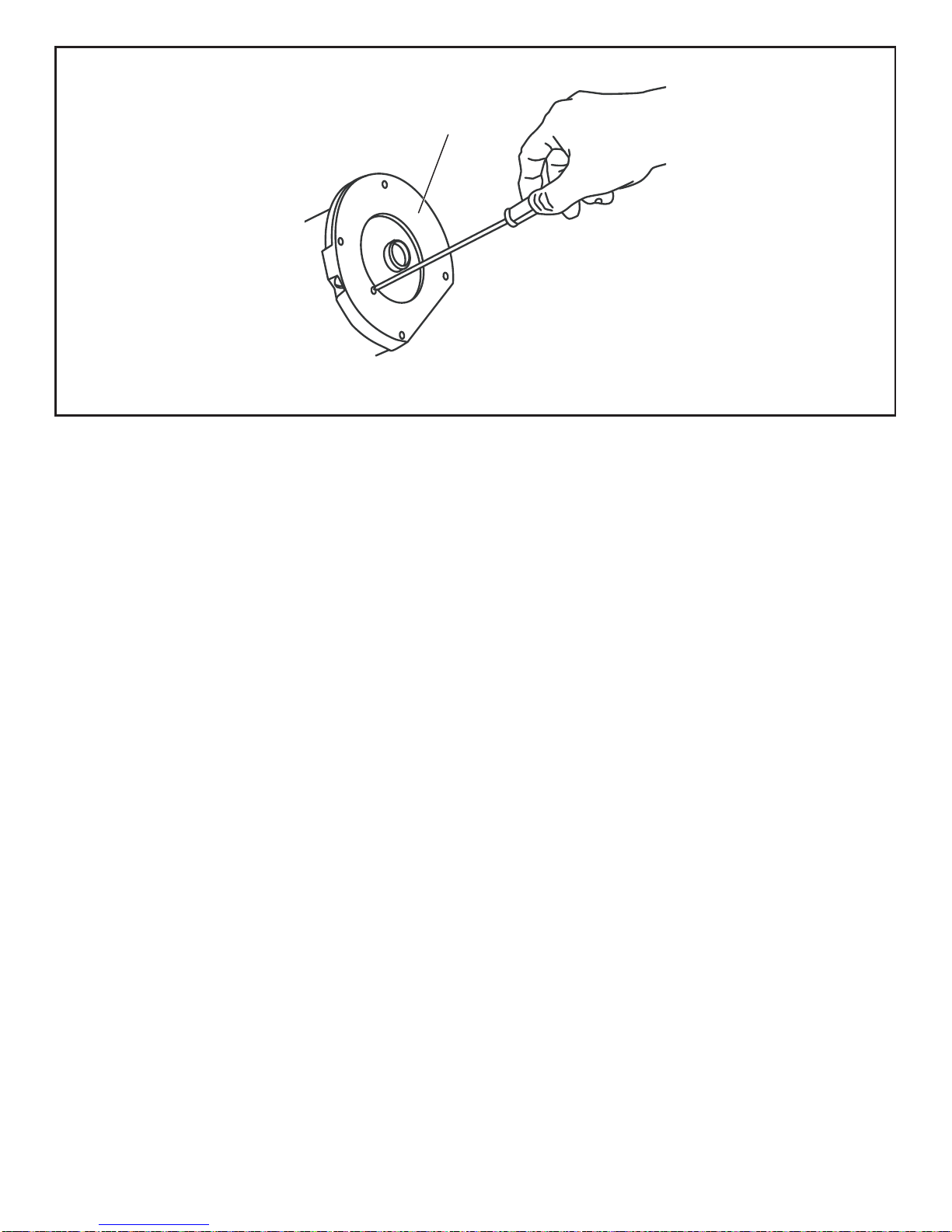
Plunge lock lever shown after extended wear
See Figure 15.
Plunge lock lever shown in original locked position
See Figure 16.
TEMPLATE GUIDE
See Figure 17.
The template guide can be fitted to the base of the router
to accurately duplicate curves and other complex shapes.
These shapes can be easily made by using a jigsaw to
cut out a template. Fix the guide to the base of the router
by removing the two screws retaining the dust extraction
port, placing the guide in the recess provided in the base
and replacing the screws. The dust extraction port must be
in place when fitting the guide to hold the screws.
The guide protrudes below the bottom of the base allowing
the router to follow the template, which must be securely
fixed to the workpiece and a firm pressure applied to the
router at all times to ensure that the edge of the guide

4
English
accurately follows the template.
The template must be at least 5 mm thick to allow for the
protrusion of the guide. Allowance must also be made in
the template for the distance between the cutting edge of
the bit and the outside edge of the template guide.
ERGONOMIC DESIGN
The design of this tool provides for easy handling. It is
designed for comfort and ease of grasp when operating in
different positions and at different angles.
ELECTRICAL CONNECTION
Your router has a precision built electric motor. It should
only be connected to a power supply of the type specified
on the rating plate of the machine,AC only. Do not operate
this tool on direct current (DC).Avoltage drop of more than
10 percent will cause a loss of power and overheating.
If your tool does not operate when plugged into an outlet,
double-check the power supply.
DOUBLE INSULATION
Double insulation is a concept in safety in electric power
tools, which eliminates the need for the usual threewire
grounded power cord.All exposed metal parts are isolated
from the internal metal motor components with protecting
insulation. Double insulated tools do not need to be
grounded.
WARNING
The double insulated system is intended to protect
the user from shock resulting from a break in the tools
internal wiring. Observe all normal safety precautions to
avoid electrical shock.
IMPORTANT
Servicing of a tool with double insulation requires
extreme care and knowledge of the system and should
be performed only by a qualified service technician. For
service, we suggest you return the tool to your nearest
authorized service center for repair.
WARNING
Do not attempt to modify this tool or create accessories
not recommended for use with this tool. Any such
alteration or modification is misuse and could result
in a hazardous condition leading to possible serious
personal injury.
ADJUSTMENTS
WARNING
Your router should never be connected to power
supply when you are assembling parts, making
adjustments, installing or removing cutters, or when not
in use. Disconnecting your router will prevent accidental
starting that could cause serious injury.
CUTTER INSTALLATION
See Figure 3 and 4.
Unplug your router.
WARNING
Failure to unplug your router could result in accidental
starting, causing serious injury.
CAUTION
To prevent damage to the spindle or spindle lock,
always allow motor to come to a complete stop before
engaging the spindle lock.
Remove chip shield from router base.
Depress spindle lock.
Lay router down on workbench in order to gain easy
access to collet nut.
Place the spanner provided through front of router
base onto collet nut and turn counterclockwise to
loosen.
WARNING
If you are changing a cutter immediately after use, be
careful not to touch the cutter or collet with your hands
or fingers. They will get burned because of the heat
buildup from cutting. Always use the wrench provided.
Install cutter once collet nut is loose. If changing
cutters, cutter will easily slip from collet after loosening
collet nut. For example: The collet is machined to
precision tolerances to fit cutters with 1/4 in (6.35 mm)
diameter shanks. To use cutters with 1/4 in (6.35 mm)
diameter shanks, insert the 1/4 in cutter into the 1/4 in
(6.35 mm) collet.
Insert shank of cutter until shank bottoms out, then pull
it out 1/16 in (1.6 mm) to allow for expansion when the
bit gets hot.
Tighten the collet nut securely by turning clockwise
with the spanner provided.
Indice
Altri manuali Ryobi Utensili elettrici

Ryobi
Ryobi DP121L Guida rapida alla configurazione

Ryobi
Ryobi DP103L Manuale utente

Ryobi
Ryobi P343 Manuale utente

Ryobi
Ryobi PCL916 Manuale utente

Ryobi
Ryobi EBS800 Manuale utente

Ryobi
Ryobi JS550LK Guida alla configurazione

Ryobi
Ryobi JS550LK Guida rapida alla configurazione

Ryobi
Ryobi EJ500 Manuale utente

Ryobi
Ryobi RP4206 Manuale utente

Ryobi
Ryobi JM80 Manuale operativo

Ryobi
Ryobi HPL52K Manuale utente

Ryobi
Ryobi R18S18G-0 Manuale utente

Ryobi
Ryobi R18MT Manuale utente

Ryobi
Ryobi RJS1050 Manuale utente

Ryobi
Ryobi P731 Manuale utente

Ryobi
Ryobi P2504 Manuale utente

Ryobi
Ryobi AirStrike P360VN Manuale utente

Ryobi
Ryobi RCG18 Manuale utente

Ryobi
Ryobi RE175 Manuale operativo

Ryobi
Ryobi ONE+ RSI18 Manuale utente