Skil CR541301 Manuale utente

WARNING: To reduce the risk of injury, the user must read and understand the
Owner’s Manual before using this product. Save these instructions for future reference.
AVERTISSEMENT : Afin de réduire les risques de blessure, l’utilisateur doit lire et
comprendre le guide d’utilisation avant d’utiliser cet article. Conservez le présent guide
afin de pouvoir le consulter ultérieurement.
ADVERTENCIA : Para reducir el riesgo de lesiones, el usuario debe leer y comprender
el Manual del operador antes de utilizar este producto. Guarde estas instrucciones para
consultarlas en caso sea necesario.
Owner’s Manual
Guide d’utilisation
Manual del propietario
For Customer Service
Pour le service à la clientèle
Servicio al cliente
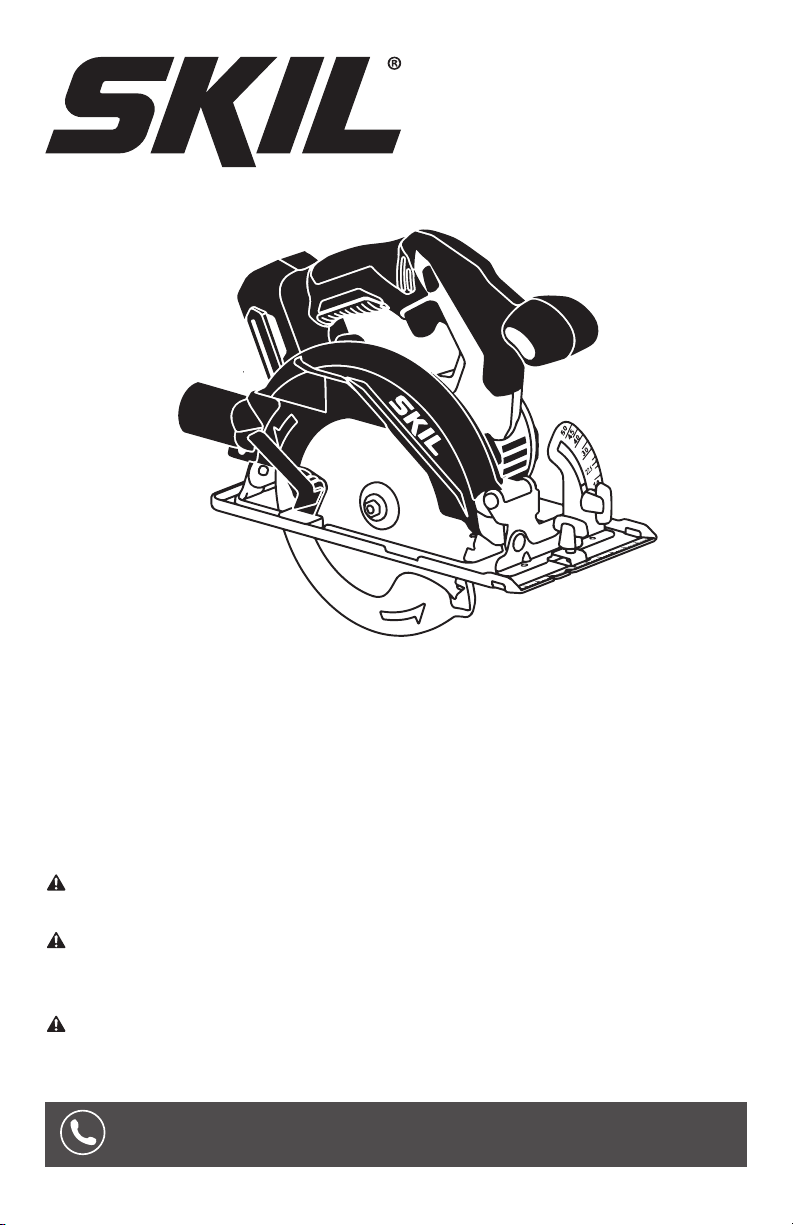
20V Brushless Circular Saw
Scie circulaire sans balai de 20 V
Sierra circular sin escobillas de 20 V
1-877-SKIL-999 OR www.skil.com
Model/ Modelo/ Modèle: CR541301

2
TABLE OF CONTENTS
General Power Tool Safety Warnings . . . . . . . . . . . . . . . . . . . . . . . . . . . . . 3-5
Additional Safety Instructions for Cricular Saws....................5-6
Symbols ....................................................7-10
Get to Know Your Circular Saw ...................................11
Specications .................................................12
Operating Instructions .......................................13-22
Maintenance...................................................23
Troubleshooting ...............................................24
Limited Warranty of SKIL Cordless Tool............................25
WARNING
• Some dust created by power sanding, sawing, grinding, drilling and other construction
activities contains chemicals known to the State of California to cause cancer, birth defects or
other reproductive harm. Some examples of these chemicals are:
–Lead from lead-based paints.
–Crystalline silica from bricks, cement, and other masonry products.
–Arsenic and chromium from chemically-treated lumber.
• Your risk from these exposures varies, depending upon how often you do this type of work.
To reduce your exposure to these chemicals:
–Work in a well-ventilated area.
–Work with approved safety equipment, such as dust masks that are specially designed to
lter out microscopic particles.
–Avoid prolonged contact with dust from power sanding, sawing, grinding, drilling, and
other construction activities. Wear protective clothing and wash exposed areas with soap
and water. Allowing dust to get into your mouth or eyes or to lie on the skin may promote
absorption of harmful chemicals.

3
GENERAL POWER TOOL SAFETY WARNINGS
WARNING Read all safety warnings, instructions, illustrations and specications
provided with this power tool. Failure to follow all instructions listed
below may result in electric shock, re and/or serious injury.
SAVE ALL WARNINGS AND INSTRUCTIONS FOR FUTURE
REFERENCE.
The term “power tool” in the warnings refers to your mains-operated (corded) power tool or
battery-operated (cordless) power tool.
Work area safety
Keep work area clean and well lit. Cluttered or dark areas invite accidents.
Do not operate power tools in explosive atmospheres, such as in the presence of
ammable liquids, gases or dust. Power tools create sparks which may ignite the dust or
fumes.
Keep children and bystanders away while operating a power tool. Distractions can cause
you to lose control.
Electrical safety
Power tool plugs must match the outlet. Never modify the plug in any way. Do not use
any adapter plugs with earthed (grounded) power tools. Unmodied plugs and matching
outlets will reduce risk of electric shock.
Avoid body contact with earthed or grounded surfaces, such as pipes, radiators,
ranges and refrigerators. There is an increased risk of electric shock if your body is earthed
or grounded.
Do not expose power tools to rain or wet conditions. Water entering a power tool will
increase the risk of electric shock.
Do not abuse the cord. Never use the cord for carrying, pulling or unplugging the power
tool. Keep cord away from heat, oil, sharp edges or moving parts. Damaged or entangled
cords increase the risk of electric shock.
When operating a power tool outdoors, use an extension cord suitable for outdoor use.
Use of a cord suitable for outdoor use reduces the risk of electric shock.
If operating a power tool in a damp location is unavoidable, use a ground fault circuit
interrupter (GFCI) protected supply. Use of a GFCI reduces the risk of electric shock.
Personal safety
Stay alert, watch what you are doing and use common sense when operating a power
tool. Do not use a power tool while you are tired or under the inuence of drugs,
alcohol or medication. A moment of inattention while operating power tools may result in
serious personal injury.
Use personal protective equipment. Always wear eye protection. Protective equipment
such as a dust mask, non-skid safety shoes, hard hat or hearing protection used for
appropriate conditions will reduce personal injuries.
Prevent unintentional starting. Ensure the switch is in the off-position before
connecting to power source and/or battery pack, picking up or carrying the tool.
Carrying power tools with your nger on the switch or energising power tools that have the
switch on invites accidents.
Remove any adjusting key or wrench before turning the power tool on. A wrench or a
key left attached to a rotating part of the power tool may result in personal injury.

4
Do not overreach. Keep proper footing and balance at all times. This enables better
control of the power tool in unexpected situations.
Dress properly. Do not wear loose clothing or jewellery. Keep your hair and clothing
away from moving parts. Loose clothes, jewellery or long hair can be caught in moving
parts.
If devices are provided for the connection of dust extraction and collection facilities,
ensure these are connected and properly used. Use of dust collection can reduce dust-
related hazards.
Do not let familiarity gained from frequent use of tools allow you to become complacent
and ignore tool safety principles. A careless action can cause severe injury within a fraction
of a second.
Power tool use and care
Do not force the power tool. Use the correct power tool for your application. The correct
power tool will do the job better and safer at the rate for which it was designed.
Do not use the power tool if the switch does not turn it on and off. Any power tool that
cannot be controlled with the switch is dangerous and must be repaired.
Disconnect the plug from the power source and/or remove the battery pack, if
detachable, from the power tool before making any adjustments, changing accessories,
or storing power tools. Such preventive safety measures reduce the risk of starting the
power tool accidentally.
Store idle power tools out of the reach of children and do not allow persons unfamiliar
with the power tool or these instructions to operate the power tool. Power tools are
dangerous in the hands of untrained users.
Maintain power tools and accessories. Check for misalignment or binding of moving
parts, breakage of parts and any other condition that may affect the power tool’s
operation. If damaged, have the power tool repaired before use. Many accidents are
caused by poorly maintained power tools.
Keep cutting tools sharp and clean. Properly maintained cutting tools with sharp cutting
edges are less likely to bind and are easier to control.
Use the power tool, accessories and tool bits etc. in accordance with these instructions,
taking into account the working conditions and the work to be performed. Use of the
power tool for operations different from those intended could result in a hazardous situation.
Keep handles and grasping surfaces dry, clean and free from oil and grease. Slippery
handles and grasping surfaces do not allow for safe handling and control of the tool in
unexpected situations.
Battery tool use and care
Recharge only with the charger specied by the manufacturer. A charger that is suitable
for one type of battery pack may create a risk of re when used with another battery pack.
Use power tools only with specically designated battery packs. Use of any other battery
packs may create a risk of injury and re.
When battery pack is not in use, keep it away from other metal objects, like paper clips,
coins, keys, nails, screws or other small metal objects, that can make a connection
from one terminal to another. Shorting the battery terminals together may cause burns or a
re.
Under abusive conditions, liquid may be ejected from the battery; avoid contact. If
contact accidentally occurs, ush with water. If liquid contacts eyes, additionally seek
medical help. Liquid ejected from the battery may cause irritation or burns.

5
Do not use a battery pack or tool that is damaged or modied. Damaged or modied
batteries may exhibit unpredictable behaviour resulting in re, explosion or risk of injury.
Do not expose a battery pack or tool to re or excessive temperature. Exposure to re or
temperature above 265 °F may cause explosion.
Follow all charging instructions and do not charge the battery pack or tool outside the
temperature range specied in the instructions. Charging improperly or at temperatures
outside the specied range may damage the battery and increase the risk of re.
Service
Have your power tool serviced by a qualied repair person using only identical
replacement parts. This will ensure that the safety of the power tool is maintained.
Never service damaged battery packs. Service of battery packs should only be performed
by the manufacturer or authorized service providers.
ADDITIONAL SAFETY INSTRUCTIONS FOR CIRCULAR SAWS
Cutting procedures
DANGER Keep hands away from cutting area and the blade. Keep your second
hand on auxiliary handle, or motor housing. If both hands are holding the saw, they cannot
be cut by the blade.
Do not reach underneath the workpiece. The guard cannot protect you from the blade
below the workpiece.
Adjust the cutting depth to the thickness of the workpiece. Less than a full tooth of the
blade teeth should be visible below the workpiece.
Never hold the workpiece in your hands or across your leg while cutting. Secure the
workpiece to a stable platform. It is important to support the work properly to minimise body
exposure, blade binding, or loss of control.
Hold the power tool by insulated gripping surfaces, when performing an operation
where the cutting tool may contact hidden wiring. Contact with a “live” wire will also make
exposed metal parts of the power tool “live” and could give the operator an electric shock.
When ripping, always use a rip fence or straight edge guide. This improves the accuracy
of cut and reduces the chance of blade binding.
Always use blades with correct size and shape (diamond versus round) of arbour holes.
Blades that do not match the mounting hardware of the saw will run off-centre, causing loss of
control.
Never use damaged or incorrect blade washers or bolt. The blade washers and bolt were
specially designed for your saw, for optimum performance and safety of operation.
Kickback causes and related warnings
– kickback is a sudden reaction to a pinched, jammed or misaligned saw blade, causing an
uncontrolled saw to lift up and out of the workpiece toward the operator;
– when the blade is pinched or jammed tightly by the kerf closing down, the blade stalls and
the motor reaction drives the unit rapidly back toward the operator;
– if the blade becomes twisted or misaligned in the cut, the teeth at the back edge of the blade
can dig into the top surface of the wood causing the blade to climb out of the kerf and jump
back toward the operator.
Kickback is the result of saw misuse and/or incorrect operating procedures or conditions and
can be avoided by taking proper precautions as given below.

6
Maintain a rm grip with both hands on the saw and position your arms to resist
kickback forces. Position your body to either side of the blade, but not in line with
the blade. Kickback could cause the saw to jump backwards, but kickback forces can be
controlled by the operator, if proper precautions are taken.
When blade is binding, or when interrupting a cut for any reason, release the trigger
and hold the saw motionless in the material until the blade comes to a complete stop.
Never attempt to remove the saw from the work or pull the saw backward while the
blade is in motion or kickback may occur. Investigate and take corrective actions to
eliminate the cause of blade binding.
When restarting a saw in the workpiece, centre the saw blade in the kerf so that the saw
teeth are not engaged into the material. If a saw blade binds, it may walk up or kickback
from the workpiece as the saw is restarted.
Support large panels to minimise the risk of blade pinching and kickback. Large panels
tend to sag under their own weight. Supports must be placed under the panel on both sides,
near the line of cut and near the edge of the panel.
Do not use dull or damaged blades. Unsharpened or improperly set blades produce narrow
kerf causing excessive friction, blade binding and kickback.
Blade depth and bevel adjusting locking levers must be tight and secure before making
the cut. If blade adjustment shifts while cutting, it may cause binding and kickback.
Use extra caution when sawing into existing walls or other blind areas. The protruding
blade may cut objects that can cause kickback.
Lower guard function
Check the lower guard for proper closing before each use. Do not operate the saw if
the lower guard does not move freely and close instantly. Never clamp or tie the lower
guard into the open position. If the saw is accidentally dropped, the lower guard may be
bent. Raise the lower guard with the retracting handle and make sure it moves freely and does
not touch the blade or any other part, in all angles and depths of cut.
Check the operation of the lower guard spring. If the guard and the spring are not
operating properly, they must be serviced before use. Lower guard may operate sluggishly
due to damaged parts, gummy deposits, or a build-up of debris.
The lower guard may be retracted manually only for special cuts such as “plunge cuts”
and “compound cuts”. Raise the lower guard by the retracting handle and as soon as
the blade enters the material, the lower guard must be released. For all other sawing, the
lower guard should operate automatically.
Always observe that the lower guard is covering the blade before placing the saw down
on bench or oor. An unprotected, coasting blade will cause the saw to walk backwards,
cutting whatever is in its path. Be aware of the time it takes for the blade to stop after switch is
released.

7
SYMBOLS
Safety Symbols
The purpose of safety symbols is to attract your attention to possible dangers. The safety
symbols and the explanations with them deserve your careful attention and understanding.
The symbol warnings do not, by themselves, eliminate any danger. The instructions and
warnings they give are no substitutes for proper accident prevention measures.
WARNING Be sure to read and understand all safety instructions in this Owner’s
Manual, including all safety alert symbols such as “DANGER,”
“WARNING,” and “CAUTION” before using this tool. Failure to following all instructions listed
below may result in electric shock, re, and/or serious personal injury.
The denitions below describe the level of severity for each signal word. Please read the manual
and pay attention to these symbols.
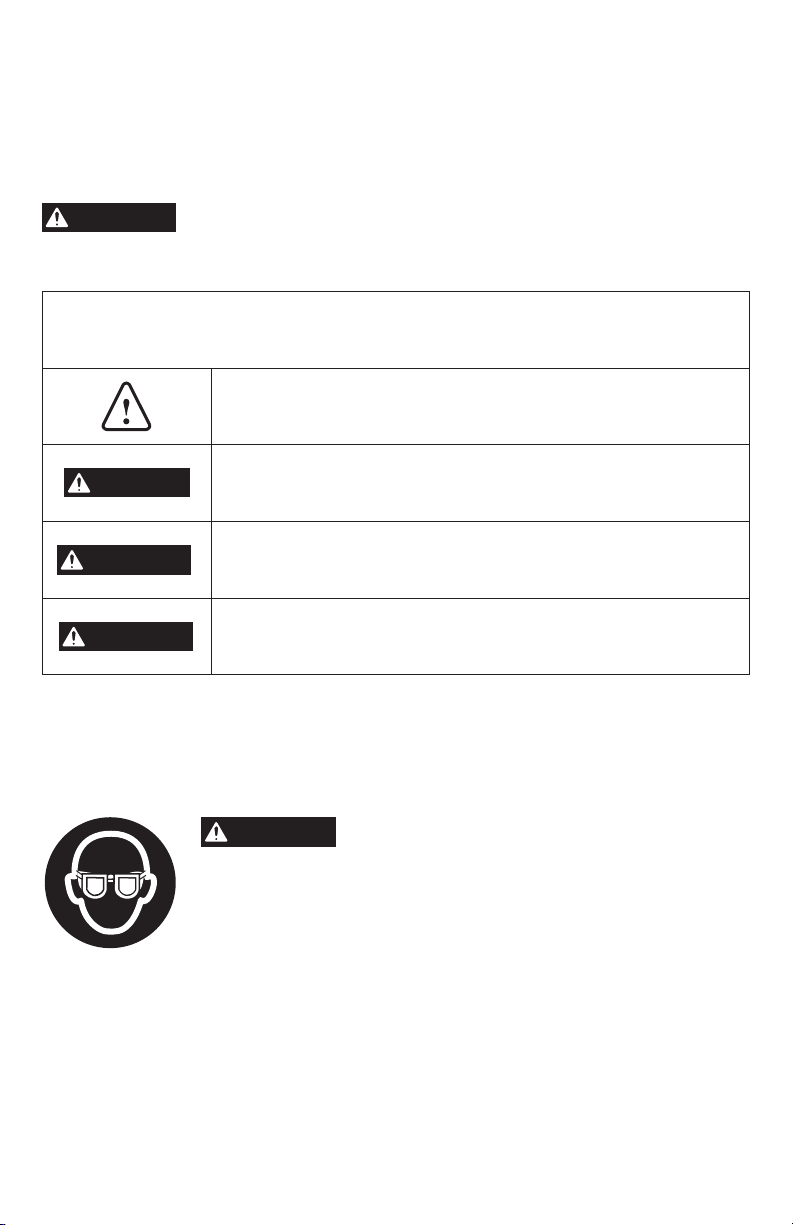
This is the safety alert symbol. It is used to alert you to potential
personal injury hazards. Obey all safety messages that follow this
symbol to avoid possible injury or death.
DANGER DANGER indicates a hazardous situation which, if not avoided, will
result in death or serious injury.
WARNING WARNING indicates a hazardous situation which, if not avoided, could
result in death or serious injury.
CAUTION CAUTION, used with the safety alert symbol, indicates a hazardous
situation which, if not avoided, will result in minor or moderate injury.
Damage Prevention and Information Messages
These inform the user of important information and/or instructions that could lead to equipment
or other property damage if they are not followed. Each message is preceded by the word
“NOTICE”, as in the example below:
NOTICE: Equipment and/or property damage may result if these instructions are not followed.
WARNING The operation of any power tools can result in foreign
objects being thrown into your eyes, which can result
in severe eye damage. Before beginning power tool operation, always
wear safety goggles or safety glasses with side shields and a full face
shield when needed. We recommend a Wide Vision Safety Mask for use
over eyeglasses or standard safety glasses with side shields. Always
use eye protection which is marked to comply with ANSI Z87.1.

8
SYMBOLS (CONTINUED)
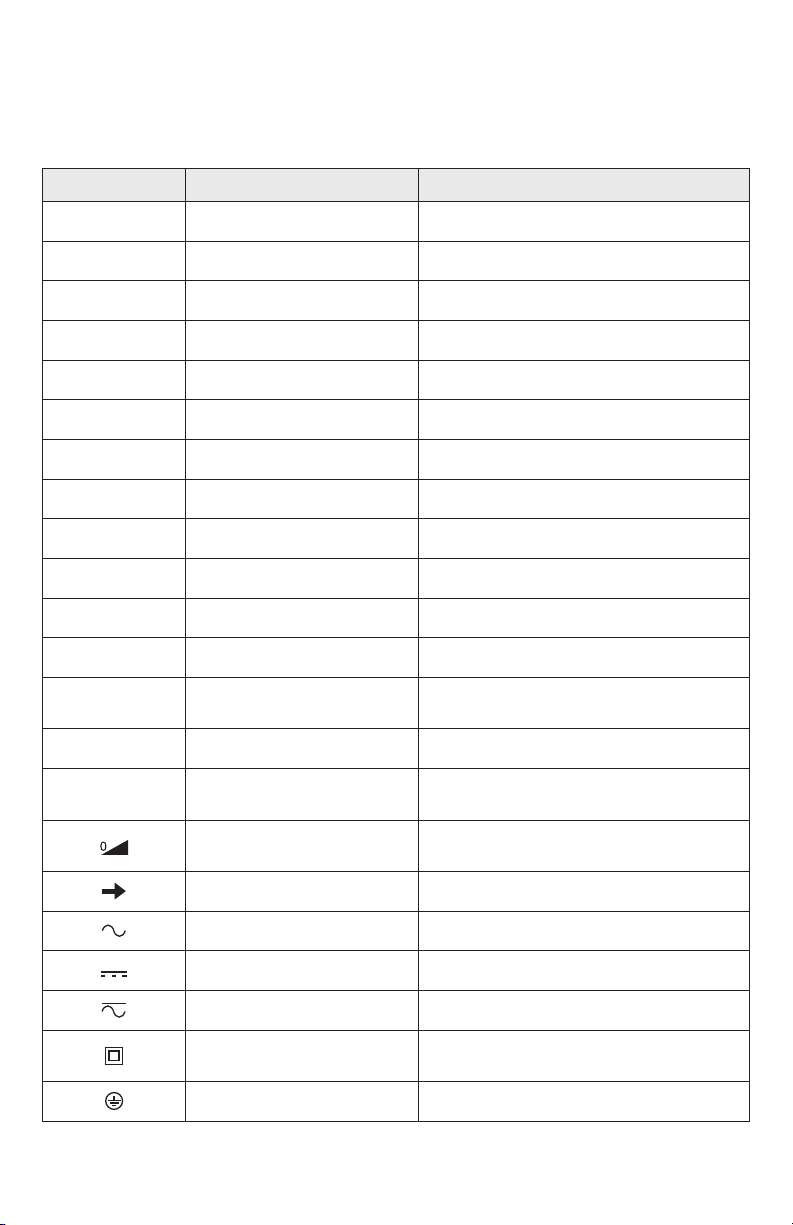
IMPORTANT: Some of the following symbols may be used on your tool. Please study them
and learn their meaning. Proper interpretation of these symbols will allow you to operate the
tool better and more safely.
Symbol Name Designation/Explanation
V Volts Voltage (potential)
A Amperes Current
Hz Hertz Frequency (cycles per second)
W Watt Power
kg Kilograms Weight
min Minutes Time
s Seconds Time
Wh Watt-hours Battery capacity
Ah Ampere-Hours Battery capacity
Ø Diameter Size of drill bits, grinding wheels, etc.
n0No load speed Rotational speed, at no load
n Rated speed Maximum attainable speed
…/min Revolutions or reciprocation
per minute Revolutions, strokes, surface speed,
orbits, etc. per minute
0 Off position Zero speed, zero torque...
1,2,3,…
I,II,III, Selector settings Speed, torque or position settings. Higher
number means greater speed
Innitely variable selector
with off Speed is increasing from 0 setting
Arrow Action in the direction of arrow
Alternating current Type or a characteristic of current
Direct current Type or a characteristic of current
Alternating or direct current Type or a characteristic of current
Class II tool Designates Double Insulated Construction
tools.
Earthing terminal Grounding terminal

9
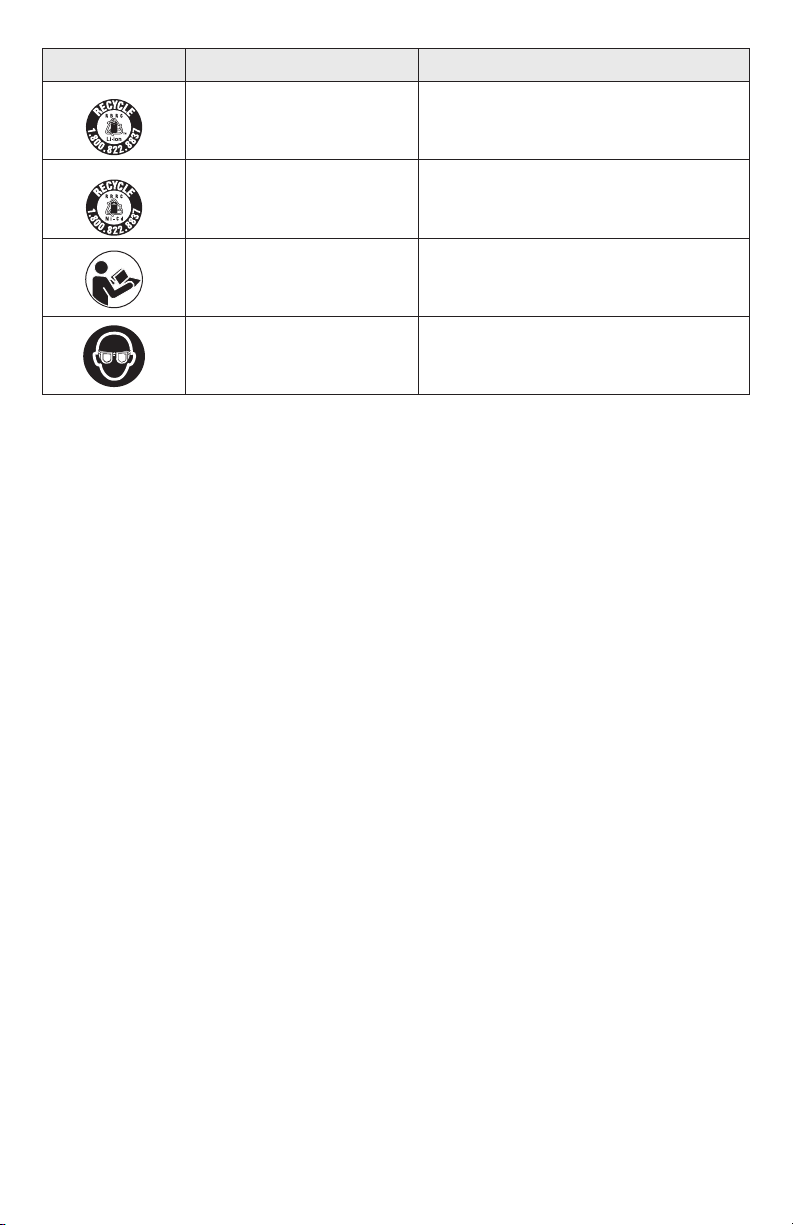
Symbol Name Designation/Explanation
Li-ion RBRC seal Designates Li-ion battery recycling
program
Ni-Cad RBRC seal Designates Ni-Cad battery recycling
program
Read manual symbol Alerts user to read manual
Wear eye protection symbol Alerts user to wear eye protection

10
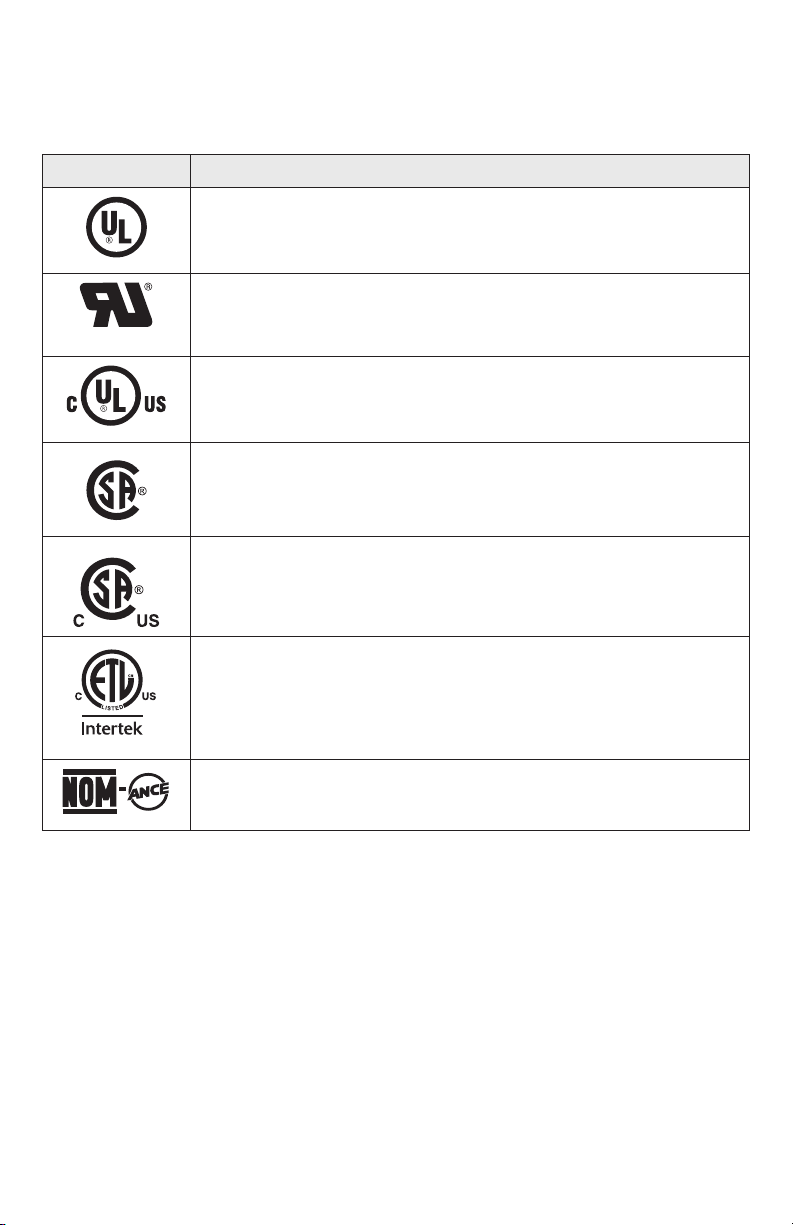
SYMBOLS (CERTIFICATION INFORMATION)
IMPORTANT: Some of the following symbols for certication information may be used on your
tool. Please study them and learn their meaning. Proper interpretation of these symbols will
allow you to operate the tool better and more safely.
Symbol Designation/Explanation
This symbol designates that this tool is listed by Underwriters Laboratories.
This symbol designates that this tool is recognized by Underwriters
Laboratories.
This symbol designates that this tool is listed by Underwriters
Laboratories, to United States and Canadian Standards.
This symbol designates that this tool is listed by the Canadian
Standards Association.
This symbol designates that this tool is listed by the Canadian
Standards Association, to United States and Canadian Standards.
This symbol designates that this tool is listed by the Intertek Testing
Services, to United States and Canadian Standards.
This symbol designates that this tool complies to NOM Mexican
Standards.
Indice
Lingue:
Altri manuali Skil Sega

Skil
Skil HD5860 Istruzioni per il montaggio

Skil
Skil 4950 Manuale utente

Skil
Skil PR0601B-00 Manuale utente

Skil
Skil Skilsaw 5064 Manuale utente

Skil
Skil Skilsaw 5166 Manuale utente

Skil
Skil HD5510 Istruzioni per il montaggio

Skil
Skil SS9503-00 Manuale utente

Skil
Skil CR5440B-00 Manuale utente

Skil
Skil 5380 Istruzioni per il montaggio

Skil
Skil 3470 Manuale utente

Skil
Skil SW1E3475CA Manuale utente

Skil
Skil 3540 Istruzioni per il montaggio

Skil
Skil 5080 Istruzioni per il montaggio

Skil
Skil 1340 Manuale utente

Skil
Skil CR5429B-00 Manuale utente

Skil
Skil 5330 Manuale utente

Skil
Skil 5500 Manuale utente

Skil
Skil Skilsaw 5064 Manuale utente

Skil
Skil 5680 Manuale utente

Skil
Skil CR5429B-00 Manuale utente