
Smart Lab mini nG Manuale utente
31
ENGLISH
User Manual
Self-Monitoring Blood Glucose Meter
Please read this manual thoroughly befo-
re rst using this device
HMM Diagnostics GmbH
Friedrichstraße 89, D-69221
Dossenheim, Germany
www.hmm.info

32

33
ENGLISH
Contents
I. Introduction 35
Measuring principle 36
Intended use 36
Important information 37
Note on smartLAB®nG „NO CODE“-test strips 39
II. Your smartLAB®mini nG 40
Display & functions 40
Specifications 40
The smartLAB®nG test strips 41
Explanation of symbols 42
Set Contents 42
III. Setup & Operating procedures 43
Installing batteries 43
Function check 44
Notes on using smartLAB®nG blood glucose test strips 45
Running a blood glucose test 46
Alternate Site Testing (AST) with the transparent cap 48
Reading stored test results from memory 49
Understanding your test results 49
IV. Miscellaneous 52
Maintenance 52
Troubleshooting 53
Limitations of the measurement procedure 56
Regularity and Safety Notice 59
Warranty 59

34

35
ENGLISH
I. Introduction
Thank you for using the smartLAB®mini nG Self-Monitoring Blood
Glucose System (SMBG). This system was designed to be depend-
able, easy-to-use, compact, lightweight and portable to help you
monitor your blood glucose on a regular basis.
Please read this manual thoroughly before you begin testing. It pro-
vides you and your diabetes care team with important information
and step-by-step direction to use meter correctly. Although your
smartLAB®mini nG system is easy to use, you should consult your
healthcare professional (this may be your doctor, diabetes nurse
educator or pharmacist) for instructions on how to use the system.
The only way to obtain accurate results from any system is to make
sure you correctly use it. If you have any concerns, please call your
authorized distributor in your country during business hours.

36
Measuring principle
The smartLAB®mini nG Self-Monitoring Blood Glucose System is de-
signed to allow rapid measurement of blood glucose by using an
electrochemical biosensor technology. This system employs a dis-
posable dry reagent strip technology, based on the FAD-binding
glucose dehydrogenase.
Each test strip features an electrode containing FAD-binding glu-
cose dehydrogenase. A capillary blood sample is applied to the col-
lecting area of the strip, and is automatically drawn into the reac-
tion zone, where the FAD-binding glucose dehydrogenase catalyzes
the glucose dehydrogenation. It will produce gluconolactone.
During the reaction, a mediator transfers electrons to the electrode
surface and generates a current. The amount of the current is pro-
portional to the amount of glucose present in the blood sample.
After 5 seconds, the smartLAB®mini nG will show glucose concen-
tration on the screen.
Intended use
The smartLAB®mini nG is intended for the quantitative measure-
ment of glucose in venous whole blood or fresh capillary whole
blood from fingertips, palm and forearm. Testing is done outside
the body (In Vitro diagnostic use). It is indicated for self-testing
(over the counter [OTC]) by persons with diabetes, or in clinical
settings by healthcare professionals, as an aid to monitor the ef-
fectiveness of diabetes control. The meter should be used only with
smartLAB®nG blood glucose test strips.

37
ENGLISH
Important information
• The smartLAB®mini nG blood glucose meter is designed and
approved for testing venous whole blood or fresh capillary
whole blood samples from your fingertips, palm and forearm.
The meter is for in vitro diagnostic use ONLY (for testing out-
side the body). It should not be used to diagnose diabetes.
• The smartLAB®mini nG blood glucose meter can only be used
with smartLAB®nG Blood Glucose Test Strips. Other test strips
will give inaccurate results.
• Severe impact may cause the meter to malfunction. Do not di-
sassemble the meter as it may damage components inside and
cause an incorrect reading. The warranty will be void if the
meter has been disassembled.
• Testing is not valid for neonatal blood specimens.
• Incorrect results may occur when performing the test. If you
believe you are not feeling well, please contact your healthcare
professional immediately.
• Always keep the meter clean and store it in a safe place. Pro-
tect from direct sunlight to ensure a longer lifespan.
• The strip slot should be kept free from dirt, dust, blood stains,
and water stains.
• Do not store the meter and test strips in a car, a bathroom or

38
a refrigerator. And the meter, strips and lancing device should
be kept away from children or pets.
• Remove batteries if the meter will not be used for one month
or more.
• Store the kits in a dry place with temperature range is 2 to
30°C (35.6 to 86 °F). Keep away from direct sunlight and heat.
• Store your test strips in their original vial only. Do not transfer
them to a new vial or any other container.
• Indicate the date you open the vial. Discard all unused
strips immediately after 90 days from open date. The strips are
for single use only.
• You should not test critically ill patients with home-use blood
glucose meters.
• Warning for potential biohazard: Healthcare professionals
using this system on multiple patients should be aware that
all products or objects that come in contact with human blood,
even after cleaning, should be handled as if capable of trans-
mitting a viral disease.
• Please dispose device according to the local rule of the dispo-
sition of electronic device /accessory waste.
• If the equipment is used in a manner not specified by the ma-
nufacturer, the protection provided by the equipment may be
39
ENGLISH
impaired.
Do not touch the test strip with wet hands
Do not use expired test strips
(see expiration date on the strip vial)
Do not bend, cut or twist the strip
Consult with your healthcare professional before testing
on your palm or forearm.
Altitude up to 3,048 meters above sea level has no effect
on readings.
Health-Related Information
• If you are experiencing dehydration, frequent urination, low
blood pressure, shock or hyperosmolar hyperglycemic nonke-
totic coma (HHNKC), you may get a test result that is lower
than what your blood glucose really is. If you think you are
dehydrated, call your healthcare professional right away.
• If you have followed the steps in the user’s manual, but still
have symptoms that do not seem to match your test results, or
if you have questions, please contact your healthcare profes-
sional.
• Please read your test strip instructions carefully for additional
health-related information
Note on smartLAB®nG „NO CODE“-test strips
The smartLAB®nG blood glucose test strips compatible with
smartLAB®nG glucose systems need not to be coded, any more.
40
II. Your smartLAB®mini nG
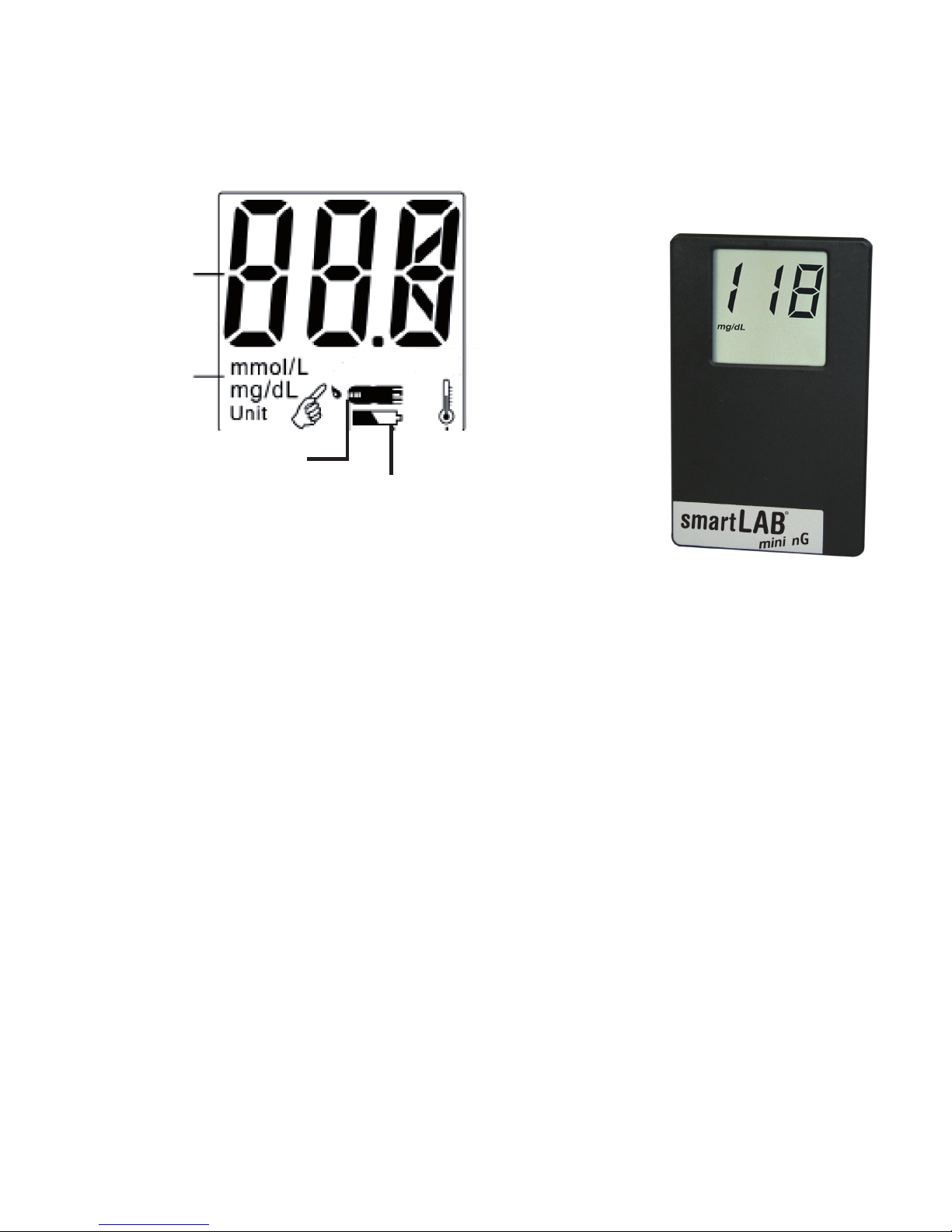
Display & functions
Test result
Measuring
unit
Battery power
Thermometer
Error code
Code number
Apply
blood to the
test strip
Specications
1. Type: smartLAB®mini nG
2. Measuring range: 20~630 mg/dL
(1.1~35.0 mmol/L)
3. Measuring duration: 5 seconds
4. Memory: 20 values
5. Operating temperature: 10°C~40°C
(50°F~104°F)
6. Relative humidity: RH ≤90%
7. Storage Temperature: -20°C ~50°C
(-4°F~122°F)
8. Blood sample: ≥ 0,6 µL capillary or
venous whole blood
9. Calibration: Plasma equivalent
10. Hematocrit (Hct): 30-55%
11. Battery type: 2 CR 3V Lithium bat-
teries
12. Battery life: over 3000
measurements
13. Display-size: 30 x 30 mm
14. Meter dimensions: 80 x 50 x 5 mm
15. Weight: 20g (without batteries)
16. Transportation temperature: -20°C
~50°C (-4°F~122°F)
17. Transportation humidity: RH ≤90%
Indice
Altri manuali Smart Lab Misuratore di glicemia


