
Soundbeam 2 Manuale utente

1
PART 1
GETTING STARTED
THE SOUNDBEAM
®2 HANDBOOK
THE SOUNDBEAM PROJECT

THE SOUNDBEAM®2 HANDBOOK
INTRODUCTION
Soundbeam was first introduced at the Frankfurt International Music Fair in
November, 1988. Ten years later, our own experiences with it - together with
the growing enthusiasm of many of its, by then, more than 1,000 users
worldwide - encouraged us to design a new, radically improved and, we
hope, even more user-friendly Soundbeam 2, offering greatly enhanced
possibilities for imaginative and expressive music making to all ages and
abilities, amateur and professional alike.
For one thing, we have tried to make Soundbeam 2 much more easily
accessible to first time users - plain sailing to connect, trouble free
to operate, and, if you get lost, simple to get back to where you started from
- in fact, fool-proof, we hope, even for the most timid of techno-phobes.
At the same time, Soundbeam 2 opens up new imaginative horizons for
professional users already experienced in MIDI technology - the composers,
choreographers, performing musicians and dancers who will be able to
explore the greatly enhanced creative and expressive possibilities of this newly
expanded MIDI controller and performance instrument.
And, of course, whatever your interests - dance and movement, therapy or
just plain music making - don’t forget that Soundbeam is one of the very
few ways of playing a musical instrument which enables people with differing
levels of dexterity and physical ability to play together as musical equals.
This 3-part “Soundbeam®2 Handbook” - with its Appendix A, “Set-ups
and Pitch Sequences” - is designed to cover everything that anyone, from
beginners to advanced users, might need to know. We have tried
to provide, in as simple and logical a way as possible, a comprehensive
description of how Soundbeam 2 works and how to use it, so that you
can explore the enjoyable and stimulating expressive possibilities it offers.
Edward and Judy Williams,
The Soundbeam Project, Bristol, January 2002.
THE SOUNDBEAM
®2 HANDBOOK • PART 1 • GETTING STARTED 1

SOUNDBEAM
®2 HANDBOOK - PART 1
GETTING STARTED
HOW TO USE THIS HANDBOOK 3
WHAT IS SOUNDBEAM®4
A. OPENING THE BOX 5
PREPARATIONS 10
MAKING THE CONNECTIONS 11
Sensor to Sensor Driver 11
Sensor Driver to Controller 12
Controller’s MIDI Output to
musical instrument’s MIDI Input 13
Musical instrument’s signal outputs to
amplifier and speakers 14
Musical instrument’s power unit
to the mains supply 14
Soundbeam’s power unit to
mains supply 14
SWITCHING ON 15
B. A LIGHTNING TOUR OF THE CONTROLS 23
PITCH SEQUENCE 25
RANGE 27
DIVISIONS 30
TRIGGER MODE 33
TRANSPOSE 36
MIDI UTILITIES 38
SENSOR 40
SET-UP 43
TO SUMMARISE - A FEW SIMPLE TIPS 46
FINALLY - IF YOU GET LOST... 47
MAKING MUSIC WITH SOUNDBEAM 2 48
CONTACTING US 50
SOUNDBEAM is a Registered Trademark throughout Europe and the USA.
2THE SOUNDBEAM
®2 HANDBOOK • PART 1 • GETTING STARTED

How to Use This Handbook
Part 1 - Getting Started
The first section, entitled Opening The Box, will help you recognise the
various components of your new machine, check whether you’ve been sent
everything you need for the kit you ordered, and connect everything up.
After that, follow through A Lightning Tour of the Controls in the second
half of Part 1, trying out the different settings suggested and beginning to
get to grips with using Soundbeam for your own purposes.
Once you have started using Soundbeam in earnest, you will probably want
to move quickly on from the Locked Set-ups and Pitch Sequences
(pre-set in the factory) - with their various settings for Sensor, Range,
Divisions, Trigger Modes, Transpose and MIDI Utilities - to developing
your own new, personal ones, and saving them to the User Set-ups and
Pitch Sequences - ie those defined by you. For this, you can consult
Part 2 - Step by Step
which gives examples of all the procedures you need for any of the
Soundbeam operations. It may be useful to try them out first yourself,
as they stand, before adapting them for use for your own specific needs.
Part 3 - EXPLANATIONS
has detailed explanations of everything you need to know about how
Soundbeam 2 works, together with various practical suggestions, a section
on Trouble Shooting and a glossary of many of the terms you’ll come across
in the course of using Soundbeam to make music with electronic
musical instruments.
APPENDIX A - SET-UPS and PITCH SEQUENCES
has details of all the settings collected in each of the 30 Locked Set-ups,
and all the sequences of notes or chords in each of the 30 Locked Pitch
Sequences, as well as those for User Set-up 31 (repeated in User Set-ups
Nos 32 - 128). and for User Pitch Sequence 31 (repeated in User Pitch
Sequences Nos 32 - 100).
In the folder on the inside back cover of Part 3, you will find 3 blank
duplicates of each of the two forms for you to photocopy. They are for
recording details of the User Set-ups and Pitch Sequences you define
and Save yourself.
And finally, of course, if you’re really in difficulties you can ring Robin Wood’s
helpline - 01726 883265 (working hours, weekdays, British time)
Edward Williams, The Soundbeam Project, Bristol, England
THE SOUNDBEAM
®2 HANDBOOK • PART 1 • GETTING STARTED 3

WHAT IS SOUNDBEAM®?
an invisible expanding MIDI keyboard in space
It sends out a ‘Beam’ of ultra-sonic pulses - like a bat -
too high for us to hear,
listens for ‘echoes’ from any interruption of the beam,
and converts them - together with their changing distance from
the Sensor and the speed of the movements in the Beam –
into MIDI instructions for playing electronic musical instruments.
4THE SOUNDBEAM
®2 HANDBOOK • PART 1 • GETTING STARTED

GETTING STARTED
A. OPENING THE BOX
THE SOUNDBEAM
®2 HANDBOOK • PART 1 • GETTING STARTED 5
MIDI IN
MIDI OUT
A
MIDI IN
MIDI OUT
B
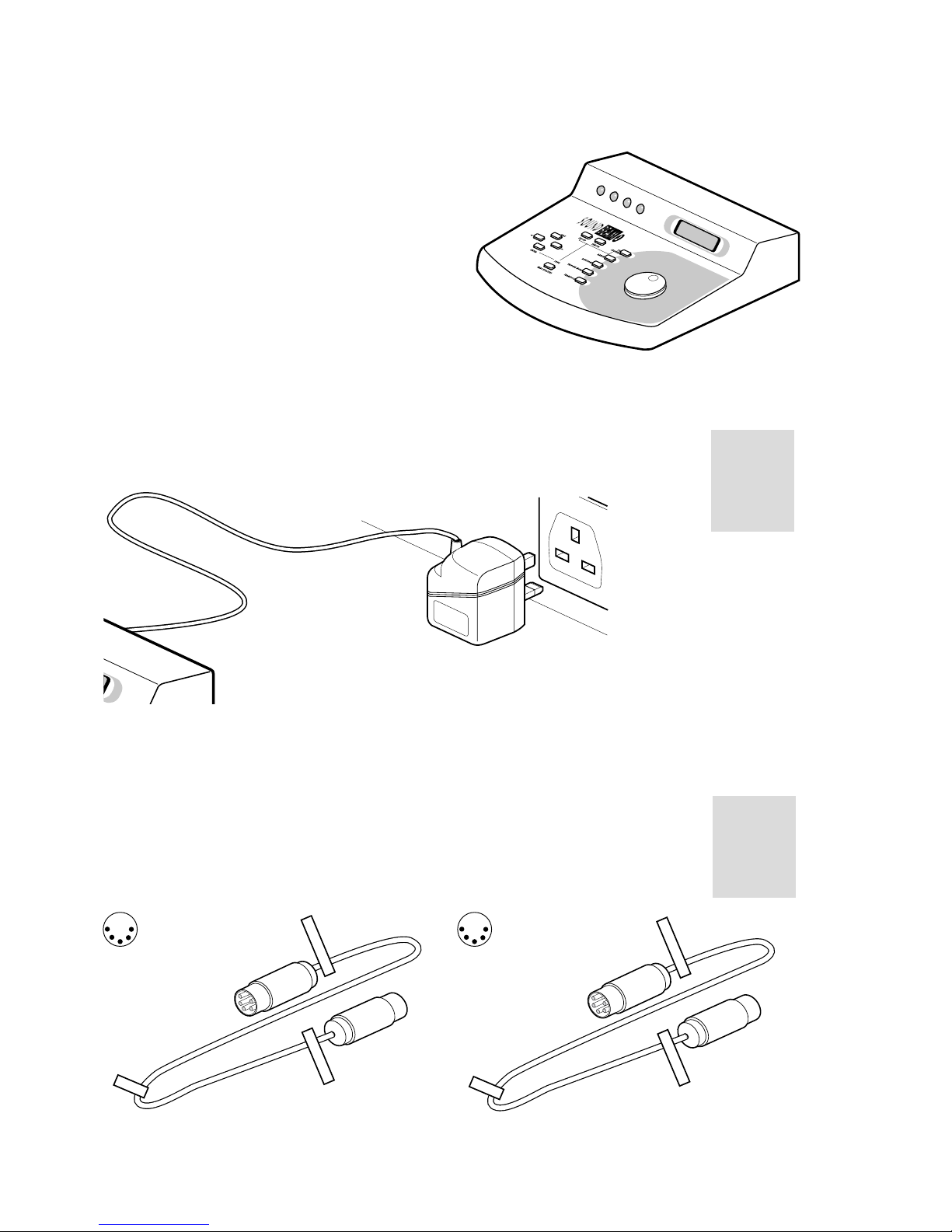
Your new SOUNDBEAM
®2kit will contain
a: The Soundbeam 2 Controller
- with a Power Unit to connect it to your Mains supply
b: 2 MIDI leads, A and B, with 5-pin connectors, each labelled at both ends
for connecting the ‘MIDI Out’ and ‘MIDI In’of the Controller to the MIDI
Input and Output of your MIDI musical instrument.
6THE SOUNDBEAM
®2 HANDBOOK • PART 1 • GETTING STARTED
* The ticks indicate
the number of
each item
normally supplied
with each Kit
Kit A ✓
Kit B ✓
Kit C ✓
Kit D ✓
Kit A ✓
Kit B ✓
Kit C ✓
Kit D ✓
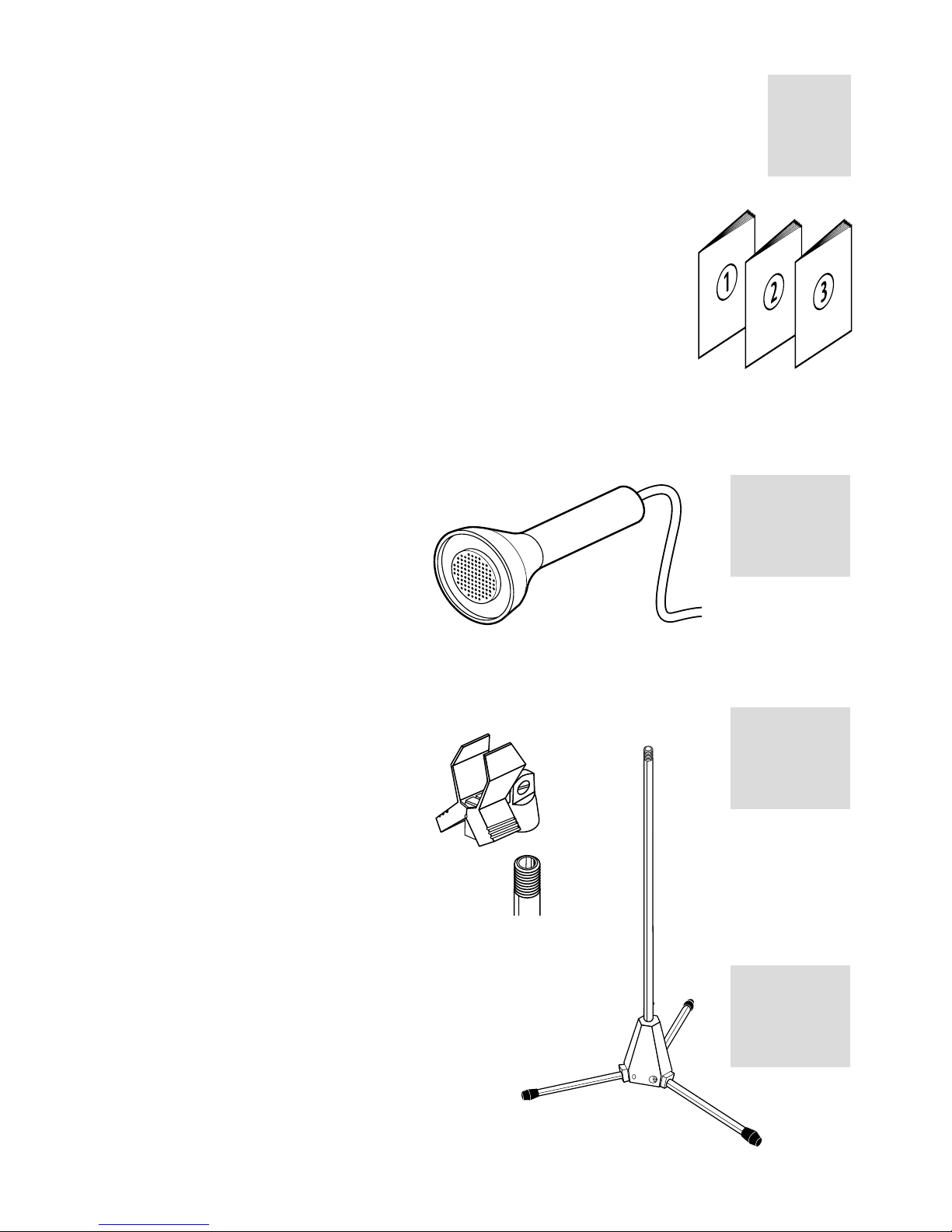
and
c: The Soundbeam 2 Handbook
Part 1 - Getting Started,
Part 2 - Step by step
Part 3 - Explanations.
Appendix A - Set-ups and Pitch Sequence
There will also be -
depending on whether you have ordered Kit A, B, C or D -
d: One or more
i. Sensors,
ii. Spring Clips - to clip Sensor(s) to Stand(s)
iii. Stands (optional) - on which
to fix the clips which hold
the Sensor(s) on
THE SOUNDBEAM
®2 HANDBOOK • PART 1 • GETTING STARTED 7
Kit A ✓
Kit B ✓
Kit C ✓
Kit D ✓
Kit A ✓
Kit B ✓✓
Kit C ✓✓✓
Kit D ✓✓✓✓
Kit A ✓
Kit B ✓✓
Kit C ✓✓✓
Kit D ✓✓✓✓
Kit A ✓
Kit B ✓✓
Kit C ✓✓✓
Kit D ✓✓✓✓
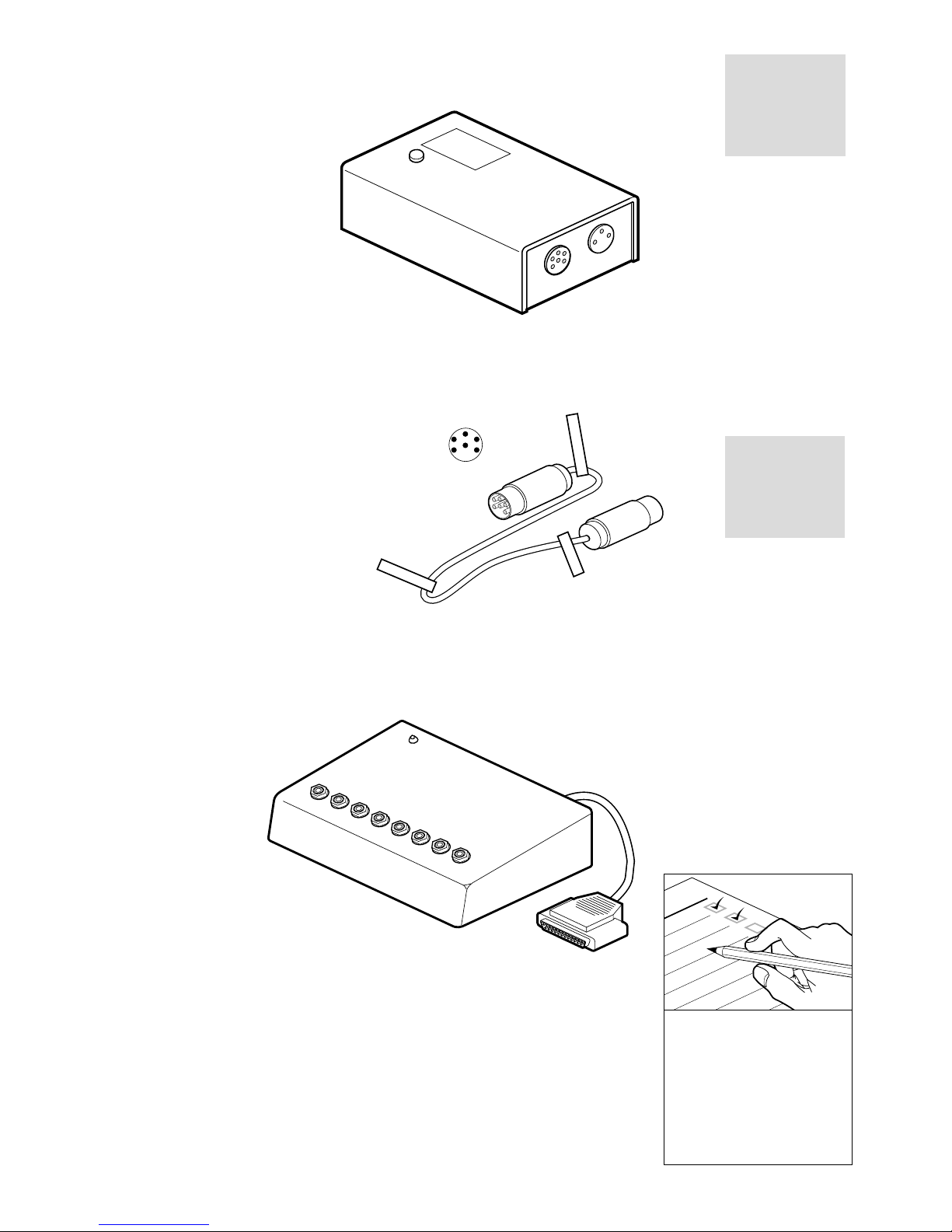
iv. Sensor Drivers - to power and control the Sensor(s) and to send
information from them back to the Controller.
v. Driver Leads - to connect the Sensor Driver(s)
to the Controller
and lastly - if you’ve ordered it -
there will be-
e: the 8-input Switchbox.
8THE SOUNDBEAM
®2 HANDBOOK • PART 1 • GETTING STARTED
SB2
DRIVER
DRIVER
Kit A ✓
Kit B ✓✓
Kit C ✓✓✓
Kit D ✓✓✓✓
Kit A ✓
Kit B ✓✓
Kit C ✓✓✓
Kit D ✓✓✓✓
Please make sure that all
the items for the Kit you
have ordered are present -
let Robin Wood, of EMS,
Cornwall, know immediately
if there are any omissions
or breakages.
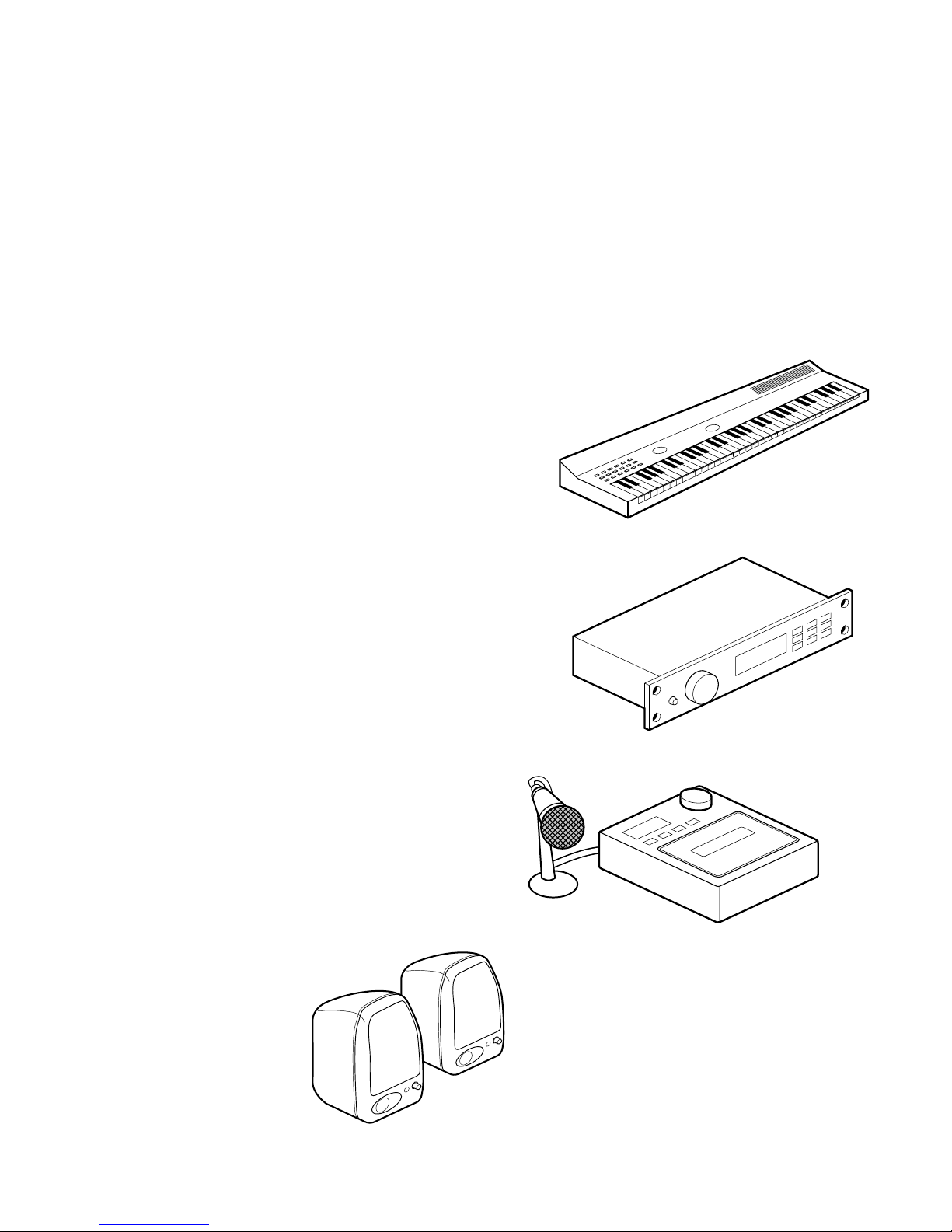
FINALLY - DON’T FORGET
Soundbeam is not itself a musical instrument -
it’s an exciting new and expressive new way
of playing one -
so…
you will need
an electronic musical instrument -
a MIDI Keyboard,
Sound Module
or Sampler.
And, unless you are using a keyboard
synthesiser with built-in amplifier and speakers,
you will also need an amplifier and a pair of
speakers - or a pair of self-powered speakers
with their own internal amplifier.
THE SOUNDBEAM
®2 HANDBOOK • PART 1 • GETTING STARTED 9
Indice


