Soundfield ST350 Manuale utente

SOUNDFIELD
ST350 Portable
Microphone System
User Guide
Version 1.02
System comprises:
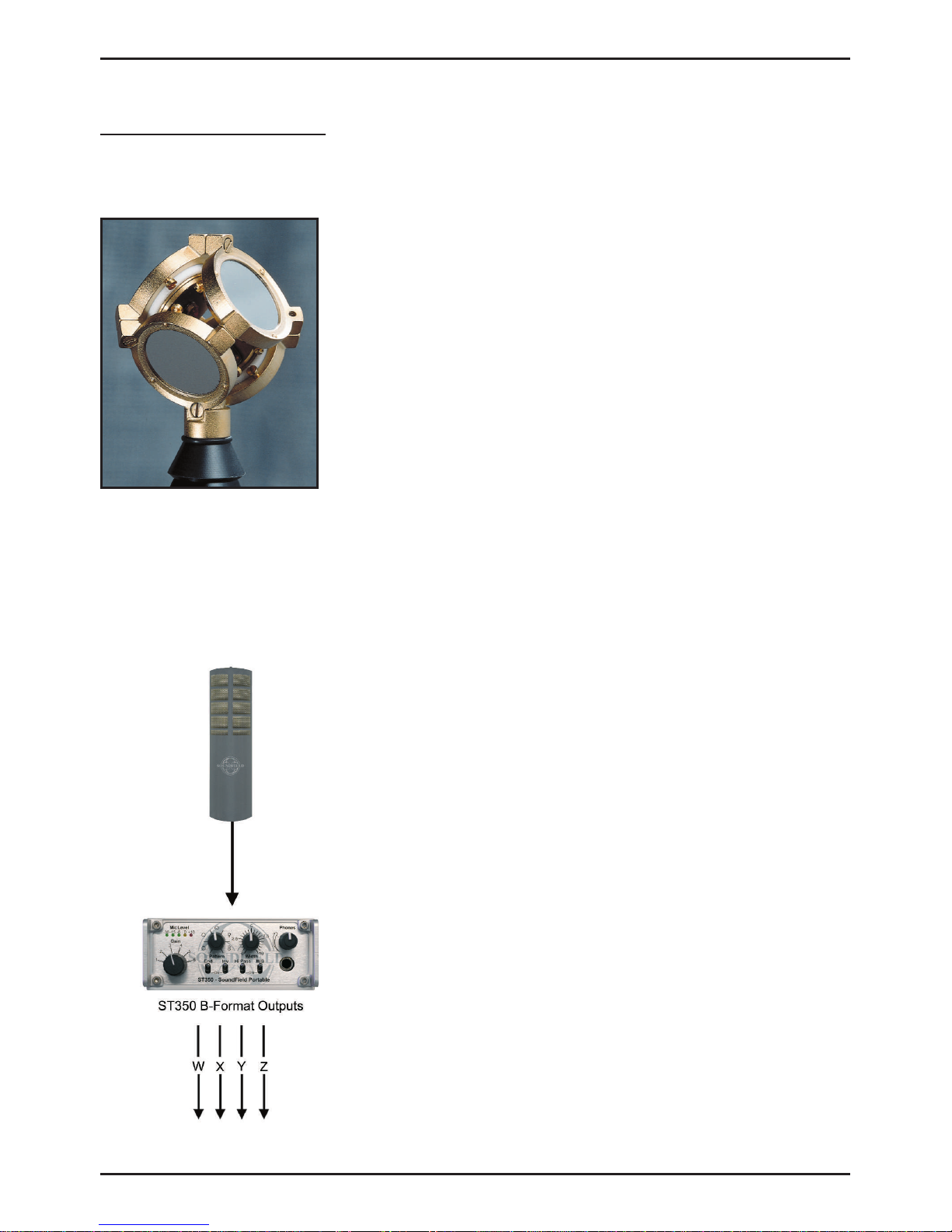
• ST350 Microphone • ST350 Control Unit
• Stand Adapter • 5 Metre 12 pin Lemo Mic Cable (Mic to Controller)
• B-Format Output Cable (10 pin Lemo Connector to 4 male In Line XLR)
• External DC Power Supply

SoundField ST350 User Guide
Safety Considerations Page 2
SOUNDFIELD ST350
MICROPHONE SYSTEM
SAFETY CONSIDERATIONS
CAUTION - EXTERNAL MAINS POWER SUPPLY
THE MAIN POWER SUPPLY SUPPLIED WITH EACH ST350 IS FOR INDOOR USE
ONLY AND HAS NO USER SERVICEABLE PARTS INSIDE.
DO NOT PERFORM ANY SERVICING; REFER ALL SERVICING TO QUALIFIED
PERSONNEL.
SHOULD ANY DAMAGE OCCUR TO POWER SUPPLY OUTER CASING, STOP
USING THE POWER SUPPLY IMMEDIATELY.
CAUTION - SERVICING
DO NOT PERFORM ANY SERVICING. REFER ALL SERVICING TO
QUALIFIED SERVICE PERSONNEL.
CAUTION
RISK OF ELECTRIC SHOCK
DO NOT OPEN
!!

SoundField ST350 User Guide
Table of Contents Page 3
TABLE OF CONTENTS
SoundField History - - - - - - 4
Introduction - - - - - - - 5
How Does it Work? - - - - - - 6-7
Controls - - - - - - - 8-10
Rycote Assembly Instructions - - - - - 11-14
Optional ST350 Shockmount - - - - - 15
Recording B-Format for Surround Post-Production - - 16
Surround Post-Production: Part One: The Surround Zone Software - 17
Surround Post-Production: Part Two: The SP451 Surround Processor - 18
Rechargeable Battery Procedure - - - - - 19
Warranty - - - - - - - 20
Shipping and Quality Assurance - - - - - 21
10 Pin Lemo B-Format Output Wiring Details - - - 22
12 Pin Connector Wiring Details for SoundField Microphone Cables - 23
Technical Specifications - - - - - - 24
Accessories - - - - - - - 25-26

SoundField ST350 User Guide
SoundField History Page 4
SOUNDFIELD HISTORY
In 1933, British scientist Alan Blumlein was issued a patent that stands today as a
landmark in the development of stereophonic recording and reproduction. Among its
numerous declarations, it defined the basis for all coincident microphone techniques,
including the Mid/Side and crossed bidirectional configurations. (The latter, in fact, is
commonly referred to as a “Blumlein Stereo” pair.) In the 1970s, British mathematicians
Michael Gerzon, Peter Craven and colleagues expanded upon the stereo concepts
pioneered by Blumlein to develop the concept of a microphone system that could
reproduce a full three-dimensional soundfield. Both Blumlein and Gerzon realised that
only when a soundwave is captured at a single point in space can it be reproduced
faithfully and without the phase distortion anomalies inherent in spaced microphone
techniques.
Early SoundField prototype models were developed using Gerzon’s theory in
conjunction with the National Research Development Corporation of Great Britain and
Calrec Audio. Chief Designer at Calrec, Ken Farrar, and colleagues played a leading role
in turning Gerzon’s theory into a real product and Ken Farrar’s contribution was later
recognised by his appointment as a Fellow of the Institution of Electrical Engineers
(F.I.E.E.). In 1993, the company SoundField Ltd. was formed specifically to manufacture
and further develop the range of products and their application in both stereo and multi-
channel audio environments. SoundField Ltd. is the owner of all patent and intellectual
property rights relating to SoundField Technology.
Today, the SoundField range enjoys a reputation as the ultimate microphones for
recording both stereo and the new developing multi-channel surround formats. These
unique microphones employ a patented tetrahedral array of closely spaced subcardioid
capsules to capture the complete three-dimensional soundfield at a single point in space.
This single point source pick-up principle avoids all of the time - or phase-related
anomalies generated by spaced microphone arrays. Thus, surround recordings made with
SoundField microphones can be collapsed to stereo - or stereo recordings to mono -
without the phase problems that result in “comb-filtering” (phase cancellation)
distortions. Furthermore, a single point source system is the only one that allows a truly
phase coherent sub-channel to be derived. Spaced microphone arrays are unable to be
reduced without introducing significant phase errors unless some of the microphone
signals are discarded, which consequently results in loss of essential audio information.

SoundField ST350 User Guide
Introduction Page 5
INTRODUCTION
The ST350 Portable Microphone System has been specifically developed for location recording and
in the design process both the microphone and control unit have been considerably ‘downsized’ in
comparison to all other previously available SoundField models. The ST350 simultaneously
provides both surround and stereo soundscapes and its big advantage over alternative methods is
that the multi-channel audio it generates from a ‘single point’ source is completely phase coherent.
This enables the recordist to collapse the surround to stereo or mono without loss of information,
frequency imbalance or any of the other phase problems associated with spaced microphones or
multi capsule ‘dummy head’ arrangements.
The ST350 can be powered by either battery (see page 19) or mains electricity and the microphone
can be used at close quarters on a hand held boom or alternatively situated up to 200 metres from
the control unit on the relevant SoundField mic extension cables (see accessories on page 25). The
ability to adjust all microphone parameters remotely from such a long distance is invaluable in
situations where the microphone is placed in an area which is difficult to access.
The ST350 is connected to the control unit by a single lightweight multiway cable which delivers
the four individual capsule signals to the control unit and carries the necessary power back to the
microphone. A small heating element is located in the microphone head to keep the capsules
condensation-free under normal operating conditions. The ST350 control unit outputs stereo
Left/Right, M/S and four channels of SoundField B-Format called W, X, Y and Z which is the
surround information. All outputs are at balanced line level.
The ST350 is designed to function as either a variable pattern single (mono) microphone, a variable
pattern, variable width, coincident stereo microphone array or to generate full surround from the
four B-Format outputs which will then be decoded into 5.1 by the SP451 Surround Processor or
Surround Zone software. This is achieved using four sub-cardioid capsules set in a regular
tetrahedron, and by adding or subtracting the outputs from these four capsules in different
proportions, it is possible to derive all possible polar patterns from omni, through cardioids to
figure-of-eights.
For surround sound recording the recordist should use the four B-Format output signals. These
contain the three dimensional information (Height, Width, Depth and Sub Bass LFE) required for
all current and future surround sound formats. The B-Format signals can be de-coded into surround
by either the Surround Zone software or the hardware SP451 Surround Processor, both of which
output six discrete channels (Left, Centre, Right, Surround Left, Surround Right and Sub Bass).
The Surround Zone software also provides full stereo re-mixing enabling adjustment of polar
patterns, stereo width and all other microphone parameters.
Please note: To maintain a high quality audio performance the ST350 microphone employs studio
grade condensor capsules - in environments of high moisture and humidity (or other extreme
weather conditions) their performance may be affected.

SoundField ST350 User Guide
How Does It Work? Page 6
HOW DOES IT WORK?
SoundField B-Format
The SoundField Four Capsule Array
The capsules are placed tightly together to eliminate the
phase problems associated with ‘spaced’ multi-
microphone set-ups.
From a single point source sound is received from all
directions, reproducing a realistic listening experience.
The four outputs from the capsules of SoundField microphones (called SoundField A-
Format) are converted by the ST350 processor into four components known as
SoundField B-Format. These convey all of the information of the entire soundfield, and
are the three directional vectors - Left/Right, Front/Rear and Up/Down - and absolute
pressure.
The signals from the four capsules are fed to the ST350
processor where it is converted into four channels of
SoundField B-Format, known as W, X, Y and Z.
Mono, Stereo, Mid-Side, 5.1 and all future surround
formats can be derived from this information.

SoundField ST350 User Guide
How Does It Work? Page 7
B-Format Illustration
B-Format is three dimensional acoustical information
and consists of three figure of eight polar patterns called
X, Y and Z plus one omni called W.
X gives Front to Rear depth information, Y gives Left to
Right horizontal information and Z gives vertical height
information. From the omni W sub-bass (LFE) is
extracted.
SoundField are the only microphones in the world that
generate B-Format.
The four channels of the B-Format signal are represented by three bidirectional and one
omnidirectional pickup, all centred at a single point in space, and are labelled W
(pressure), X (Front/Rear), Y (Left/Right), and Z (Up/Down). These signals contain all
of the information required to describe a soundwave and are the essential elements
needed to create any conventional mono, stereo, or surround format where the
microphone positions and polar patterns can be fully variable. By recording the four B-
Format outputs from the ST350 controller these components can be preserved for
subsequent production and processing of current and all future surround formats.
THE FOUR PRIME COMPONENTS GENERATED BY SOUNDFIELD MICROPHONES
PLAN VIEW ELEVATION VIEW PERSPECTIVE VIEW

SoundField ST350 User Guide
Controls Page 8
CONTROLS
1 3 5 6 8
2 4 7 9
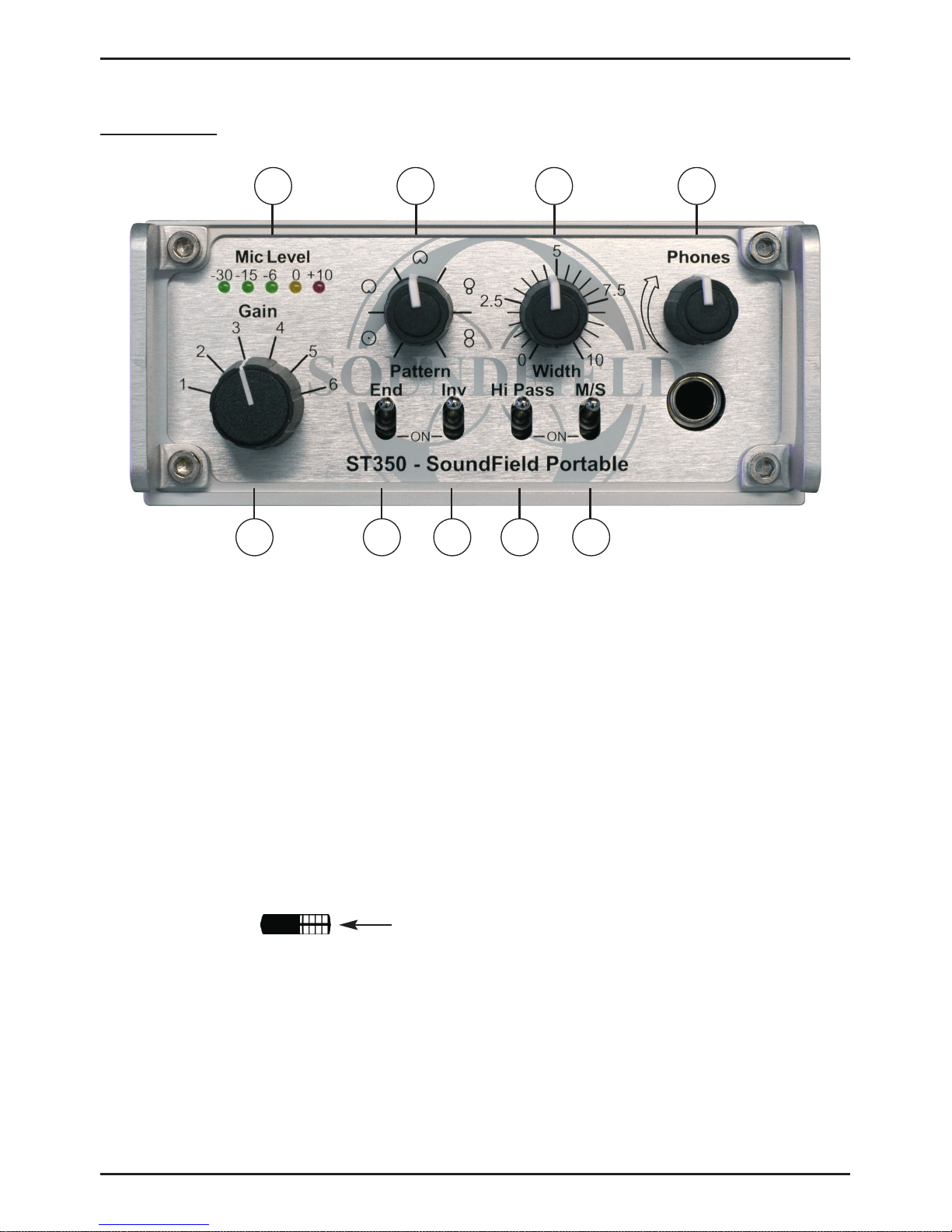
1. Gain
A switched gain control adds further gain to the microphone in 6dB steps. A switch has
been selected in preference to a potentiometer to provide excellent level matching of the
four capsule signals.
2. LED Bargraph
A 5 segment LED bargraph meter displays the mic level over a range of -30dB to +10dB.
3. End Fire
The End Fire mode should be selected when the microphone is horizontally pointed at
the sound source ( sound source ) as you would with a flashlight.
Selecting End Fire maintains the correct three-dimensional perspective in both surround
and stereo when the mic is used in the horizontal position.
If you do not select this mode when the microphone is horizontal it will result in the
Front/Back depth information and the Up/Down height information being reversed. When
making B-Format recordings for later surround or stereo post production with the
Surround Zone software or hardware SP451 processor, it is important to document the

SoundField ST350 User Guide
Controls Page 9
status of the End Fire switch. This mode is particularly necessary when the microphone is
mounted in a Rycote or on a fishpole and pointed directly at the sound source.
4. Pattern
The Polar Pattern control is continuously variable ranging from Omni through Sub-
Cardioid, Cardioid, Hyper-Cardioid to Figure-of-eight and sets the polar patterns used for
the stereo pair.
5. Invert
The Invert mode maintains the correct three-dimensional perspective in both surround
and stereo when the microphone is suspended upside down above the sound source ( ).
Not selecting this mode with the mic suspended will result in the Left/Right width
information and Up/Down height information being reversed. It is important to document
the status of the Invert switch when making B-Format recordings for later post
production
6. Hi-Pass
100Hz hi-pass filter is available to attenuate unwanted low frequency rumble or wind
noise. PLEASE NOTE: THE HI-PASS FILTER IS ACTIVE ACROSS THE STEREO
OUTPUTS ONLY. THE B-FORMAT OUTPUTS ARE NOT AFFECTED.
7. Width
Offers continuous adjustment of the stereo width from mono (‘0’) through to wide angle
stereo (‘10’).
8. Mid Side
When the Mid/Side switch is engaged the stereo outputs will be M/S encoded. The Left
output channel provides the Mid signal and the Right output channel provides the Side
signal.
9. Headphone Monitoring
Front panel headphone monitoring is provided with a continuously variable volume
control. The headphone section monitors the Left/Right stereo output. Connection is via a
stereo 1/4 inch jack socket (TRS) and is for use with headphones having an impedance of
400 ohms or greater.

SoundField ST350 User Guide
Controls Page 10
REAR PANEL
1 32 4
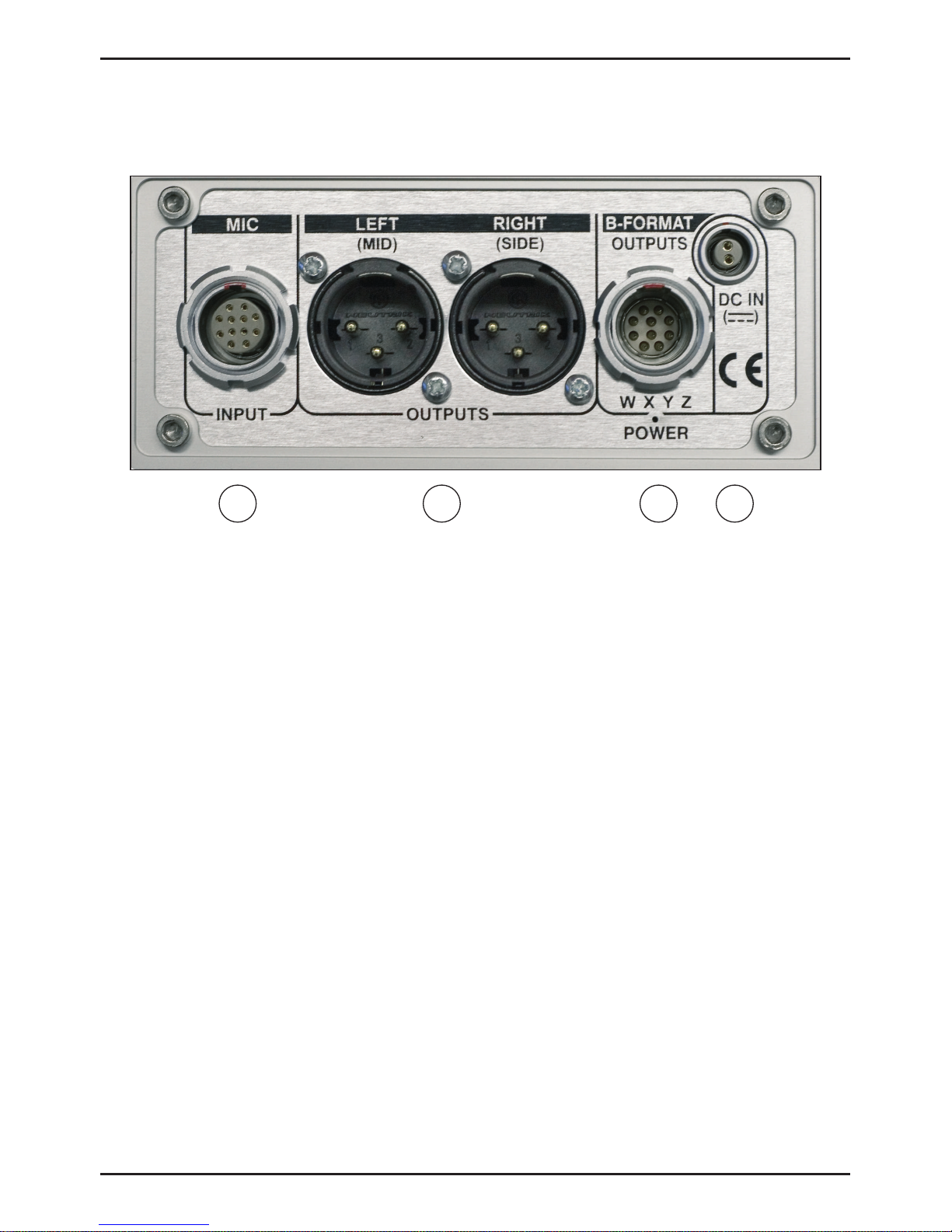
1. MIC INPUT
Lemo 12 pin female panel mount connector.
2. STEREO OUTPUT
Left/Right stereo analogue balanced line outputs on XLR connectors.
(Pin 1 = ground, Pin 2 = + (positive) and Pin3 = - (negative).
3. B-FORMAT OUTPUTS
W, X, Y & Z analogue balanced line level outputs on 10 pin Lemo (see page 22 for
wiring diagram). A 10 pin Lemo to 4 male XLR breakout cable is supplied as standard
with each ST350 system (part no. 3101).
4. DC IN
The DC input can range between 9 and 18V DC and requires 7W of power consumption.
Power is supplied by a 2 pin Lemo (pin 1 = DC, pin 2 = GND).
Indice
Altri manuali Soundfield Sistema microfonico
Manuali Sistema microfonico popolari di altre marche

Sennheiser
Sennheiser Evolution Wireless Digital EW-DX EM 2 Manuale utente

Alpha Technologies
Alpha Technologies RBMS Manuale utente

SWIT Electronics Co.,LTD.
SWIT Electronics Co.,LTD. CW-S150 Manuale utente

Shure
Shure UA844 Manuale utente

Panasonic
Panasonic SHFX70 - DVD HOME THEATER WIRELESS SYSTEM Manuale utente

Pyle
Pyle PDWM5000 Manuale utente