Terms and Definitions
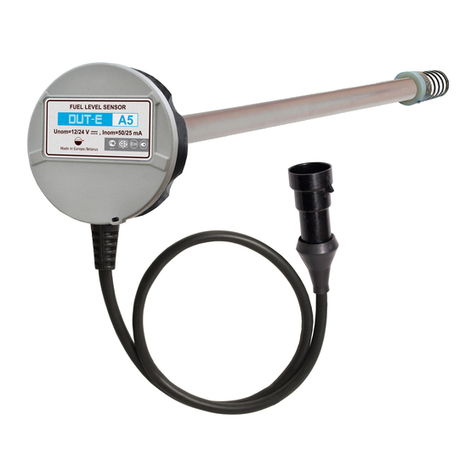
DUT-E 2Bio fuel level sensors. Operation manual. Version 3.1
© Technoton, 2019 6
Terms and Definitions
IoT Burger is the Technology of creating smart sensors and complex telematics IIoT
devices operating in real time with built-in analytic features
(further on –IoT Burger). The basis of IoT Burger is the software/hardware core, a
set of ready-to-use universal Functional Modules, the database of standartized IoT
parameters.
Particular features of IoT Burger:
•Inbuilt analytic features for maximum treatment of signals within the device itself;
•A possibility to design devices with extremely low power consumption;
•Doesn’t require programming in the majority of applications, flexible setup;
•Using inexpensive industrially manufactured equipment parts;
•Measurement and treatment of “quick” processes which is impossible to implement
using cloud technologies;
•An option of ready Reports delivery to the user avoiding server platforms;
•The inbuilt system of data authenticity assurance (self-diagnostics, authorization,
impact control).
The technology provides for the availability of several measurement channels in any device
including pre-set analytical treatment (filtration, linearization, thermal compensation) and the
controlled error of measurement.
Devices created using Iota Burger may be united to form a wire-connected or wireless
connection network. Data may be transmitted to the telematics server, to popular IoT
platforms, by SMS, E-mail, to social networks.
At present, GSM 2G/3G data transmission standards are used in devices with IoT Burger. The
reports transmitted contain data on instant and average values of Parameters, Counters,
Events. The flexible system of Reports setup enables the user to select the optimal ratio of the
data completeness and the volume of traffic.
All DUT-E 2Bio fuel level sensors manufactured after 01.09.2017 are designed using IoT Burger
Technology.
S6 —technology of combining smart sensors and other IoT devices within one wire
network for monitoring of complex stationary and mobile objects: vehicles,
locomotives, smart homes, technological equipment etc. The technology is based and
expands SAE J1939 automotive standards.
Information on cabling system, service adapter and S6 software refer to
CAN j1939/S6 Operation manual.
PGN (Parameter Group Number) —is a combined group of S6 parameters, which has common
name and number. Functional modules (FM) of the Unit can have input/output PGNs and setup
PGNs.
SPN (Suspect Parameter Number) —informational unit of S6. Each SPN has determined name,
number, extension, data type and numerical value. The following types of SPN exist:
Parameters, Counters, Events. SPN can have a qualifier which allows qualification of
parameter’s value (e.g. – Onboard power supply limit/Minimum).
Analytical report —report generated in ORF 4 on vehicle or group of vehicles operation for
chosen time period (usually a day, week or month). Can be composed of numbers, tables,
charts, mapped route of vehicle, diagrams.
Onboard equipment (OE) —Telematics system elements, directly installed in Vehicle.