Quick-Manual TMC363-Evalboard 9
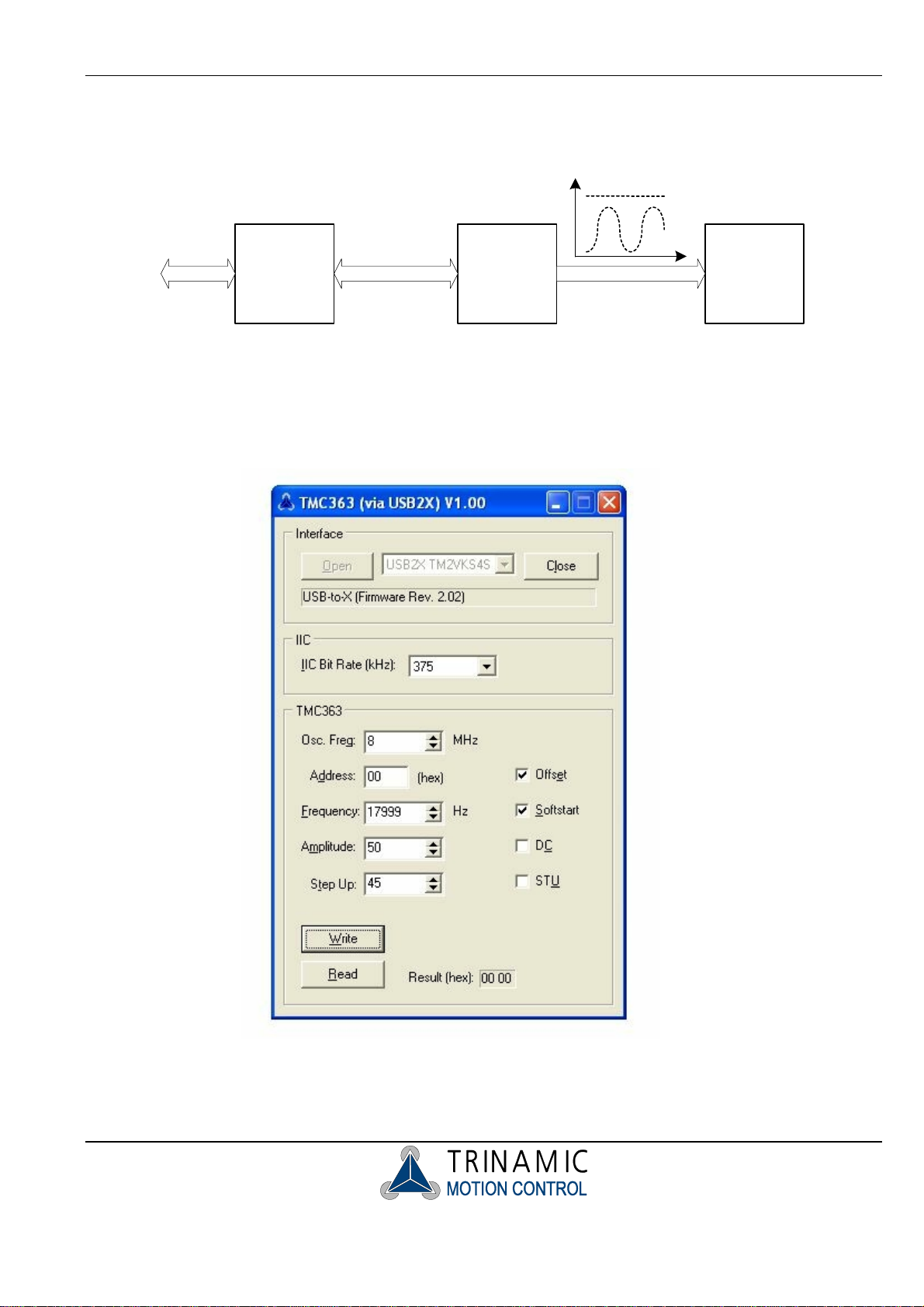
Interface:
Click the open button to enable the interface. If the PC doesn’t find the adapter, please install the actual
driver of the USB-2-X adapter from the TRINAMIC TechLib CD.
IIC Bit Rate (Hz):
Fill in the desired bit rate of the two wire serial interface. The IIC bit rate must be less than 1/10 of
oscillator frequency.
Osc. Freq.:
Fill in the actual oscillator frequency of the TMC363-Evalboard. This value is significant for the preset
frequency value.
Address:
This address is the slave address of the TMC363. If only one device is connected to the serial interface
set this value to '00'. Otherwise select another slave address with the jumper FS0, FS1, FS2 and OFFS
(see Datasheet of TMC363).
Frequency:
The selectable frequency range of the TMC363-Evalboard is 3Hz up to 125kHz. Be careful when
selecting a frequency (see chapter 2.6 'Filter Table'). To get the optimum result it is advisable to use
maximum frequency of 1/200 of the oscillator frequency.
Amplitude:
This value sets the amplitude of the sine wave voltage. The resolution of this setting is 6 bit (63 steps).
Step Up:
This value sets the amplitude of the step up converter voltage. The resolution of this setting is 6 bit (63
steps).
Offset:
Activate this option to set the offset of sine wave to 2V. Otherwise the offset is 0V.
Softstart:
After activating this option the sine wave amplitude ramps up with reduced speed. This option eliminates
high current peak at the switch on.
DC:
In this mode the output of the TMC363-Evalboard is a DC voltage. The amplitude of this voltage depends
on the settings of the field 'Amplitude'.
STU:
The standard maximum duty cycle of the step up converter PWM signal is at 60%. By activating this
option the maximum duty cycle can set up to 75%.
To send the actual setting to the device press the 'Write' button.
Result:
This value will be updated by pushing the 'Read' button. It is a two byte value. The second byte
corresponds to the control value of the amplitude. If the value of byte two is nearly by the maximum (FF)
the supply voltage Vs is too low for the selected amplitude. The first byte corresponds to the diagnostic
bits of the TMC363 (see Datasheet).