
Worx WU427.1 Manuale di installazione

CompaCt CirCular saw wu427.1
SAFETY AND OPERATING MANUAL
ORIGINAL INSTRUCTIONS
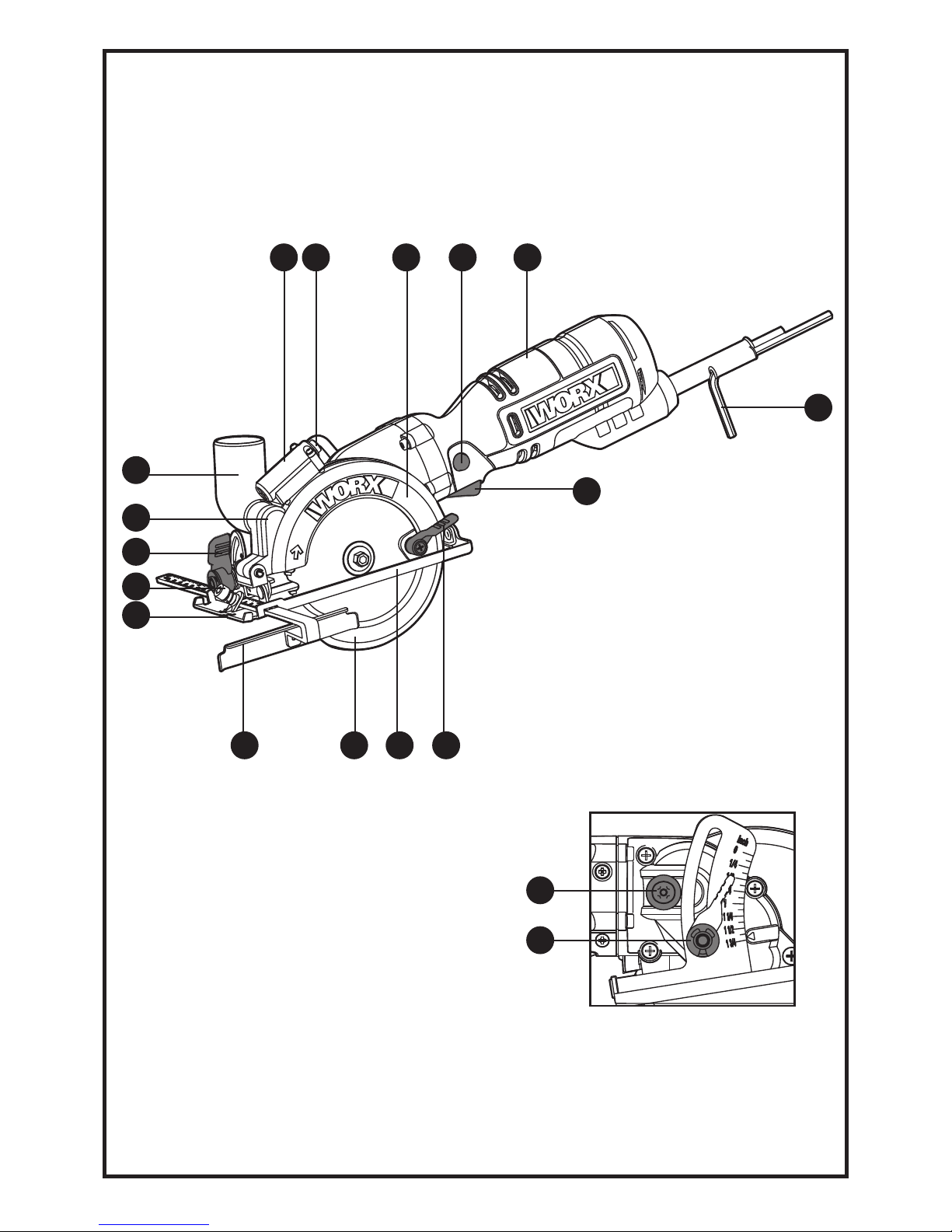
8 1 2
4
71216
10
20 21
6
9
18
17
23
3
5
11

45O
45o0o
45o0o
1
2
2
14 13 19 15
1
2
13
21
22
I2
J
A
B C1
C2 D1
D2 E1
E2 E3
F1 F2
G1 G2
H
I1

45O
45o0o
45o0o
1
2
2
14 13 19 15
1
2
13
21
22
I2
J
A
B C1
C2 D1
D2 E1
E2 E3
F1 F2
G1 G2
H
I1

45O
45o0o
45o0o
1
2
2
14 13 19 15
1
2
13
21
22
I2
J
A
B C1
C2 D1
D2 E1
E2 E3
F1 F2
G1 G2
H
I1

6
45O
45o0o
45o0o
1
2
2
14 13 19 15
1
2
13
21
22
I2
J
A
B C1
C2 D1
D2 E1
E2 E3
F1 F2
G1 G2
H
I1

7
COMPONENT LIST
1. Lock Off Button
2. Soft Grip Handle
3. Hex Key
4. On/Off Switch
5. Spindle Lock Button
6. Lower Blade Guard
7. Lower Guard Lever
8. Fixed Upper Guard
9. Dust Extraction Outlet
10. Vacuum Adapter
11. Depth Adjustment Lever
12. Base Plate
Not all the accessories illustrated or described are included in standard delivery.
13. Saw Blade (See Fig. A)
14. Inner Flange (See Fig. A)
15. Blade Bolt (See Fig. A)
16. Parallel Guide
17. Parallel Guide Clamping Fixture
18. Bevel Adjustment Lever
19. Outer Flange (See Fig. A)
20. Laser
21. Laser On-Off Switch
22. Laser Batteries (Two) (See Fig. E2)
23. Blade Alignment Indicator
TECHNICAL DATA
Type WU427.1 (4 - designation of machinery, representative of Saw)
Voltage 230-240V ~ 50Hz
Rated power 710W
No load (rated) speed 3700/min
Blade size TCT blade 120mmx9.5mmx1.2mmx24T
HSS blade 115mmx9.5mmx1.2mmx60T
Diamond disc 115mmx9.5mmx1.6mmx60G
Cutting capacity Cutting Depth at 90° 46mm
Cutting Depth at 45° 30mm
Arbor size 9.5mm
Recommended maximum material thickness Wood 46mm
Aluminum 2.5mm
PVC pipe (diameter) 46mm
Tile 12mm
Sheet steel 0.5mm
Protection class /ll
Bare tool weight 2.3kg
NOISE INFORMATION
A weighted sound pressure LpA: 76dB(A)
A weighted sound power LwA: 87dB(A)
KPA& KWA 3.0dB(A)
Wear ear protection.

8
VIBRATION INFORMATION
Vibration total values (triax vector sum) determined according to EN 60745:
Vibration emission value:
Cutting wood: ah,W = 6.82m/s2
Uncertainty K = 1.5m/s²
Cutting metal: ah,M = 5.63m/s2
Uncertainty K = 1.5m/s²
Warning: The vibration emission value during actual use of the power tool can differ from the
declared value depending on the ways in which the tool is used dependant on the following examples
and other variations on how the tool is used:
How the tool is used and the materials being cut or drilled.
The tool being in good condition and well maintained
The use the correct accessory for the tool and ensuring it is sharp and in good condition.
The tightness of the grip on the handles and if any anti vibration accessories are used.
And the tool is being used as intended by its design and these instructions.
This tool may cause hand-arm vibration syndrome if its use is not adequately managed.
Warning: To be accurate, an estimation of exposure level in the actual conditions of use should also
take account of all parts of the operating cycle such as the times when the tool is switched off and
when it is running idle but not actually doing the job. This may significantly reduce the exposure level
over the total working period.
Helping to minimise your vibration exposure risk.
ALWAYS use sharp chisels, drills and blades
Maintain this tool in accordance with these instructions and keep well lubricated (where appropriate)
If the tool is to be used regularly then invest in anti vibration accessories.
Avoid using tools in temperatures of 10°C or less
Plan your work schedule to spread any high vibration tool use across a number of days.
ACCESSORIES
TCT blade: 24T for wood (WA5076) 1
HSS blade: 60T for thin sheet steel and aluminum, PVC pipe, plastic (WA5077) 1
Diamond disc: 60G for concrete, marble, tile , cement backerboard (WA5078) 1
Parallel guide 1
Vacuum adaptor 1
Hex key 1
We recommend that you purchase your accessories from the same store that sold you the tool. Use
good quality accessories marked with a well-known brand name. Choose the type according to the
work you intend to undertake. Refer to the accessory packaging for further details. Store personnel can
assist you and offer advice.

9
SAFETy INSTRuCTIONS
FOR ALL SAwS
CUTTING PROCEDURES
a) DANGER: Keep hands away from
cutting area and the blade. Keep your
second hand on auxiliary handle, or motor
housing. If both hands are holding the saw,
they cannot be cut by the blade.
b) Do not reach underneath the workpiece.
The guard cannot protect you from the blade
below the workpiece.
c) Adjust the cutting depth to the thickness
of the workpiece. Less than a full tooth of
the blade teeth should be visible below the
workpiece.
d) Never hold piece being cut in your hands
or across your leg. Secure the workpiece to
a stable platform. It is important to support
the work properly to minimize body exposure,
blade binding, or loss of control.
e) Hold power tool by insulated gripping
surfaces when performing an operation
where the cutting tool may contact hidden
wiring or its own cord. Contact with a "live"
wire will also make exposed metal parts of
the power tool "live" and shock the operator.
f) When ripping always use a rip fence or
straight edge guide. This improves the accuracy
of cut and reduces the chance of blade binding.
g) Always use blades with correct size and
shape (diamond versus round) of arbour
holes. Blades that do not match the mounting
hardware of the saw will run eccentrically,
causing loss of control.
h) Never use damaged or incorrect blade
washers or bolt. The blade washers and
bolt were specially designed for your saw, for
optimum performance and safety of operation.
FuRTHER SAFETy
INSTRuCTIONS FOR ALL
SAwS
Kickback causes and related warnings
- Kickback is a sudden reaction to a pinched,
bound or misaligned saw blade, causing an
uncontrolled saw to lift up and out of the
workpiece toward the operator.
- When the blade is pinched or bound tightly
by the kerf closing down, the blade stalls and
the motor reaction drives the unit rapidly back
toward the operator.
- If the blade becomes twisted or misaligned
in the cut, the teeth at the back edge of the
blade can dig into the top surface of the wood
causing the blade to climb out of the kerf and
jump back toward the operator.
Kickback is the result of saw misuse and/or
incorrect operating procedures or conditions and
can be avoided by taking proper precautions as
given below.
a) Maintain a firm grip on the saw and
position your arm to resist kickback
forces. Position your body to either side
of the blade, but not in line with the
blade. Kickback could cause the saw to
jump backwards, but kickback forces can
be controlled by the operator, if proper
precautions are taken.
b) When blade is binding, or when interrupting
a cut for any reason, release the trigger and
hold the saw motionless in the material
until the blade comes to a complete stop.
Never attempt to remove the saw from the
work or pull the saw backward while the
blade is in motion or kickback may occur.
Investigate and take corrective actions to
eliminate the cause of blade binding.
c) When restarting a saw in the workpiece,
center the saw blade in the kerf and check
that saw teeth are not engaged into the
material. If saw blade is binding, it may walk
up or kickback from the workpiece as the saw
is restarted.
d) Support large panels to minimize the risk
of blade pinching and kickback. Large
panels tend to sag under their own weight.
Supports must be placed under the panel on
both sides, near the line of cut and near the
edge of the panel.
e) Do not use dull or damaged blades.
Unsharpened or improperly set blades
produce narrow kerf causing excessive
friction, blade binding and kickback.
f) Blade depth and bevel adjusting locking
levers must be tight and secure before
making cut. If blade adjustment shifts while
cutting, it may cause binding and kickback.
g) Use extra caution when making a “plunge
cut” into existing walls or other blind
areas. The protruding blade may cut objects
that can cause kickback.

10
SAFETy INSTRuCTIONS
FOR SAwS wITH INNER
pENDuLuM guARD
Lower Guard Function
a) Check lower guard for proper closing
before each use. Do not operate the saw
if lower guard does not move freely and
close instantly. Never clamp or tie the
lower guard into the open position. If saw
is accidentally dropped, lower guard may be
bent.Raise the lower guard with the retracting
handle and make sure it moves freely and
does not touch the blade or any other part, in
all angles and depths of cut.
b) Check the operation of the lower guard
spring. If the guard and the spring are not
operating properly, they must be serviced
before use. Lower guard may operate
sluggishly due to damaged parts, gummy
deposits, or a build-up of debris.
c) Lower guard may be retracted manually
only for special cuts such as "plunge cuts"
and "compound cuts." Raise lower guard
by retracting handle and as soon as blade
enters the material, the lower guard must
be released. For all other sawing, the lower
guard should operate automatically.
d) Always observe that the lower guard is
covering the blade before placing saw
down on bench or floor. An unprotected,
coasting blade will cause the saw to walk
backwards, cutting whatever is in its path. Be
aware of the time it takes for the blade to stop
after switch is released.
ADDITIONAL SAFETy
RuLES FOR yOuR
CIRCuLAR SAw
1. Always wear a dust mask, hearing protection
and eye protection.
2. Only use saw blades recommended in the
specification.
3. Do not use any abrasive wheels.
4. Use only blade diameter(s) in accordance with
the markings.
SAFETy INSTRuCTIONS
FOR ABRASIVE
CuTTINg-OFF OpERATIONS
Cut-off machine safety warnings
a) The guard provided with the tool must
be securely attached to the power tool
and positioned for maximum safety, so
the least amount of wheel is exposed
towards the operator. Position yourself
and bystanders away from the plane of the
rotating wheel. The guard helps to protect
operator from broken wheel fragments and
accidental contact with wheel.
b) Use only diamond cut-off wheels for your
power tool. Just because an accessory can
be attached to your power tool, it does not
assure safe operation.
C) The rated speed of the accessory must
be at least equal to the maximum speed
marked on the power tool. Accessories
running faster than their rated speed can
break and fly apart.
d) Wheels must be used only for
recommended applications. For example:
do not grind with the side of cut-off wheel.
Abrasive cut-off wheels are intended for
peripheral grinding, side forces applied to
these wheels may cause them to shatter.
e) Always use undamaged wheel flanges that
are of correct diameter for your selected
wheel. Proper wheel flanges support the
wheel thus reducing the possibility of wheel
breakage.
f) Do not use worn down reinforced wheels
from larger power tools. Wheels intended
for a larger power tool are not suitable for the
higher speed of a smaller tool and may burst.
g) The outside diameter and the thickness of
your accessory must be within the capacity
rating of your power tool. Incorrectly sized
accessories cannot be adequately guarded or
controlled.
h) The arbour size of wheels and flanges
must properly fit the spindle of the power
tool. Wheels and flanges with arbour holes
that do not match the mounting hardware of
the power tool will run out of balance, vibrate
excessively and may cause loss of control.
i) Do not use damaged wheels. Before
each use, inspect the wheels for chips
and cracks. If power tool or wheel is
dropped, inspect for damage or install an
Indice
Altri manuali Worx Sega

Worx
Worx WA0222 Manuale utente

Worx
Worx WX440 Manuale di installazione

Worx
Worx WA4301 Manuale utente

Worx
Worx WX523 WorxSaw Manuale utente

Worx
Worx WU404 Manuale utente

Worx
Worx WX425 Manuale utente

Worx
Worx WG324E Manuale utente

Worx
Worx WX429L Manuale utente

Worx
Worx WG894E Manuale utente

Worx
Worx WG894E Manuale di installazione

Worx
Worx WX80RS Manuale di installazione

Worx
Worx WorxSaw XL WX429 Manuale utente

Worx
Worx WX523 WorxSaw Manuale di installazione

Worx
Worx WX845 Manuale utente

Worx
Worx WX426 Manuale utente

Worx
Worx WX80RS Manuale utente

Worx
Worx WX527 Manuale utente

Worx
Worx WorxSaw WX523L Manuale utente

Worx
Worx WX439 Manuale utente

Worx
Worx WG368E Manuale di installazione


