
AEG SANTO 70398-DT Manuale utente

SANTO 70398-DT
Refrigerator/Freezer
Operating Instructions
2
Dear customer,
Before switching on your new refrigerator/freezer please read these opera-
ting instructions carefully. They contain important information for safe use,
for installation and for care of the appliance.
Please keep these operating instructions for future reference. Pass them on
to possible new owners of the appliance.
Notes which are important for your safety or for the proper functioning of
the appliance are stressed with a warning triangle and/or with signal words
(Warning!, Caution!, Attention!). Please observe the following carefully.
Additional information regarding operation and practical applications of
the appliance appear after this symbol.
Tips and notes concerning economical and environmentally sound use of
the appliance are marked with the flower.
In the event of a malfunction, these operating instructions contain infor-
mation on how to rectify faults yourself, see the “Something Not Working”
section.
For further assistance contact your local AEG Service Force Centre, see the
chapter “Service and Spare Parts.
Printed on paper manufactured with environmentally sound processes.
who thinks ecologically acts accordingly ...

3
Contents
Safety . . . . . . . . . . . . . . . . . . . . . . . . . . . . . . . . . . . . . . . . . . . . . . .4
Disposal . . . . . . . . . . . . . . . . . . . . . . . . . . . . . . . . . . . . . . . . . . . . .5
Appliance Packaging Information . . . . . . . . . . . . . . . . . . . . . . . . . . . . .5
Disposal of Old Appliances . . . . . . . . . . . . . . . . . . . . . . . . . . . . . . . . . . .5
Remove Transport Packaging . . . . . . . . . . . . . . . . . . . . . . . . . . . . . .6
Prior to Initial Start Up . . . . . . . . . . . . . . . . . . . . . . . . . . . . . . . . . .7
Starting Up and Temperature Regulation . . . . . . . . . . . . . . . . . . . .7
Switching the Appliance Off . . . . . . . . . . . . . . . . . . . . . . . . . . . . . .8
Opening the Freezer Compartment Door . . . . . . . . . . . . . . . . . . . . .8
Interior Accessories . . . . . . . . . . . . . . . . . . . . . . . . . . . . . . . . . . . . .9
Storage shelves . . . . . . . . . . . . . . . . . . . . . . . . . . . . . . . . . . . . . . . . . . . .9
Door rack . . . . . . . . . . . . . . . . . . . . . . . . . . . . . . . . . . . . . . . . . . . . . . . .9
Moisture regulator . . . . . . . . . . . . . . . . . . . . . . . . . . . . . . . . . . . . . . . . .9
Fresh Food Refrigeration . . . . . . . . . . . . . . . . . . . . . . . . . . . . . . . .10
Freezing . . . . . . . . . . . . . . . . . . . . . . . . . . . . . . . . . . . . . . . . . . . . .11
Frozen Storage . . . . . . . . . . . . . . . . . . . . . . . . . . . . . . . . . . . . . . . .12
Preparation of Ice Cubes . . . . . . . . . . . . . . . . . . . . . . . . . . . . . . .13
Freezing Calender . . . . . . . . . . . . . . . . . . . . . . . . . . . . . . . . . . . . .13
Defrosting . . . . . . . . . . . . . . . . . . . . . . . . . . . . . . . . . . . . . . . . . . .14
Cleaning and Care . . . . . . . . . . . . . . . . . . . . . . . . . . . . . . . . . . . . .15
Energy Saving Tips . . . . . . . . . . . . . . . . . . . . . . . . . . . . . . . . . . . .16
What to do if . . . . . . . . . . . . . . . . . . . . . . . . . . . . . . . . . . . . . . . .17
Correcting Malfunctions . . . . . . . . . . . . . . . . . . . . . . . . . . . . . . . . . . .17
Changing the Light Bulb . . . . . . . . . . . . . . . . . . . . . . . . . . . . . . . . . . .18
Service and Spare Parts . . . . . . . . . . . . . . . . . . . . . . . . . . . . . . . . .19
Customer Care Department . . . . . . . . . . . . . . . . . . . . . . . . . . . . .19
Guarantee Conditions . . . . . . . . . . . . . . . . . . . . . . . . . . . . . . . . . .20
Installation - Electrical Connection . . . . . . . . . . . . . . . . . . . . . . . .21
Positioning . . . . . . . . . . . . . . . . . . . . . . . . . . . . . . . . . . . . . . . . . . . . . .22
Reversing the Door . . . . . . . . . . . . . . . . . . . . . . . . . . . . . . . . . . . . . . . .23
Regulations, Standards, Guidelines . . . . . . . . . . . . . . . . . . . . . . .24
4
Safety
The safety aspects of our refrigerator/freezers comply with accepted tech-
nical standards and the German Appliance Safety Law. Nevertheless, we
consider it our obligation to make you aware of the following safety infor-
mation:
Intended use
• The refrigerator is intended for use in the home. It is suitable for the coo-
ling, freezing and storing of frozen food, as well as for making ice. If the
appliance is used for purposes other than those intended or used incor-
rectly, no liability can be accepted by the manufacturer for any damage
that may be caused.
• Alterations or changes to the freezer are not permitted for reasons of
safety.
Prior to initial start–up
• Check the refrigerator for transport damage. Under no circumstance
should a damaged appliance be plugged in! In the event of damage, please
contact your retailer.
Refrigerant
The refrigerant isobutane (R600a) is contained within the refrigerant circuit
of the appliance, a natural gas with a high level of environmental compa-
tibility, which is nevertheless flammable.
• During transportation and installation of the appliance, be certain that
none of the components of the refrigerant circuit become damaged.
• If the refrigerant circuit should become damaged:
– avoid open flames and sources of ignition;
– thoroughly ventilate the room in which the appliance is situated.
Safety of children
• Packaging (e.g. wraps, polystyrene) can be dangerous for children. There
is a risk of suffocation! Keep packaging material away from children!
• Please make old appliances unusable prior to disposal. Pull out the mains
plug, cut off the mains cable, break or remove spring or boltcatches, if fit-
ted. By doing this you ensure that children cannot lock themselves in the
fridge when playing (there is risk of suffocation!)or get themselves into
other dangerous situations.
• Often children cannot recognise the hazards present in household
appliances. It is therefore important that you ensure adequate supervision
and never let children play with the appliance!

5
Daily Operation
• Containers with flammable gases or liquids can leak at low temperatures.
There is a risk of an explosion! Do not store any containers with flamma-
ble materials such as, for example, spray cans, fire extinguisher refill car-
tridges etc in the refrigerator/freezer.
• Bottles and cans must not be placed in the freezer compartment. They can
burst when the contents freeze, high carbonate content drinks can even
explode! Never store lemonade, juices, beer, wine, sparkling wine etc. in
the freezer compartment. Exception: high alcohol content spirits can be
stored in the freezer compartment.
• Do not put ice creams or ice cubes in the mouth immediately after remo-
val from the freezer compartment. Very cold ice can freeze to the lips or
tongue and cause injury.
• Do not touch frozen food with wet hands. Your hands could freeze to the
food.
• Do not operate any electrical appliances in the refrigerator/freezer (e.g.
electric ice cream makers, mixers etc.).
• Before cleaning the appliance, always switch off the appliance and unplug
it, or pull the house fuse or switch off the circuit breaker.
• When unplugging always pull the plug from the mains socket, do not pull
on the cable.
Service
• Under no circumstances should you attempt to repair the appliance your-
self. Repairs carried out by inexperienced persons may cause injury or
serious malfunctioning. Contact your local AEG Service Force Centre.
Disposal
Appliance Packaging Information
All materials are environmentally sound!
The plastics can be recycled and are identified as follows:
>PE< for polyethylene, e.g. the outer covering and the bags in the interior.
>PS< for polystyrene foam, e.g. the pads, which are all free of chlorofluo-
rocarbon.
The carton parts are made from recycled paper and should be disposed of
at a waste-paper recycling collection location.
Disposal of Old Appliances
For environmental reasons, refrigeration appliances must be disposed of
properly. This applies to your old appliance, and - at the end of its service
life - for your new appliance as well.
6
Warning! Before disposing of old appliances make them inoperable. Remo-
ve plug from mains, sever the power cable, remove or destroy any snap or
latch closures, to prevent small children being trapped inside.
• Use an authorised disposal site.
Contact your local Council or Enviromental Health Office to see if there are
facilities in your area to recycle the appliance;
Remove Transport Packaging
The appliance and the interior fittings are protected for transport.
• Remove all adhesive tape and packing pieces from the interior of the
appliance.
7
Prior to Initial Start-Up
Before connecting the appliance to the mains and putting it into ope-
ration for the first time, leave the appliance to stand for 30 minutes if
it was transported upright. After transporting on its side, the appliance
must be left to stand for 4 hours before switching it on.This is necessary
to allow the oil to flow back into the compressor. Otherwise
the compressor may be damaged.
Please clean the appliance interior and all accessories prior to initial
start-up (see section: "Cleaning and Care").
Starting Up and Temperature Regulation
Refrigerator and freezer compartments can not be operated indepen-
dently of one another.
Insert plug into mains socket.
The temperature regulator is on the right side in the refrigerator com-
partment. It is also the ON/OFF-switch.
Position "0" means:
Cooling OFF
Position "1"means:
Highest interior temperature (warmest setting)
Position "6" means:
Lowest interior temperature (coldest setting)
Recommended settings:
For normal use: position "3" - "4";
Turn the temperature regulator to the desired setting. The compressor
starts and then runs automatically.
Goods to be refrigerated can be loaded immediately after switching on,
because the storage temperature in the refrigerator is quickly reached.
Important! Wait until the freezer compartment has reached a tempera-
ture of –18 °C before storing frozen food.
Note: From a food science point of view, +5 °C for the refrigerator
compartment and -18 °C for the freezer compartment should be consi-
dered cold enough as a storage temperature.
8
The following effects are of significance in respect of the interior tem-
perature:
– Ambient temperature;
– Quantity and temperature of the food stored;
– Frequency with which the door is opened and how long it is left
open.
Switching the Appliance Off
Refrigerator and freezer compartments can not be switched off inde-
pendently of one another.
To switch off, turn the temperature regulator to position "0".
If the appliance is to be removed from service for a lengthy period:
Turn the temperature regulator to position "0".
Unplug the appliance, or remove the fuse.
Defrost freezer compartment and clean thoroughly (see section: "Cle-
aning and Care").
Leave doors open after defrosting to avoid accumulation of odours.
Opening the Freezer Compartment Door
If the freezer compartment door is closed when the appliance is in ope-
ration, it is possible that it cannot be immediately opened again,
because a vacuum occurs in the freezer compartment which holds the
door closed until pressure has been equalised. The door can be opened
again after several minutes.
9
Interior Accessories
Storage shelves
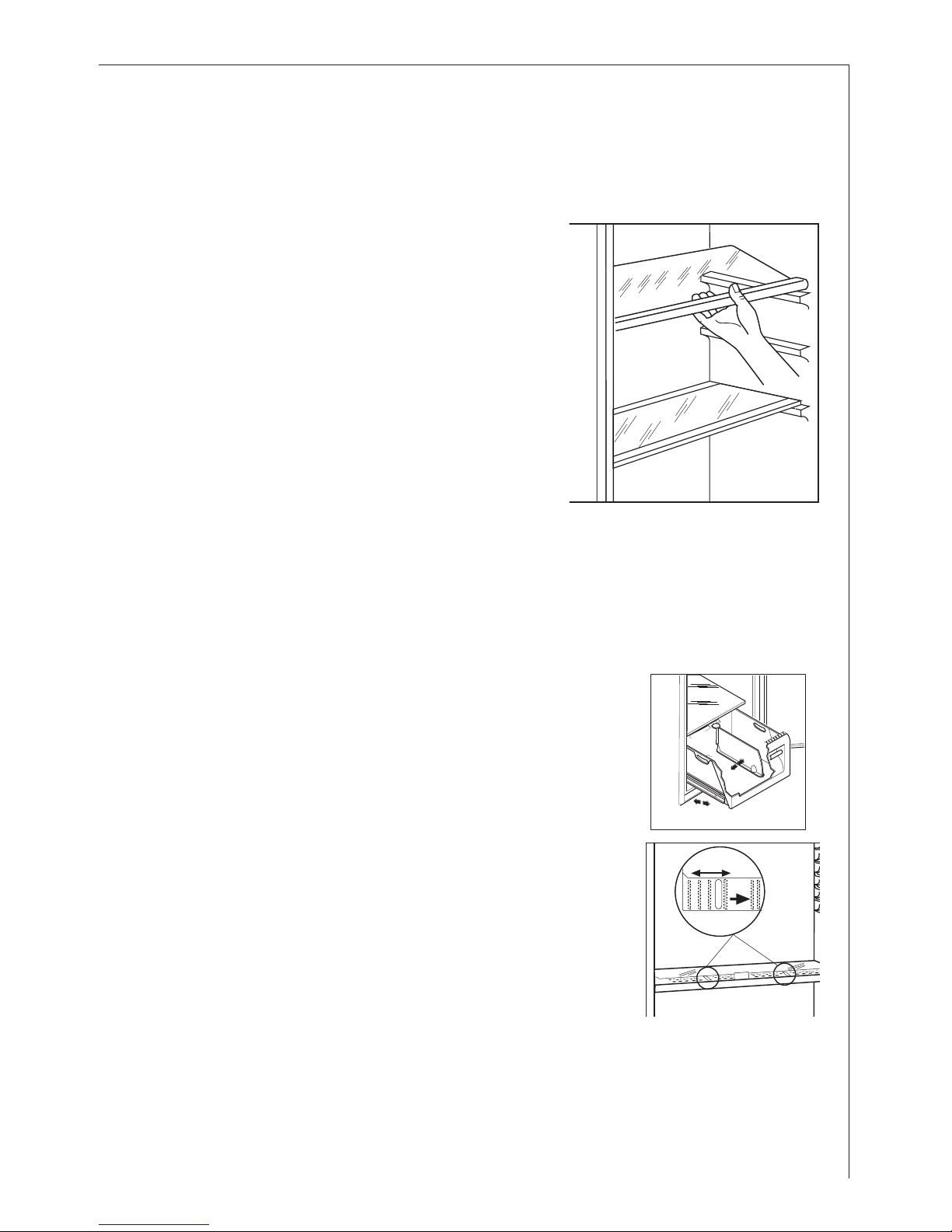
• You should always slide one of the full size glass storage shelf into the
lowest set of guides, above the fruit and the vegetable containers, and
keep it in this position.
• The height of the storage shelves
can be adjusted:
• To do this pull the storage shelf
forward until it can be swivelled
upwards or downwards and remo-
ved.
• Please do the same in reverse to
insert the shelf at a different hei-
ght.
Adjusting the upper door rack
• Depending on the food stored, the upper door racks can be changed to
other holders or removed. In order to do this ensure the door racks are
empty, press the door racks digonally upwards at their edges, reposition
them, and press them back into place.
Moisture regulator
There is an adjustable air grill in front of the
shelf above the fruit and vegetable compart-
ments.
The opening in the ventilation slots can be adjus-
ted with the slider.
Right slider: Ventilation slots opened.
With the ventilation slots open, more
air circulation results in a lower air
moisture content in the fruit and
vegetable compartments.
Left slider: Ventilation slots closed.
When the ventilation slots are closed,
the natural moisture content of the
food in the fruit and vegetable compartments
is preserved for longer.
ON

10
Cooked foods, cold dishes, etc: these should be covered and may be placed
on any shelf.
Fruit and vegetables: these should be thoroughly cleaned and placed in the
special drawer(s) provided.
Butter and cheese: these should be placed in special airtight containers or
wrapped in aluminium foil or polythene bags to exclude as much air as pos-
sible.
Milk bottles: these should have a cap and should be stored in the bottle
rack on the door.
Bananas, potatoes, onions and garlic, if not packed, must not be kept in
the refrigerator.
Fresh Food Refrigeration
To obtain the best performance:
• do not store warm food or evaporating liquid in the refrigeator
• do cover or wrap the food, particularly if it has a strong flavour.
• position food so that air can circulate freely round it.
Useful hints:
Meat (all types): wrap in polythene bags and place on the glass shelf above
the vegetable drawer(s). For safety, store in this way only one or two days
at the most.
Indice
Altri manuali AEG Frigorifero

AEG
AEG OKO-SANTO SUPER 2870-4 Manuale utente

AEG
AEG SANTO 3151 Manuale utente

AEG
AEG SCE81831FS Manuale utente

AEG
AEG AIK2654R Manuale utente

AEG
AEG SKE818E1DC Manuale utente

AEG
AEG AIK2654R Manuale utente

AEG
AEG SKS818E9ZC Manuale utente

AEG
AEG SCS8191LTS Manuale utente

AEG
AEG Oko santo 1504-4 Manuale utente

AEG
AEG OKO-SANTO Series Manuale utente

AEG
AEG SANTO 3605 KGL Manuale utente

AEG
AEG RDB424E1AW Manuale utente

AEG
AEG RMB952D6VU Manuale utente

AEG
AEG SANTO 70438-6 DT Manuale utente

AEG
AEG AIK1344L Manuale utente

AEG
AEG OKO-SANTO 2972-6 i Manuale utente

AEG
AEG KO_SANTO 4085 Manuale utente

AEG
AEG SKS58240F0 Manuale utente

AEG
AEG SKB51221AS Manuale utente

AEG
AEG SKB48811AS Manuale utente


