AGC ProFlow Pro3-XP Manuale utente

AGC Model Pro3-XP
Operation and Maintenance Manual


Table of Contents
Scope:........................................................................................................................1
Receiving and Inspection:..........................................................................................1
Drawing Package:......................................................................................................2
Frame Placement:......................................................................................................3
Frame Connections:...................................................................................................5
Normal Operation:......................................................................................................6
Opening the Heat Exchanger:....................................................................................7
Operator Maintenance:...............................................................................................8
Parts List:...................................................................................................................9
Pro3-XP Frame Components............................................................................10
Pro3-XP Rail Size Chart....................................................................................11
Pro3-XP Tiebolt Assembly ................................................................................12
Pro3-XP Terminal Assembly.............................................................................13
Pro3 Plate and Frame Gaskets.........................................................................14
www.agcheattransfer.com
Western
3109 NE 230th Avenue
Fairview, OR 97024
+1.503.774.7342
++1.800.715.8820
FAX +1.503.774.2550
Central
8400 Lakeview Parkway
Suite 700
Pleasant Prairie, WI 53158
+1.847.301.6890
+1.888.489.8820
Eastern
10129 Piper Lane
Bristow, VA 20136
+1.703.257.1660
+1.800.825.8820
FAX +1.703.330.7940


1
Scope:
This manual is a supplement to the AGC Heat Transfer ProFlow plate heat exchanger manual. We
recommend you read the ProFlow manual first because it will provide you with a basic understanding of
plate heat exchangers and define the technical terms used in this document. The information provided
within this manual describes the installation, operation, and maintenance of the AGC Heat Transfer Pro3-
XP heat exchangers.
Please read this manual carefully before installing your heat exchanger. Pay particular attention to
the safety instructions and the initial startup procedures. Failure to follow all safety recommendations could
result in injury to the operator or cause damage to the heat exchanger.
Receiving and Inspection:
Each AGC heat exchanger is assembled and fully tested at the factory prior to shipping. Once the
unit has successfully passed all tests it is prepared for shipping. Every AGC heat exchanger is thoroughly
inspected to ensure it is in perfect condition before leaving the factory. Upon arrival, carefully inspect your
new heat exchanger for any damage that may have occurred during shipping. If the press was damaged
during shipping make sure it is annotated on the shipping documents. Also, report any damage to AGC
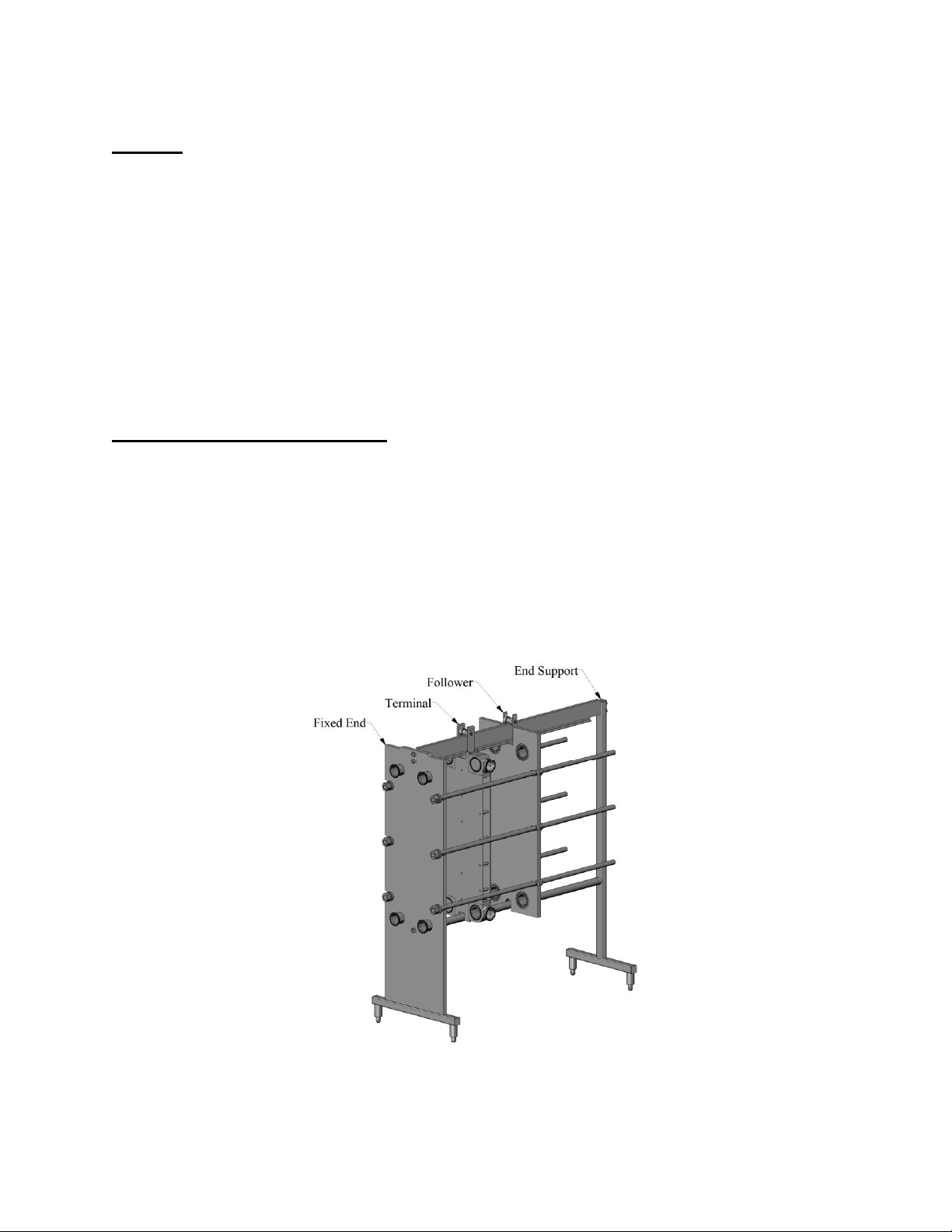
immediately. To aid you in describing where any damage may have occurred, figure one shows the major
components of a typical Pro3 frame with one terminal.
Figure 1
Major Frame Components

2
Normally, Pro3-XP frames are shipped with the plates installed. As a result the press and plates
can weigh several thousand pounds. We recommend only qualified forklift operators should lift and
position the unit. It should be noted that the high leg frame, also known as the Pro3-XPH, can be top heavy
and could tip if they are not moved properly.
Drawing Package:
Every frame is shipped with a drawing package. This drawing package contains important
information that is specific to your heat exchanger. If you cannot find the drawing package, contact AGC
Heat Transfer or your local AGC distributor to obtain a replacement prior to installing the heat exchanger.
The drawing package is a collection of several important documents related explicitly to your heat
exchanger. The first of these is the streaming diagram. Two copies of the streaming diagram are included.
One copy has been laminated to protect it. This copy is intended to be used by production and maintenance
personnel when installing and/or servicing the heat exchanger. The remaining copy should be kept on file
in a safe place in the event the production copy is lost or damaged. The streaming diagram (also referred
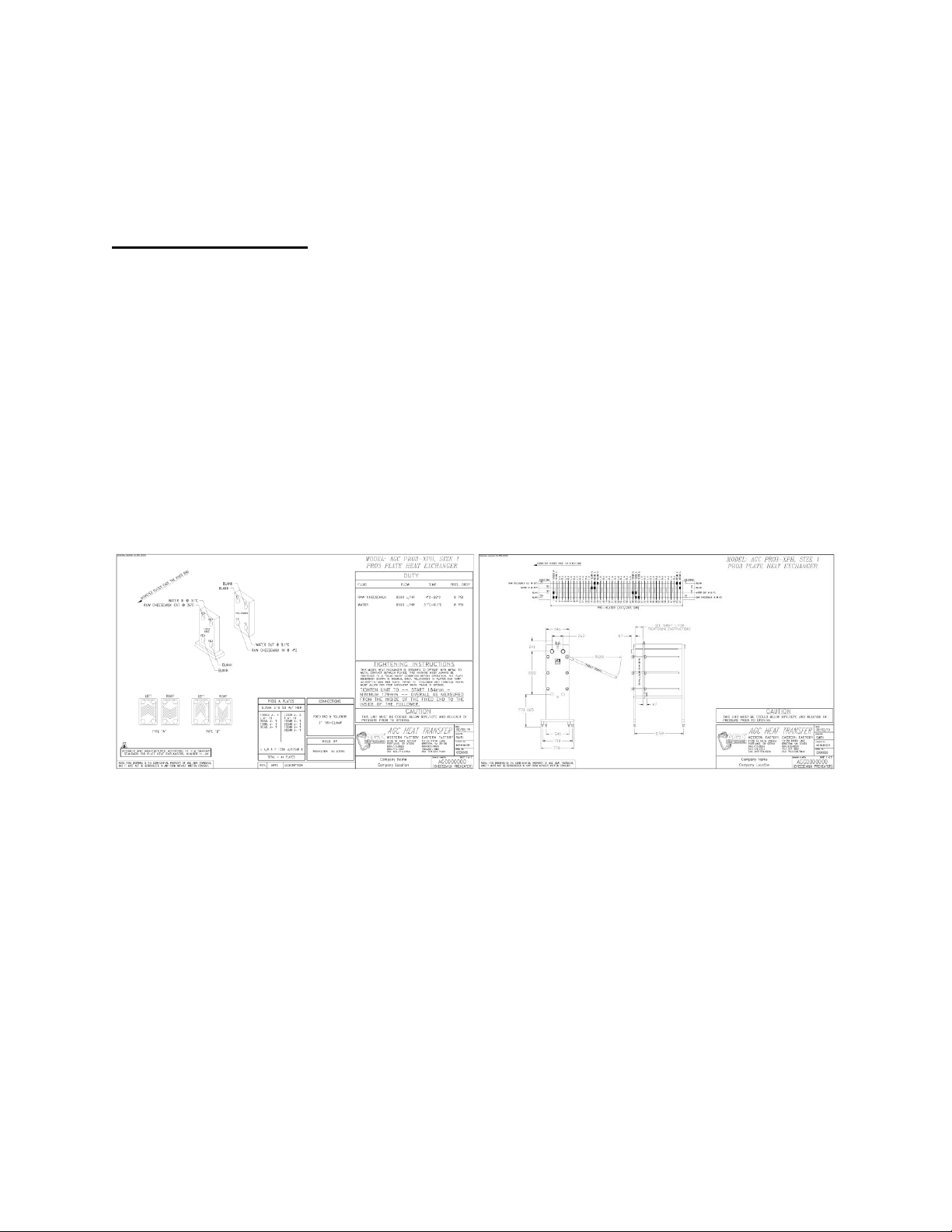
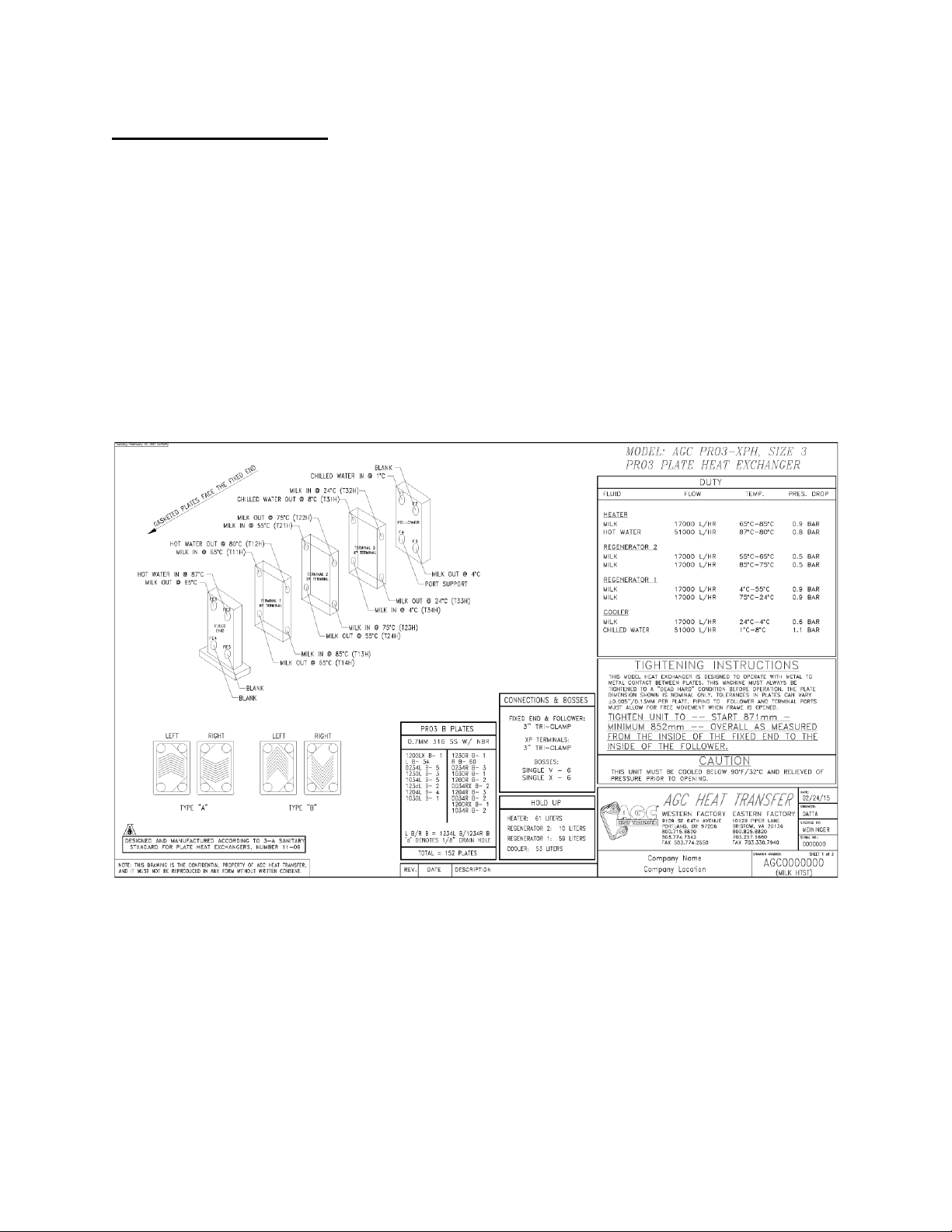
to as the drawing) describes all the characteristics of the heat exchanger. Figure 2 shows a typical two page
streaming diagram.
Figure 2
Typical Streaming Diagram
Page one shows the unit serial number, the duty, plate type, plate count, gasket type, connection
type, connection size, and the tightening dimension. Revisions are also listed on page one. Page two of
the drawing shows how the fluids pass through the heat exchanger. (The ProFlow manual describes how
to read this flow diagram). If the unit is small, such as the unit in figure two, a front and side view of the
heat exchanger will be shown as well. For larger units the front and side views are shown on page three or
page four.
The second document in the drawing package is a plate punching diagram. This diagram will show
you how to identify each Pro3 plate either by its configuration number (stamped at the top of each plate) or
by looking at the plate noting which ports have been opened. Since the Pro3 plate is a vertical flow plate,
each plate can be used for either a right or left hand plate. The ProFlow manual explains how these plates
are used in greater detail.


3
The final document in the drawing package is the ProFlow manual. The ProFlow manual has
information about the AGC Heat Transfer product line and a more in-depth discussion about plate heat
exchangers in general.
Frame Placement:
Locate the Pro3-XP frame on a firm flat surface capable of supporting the press and all of its
contents when full. If possible, the frame should remain strapped to the shipping skid until it is near its
final location. Once the press is positioned cut the metal bands holding it to the shipping skid and, using
an appropriately sized lifting strap, carefully lift the press off the skid. The top rail can be used as a lifting
point. Never lift the pressby the tiebolts. These bolts are in slots and are not designed to support the weight
of the frame for lifting. When locating the heat exchanger, ensure that adequate space is left around the
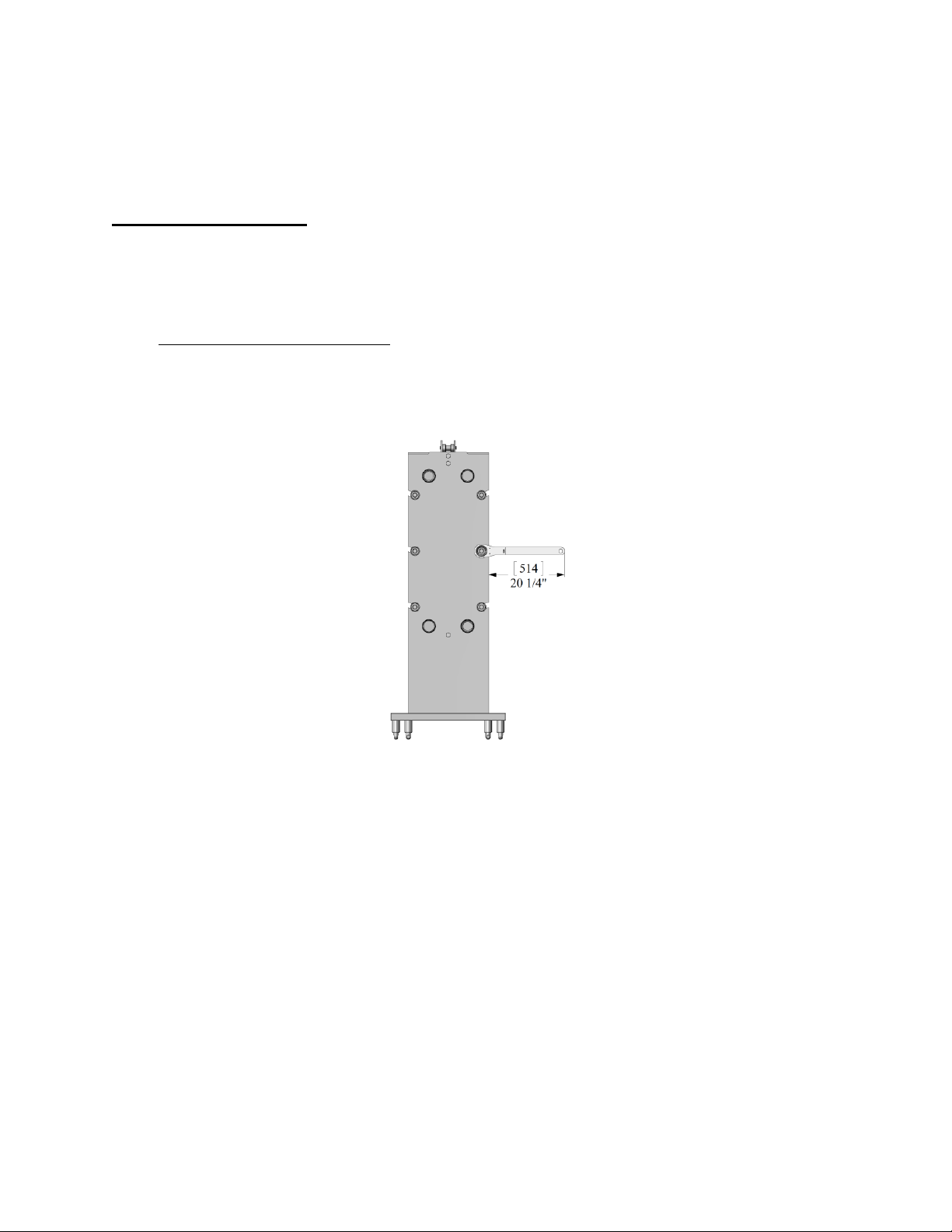
frame for maintenance and for plate installation/removal. Also include enough space to allow the AGC Fat
Boy™wrench to fully swing. See figure 3.
Figure 3
Wrench Space Requirement
The Pro3-XP and Pro3-XPH frames are equipped with adjustable ball feet. These feet are adjusted
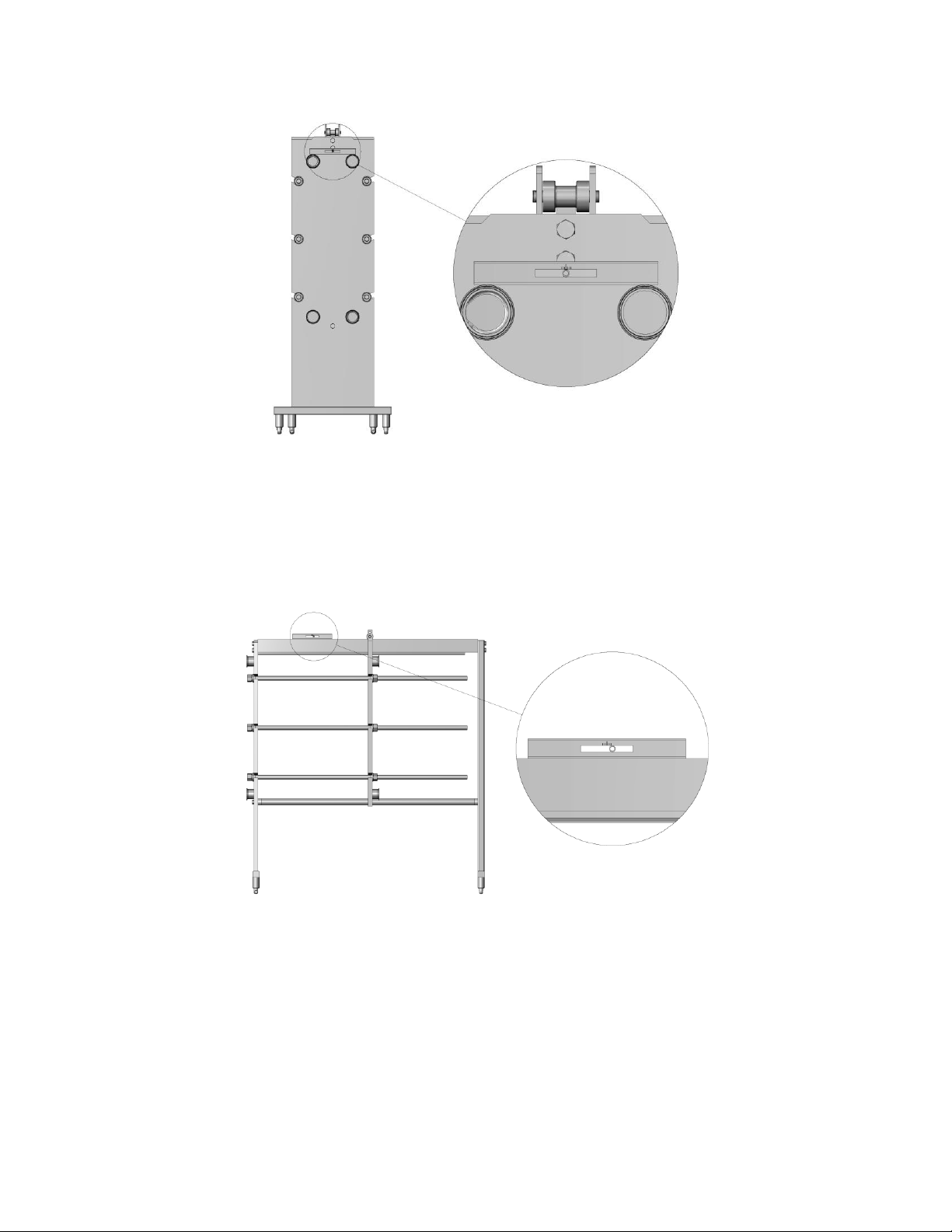
by turning the base clockwise to lower and counterclockwise to raise the press. The ball feet should be
adjusted so the ports are level from side to side. Figure 4 shows a spirit level placed across the ports to
establish level.

4
Figure 4
Port Leveling
Once the ports are level, the heat exchanger should be adjusted so it will drain properly. This is
done by adjusting the ball feet to establish a slope from end to end. Figure 5 shows a press adjusted to drain
forward to the fixed end.
Figure 5
Frame Adjusted to Drain to Fixed End
Consult your onsite Plant Engineer or Project Manager to determine how much slope and which
direction (toward the fixed end or follower) is appropriate for your installation.

5
Frame Connections:
Careful planning during the installation of your new heat exchanger will help ensure years of
trouble free operation. All piping connections should be well supported and carefully aligned with the ports
on the heat exchanger. Misaligned pipes or pipes that are not properly supported can lead to connection
failures or cracks in the welded joints. When laying out a new installation, include enough breaks in the
piping so service and maintenance can be completed easily. The piping connected to the follower should
be configured with joints that are easy to remove so the follower can be fully retracted. This will provide
enough space for clear inspection of the heat exchanger plates. The streaming diagram will show where all
external connections should be made. Figure 6 shows page one of a typical streaming diagram for a multi
section heat exchanger.
Figure 6
Typical Streaming Diagram
Notice that all ports have labels that clearly state what is to be connected to each one.

6
Normal Operation:
The Pro3-XP series heat exchangers are tiebolt style frames. This means the press is closed by
using 6 tiebolts to compress the plates. For this type of frame it is important for each tiebolt to take an
equal share of the load. After your heat exchanger is in place you should check the compressed dimension
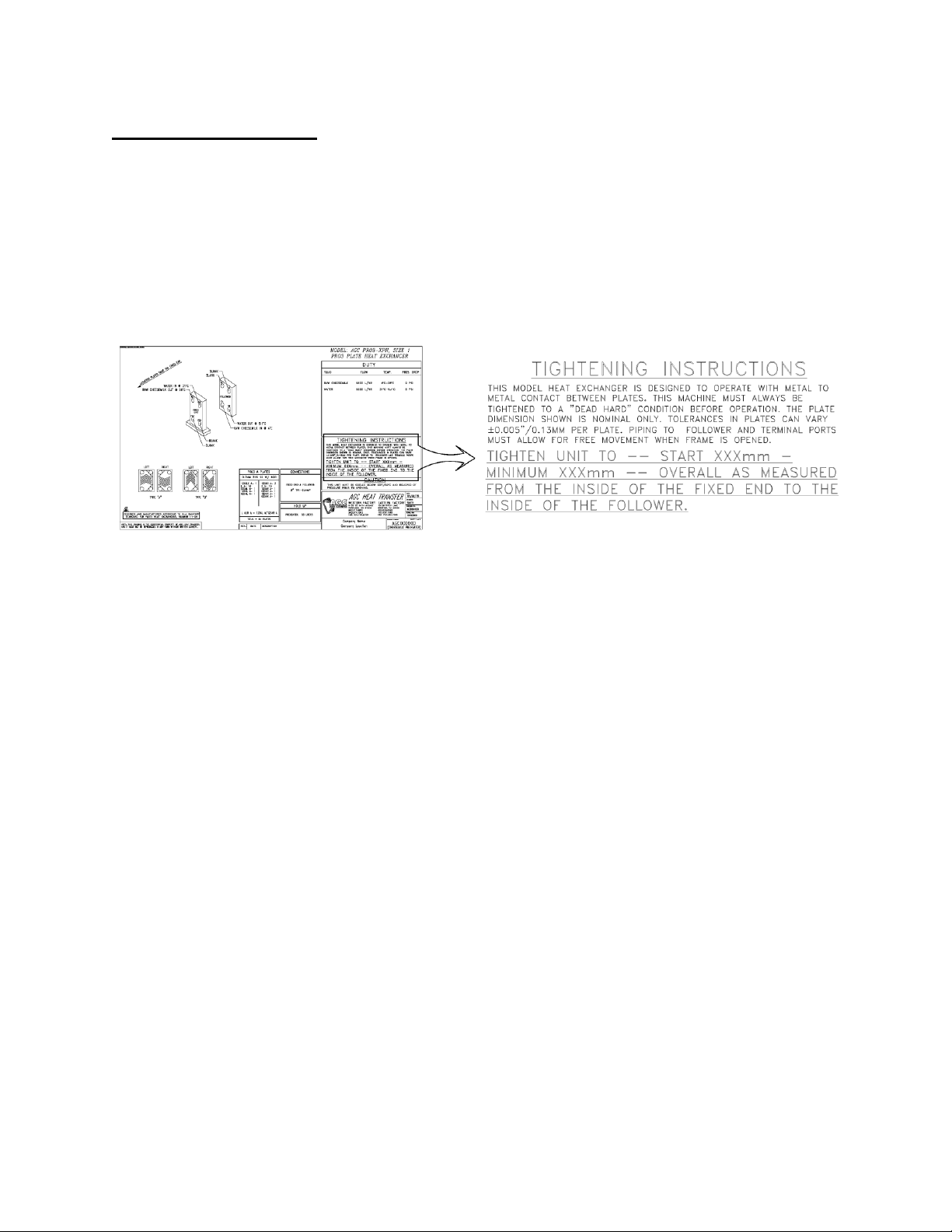
if the plates were shipped installed. The dimension for your heat exchanger is listed on the first page of
your streaming diagram. Figure 7 shows where the tightening dimension is located on the drawing. If the
plates were shipped in a separate crate refer to the ProFlow manual for instructions on installing them.
Figure 7
Tightening Instructions
Most new plate packs will seal at the start dimension. As the plates and gaskets wear it may be
necessary to compress or close the press further. You should never exceed the minimum dimension shown
on the streaming diagram. If your press is closed to the minimum dimension and leaks are noticed contact
AGC Heat Transfer for technical assistance. Closing the press beyond the minimum dimension could cause
permanent damage to the plates, frame, or both. When measuring the compressed dimension it is a good
practice to take the measurement in several locations on the inside of the fixed end and follower as shown
in figure 8.
Indice
Altri manuali AGC Attrezzature industriali